Find us at booth #83, join us for a harbor side happy hour, or catch Gorish’s talk.

Sept, 16-18 > Learn more

%20(1).avif)
Mamta Tainwala

May 21, 2026
.png)
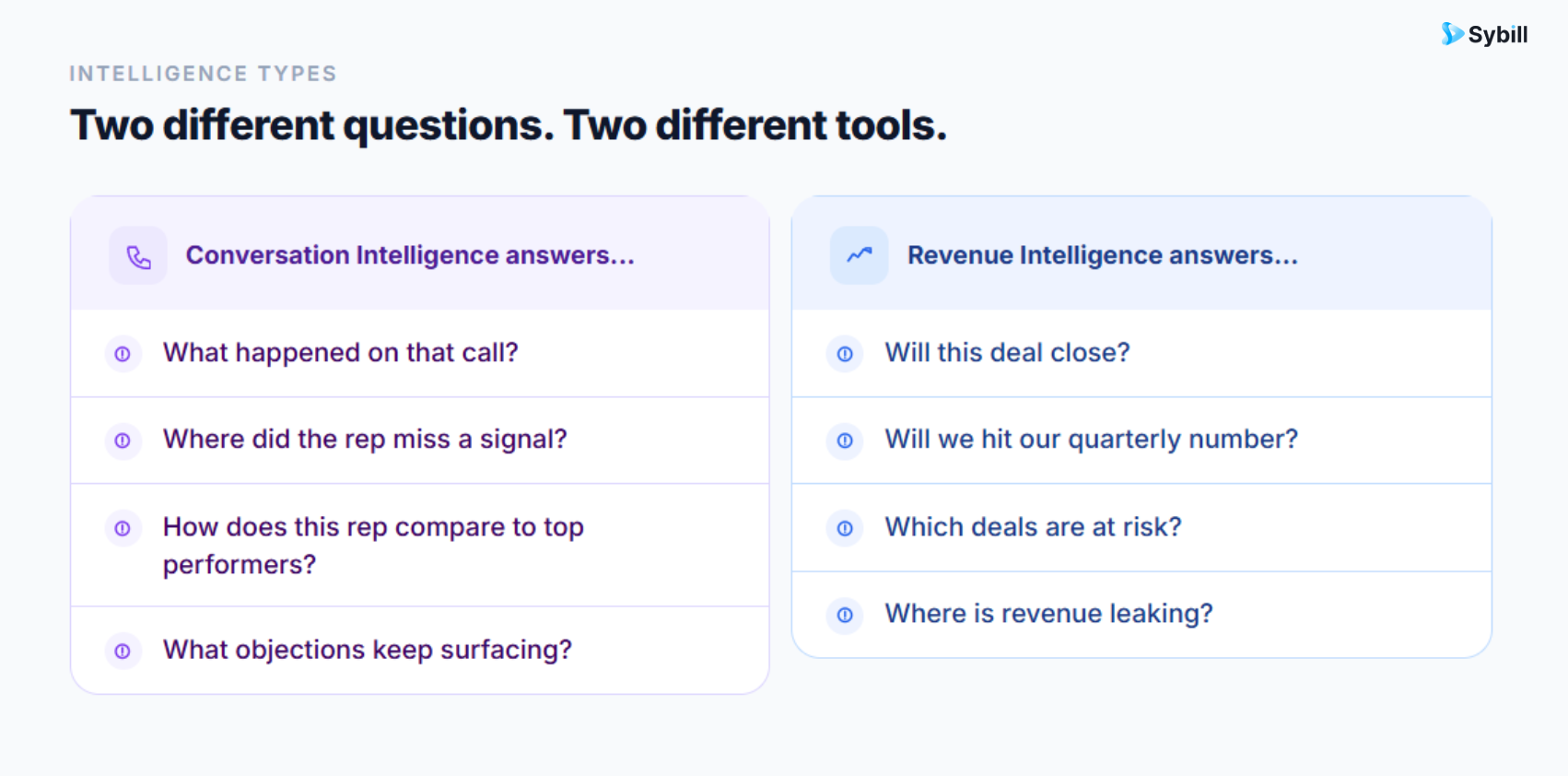
Revenue intelligence analyzes data from across the entire sales process, including CRM records, email activity, calendar signals, and call transcripts, to forecast revenue outcomes, score deal health, and surface pipeline risks. Conversation intelligence records, transcribes, and analyzes sales calls and meetings to surface coaching insights, identify buyer signals, and improve how reps sell. Revenue intelligence answers "Will this deal close and will we hit our number?" Conversation intelligence answers "What actually happened on that call and how can the rep do better next time?"
The distinction used to be clean. In 2026, it is collapsing.
Conversation intelligence platforms are adding pipeline analytics and forecasting. Revenue intelligence platforms are embedding call recording and coaching. AI notetakers are bolting on deal insights.
This guide breaks down what each category genuinely does well, where each falls short on its own, why the lines between them are blurring, and what a unified approach looks like when your goal is closing more deals.
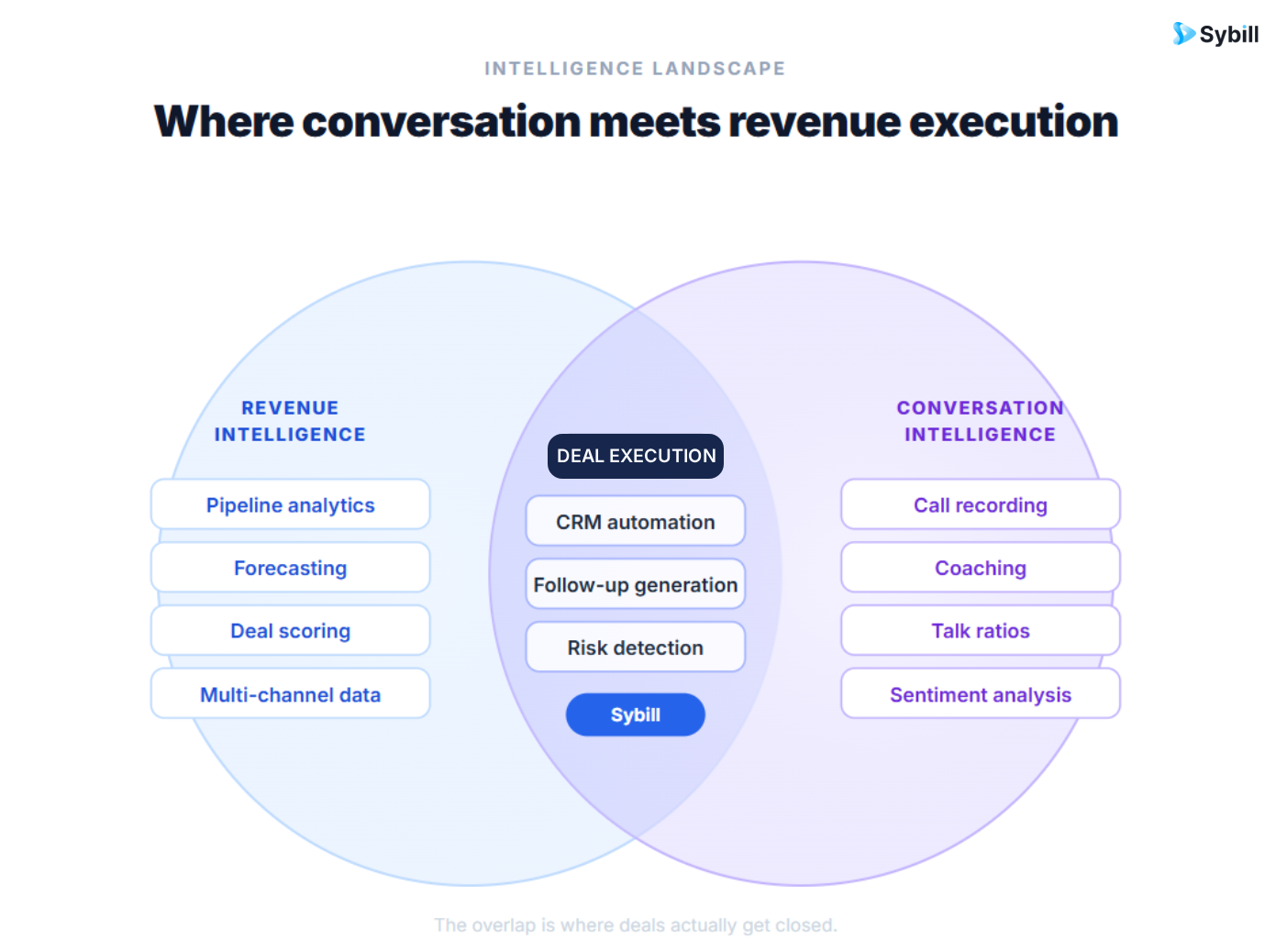
Conversation intelligence is software that captures, transcribes, and analyzes customer-facing conversations to extract actionable insights for sales teams. At its foundation, a conversation intelligence platform records sales calls and meetings, generates searchable transcripts, and uses AI to identify patterns in how reps sell and how buyers respond.
The core capabilities of a conversation intelligence platform include automatic call recording and transcription across Zoom, Teams, Google Meet, and phone, along with speaker identification that separates rep speech from buyer speech, topic and keyword detection that flags competitor mentions, pricing discussions, objection moments, and buying signals, talk-to-listen ratio tracking that measures how much reps talk versus listen, sentiment analysis that identifies buyer engagement, hesitation, or enthusiasm, and coaching views that surface specific moments where reps can improve.
The primary audience for conversation intelligence is front-line sales managers and enablement teams. A manager cannot sit on every call, but CI gives them visibility into what is actually happening across the team's conversations. Instead of coaching from memory or self-reported summaries, managers coach from evidence.
Conversation intelligence is strongest at answering questions at the individual call level: What did the buyer actually say? Where did the rep miss a signal? How does this rep's discovery compare to our top performer's? What objections keep surfacing across the team?
But conversation intelligence has a structural limitation. It sees what happens inside conversations. It does not see what happens between them.
That is the gap revenue intelligence was built to fill.
Revenue intelligence is the practice of aggregating and analyzing data from across the entire sales process to forecast revenue outcomes, score deal health, and guide strategic decisions.
A revenue intelligence platform ingests data from multiple sources: CRM records including deal stages, amounts, close dates, and field history, email metadata including response times, thread depth, and stakeholder engagement, calendar activity including meeting frequency, attendees, and scheduling patterns, call data often pulled from a conversation intelligence layer, and sometimes product usage signals and billing data.
It then applies machine learning to produce pipeline visibility showing real-time deal progression across stages and segments, AI-powered forecasting that predicts revenue outcomes based on actual activity patterns rather than rep self-reporting, deal health scoring that flags at-risk opportunities based on engagement gaps, stalled timelines, or missing stakeholders, buyer engagement tracking that measures multi-threaded engagement across buying committees, and revenue leak detection that identifies where deals fall out of the pipeline and why.
The primary audience for revenue intelligence is CROs, VPs of Sales, RevOps leaders, and Finance teams. When a CRO needs to commit a forecast number to the board, gut feeling is not sufficient. Revenue intelligence provides the evidence layer that separates "I think we'll hit $4.2 million" from "Based on deal activity patterns, we have 78% probability of landing between $3.9 million and $4.4 million."
Revenue intelligence is strongest at answering questions at the pipeline and organizational level: Will we hit our number this quarter? Which deals are genuinely progressing and which are stalled? Where is revenue leaking? How does this quarter's pipeline health compare to last quarter at the same point?
RI is only as good as its inputs. If CRM fields are rarely updated after calls, if next steps are vague or missing, if stakeholder information never gets recorded, even the best forecasting algorithm is modeling on partial truth. Revenue intelligence built on incomplete data produces confident-sounding but unreliable outputs.
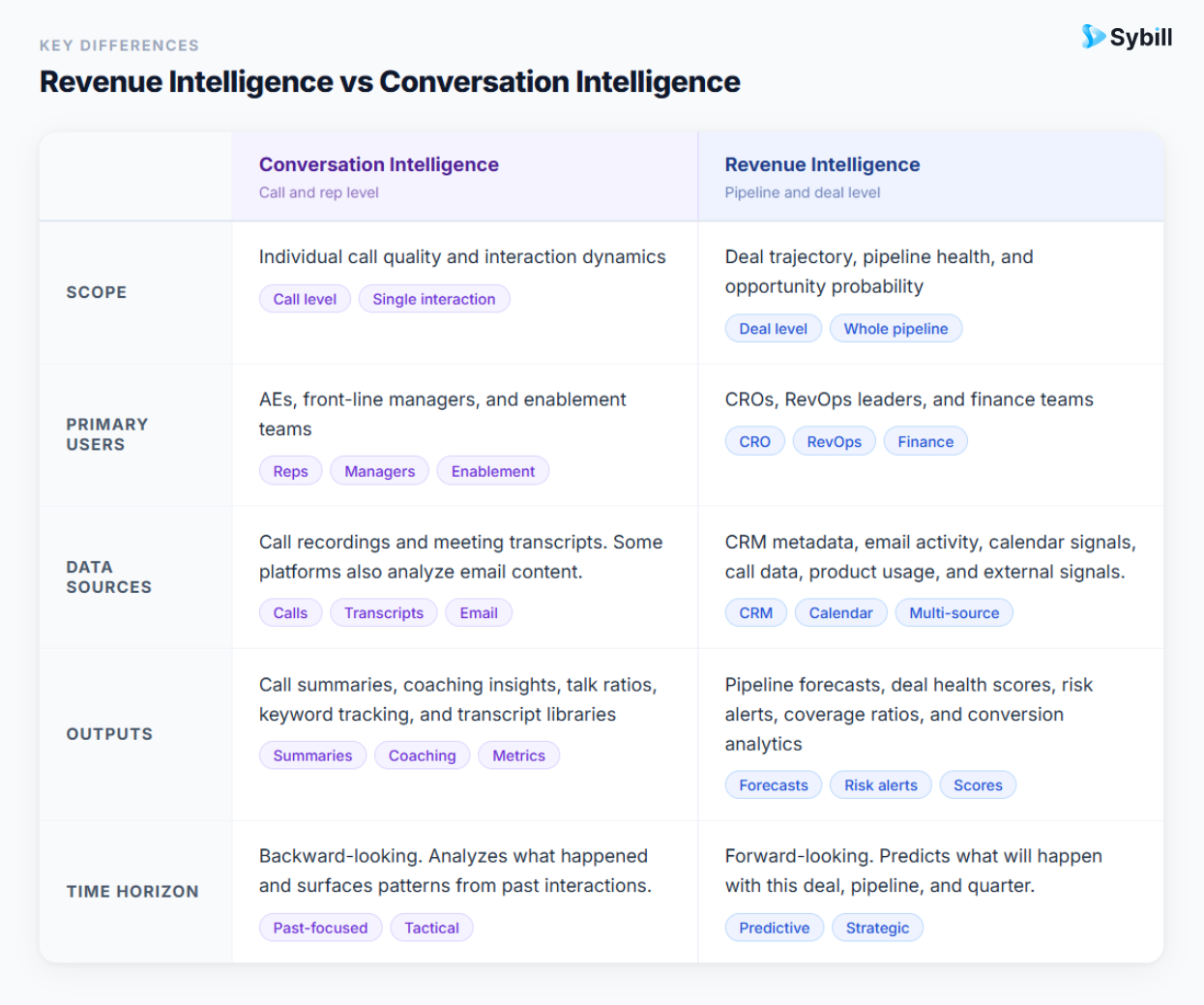
The differences between revenue intelligence and conversation intelligence come down to five dimensions. Understanding each one helps sales leaders decide what their team actually needs versus what vendor marketing tells them they need.
Conversation intelligence operates at the call level. It analyzes the content, dynamics, and quality of individual sales interactions. Revenue intelligence operates at the deal and pipeline level. It analyzes the trajectory, health, and probability of opportunities across all data sources, not just calls.
Think of it this way. Conversation intelligence tells you that the buyer mentioned a competitor three times and the rep failed to address it. Revenue intelligence tells you that this deal has a 35% probability of closing because email engagement dropped 60% in the last two weeks and the economic buyer has not attended a meeting since the initial demo.
Both are valuable. Neither alone gives you the full picture.
Conversation intelligence is built for the people closest to the conversation: account executives who want better call prep and follow-through, front-line managers who need to coach specific skills, and enablement teams who want to identify and scale winning behaviors.
Revenue intelligence is built for the people responsible for the number: CROs who need to commit accurate forecasts, RevOps leaders who manage pipeline health and process compliance, and finance teams who need revenue predictability for planning and resource allocation.
The most effective organizations do not force these users into the same tool with the same interface. They need the same data flowing through systems that serve each audience's actual workflow.
Conversation intelligence is primarily fueled by call and meeting recordings. Some platforms also analyze email content, but the core data source is the spoken conversation.
Revenue intelligence casts a wider net. It pulls from CRM metadata, email activity logs, calendar signals, call data, sometimes product usage data, and external signals like company news or hiring patterns. The broader data set is what enables pipeline-level analysis that goes beyond what any single conversation can reveal.
Conversation intelligence produces call summaries, coaching insights, talk ratio metrics, keyword tracking, competitive mention alerts, and searchable transcript libraries.
Revenue intelligence produces pipeline forecasts, deal health scores, risk alerts, coverage ratios, conversion analytics, and segment-level performance views.
The distinction matters because it determines who acts on the output and how. A coaching insight from CI leads to a 1:1 conversation between a manager and a rep. A deal risk alert from RI leads to a strategic intervention on a specific opportunity. A forecast from RI shapes quarterly planning and board communication.
Conversation intelligence is inherently backward-looking or present-focused. It analyzes what already happened on a call and surfaces patterns from past interactions to inform future behavior.
Revenue intelligence is forward-looking. Its primary value is prediction: what will happen with this deal, this pipeline, this quarter. The forecasting and risk-scoring capabilities are what make it strategic rather than tactical.
Neither conversation intelligence nor revenue intelligence is sufficient as a standalone solution. Understanding where each one breaks down explains why the market is converging.
A conversation intelligence platform that stops at call analysis creates a coaching-rich but strategically incomplete view. You know how the call went. You do not know whether the deal is actually progressing.
The specific gaps include no visibility into email engagement, no deal health scoring based on multi-channel activity, no pipeline-level forecasting, no ability to compare deal trajectory against historical win patterns, and no cross-channel risk detection. A call can score perfectly on every CI metric, with great talk ratio, strong discovery, clear next steps, and the deal can still die quietly because the champion left the company, the procurement team introduced a new vendor requirement, or the economic buyer stopped responding to emails. CI alone cannot see any of that.
A revenue intelligence platform that does not listen to calls has a different blind spot. It can model deal probability from CRM and email signals, but it misses the richest source of buyer intent: what they actually said.
Without conversation data, revenue intelligence cannot detect the emotional tone of buyer engagement, cannot identify whether objections were handled or ignored, cannot assess whether discovery was deep or superficial, and cannot flag when a prospect's words contradict their email behavior (saying "we're excited" on the call while going silent in email threads).
Revenue intelligence built on CRM data and email metadata without conversation inputs produces forecasts that look sophisticated but miss the qualitative signals that experienced sales leaders use to distinguish real deals from polite prospects.
Both categories share a dependency on CRM accuracy, and both suffer when CRM data is unreliable. If reps do not update deal fields after calls, if next steps live in notebooks instead of Salesforce, and if stakeholder information never gets logged, then conversation intelligence is coaching in a vacuum and revenue intelligence is forecasting on fiction.
This is the fundamental infrastructure problem that neither category was originally designed to solve. CI was designed to analyze calls. RI was designed to analyze pipelines. Neither was designed to ensure that the data connecting calls to pipelines is actually accurate and complete.
The platforms that are winning in 2026 are the ones that solve this problem at the source: automatically translating conversation data into structured CRM updates so that both coaching and forecasting operate on a shared foundation of truth.
The revenue intelligence vs conversation intelligence debate made sense when these were genuinely separate product categories sold to different buyers. In 2026, the boundaries are dissolving for three reasons.
Conversation intelligence platforms that started with call recording and coaching have expanded into deal health scoring, pipeline analytics, and forecasting. Gong is the most prominent example, having repositioned from "conversation intelligence" to "revenue intelligence" over the past two years. Their 2025 pricing restructure unbundled forecasting and engagement features into separate paid modules, effectively acknowledging that call analytics alone is no longer a sufficient product.
Revenue intelligence platforms that started with pipeline analytics and forecasting have added conversation recording and coaching capabilities. Clari acquired and built Clari Copilot specifically to embed conversation intelligence inside its revenue platform. The logic is straightforward: if your forecasting depends on accurate deal data, and the richest deal data comes from conversations, then owning the conversation capture layer gives you better inputs.
A third force is accelerating convergence: AI notetakers and meeting copilots. These tools started as simple transcription assistants and have rapidly added features that overlap with both CI and RI, including call summaries, action items, CRM sync, deal insights, and buying signal detection.
For many sales teams, an AI notetaker is their first experience with "conversation intelligence," even if the vendor does not use that label. When these tools add CRM automation and deal tagging, they start crossing into revenue intelligence territory. The category lines become meaningless from the buyer's perspective.
The practical implication for sales leaders is clear: evaluating tools by category label ("Is this CI or RI?") is less useful than evaluating them by workflow impact ("Does this tool improve what happens after my team's conversations and does it make our pipeline data more reliable?").
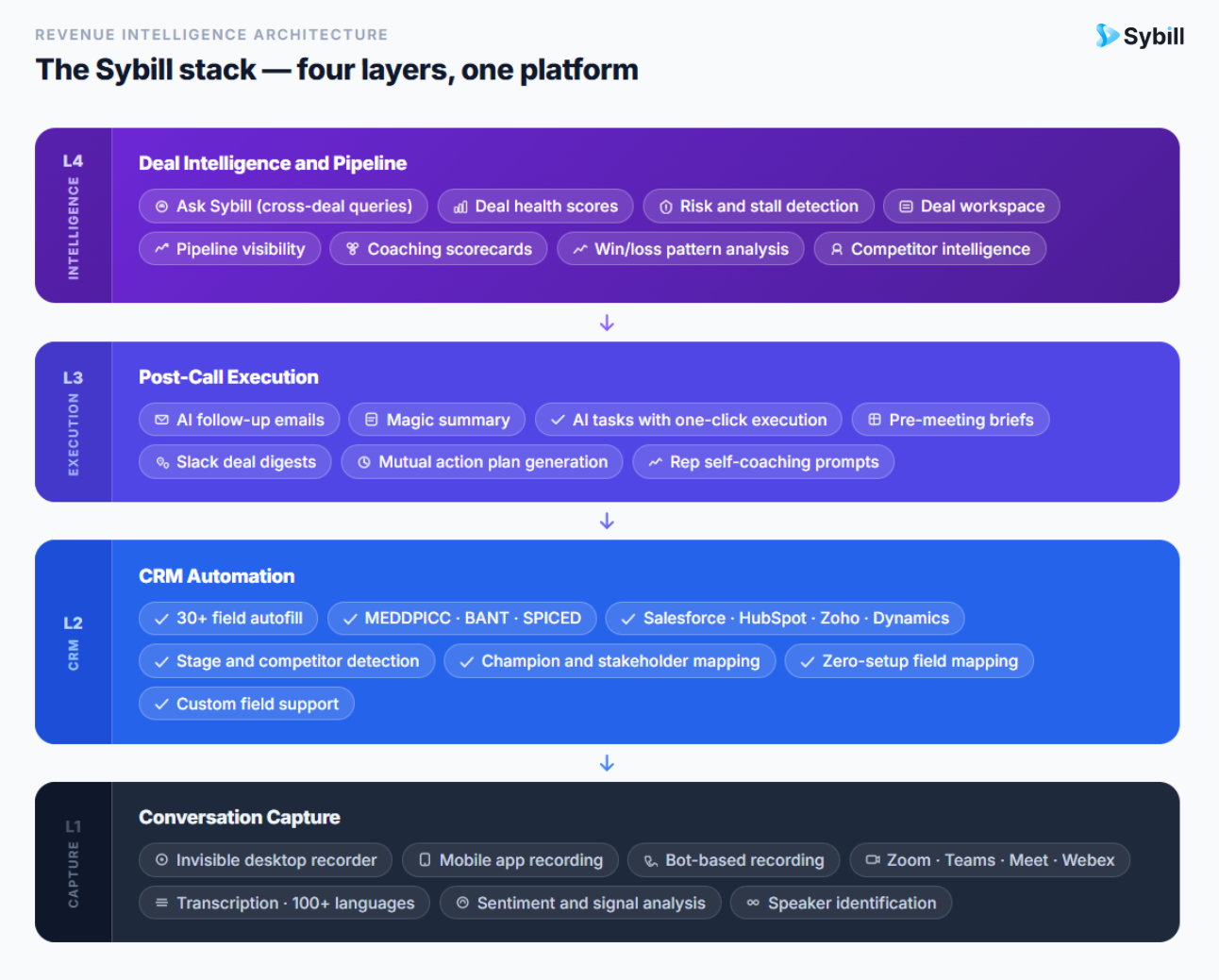
The convergence of conversation intelligence and revenue intelligence points toward what modern sales teams actually need: a single platform that captures conversation data, translates it into accurate deal intelligence, and drives post-call execution, all without requiring reps to change how they sell or managers to learn a new analytics dashboard.
Every deal begins with a conversation. The foundation of any intelligence system is reliable, accurate capture of what happens in those conversations, across video calls, phone calls, and in-person meetings.
This means recording and transcription that handles multi-speaker calls, industry jargon, and accents accurately, structured summaries that extract outcomes, pain points, objections, next steps, and buyer signals (not just raw transcripts), and coverage across all conversation types, not just Zoom calls.
This is the layer most platforms skip or do poorly. The conversation capture is only valuable if it flows into the systems where deal decisions are made.
Sybill's CRM Autofill writes structured updates into 30 or more CRM fields after every call and email interaction, including MEDDPICC qualification criteria, next steps, pain points, competitive mentions, stakeholder information, and custom fields. The entries read like a human wrote them, not a bot that summarized three bullet points.
This layer is what turns conversation intelligence into revenue intelligence infrastructure. When CRM data is accurate and complete because it comes from actual conversations rather than rep memory, every downstream function improves: forecasting becomes more reliable, pipeline reviews become more productive, coaching becomes more targeted, and deal risk becomes detectable earlier.
Intelligence without action is a dashboard nobody uses. The most valuable output of any sales intelligence platform is not an insight or a score. It is an action that moves a deal forward.
Sybill automates the execution layer that sits between "understanding what happened" and "doing something about it." AI follow-up emails draft in the rep's tone within minutes of a call ending, referencing specific pain points and commitments discussed. AI Tasks automatically identify next steps and track them. Pre-meeting briefs pull everything relevant from CRM and past interactions so reps walk into every call prepared instead of scrambling. Ask Sybill enables cross-deal querying in natural language: "Which deals have gone quiet after the second call?" or "Show me all calls where competitors were mentioned this month."
With accurate CRM data flowing from every conversation and execution happening automatically, the revenue intelligence layer has a solid foundation. Deal health becomes assessable not from CRM stage labels but from actual buyer behavior across calls and emails. Pipeline visibility shifts from self-reported optimism to evidence-backed assessment.
This is what Sybill's deal workspace provides: a unified view of every deal that combines conversation intelligence, CRM data, and cross-deal patterns into a single interface where reps manage deals and managers manage pipeline without switching between six different tools.
The right approach depends on your team's current pain point and maturity.
Your biggest problem is that no one remembers what was said on calls and coaching feels like guesswork. Your reps spend hours on post-call admin (CRM updates, follow-up emails, note reconstruction) that eats into selling time. You have a new or growing team that needs to ramp faster by learning from real winning conversations. Your front-line managers lack visibility into rep performance across all calls, not just the handful they can attend.
In this scenario, the immediate ROI comes from time savings and coaching quality. The conversation intelligence ROI math is straightforward: recovered rep hours plus coaching-driven close rate improvement far exceeds the platform cost.
Your forecasts are consistently off and the board is losing confidence in the numbers. You have pipeline visibility problems where deals stall or disappear without early warning. Your RevOps team spends excessive time manually stitching together data from calls, CRM, and email to assess deal health. You need to understand conversion patterns across segments, territories, or product lines.
In this scenario, the immediate ROI comes from forecast accuracy and deal risk detection. But be warned: revenue intelligence deployed on top of unreliable CRM data will produce confident-looking outputs built on a shaky foundation.
You recognize that the conversation data and the pipeline data need to be connected, and you do not want to manage separate tools for each. You want CRM accuracy to improve automatically as a byproduct of reps having conversations, not as an additional administrative requirement. You need both rep-level coaching and pipeline-level visibility but lack the budget or integration bandwidth for two enterprise platforms.
This is where Sybill's approach is fundamentally different. Rather than positioning as a CI tool that added RI features or an RI tool that added CI features, Sybill was built as the execution layer that makes both conversation intelligence and revenue intelligence work by solving the data quality problem at the source.
The revenue intelligence vs conversation intelligence debate ends when the platform does both and adds the execution layer that makes both categories actually work. Connect your calendar, take your next call, and see a structured summary, auto-populated CRM fields, and a follow-up email draft before your next meeting starts.
Try Sybill free and stop choosing between coaching insights and pipeline visibility. Get both, plus the execution layer that turns intelligence into closed deals.
Conversation intelligence records, transcribes, and analyzes sales calls to surface coaching insights and improve how reps sell. Revenue intelligence aggregates data from CRM, email, calendar, and calls to forecast revenue, score deal health, and surface pipeline risks. Conversation intelligence operates at the call level and serves reps and managers. Revenue intelligence operates at the pipeline level and serves CROs, RevOps, and finance. In 2026, the categories are converging as platforms add capabilities from both sides.
Most sales organizations benefit from both, but they do not necessarily need two separate tools. Conversation intelligence without revenue context produces coaching in a vacuum. Revenue intelligence without conversation data produces forecasts on incomplete information. The most effective approach is a unified platform that captures conversations, translates them into structured CRM data, and provides both coaching insights and pipeline-level visibility from a single data foundation.
Sybill captures and analyzes sales conversations (conversation intelligence), automatically updates 30 or more CRM fields after every call and email (the data bridge), generates follow-up emails and tracks next steps (execution), and provides cross-deal querying and deal health assessment (revenue intelligence). This unified approach means CRM data is always accurate because it comes from actual conversations, not rep memory, which makes both coaching and forecasting more reliable.
Gong started as a conversation intelligence platform focused on call recording, coaching, and analytics. It has since repositioned as a revenue intelligence platform, adding forecasting, engagement tracking, and deal management capabilities. The full CI-plus-RI experience requires Gong's higher-tier bundles. For teams that need both capabilities without enterprise pricing, platforms like Sybill deliver comparable conversation intelligence with built-in CRM automation and deal intelligence at a fraction of the cost.
For small teams (under 25 reps), conversation intelligence typically delivers faster and more measurable ROI because the immediate time savings from automated summaries, CRM updates, and follow-up drafting are felt by every rep from day one. Revenue intelligence features like forecasting and pipeline analytics become increasingly valuable as the team scales and pipeline complexity grows. The ideal solution for small teams is a platform that starts delivering CI value immediately while building the data foundation for RI capabilities as the team grows.
AI notetakers record meetings, transcribe them, and produce summaries and action items. Conversation intelligence adds coaching insights, behavioral analysis, pattern identification across calls, and sales-specific intelligence like competitive mention tracking, qualification scoring, and cross-deal querying. Many AI notetakers are adding CI-adjacent features, but the depth of sales-specific analysis and the integration with CRM and deal workflows still distinguishes purpose-built conversation intelligence platforms from general-purpose meeting tools.
Yes, significantly. When conversation data flows automatically into CRM fields, deal qualification becomes evidence-based rather than assumption-based. Teams using MEDDPICC frameworks with AI-populated qualification fields report forecast accuracy improvements from the 60 to 70% range to above 85%. The mechanism is straightforward: deals with verified conversation evidence (confirmed economic buyer, quantified pain, mapped decision process) close at predictable rates. Deals without that evidence do not. Conversation intelligence makes the evidence visible and trackable.
Conversation intelligence records, transcribes, and analyzes sales calls to surface coaching insights and improve how reps sell. Revenue intelligence aggregates data from CRM, email, calendar, and calls to forecast revenue, score deal health, and surface pipeline risks. Conversation intelligence operates at the call level and serves reps and managers. Revenue intelligence operates at the pipeline level and serves CROs, RevOps, and finance. In 2026, the categories are converging as platforms add capabilities from both sides.
Most sales organizations benefit from both, but they do not necessarily need two separate tools. Conversation intelligence without revenue context produces coaching in a vacuum. Revenue intelligence without conversation data produces forecasts on incomplete information. The most effective approach is a unified platform that captures conversations, translates them into structured CRM data, and provides both coaching insights and pipeline-level visibility from a single data foundation.
Sybill captures and analyzes sales conversations (conversation intelligence), automatically updates 30 or more CRM fields after every call and email (the data bridge), generates follow-up emails and tracks next steps (execution), and provides cross-deal querying and deal health assessment (revenue intelligence). This unified approach means CRM data is always accurate because it comes from actual conversations, not rep memory, which makes both coaching and forecasting more reliable.