Find us at booth #83, join us for a harbor side happy hour, or catch Gorish’s talk.

Sept, 16-18 > Learn more

%20(1).avif)
Mamta Tainwala

July 14, 2026
%20(37).png)
Improving net dollar retention comes down to three levers: reducing gross churn, limiting contraction from downgrades, and growing expansion revenue. The highest-impact tactics are proactive churn-signal monitoring, structured onboarding that reaches first value within days, usage-triggered expansion plays, and dunning optimization for involuntary churn. Most teams work only one lever. The best work all three.
Everything below is how to actually pull those levers, with the 2026 numbers that tell you where you stand.
Net dollar retention (NDR) measures the %age of recurring revenue retained from an existing customer cohort over a period, after adding expansion revenue and subtracting churn and contraction. NDR above 100% means your existing base grows on its own. It matters because expansion revenue is cheaper, more predictable, and more valuation-defining than new logo acquisition.
We keep this section short on purpose, because we already wrote the complete guide to net dollar retention: definition, formula, worked calculations, NDR versus GRR, the whole thing. If you need the fundamentals, start there.
This post is for the reader with a different problem: you already know your NDR, and you do not like it.
One number to frame why this fight is worth it. According to Fullcast's 2025 Revenue Benchmark Report, 52% of new revenue last year came from expansion into existing accounts rather than new logos. Expansion is not a side quest anymore. For most SaaS companies, it is the main storyline.
A good NDR in 2026 depends on segment: SaaS Capital's 2025 data puts median NDR at 118% for enterprise, 108% for mid-market, and 97% for SMB-focused companies. Among public SaaS companies, median NDR was roughly 110% in Q4 2025, down from over 123% in early 2022. Benchmarking against a flat 120% target is outdated.
Let us be adults for a second about the benchmark inflation in older content, including the previous version of this very post. The "top companies maintain 120%+" framing comes from the 2021 era, when money was free and seat counts only went up. That era ended.
The current picture, from sources that actually publish their data:
So calibrate honestly. If you sell to SMBs and your NDR is 102%, you are not failing. You are above median for your segment. If you sell enterprise and you are at 105%, you have work to do, and the eight levers below are the work.
NDR rarely collapses in one dramatic renewal. It erodes through small missed signals: a champion who goes quiet, a concern nobody documented, declining usage nobody flagged, a use case that never expanded. Diagnosing which of the three levers is broken (churn, contraction, or expansion) must come before picking tactics.
Here is the diagnostic most teams skip. Decompose your NDR:
Gross churn problem. Customers leaving entirely. Usually an onboarding, product-fit, or support failure. Fix retention before touching expansion, because upselling into a leaky base is pouring water uphill.
Contraction problem. Customers staying but shrinking: seat reductions, tier downgrades. Usually a value-demonstration failure or a pricing model that punishes partial adoption.
Expansion problem. Low churn, flat accounts. You keep everyone and grow no one. Usually a process failure: no expansion triggers, no playbook, and account teams flying blind on what customers actually said they need.
That last point is the one dashboards cannot fix, because the evidence lives in conversations. Every renewal risk and every expansion opening is spoken out loud on a call months before it shows up in revenue. Teams that mine their customer conversations for buyer needs and intent catch both. Teams that rely on rep memory catch neither.
The eight highest-impact NDR levers: proactive churn-signal monitoring, seamless sales-to-CS handoffs, onboarding that reaches first value fast, usage-based expansion triggers, an expansion playbook with trained CS teams, product stickiness through integrations, dunning optimization for involuntary churn, and AI-driven account intelligence across every conversation. Sequence them by which lever your diagnostic showed is broken.
By the time a customer emails "we need to talk about the renewal," the decision was made weeks ago. The signals were there: login frequency dropped, support tickets spiked, the champion stopped joining calls.
How to run it: define three to five leading indicators per segment, score accounts weekly, and route at-risk accounts to a human within 48 hours of a threshold breach. Our churn analysis guide covers building the scoring model.
And do not forget the silent kind: customers who never complain, never cancel, and quietly stop engaging. Behavioral signals from calls catch what product telemetry misses, because a distracted, camera-off, one-word-answers stakeholder is a churn signal no login dashboard will ever show you.
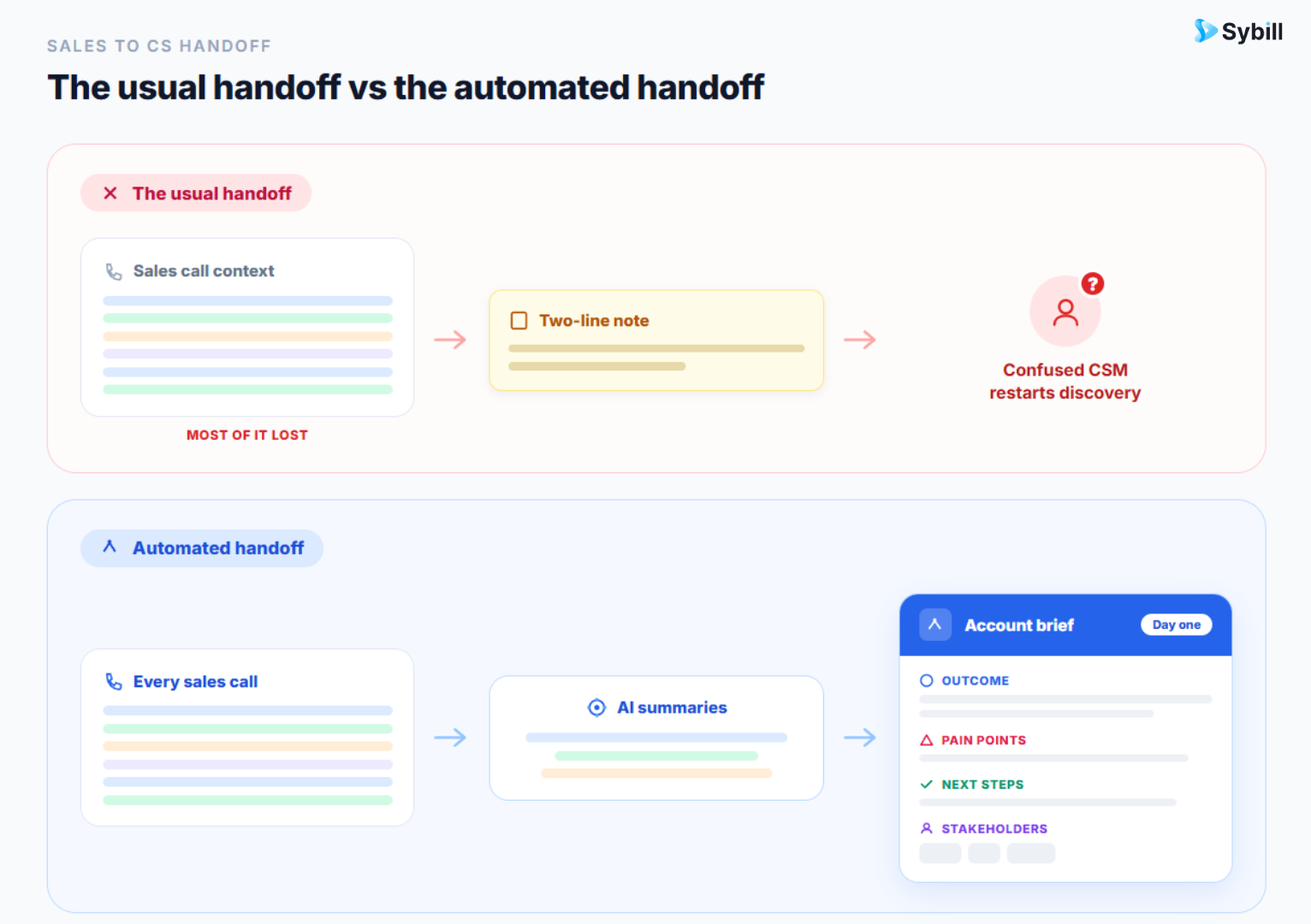
The single most preventable NDR killer: the customer explains their goals in the sales cycle, then re-explains everything to a CSM who got a two-line handoff note. Nothing says "we value your business" like making the buyer repeat themselves.
How to run it: make the handoff artifact automatic, not heroic. Magic summaries of every sales call give customer success teams the full deal context: goals, promised outcomes, stakeholder dynamics, objections raised. The CSM's first call starts from everything the customer already said, and keeping every deal's history in one place means it stays that way through every team transition after.
Poor onboarding is the biggest driver of early churn, and early churn is the most expensive kind: full CAC spent, minimal revenue collected.
How to run it: design onboarding around time-to-first-value, not feature tours. Guided flows with visible milestones. White-glove treatment for enterprise accounts. Automated intervention when a user stalls in the first week. The goal is the customer's "aha moment" measured in days, not quarters.
Expansion revenue should not depend on a CSM happening to notice an opportunity. It should fire on triggers: usage approaching plan limits, new departments appearing on calls, feature requests that map to a higher tier.
How to run it: instrument the triggers, then arm the play. When an account trips one, pre-meeting briefs put the full account context in front of the AE or CSM before the expansion conversation, and sales plays built from your past wins tell them which motion worked on similar accounts. This is not guesswork. It is pattern-matching on your own history.
Most CS teams were hired to retain, not expand, and asking them to upsell without training produces awkward, apologetic pitches that damage trust.
How to run it: teach expansion as problem-solving. The upgrade is the natural answer to a need the customer already voiced. Which requires knowing what they voiced: Ask Sybill lets a CSM query every conversation with an account before proposing anything. "What has this customer said about reporting needs this quarter?" beats "so, have you considered our premium tier?" every single time.
Stickiness is structural. Every integration a customer sets up, every workflow they automate, every teammate they invite raises switching costs.
How to run it: push integration setup into onboarding, not month six. Nurture power users, who are both your lowest churn risk and your internal champions for expansion. Build collaboration features into daily workflows so removing your product means disrupting the team, not just one user.
A meaningful slice of churn is not a decision at all: failed payments, expired cards, lapsed accounts. Dunning optimization alone is worth an estimated 1 to 3 points of NRR, takes one to two weeks to implement, and most SaaS teams have never touched it.
How to run it: automated retry logic, pre-expiry card update prompts, grace periods with human follow-up for high-value accounts, and annual contracts where the economics support them. This is the least glamorous lever on this list and the fastest payback. Do it first if you have not.
Your team runs hundreds of customer conversations a quarter. Somewhere in there is every renewal risk and every expansion opening you will encounter this year. No human reads all of it. AI does.
How to run it: record and analyze every customer-facing call. Sybill has analyzed [SYBILL CONVERSATION VOLUME STAT - VERIFY] sales conversations, and the consistent finding is that risk and opportunity signals surface in conversation long before they surface in revenue. Route those signals into your CRM automatically so account records reflect reality, feed them into your forecast calls, and give RevOps an account-health view built on what customers actually said instead of what reps remembered to log.
Your next expansion deal was mentioned on a call three weeks ago. Sybill captures every customer conversation, flags the risks and openings, and updates your CRM without anyone lifting a finger. Start for free.
Prioritize by diagnostic, then by payback speed. If gross churn exceeds your segment norm, fix onboarding and churn signals first. If churn is fine but accounts stay flat, build expansion triggers and playbooks. Dunning optimization comes first for almost everyone because it takes two weeks and pays back immediately.
A simple sequencing rule for resource-constrained teams, which is all teams:
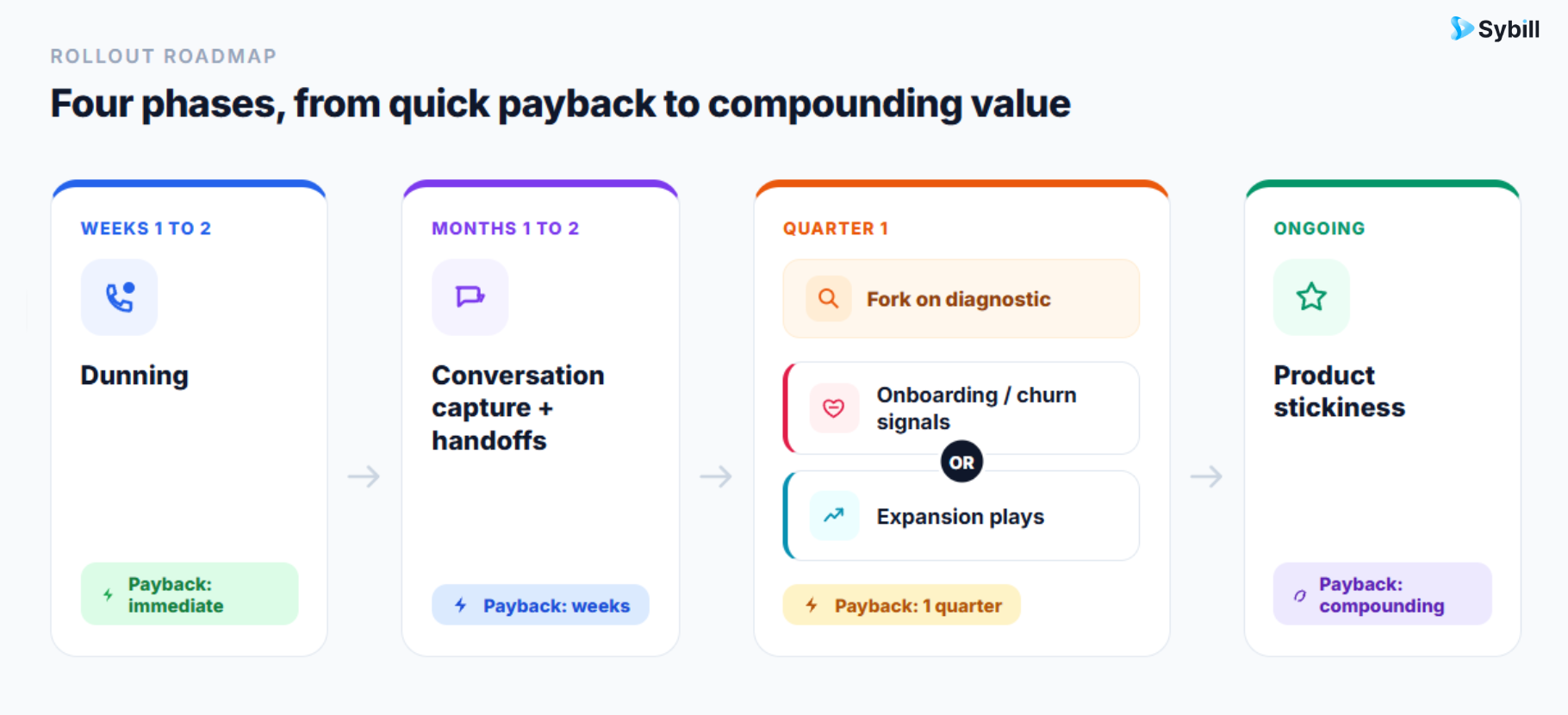
Week 1 to 2: Dunning and involuntary churn (lever 7). Fastest ROI in retention, full stop.
Month 1 to 2: Conversation capture and handoff automation (levers 2 and 8). This is infrastructure: every other lever runs better once account intelligence is flowing, and it costs your team nothing to maintain because the AI does the documenting.
Quarter 1: Onboarding redesign and churn-signal scoring (levers 1 and 3) if your diagnostic says churn; expansion triggers and CS training (levers 4 and 5) if it says flat accounts.
Ongoing: Product stickiness (lever 6), because integrations and workflow depth compound quarter over quarter.
Then re-measure. NDR moves slowly, so judge levers on their leading indicators (time-to-value, signal-to-intervention lag, expansion pipeline created) and give the headline number two to three quarters to respond. Sales leaders who inspect this in their regular pipeline reviews catch the drift early. Everyone else finds out at the board meeting.
Here is the thread running through all eight levers: net dollar retention is a lagging indicator of how well you listen. Every churn was foreshadowed on a call. Every expansion was requested, hinted at, or wished for out loud. The companies with elite NDR are not luckier. They are better at capturing what customers say and acting on it before the renewal forces the issue.
Dashboards tell you what already happened. Conversations tell you what is about to.
Sybill sits in every customer conversation, turns it into summaries, CRM updates, follow-ups, and account intelligence, and makes sure the signal that saves the renewal or opens the expansion never dies in someone's notebook.
Your customers are already telling you how to hit 115%. Start listening at scale.
Try Sybill free or book a demo.
Dunning optimization. Automated payment retries, pre-expiry card prompts, and failed-payment recovery flows address involuntary churn, take one to two weeks to implement, and are worth an estimated 1 to 3 points of NRR according to 2026 benchmark analysis. Nearly every other lever takes a quarter or more to show up.
It depends on segment. Per SaaS Capital's 2025 data, 100% beats the SMB median of 97% but trails the mid-market median of 108% and the enterprise median of 118%. At 100% your existing base is holding flat, which means all growth must come from new acquisition.
Gross revenue retention (GRR) only subtracts churn and contraction, so it can never exceed 100% and shows pure retention strength. NDR adds expansion revenue on top, so it can exceed 100% and shows whether your customer base grows on its own. Track both: GRR diagnoses leaks, NDR measures the growth engine.
Expect two to three quarters before the headline NDR number responds, because it measures cohort revenue over trailing periods. Track leading indicators in the meantime: time-to-first-value, churn-signal response lag, and expansion pipeline created. Involuntary churn fixes show up fastest, often within one billing cycle.
Yes, primarily through earlier signal detection. Churn risks and expansion opportunities appear in customer conversations weeks or months before they appear in revenue data. AI that analyzes every call catches disengagement patterns, unmet needs, and buying signals at a scale no human team can, then routes them to the right owner while there is still time to act.
Dunning optimization. Automated payment retries, pre-expiry card prompts, and failed-payment recovery flows address involuntary churn, take one to two weeks to implement, and are worth an estimated 1 to 3 points of NRR according to 2026 benchmark analysis. Nearly every other lever takes a quarter or more to show up.
It depends on segment. Per SaaS Capital's 2025 data, 100% beats the SMB median of 97% but trails the mid-market median of 108% and the enterprise median of 118%. At 100% your existing base is holding flat, which means all growth must come from new acquisition.
Gross revenue retention (GRR) only subtracts churn and contraction, so it can never exceed 100% and shows pure retention strength. NDR adds expansion revenue on top, so it can exceed 100% and shows whether your customer base grows on its own. Track both: GRR diagnoses leaks, NDR measures the growth engine.