Find us at booth #83, join us for a harbor side happy hour, or catch Gorish’s talk.

Sept, 16-18 > Learn more


Tamanna Mishra

July 11, 2026
%20(33).png)
CRM should be the single source of truth for sales deals. In practice, the real deal story often lives across call transcripts, emails, Slack threads, notes, follow-ups, dashboards, and the rep’s memory. That creates stale CRM fields, weak forecast confidence, and painful manager reviews.
A true single source of truth for sales deals should capture buyer priorities, stakeholders, objections, competitors, risks, next steps, and CRM updates in one place. AI sales assistants like Sybill help by turning calls, emails, and deal activity into a living workspace, then updating CRM automatically through CRM Autofill.
Every sales team has seen this movie.
The deal is in the right stage. The amount is entered. The close date looks ambitious but not completely delusional. The next step says “follow up.” CRM looks clean enough to survive a pipeline review.
Then someone asks one tiny question.
“What did the buyer actually care about?”
Suddenly the room gets weird.
The answer is not in the CRM field. It is in a transcript nobody wants to read. Or in an email thread with seven people copied. Or in a Slack message from three weeks ago. Or in the rep’s memory, which is currently competing with five calls, two demos, and one very aggressive end-of-quarter forecast meeting.
That is the real problem. Sales teams do not have a tool shortage. They have a deal context problem.
CRM is still necessary. But CRM alone is not enough if it only captures the cleaned-up version of the deal, not the buyer reality behind it. A single source of truth for sales deals needs to include what happened, what changed, what was promised, what is risky, and what needs to happen next.
A single source of truth for a sales deal is one trusted place where reps, managers, RevOps, and leadership can see the latest deal stage, buyer priorities, stakeholders, objections, risks, competitors, next steps, and CRM updates without digging through calls, emails, Slack, transcripts, or rep memory.
Notice the important part: it is not just where the data lives. It is where the deal story is actually usable.
A CRM record with a stage, amount, close date, and last activity is useful. But it does not always answer:
A single source of truth should make those answers easy to find.
That is especially important now because buying committees are getting messier. Forrester’s 2026 State of Business Buying research found that a typical buying decision includes 13 internal stakeholders and nine external influencers, with even larger groups for complex purchases. Gartner also found that 74% of B2B buyer teams show unhealthy conflict during the decision process.
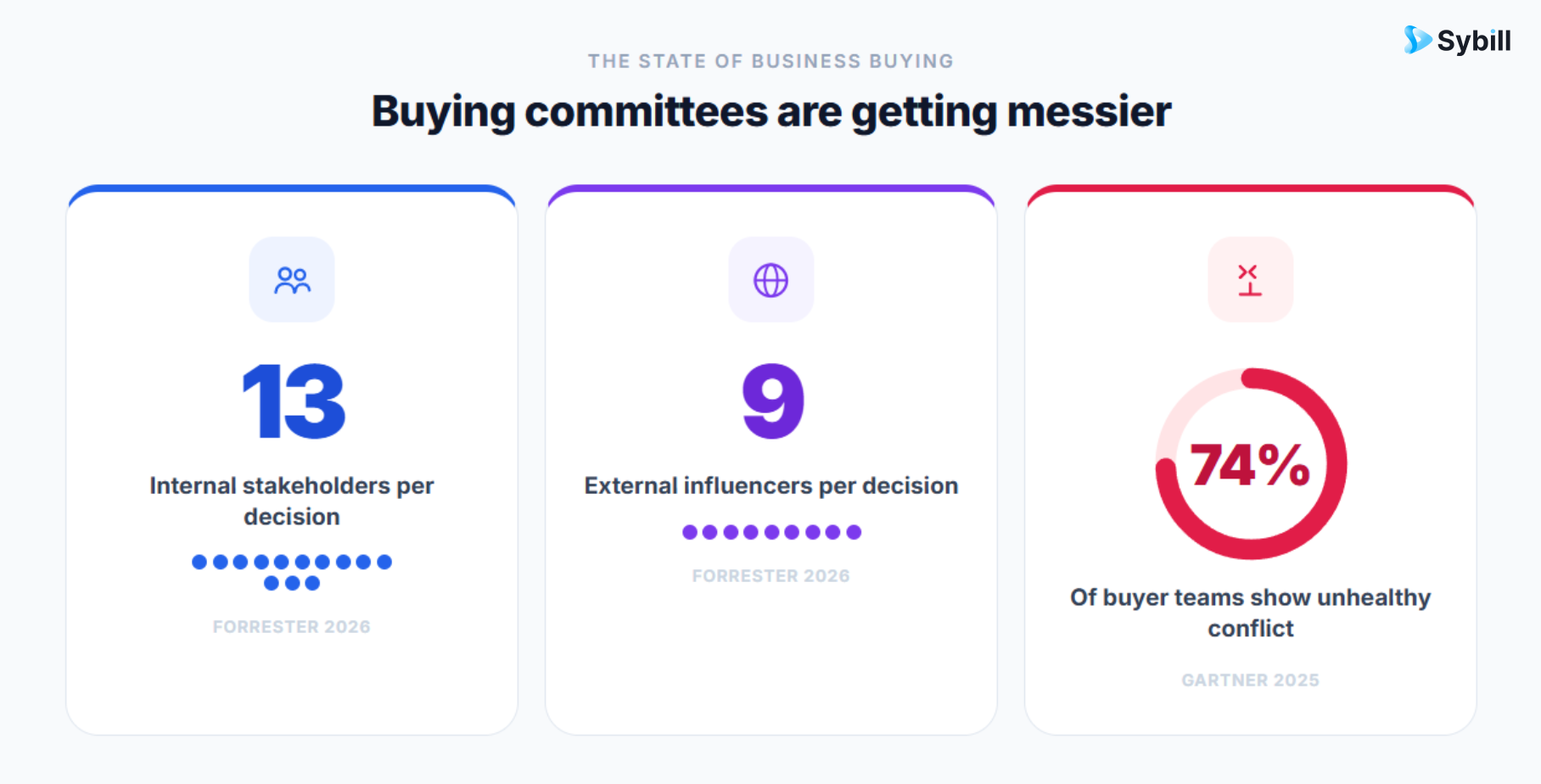
Translation: you are not just selling to a company. You are selling into a group chat with politics, priorities, fear, finance, legal, IT, and one mystery stakeholder who appears in week six and asks if you integrate with something nobody mentioned before.
Your source of truth has to keep up.
CRM is the system of record. It is excellent for pipeline reporting, account ownership, activity tracking, opportunity stages, and leadership visibility.
But a system of record is not automatically a system of context.
Most CRMs depend on humans entering the right information at the right time in the right format. That sounds reasonable until you remember the average seller’s day. Salesforce reported in 2026 that sales reps spend 60% of their time on non-selling work, including tasks like manually entering customer notes into CRM. Asking reps to “just update CRM better” is not a strategy. It is corporate fan fiction.
The issue is not that reps are lazy. The issue is that the workflow is broken.
A sales call creates context. An email creates commitments. A Slack thread creates internal decisions. A follow-up creates momentum. A manager one-on-one creates coaching notes. CRM usually gets whatever survives all of that chaos.
And what survives is often thin.
“Good call.”
“Pricing discussed.”
“Send follow-up.”
“Legal next.”
That is not a deal story. That is a weather report from someone who glanced outside for three seconds.
This is why AI sales workflows matter. Sybill’s CRM Autofill, for example, captures important details from meetings and emails, then updates CRM automatically. It can pick up deal signals like MEDDPICC, BANT, next steps, and competitors from calls and emails, then update CRM in minutes.
That is the shift: from manual recollection to automatic context capture.
Also read: CRM Automation: Complete Guide for Sales Teams
Deal data rarely disappears in one dramatic moment. It leaks slowly.
A buyer mentions a competitor. The rep remembers it but does not log it. Finance raises a concern on email. Nobody updates the risk field. The champion says legal will need two weeks. The close date stays decorative. The manager gives good advice in Slack. It never reaches the opportunity record.
Then everyone acts shocked when the forecast slips.

The fix is not to create yet another place to paste notes. Please, no more digital junk drawers.
The fix is to create a workflow where calls, emails, CRM, tasks, and deal context feed into one trusted deal workspace. Sybill’s Deal Workspace is built around that idea: AEs can manage deals, meetings, and tasks in one place instead of bouncing between notetakers, CRMs, and dashboards.
A single source of truth should not be a prettier CRM page. It should answer the questions that decide whether a deal is real, risky, stuck, or ready to move.
Here is the practical checklist.

This is where many teams confuse activity with intelligence.
A logged call is activity. A call summary that captures buyer pain, objections, stakeholders, and next steps is intelligence. A transcript is a record. A deal workspace is a working surface.
For a deeper breakdown, read Sales Call Summary: What It Should Include and How AI Automates It.
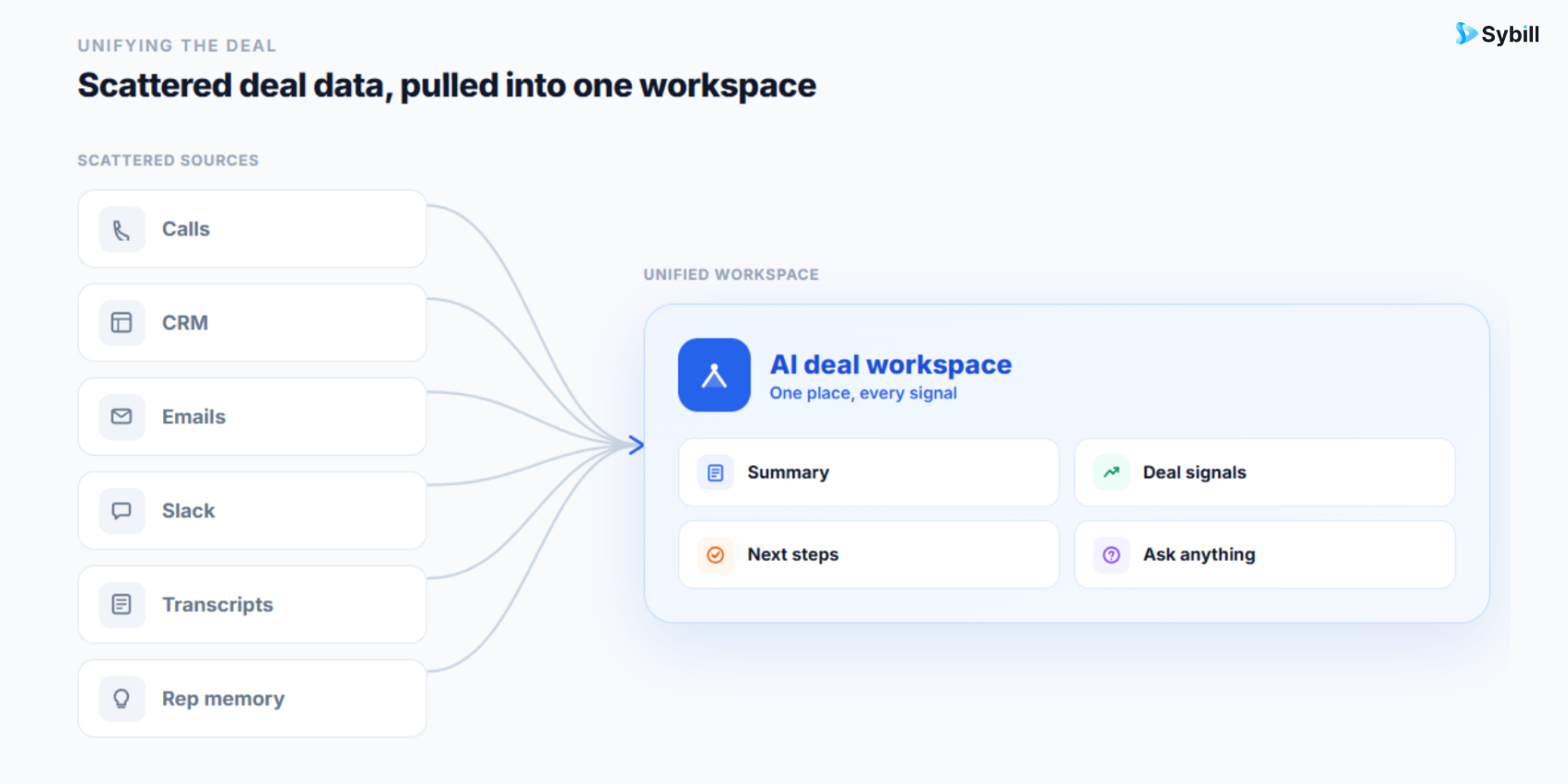
AI is useful in sales only when it reduces chaos. If it simply creates more summaries, more tabs, and more dashboards, congratulations, you have automated clutter.
A useful AI sales assistant should do five things.
First, it should capture what happened across calls, emails, and CRM.
Second, it should extract deal signals: pain points, objections, competitors, stakeholders, timeline, budget, next steps, and risks.
Third, it should update CRM fields automatically, not ask the rep to copy-paste a summary like it is 2013.
Fourth, it should give reps and managers a place to inspect the deal story.
Fifth, it should help the seller act: send the follow-up, complete the task, prepare for the next meeting, or ask a smarter question.
Sybill is built for that full loop. It understands context from calls, emails, Slack, calendar invites, and CRM updates to build a picture of deals, accounts, and buyers, then automates busywork like follow-ups, CRM updates, and sales tasks. Its Workspace gives every deal a dedicated room with deal summary, stage, activity timeline, tasks, risks, blockers, MEDDPICC, and more.
That matters because deal truth is not static. It changes after every call, every email, every stakeholder meeting, and every internal conversation. Your source of truth should update as the deal moves, not after the rep survives Friday admin hour.
Start with the work, not the tool.
Before RevOps adds another required field, define what your team actually needs to know.
For reps, deal truth might mean: what should I do next?
For managers, it might mean: where is the risk?
For RevOps, it might mean: is CRM accurate enough to forecast and analyze?
For leadership, it might mean: can we trust the pipeline?
Once you know the decisions your deal data should support, you can design the source of truth around those decisions.
Use MEDDPICC, BANT, SPICED, or your own qualification framework. The framework matters less than consistency.
Every deal should capture the same core signals:
Without standardization, every rep creates a different version of “good notes.” That makes manager inspection harder and pipeline reporting weaker.
A single source of truth cannot work if it only reads one source.
Calls show what buyers say out loud. Emails show what they commit to in writing. CRM shows the official sales record. Slack shows internal judgment and deal coaching. Calendar data shows meeting history and stakeholder involvement.
Sybill’s Pre-Meeting Briefs scan calendar, calls, email, CRM, and more to research prospects and pull the context reps need before a call. That same principle applies across deal management: context gets better when systems talk to each other.
Manual CRM updates are where deal truth goes to lose weight.
The rep knows more than the CRM shows because typing everything in is tedious. Then the manager asks what changed. Then the rep explains it verbally. Then leadership looks at CRM and sees something else. Beautiful chaos. Terrible operating system.
Automated CRM updates fix the bottleneck by turning real buyer conversations into structured CRM data. Sybill’s CRM Autofill updates CRM after calls and emails, including deal signals like next steps, competitors, MEDDPICC, and BANT.
Also read: The New CRM Autofill: Smarter CRM Automation for Sales Teams
If the source of truth only helps leadership inspect pipeline, reps will treat it like homework.
A good deal workspace should help reps sell. It should show past meetings, next steps, risks, blockers, stakeholders, tasks, and useful prompts. It should make the next move obvious.
Sybill’s Deal Workspace is designed around seller workflow, with deal summaries, activity timelines, tasks, risks, blockers, MEDDPICC, meeting links, pre-meeting briefs, and post-meeting summaries organized in one place.
That is the difference between “please update the system” and “here is the system helping you win.”
Forecast reviews should not feel like courtroom cross-examination.
Managers should be able to inspect:
If the manager has to ask the rep for every answer, the deal source of truth is not doing its job.
Different tools solve different problems. The mistake is expecting one category to do everything.
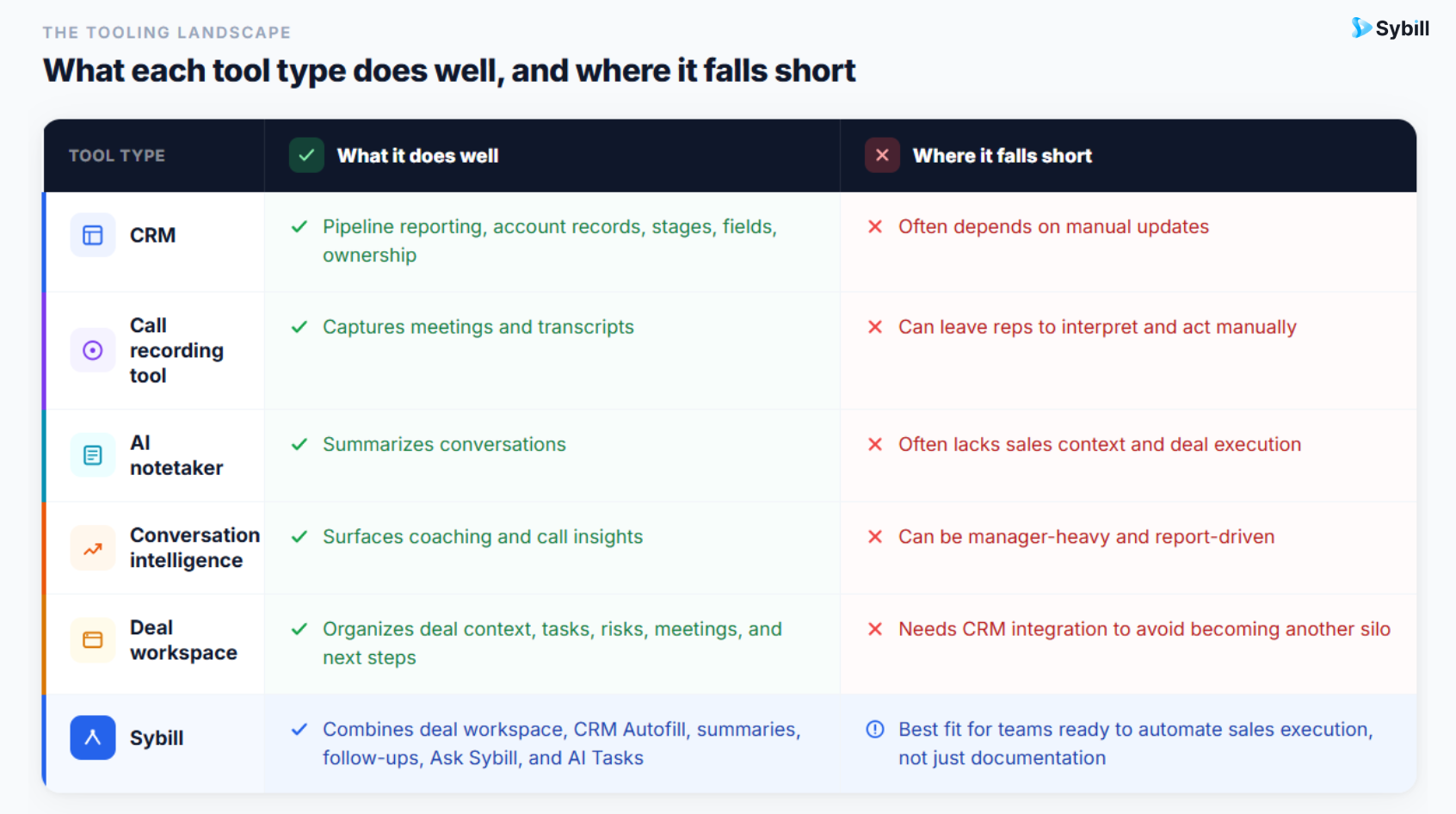
Think of CRM as the official record. Think of an AI deal workspace as the operating room where the deal is actually diagnosed, updated, and moved forward.
Sales managers do not need more dashboard theater. They need deal clarity.
A manager should be able to open a deal and answer:
This is where a single source of truth becomes more than a data hygiene project. It becomes a coaching advantage.
If managers can see deal reality without interrogating reps, one-on-ones become more useful. Forecast calls get cleaner. Coaching gets sharper. Reps stop wasting half the meeting reconstructing history.
For more on follow-through, read Follow Up vs Follow Through.
RevOps should not have to become the CRM police. Nobody joins revenue operations dreaming of chasing “next step” fields like a hall monitor with a spreadsheet.
But RevOps does need to define what clean deal data means.
Standardize:
Then let AI do the repetitive capture work.
This is the healthier model: RevOps defines the structure, AI captures the data, reps validate and act, managers coach, and leadership gets cleaner visibility.
The phrase “single source of truth” sounds tidy. The implementation is where teams get chaotic.
Fields matter. But a deal is not just fields. It is buyer language, stakeholder tension, objections, urgency, and promises.
A transcript is useful evidence. It is not a workflow. Nobody wants to Ctrl+F their way through a deal review.
Reps are not human hard drives. They are running discovery, demos, negotiation, follow-ups, internal updates, and pipeline reviews. Memory is not a system.
If the source of truth helps executives but annoys reps, adoption will be fake. Design it around rep usefulness first.
A logged call tells you something happened. A useful source of truth tells you what changed.
Sybill’s role is simple: it turns scattered buyer and deal context into structured sales execution.
With CRM Autofill, Sybill captures details from meetings and emails and updates CRM automatically. It detects deal signals from calls and emails, including MEDDPICC, BANT, next steps, and competitors.
With Workspace, reps can manage deals, meetings, tasks, risks, blockers, summaries, and activity timelines in one place.
With AI Tasks, Sybill captures to-dos from calls, organizes them into a prioritized task list, and helps complete them.
With Ask Sybill, reps can ask questions about buyer objections, competitors, past conversations, deal risks, and next moves without digging through transcripts or filters. Ask Sybill is a way to find answers from buyer objections to battlecards without context switching.
The result is not just cleaner notes. It is a sales workflow where the CRM stays updated, the deal story stays visible, and the rep can focus on moving the buyer forward.
That is precisely what a single source of truth should do.
Rep memory is impressive. But it’s not a reliable revenue system.
If your team needs to ask the rep what happened in every deal, your source of truth is not your CRM. It is the rep’s brain with a dashboard nearby.
That does not scale. It does not forecast well. It does not help managers coach early. It does not help RevOps trust the data. And it definitely does not help reps after six back-to-back calls when every buyer conversation starts to blur into one long enterprise procurement fever dream.
A real single source of truth for sales deals captures what buyers said, what changed, what matters, what is risky, and what needs to happen next. CRM remains the system of record. Sybill becomes the AI layer that keeps the deal story alive, accurate, and actionable.
Want your CRM to reflect what buyers actually said, not what reps had time to type? Try Sybill’s CRM Autofill and Deal Workspace.
A single source of truth in sales is one trusted place where the team can see accurate and current deal information, including CRM fields, buyer context, stakeholders, objections, risks, next steps, and past interactions.
CRM can be the system of record, but it is not always a complete source of truth if important buyer context still lives in calls, emails, Slack threads, transcripts, and rep memory.
The most reliable way is to use AI-powered CRM automation that extracts key details from sales calls and emails, then updates CRM fields automatically. This reduces manual data entry and improves consistency.
A sales deal workspace should include deal stage, buyer priorities, stakeholders, decision criteria, objections, competitors, risks, next steps, tasks, call summaries, email context, and CRM updates.
Deal data gets scattered because every buyer interaction creates context in a different place. Calls create transcripts, emails create commitments, Slack creates internal decisions, and CRM only gets updated if someone manually enters the information.
AI can capture buyer context, summarize sales conversations, identify deal signals, update CRM fields, surface risks, create follow-ups, and help reps ask questions across deal history.
A single source of truth in sales is one trusted place where the team can see accurate and current deal information, including CRM fields, buyer context, stakeholders, objections, risks, next steps, and past interactions.
CRM can be the system of record, but it is not always a complete source of truth if important buyer context still lives in calls, emails, Slack threads, transcripts, and rep memory.
The most reliable way is to use AI-powered CRM automation that extracts key details from sales calls and emails, then updates CRM fields automatically. This reduces manual data entry and improves consistency.