Find us at booth #83, join us for a harbor side happy hour, or catch Gorish’s talk.

Sept, 16-18 > Learn more


Tamanna Mishra

July 11, 2026
%20(34).png)
Forecast calls are where rep optimism meets revenue reality.
A rep says, “This should close.” A manager asks, “Why?” The CRM says, “Proposal sent.” The buyer has not replied in nine days. Finance was mentioned once. Legal has not joined the thread. The close date is still sitting politely inside this quarter because nobody wants to move it and ruin the mood.
That is not forecasting. That is group astrology with pipeline stages.
A good forecast call should help reps and managers inspect what is real, what is risky, and what needs action before the quarter gets dramatic. But that only works if the team walks into the meeting with evidence. Not vibes. Not “they seemed excited.” Not “I feel good about it.”
This is where AI becomes useful. Not because it can magically predict the future, but because it can pull together the messy deal signals that humans miss when they are drowning in calls, emails, CRM updates, Slack threads, and next-step follow-ups.
A Gartner guide on improving pipeline management and sales forecasting says sales teams need consistent opportunity management, actionable metrics, and qualitative insights to increase confidence in forecasting analytics. That matters because the forecast is not just a number problem. It is a deal-evidence problem.
A forecast call is a recurring sales meeting where reps and managers review expected revenue for a specific period. Usually, they look at deal stage, amount, close date, forecast category, confidence level, and risks.
But a forecast call is not the same as a pipeline review.
A sales pipeline review meeting focuses on deal health, blockers, and next actions. A forecast call focuses on revenue prediction. They are connected, though. If deal health is fuzzy, forecast confidence is fiction.
The best forecast calls answer three questions:
The weak ones answer a fourth question nobody asked: “How creative can we get with optimism?”
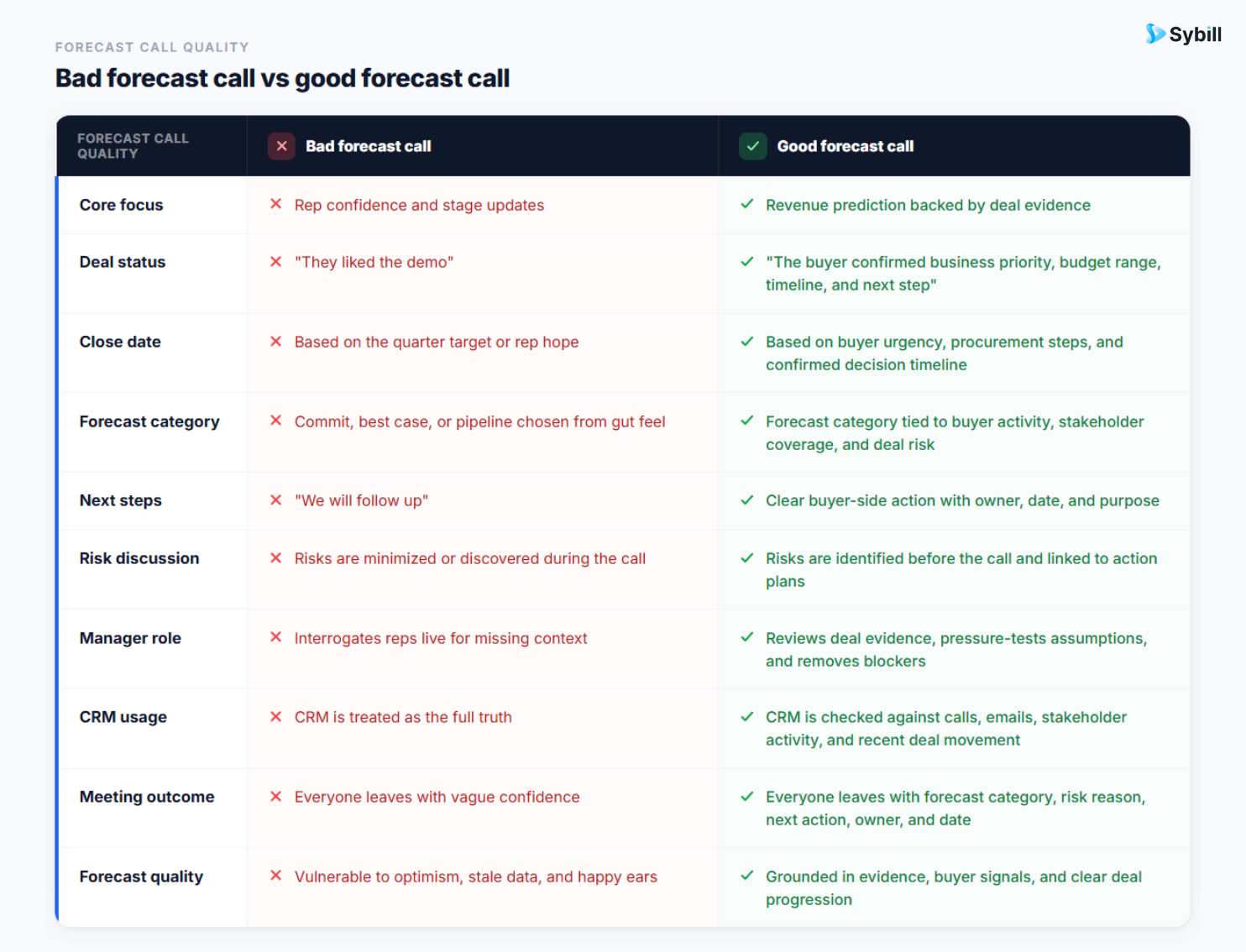
Most forecast calls do not fail during the meeting. They fail before anyone joins the Zoom.
Rep memory matters. It helps sellers understand tone, nuance, and buyer politics. But memory is not a forecast system.
Deals move across discovery calls, demos, pricing conversations, security reviews, procurement threads, internal buyer meetings, CRM notes, and follow-up emails. No rep should be expected to hold every buyer concern, stakeholder name, objection, decision criterion, and next step in their head.
That is how teams end up with summaries like “they liked the demo” or “waiting on legal.” Both sound fine until you ask: Who liked the demo? What did legal ask for? Who owns the next step? What happens if the review slips by a week?
A CRM can be technically complete and still strategically useless.
The stage can be updated. The amount can be correct. The close date can be this quarter. The forecast category can say commit. But if the deal story is weak, the forecast is still fragile.
Weak deal story:
“They asked for pricing and said they would circle back.”
Strong deal story:
“The VP of Sales wants to cut rep admin before Q4 onboarding. RevOps needs CRM field mapping confirmed by Friday. Finance has approved the budget range, but procurement needs vendor security docs before contract review.”
See the difference? One is a shrug in a blazer. The other is evidence.
If the first serious deal inspection happens during forecast review, the manager is already late.
By then, it may be too late to multi-thread, rebuild urgency, loop in finance, clarify procurement, or fix a weak business case. A forecast call should validate deal truth. It should not be the first time anyone asks whether the economic buyer exists.
For a deeper risk framework, read our guide on how to spot deal risk before forecast review.
Think of forecast prep as deal inspection with a deadline. Before the call, every rep and manager should review six things.

Deal risk usually shows up before the deal slips. The problem is that teams often notice it only after the forecast has already been embarrassed.
Look for signals like:
No confirmed next step.
No buyer-owned urgency.
No economic buyer.
Champion going quiet.
Close date moved more than once.
Competitor mentioned late in the cycle.
Pricing concern brushed aside.
Legal or security review has no clear owner.
Procurement appears suddenly and nobody knows the process.
Our guide on identifying at-risk deals before they slip is a good read because it frames risk as a set of observable signals, not manager intuition.
A next step is not “follow up next week.” That is a calendar placeholder pretending to be sales execution.
A real next step has five things:
A date.
An owner.
A purpose.
A buyer-side action.
A clear consequence if it does not happen.
Weak next step: “They will get back to us.”
Strong next step: “Priya from RevOps will send current CRM field mapping by July 10 so we can confirm implementation scope before the procurement call.”
Forecast confidence improves when the next step belongs to the buyer, not just the rep.
A close date is credible only when it is connected to buyer reality.
Before a forecast call, ask:
Why this date?
Who on the buyer side needs this done by then?
What business event is driving the timeline?
What steps must happen before signature?
Has the buyer confirmed that sequence?
What could delay the date?
A close date without buyer urgency is just a calendar-shaped wish.
According to Forrester’s 2026 State of Business Buying research, the typical buying decision now includes 13 internal stakeholders and nine external influencers, with even larger groups for complex purchases. That means the person who likes your product is often not the whole deal. They may not even be the most important person in the deal.
Before forecast review, inspect the stakeholder map.
Who is the champion?
Who owns the budget?
Who signs?
Who can block the deal?
Who uses the product?
Who cares if nothing changes?
Who has gone quiet?
Who keeps appearing in email threads but has never joined a call?
Stakeholder gaps are forecast gaps. If the buying committee is bigger than your relationship map, your forecast needs humility.
“Pricing came up” is not enough detail.
Pricing concerns need diagnosis. Is the buyer comparing you with a cheaper competitor? Does procurement need a standard discount? Is the champion struggling to sell the value internally? Is there no budget? Is the business case weak? Is the pricing concern actually a risk concern in disguise?
A pricing objection with a clear owner, next step, and value narrative is manageable. A pricing objection floating in the CRM with no context is a late-stage jump scare.
Forecast calls get cleaner when urgency belongs to the buyer.
Weak urgency: “We want to close them this month.”
Strong urgency: “Their new SDR cohort starts August 12, and they need call summaries and CRM updates live before onboarding.”
The difference is massive. One is seller hope. The other is buyer pressure.
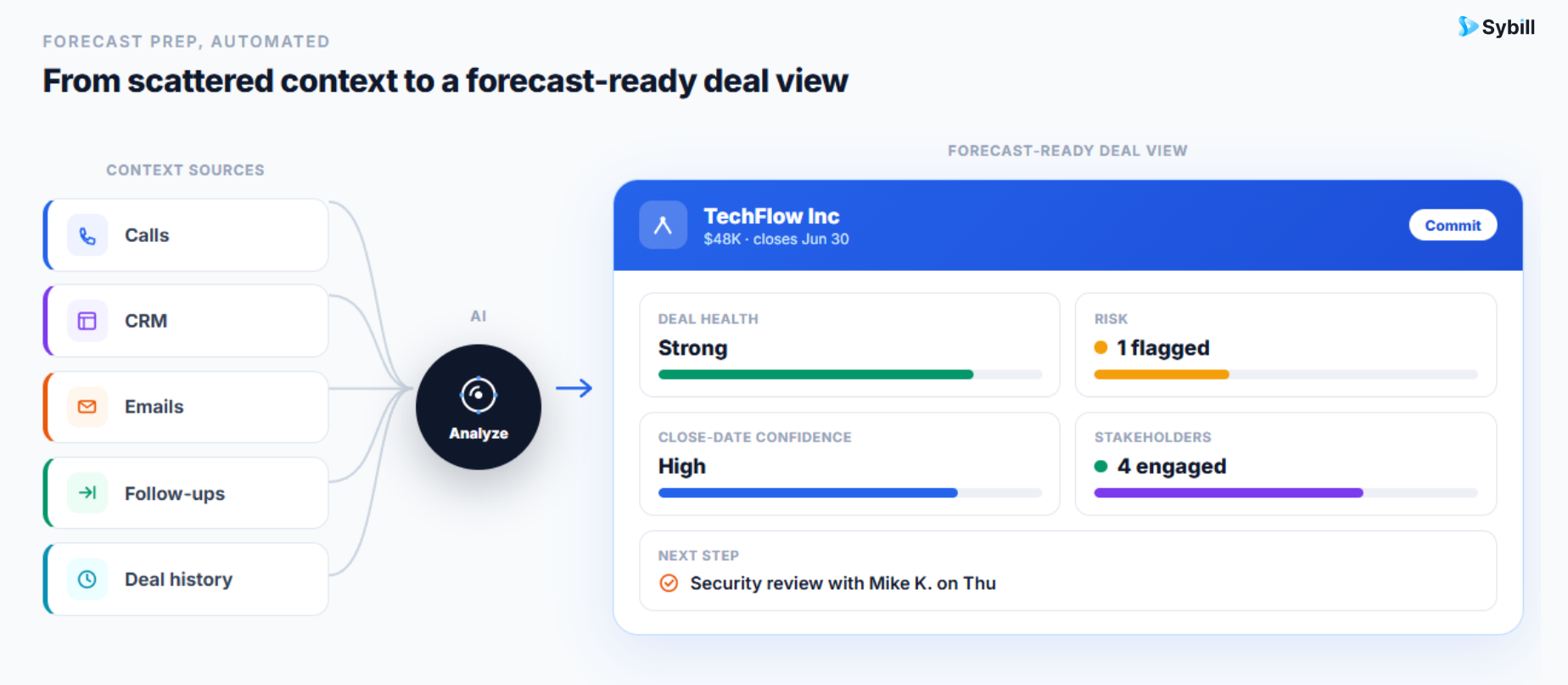
AI helps forecast prep by turning scattered sales activity into usable deal evidence.
It can summarize calls, extract objections, identify decision criteria, capture next steps, detect stakeholder mentions, flag pricing concerns, and connect recent conversations to prior deal history.
That is the useful version of AI. Not a shiny forecast oracle. A deal-inspection assistant that helps reps and managers ask better questions before the forecast call starts.
Salesforce defines revenue intelligence as using data and AI to uncover risks and opportunities across the sales pipeline so teams can act on insights and improve forecasts. That is the right frame here: AI is valuable when it improves the quality of the underlying deal inspection, not when it just adds another dashboard to stare at.
This is where Sybill shows up. Sybill is not just a note-taker sitting quietly in the corner of your calls. It helps capture meeting context, update CRM fields, organize deal history, draft follow-ups, and answer deal questions using real sales data.
That matters because forecast prep is only as strong as the deal context underneath it.
AI does not replace sales judgment. It replaces avoidable blindness.
The real comparison is not “human forecast versus AI forecast.” It is manual prep versus workflow-native intelligence.
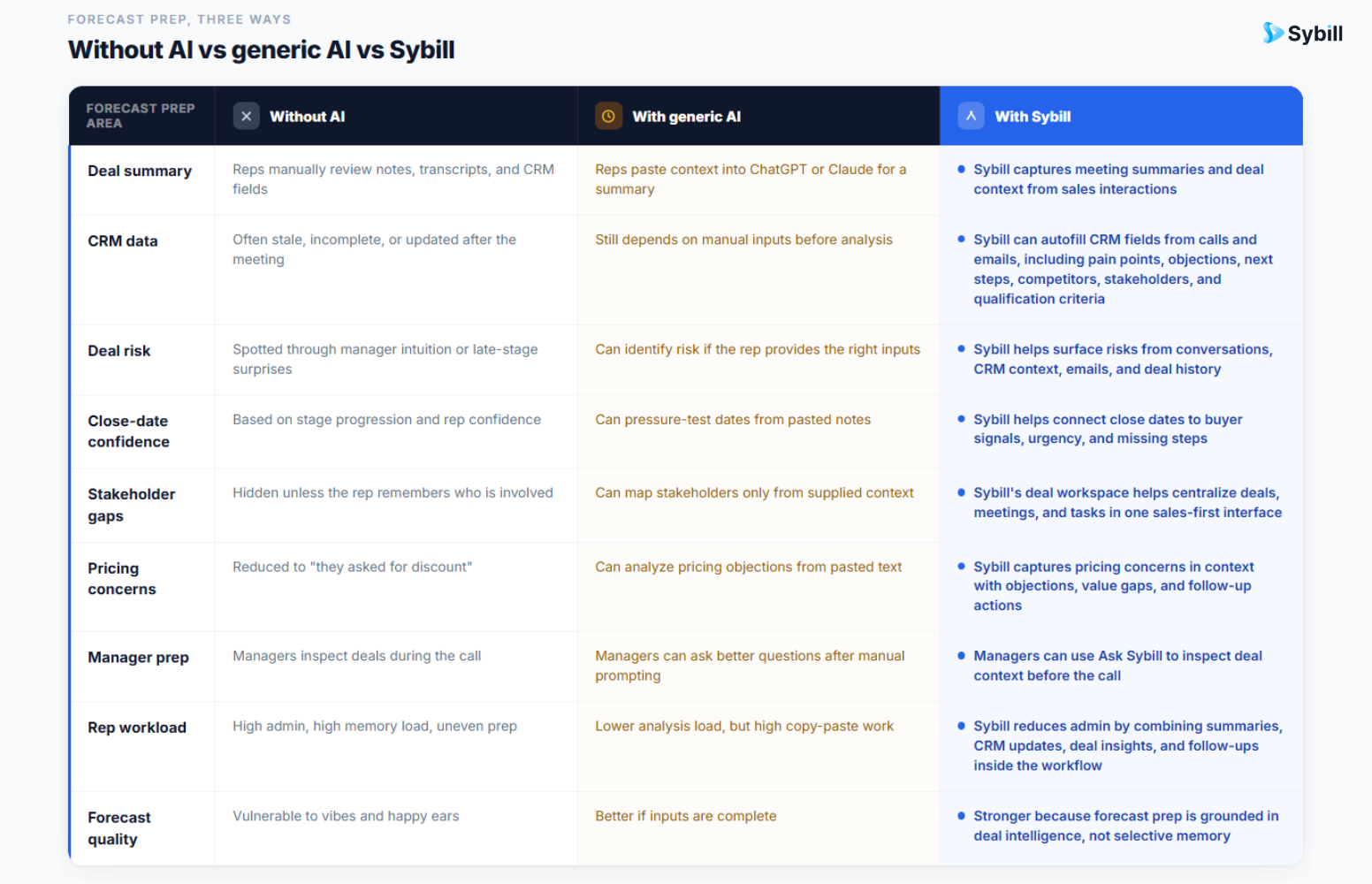
Generic AI can be useful. A rep can ask ChatGPT or Claude to analyze a deal, pressure-test a close date, summarize risks, or draft manager talking points. But generic AI only knows what the rep gives it.
That means the rep still has to gather transcripts, CRM fields, emails, pricing notes, stakeholder names, and previous call context. Congrats, you automated the analysis but kept the homework.
Sybill is stronger for forecast prep because it sits closer to the sales workflow. It captures the context as work happens. It connects calls, emails, CRM, follow-ups, tasks, and deal history. Ask Sybill uses sales data from calls, CRM, emails, and calendars to answer deal questions, which makes it far more useful for pre-forecast inspection than a blank chatbot waiting for a paste dump.
For a broader comparison, read ChatGPT vs Claude vs Sybill for sales workflows.
Use this workflow before every forecast call. Reps can use it to prepare their deal narrative. Managers can use it to inspect pipeline before they walk into the meeting.
Start with movement.
Which deals moved stages?
Which deals had meaningful buyer activity?
Which deals went quiet?
Which close dates changed?
Which stakeholders were added?
Which objections appeared?
Which commit deals have not changed at all?
That last one matters. A deal sitting still inside commit is not stability. It may be a mannequin in a pipeline jacket.
Every commit deal should have evidence, not just confidence.
Check:
Confirmed next step.
Buyer-owned urgency.
Known economic buyer.
Clear procurement path.
Budget status.
Legal or security status.
Competition.
Pricing risk.
Last meaningful buyer engagement.
Manager intervention needed.
If a commit deal has no confirmed next step, no economic buyer, and no buyer urgency, it should not be in commit. It should be in “please investigate before finance notices.”
Ask AI to help pressure-test the close date based on actual deal context.
Try questions like:
What evidence supports this close date?
What buyer-side steps still need to happen?
Which stakeholder could delay signature?
What has changed since the close date was last updated?
What risk could push this into next quarter?
The point is not to punish reps for being optimistic. The point is to separate justified confidence from quarter-end fan fiction.
Managers should not spend forecast calls interrogating every detail from scratch. They should arrive knowing where they can help.
Manager intervention may be needed when:
The champion needs help selling internally.
Finance has not been engaged.
Procurement is unclear.
Security review is delayed.
Pricing needs value reframing.
Executive alignment is missing.
The buyer has gone quiet after a strong meeting.
This is where AI helps managers move from inspection to coaching.
Every reviewed deal should end with:
Forecast category.
Confidence level.
Risk reason.
Next action.
Owner.
Date.
Manager support needed.
A forecast call without next actions is just a weather report. Interesting, maybe. Useful, no.
Reps should walk into forecast review ready for sharper questions.
What changed in this deal since the last forecast call?
Why is this deal in commit, best case, or pipeline?
What evidence supports the close date?
Who is the economic buyer?
Who is missing from the buying committee?
What is the buyer’s business reason to act now?
What pricing concern has been raised?
What could make this deal slip?
What is the next buyer-side action?
What do you need from your manager?
The best reps do not just defend a number. They explain the deal.
Managers should use forecast calls to inspect assumptions, not perform confidence theatre.
Ask:
What buyer action supports this forecast category?
What risk are we underestimating?
What has not changed since last week?
Who needs to be multi-threaded?
Where are we relying too much on the champion?
What is the real procurement path?
What evidence would make us downgrade this deal?
What can I do this week to improve close probability?
The goal is not to catch reps out. It is to catch deal risk early enough to do something about it.
Sybill helps forecast prep by improving the quality of the deal data teams bring into the meeting.
Forecast prep starts with accurate meeting context. Sybill’s AI call summaries help reps and managers understand what happened in buyer conversations without digging through every transcript.
Good summaries should capture outcomes, pain points, objections, next steps, competitor mentions, stakeholder roles, and decision criteria. Not just “good call.”
Forecasts break when CRM data lags behind buyer reality.
Sybill’s CRM automation can push structured call summaries and update fields from conversations, including pain points, objections, next steps, competitor mentions, stakeholder details, and qualification criteria.
That means forecast prep does not depend on reps doing a Friday afternoon CRM cleanup while their soul leaves the building.
Instead of hunting across transcripts, emails, CRM notes, and Slack threads, reps need one place to understand what is happening in a deal.
Sybill’s deal workspace is built to help AEs manage deals, meetings, and tasks in one sales-first interface.
That makes it easier to prepare a real deal narrative before forecast review.
Ask Sybill can help reps and managers query deal context in natural language.
Examples:
Which commit deals mentioned pricing concerns this week?
Which late-stage deals have no next step?
Which deals have no economic buyer?
Which close dates moved more than once?
Which deals went quiet after proposal?
Which deals need manager intervention before Friday?
This is the difference between “let me search six places” and “ask the deal system what is going on.”
Managers need to see patterns before the call, not discover them live.
Sybill dashboards can help managers review pipeline movement, deal velocity, account health, stakeholder engagement, activity trends, and deal risk before forecast review. That makes the call sharper because the manager is not starting from a blank screen and a prayer.
Forecast prep is pointless if the next action does not happen.
If AI surfaces that pricing is unresolved, the buyer is missing finance, or the next step is vague, the rep needs to act. Sybill’s AI follow-ups help turn deal inspection into buyer-facing action, so forecast review does not become a museum of problems everyone politely observed.
[Body image idea: Create a manager dashboard view showing priority deals sorted by forecast risk: no next step, missing economic buyer, pricing concern, close date not validated, and no recent buyer activity.
Alt text: Prepare for a forecast call using AI with a manager dashboard showing at-risk deals, stakeholder gaps, and close-date confidence.]
AI cannot fix missing context. If all it sees is “proposal sent,” the output will be shallow. Better inputs create better inspection.
AI should support sales judgment, not replace it. Managers still need to inspect assumptions, challenge weak reasoning, and decide where to intervene.
If reps have to collect context from six systems and paste everything into a chatbot, the workflow will not scale. It may help one very organized rep. It will not transform forecast discipline across a team.
Forecasting is not only stage, amount, and probability. Buyer urgency, stakeholder coverage, objections, pricing concerns, and engagement all matter. Gartner specifically recommends enhancing forecasting analytics with qualitative insights, which is exactly where conversation intelligence and deal context become valuable.
A forecast call should not feel like courtroom testimony where every rep defends their optimism under pressure.
It should feel like a clean inspection of reality.
AI helps teams stop asking, “How do we feel about this deal?” and start asking, “What does the evidence say?”
Sybill makes that shift practical because it does not just give you another forecast dashboard. It improves the quality of the deal data underneath the forecast: call summaries, CRM updates, stakeholder context, deal risks, next steps, pricing concerns, follow-ups, dashboards, and natural-language deal inspection.
That is how forecast calls get sharper. Less theatre. More truth. Better calls.

Prepare by reviewing deal stage, amount, close date, forecast category, buyer activity, next steps, stakeholder coverage, pricing concerns, and deal risks. The strongest forecast prep uses evidence from calls, emails, CRM updates, and buyer actions rather than rep opinion alone.
AI can help by analyzing sales conversations, CRM data, engagement signals, deal history, and buyer activity to surface risks, next steps, stakeholder gaps, and close-date confidence. It helps teams prepare better forecast calls by making deal inspection faster and more evidence-based.
Managers should ask what changed, what evidence supports the close date, who the economic buyer is, what risks remain unresolved, what buyer action happens next, and what support the rep needs to move the deal forward.
A pipeline review focuses on deal health, next actions, and risk removal. A forecast review focuses on expected revenue, close timing, and forecast category. Good pipeline inspection improves forecast accuracy.
No. AI can surface deal evidence, risks, and patterns faster, but managers still need to apply judgment, coach reps, inspect assumptions, and decide where to intervene.
Prepare by reviewing deal stage, amount, close date, forecast category, buyer activity, next steps, stakeholder coverage, pricing concerns, and deal risks. The strongest forecast prep uses evidence from calls, emails, CRM updates, and buyer actions rather than rep opinion alone.
AI can help by analyzing sales conversations, CRM data, engagement signals, deal history, and buyer activity to surface risks, next steps, stakeholder gaps, and close-date confidence. It helps teams prepare better forecast calls by making deal inspection faster and more evidence-based.
Managers should ask what changed, what evidence supports the close date, who the economic buyer is, what risks remain unresolved, what buyer action happens next, and what support the rep needs to move the deal forward.