Find us at booth #83, join us for a harbor side happy hour, or catch Gorish’s talk.

Sept, 16-18 > Learn more

%20(1).avif)
Mamta Tainwala

July 13, 2026
%20(36).png)
Effective sales training combines four elements: a needs analysis that identifies real skill gaps, a curriculum built on your own call data, interactive practice like role-play and live call review, and continuous feedback tied to deal outcomes. Teams that train on recorded conversations instead of hypotheticals ramp faster and retain more, because the material is their own pipeline, not a slide deck.
That is the whole playbook in one paragraph. The rest of this guide is how to actually pull it off without your reps checking Slack under the table.
Most sales training fails because it is generic, disconnected from real deals, and never reinforced. Research on training retention consistently shows that learners forget the majority of new material within weeks without reinforcement. A one-off workshop with no follow-up call review, no coaching cadence, and no connection to live pipeline is a team-building event, not training.
Let us be adults for a second. You have sat through that workshop. The facilitator with the flipchart. The "sell me this pen" icebreaker. The binder nobody opens again.
The problem is not that your reps cannot learn. It is that the training was never designed around what they specifically do wrong. A rep who crushes discovery but fumbles objection handling does not need a full-funnel bootcamp. She needs two focused hours on objections, using recordings of her own calls where the deal went sideways.
Generic training treats your team like an average. Your team is not an average. It is a specific collection of specific gaps, and until you know what those gaps are, every training dollar is a coin flip.
A complete sales training program includes four components: a needs analysis to identify individual skill gaps, a structured curriculum that builds progressively, interactive learning through role-play and real call review, and ongoing assessment with actionable feedback. Skip any one of these and retention drops sharply, because reps learn by doing and improve by being corrected.
Here is how each one works in practice.
Before you book a facilitator or build a deck, figure out what is actually broken. Not what you assume is broken. What the data says.
Pull three sources:
Performance metrics. Win rates by stage, average deal cycle, discovery-to-demo conversion. If deals die at the proposal stage across the team, that is a negotiation and value-articulation gap, not a prospecting one.
Call recordings. This is where the truth lives. Listen to how your reps handle pricing pushback, how much they talk versus listen, whether they actually confirm next steps. Tools with coaching and performance analytics surface these patterns across every rep automatically, so you are diagnosing from evidence, not from the two calls you happened to shadow.
The reps themselves. Ask them where they feel shaky. Reps usually know. They just do not volunteer it in a team meeting.
Structure the curriculum so each session builds on the last. A common pattern is a six-week onboarding arc: product and ICP in weeks one and two, discovery and qualification in weeks three and four, demo and objection handling in weeks five and six, ending with the rep delivering a full mock demo.
Two rules that separate curricula that stick from curricula that evaporate:
Use your own deals as case studies. A deal inspection view of a real won deal and a real lost deal teaches more in 30 minutes than a hypothetical ever will. Reps remember stories about accounts they recognize.
Connect every module to a number. If a session on discovery does not tie back to discovery-to-demo conversion, reps will treat it as optional. Your team has targets, not vibes. Train to the targets.
Nobody ever got better at sales by watching slides. The formats that actually build skill:
Role-play with teeth. Rep plays seller, manager plays a specific buyer persona from your actual ICP, complete with the objections your buyer intelligence shows coming up most often. Record it. Review it.
Live call review. Pull a real recorded call, pause it at decision points, and ask the room: what would you say next? Then play what the rep actually said. This is the single highest-leverage training format in existence, and it costs nothing if you are already recording calls.
Film room for winners. Build a library of your best calls, snipped into moments: the perfect pricing pivot, the discovery question that unlocked the deal. Sharing and collaboration features let managers clip and circulate these in minutes. New reps ramp on how your best people actually sell, not on how the playbook says they should.
Peer teaching. Have your top objection handler run the objection session. Reps trust reps.
Training without assessment is content. Assessment options that work:
Feedback should land within 48 hours of the behavior. A coaching note delivered three weeks later about a call the rep barely remembers is noise.
Sybill sits in every call so your training writes itself. Magic summaries, talk-time analytics, and coaching insights from real conversations, automatically. Start free and see what your team's calls have been trying to tell you.
Reps tolerate workshops that respect their time and hate ones that do not. Keep sessions to half days maximum, schedule breaks every 60 to 70 minutes so reps can check on live deals, open with a check-in that surfaces individual goals, and close with each rep committing to one specific behavior change. Relevance and brevity beat production value every time.
A few field-tested mechanics:
Check-in, check-out. Open every session by asking each rep what they want out of it. Close by asking what one thing they will do differently on their next call. This is not kumbaya. It is accountability with witnesses.
Protect their pipeline. Reps are laser-focused on selling, and pulling them off live deals for a full day creates resentment before slide one. Half-day blocks, or start early and release by 2 PM so they can run follow-ups. Better yet, let AI handle the follow-ups and CRM updates during training days so nothing rots while they learn.
Split tracks by tenure. A five-year enterprise AE and a month-two SDR should not sit through the same session. Novices need process. Veterans need edge cases and deal strategy. Mixing them bores one group and drowns the other.
End with a live application. The last 30 minutes of any workshop should be reps applying the material to a deal currently in their pipeline. Pull up the deal workspace, pick a stuck opportunity, and workshop it with the new framework. Now the training has a deal attached to it, and deals get remembered.
AI transforms sales training from opinion-based to evidence-based. Conversation intelligence platforms record and analyze every call, surface coaching moments automatically, track behavior change across weeks, and let reps self-coach against their own recordings. Managers stop guessing which reps need help with what, because the data shows exactly where each rep wins and stalls.
This is the part most training guides written before 2024 completely miss, so pay attention.
Traditional coaching had a coverage problem. A manager with eight reps can shadow maybe three calls a week. That is a rounding error against the hundreds of conversations the team runs. Every coaching decision was based on a tiny, biased sample.
Conversation intelligence removes the sample problem. When every call is recorded, summarized, and analyzed, you can:
Diagnose at scale. Ask a question across your whole call library with Ask Sybill: "Which reps are getting pricing objections, and how are they responding?" Sybill has analyzed thousands of sales conversations, and the pattern is consistent: the gap between what managers think happens on calls and what actually happens is enormous.
Coach asynchronously. Managers review magic summaries instead of full recordings, spot the moment worth coaching, clip it, and send it with a note. Fifteen minutes of manager time per rep per week, instead of the four hours full call review would take.
Enable self-coaching. Give reps a personal coach view of their own calls: talk ratio, question counts, engagement signals. Most reps course-correct on their own once they see the tape. Nobody wants to be the rep with an 80 percent talk ratio.
Prep with intelligence. Training does not stop at the workshop. Pre-meeting briefs put the account context, past objections, and open threads in front of the rep before every call, which is just-in-time training in its most usable form.
For a deeper build-out of this approach, we wrote a full guide on coaching sales reps with AI.
Measure sales training against behavior change and revenue outcomes, not attendance or satisfaction scores. Track leading indicators like talk ratio, discovery question count, and objection handling quality from call recordings, then lagging indicators like stage conversion, win rate, and ramp time. If a metric did not move within one to two quarters, redesign the training.
The measurement ladder, from weakest to strongest:
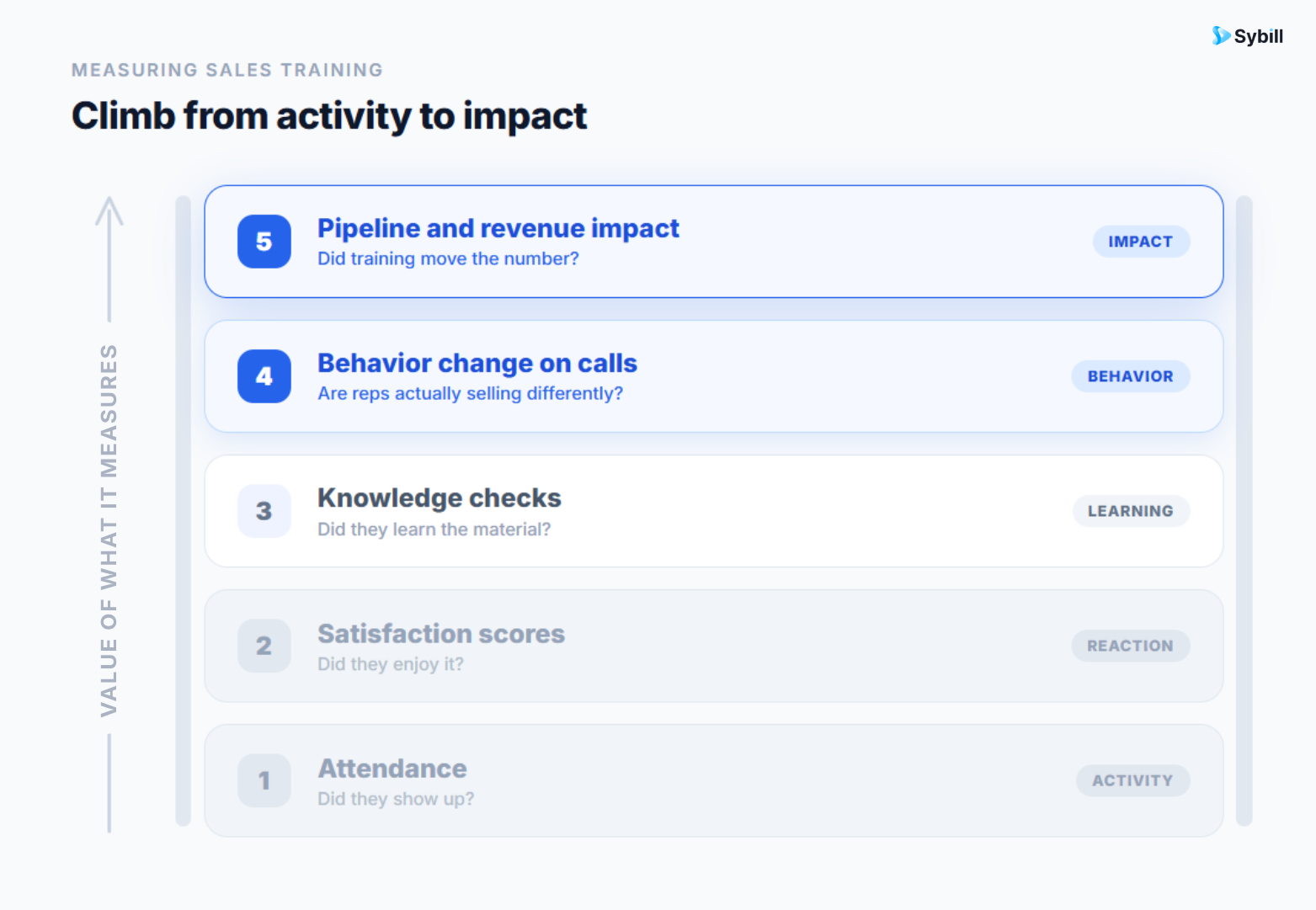
Sales leaders reviewing this quarterly alongside their pipeline view will know within two quarters which training investments pay and which are theater. Cut the theater.
A practical 90-day rollout: spend weeks one to two on needs analysis using call data and performance metrics, weeks three to four designing the curriculum around the top three gaps, weeks five to ten running biweekly interactive sessions with call review between them, and weeks eleven to thirteen measuring behavior change and iterating. Small, continuous, and evidence-based beats one big annual event.
Week-by-week:
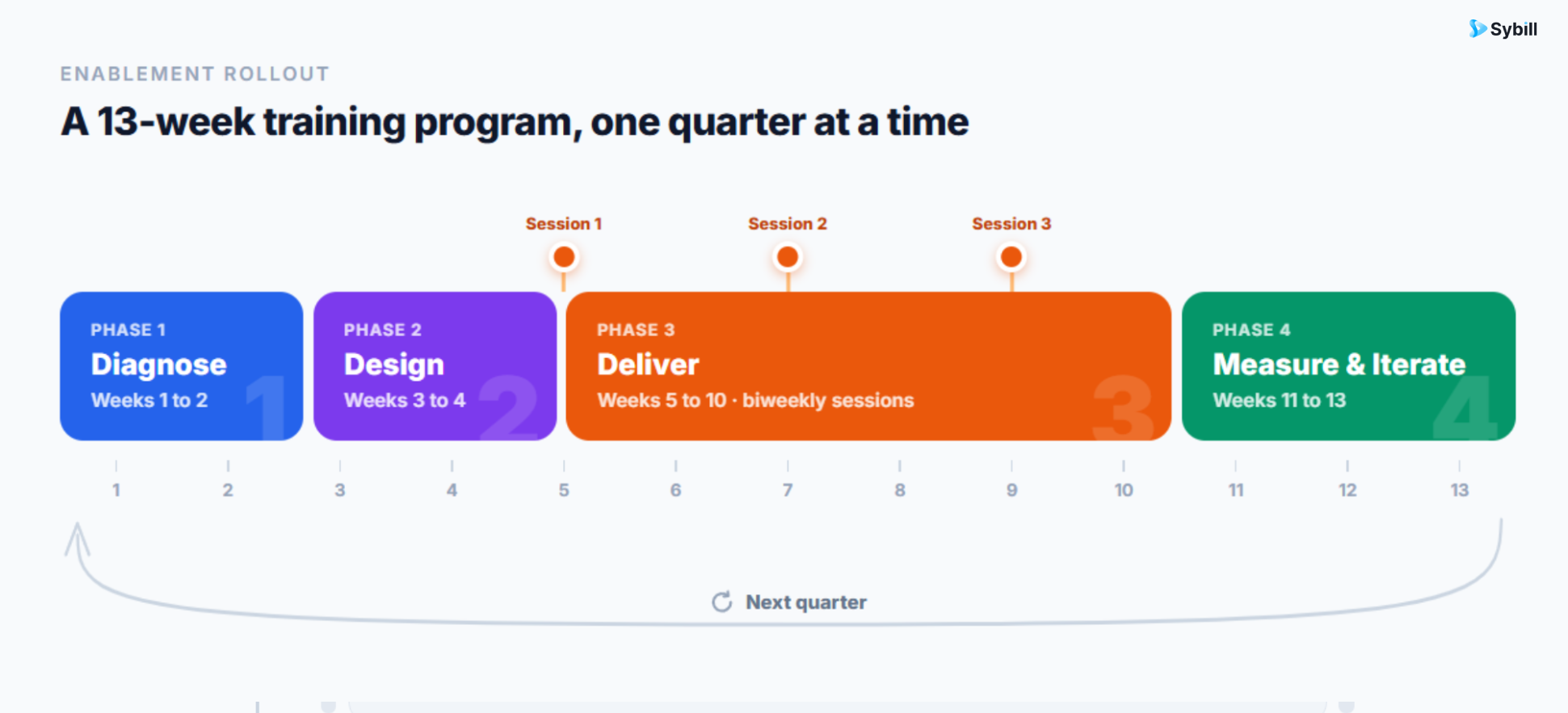
Weeks 1 - 2: Diagnose. Review call analytics, stage conversion data, and rep self-assessments. Pick the three gaps with the biggest revenue impact. Not five. Three.
Weeks 3 - 4: Design. Build sessions around real recorded calls and live deals. Recruit your top performers as co-facilitators.
Weeks 5 - 10: Deliver. One half-day session every two weeks. Between sessions, reps apply the skill on live calls, and managers review the recordings for evidence it stuck. This is the reinforcement loop that one-off workshops never have.
Weeks 11 - 13: Measure and iterate. Compare call behavior and conversion metrics against your week-one baseline. Double down on what moved. Kill what did not.
Then run it again next quarter with the next three gaps. Training is not an event. It is an operating rhythm.
Here is the uncomfortable truth this entire guide builds toward: your training program is only as good as your visibility into what reps actually do on calls. No visibility, no diagnosis. No diagnosis, generic training. Generic training, forgotten in 90 days.
The fix is not a bigger training budget. It is making every conversation a training asset.
Sybill records, summarizes, and analyzes every sales call, then turns that into coaching insights, follow-ups, and CRM updates automatically. Your managers coach from evidence. Your reps learn from their own tape. Your RevOps team finally gets training metrics that connect to revenue.
Workshops teach your reps what good looks like. Sybill shows them, on their own calls, every single day.
Start your free trial or book a demo and turn your call library into your best trainer.
Continuously, not annually. High-performing teams run short training touchpoints weekly or biweekly: call reviews, film sessions, and micro-workshops. Formal deep-dive training works best quarterly, targeted at the specific gaps your call data and conversion metrics reveal that quarter.
Most B2B teams target 30 to 90 days from hire to first self-run demo, depending on deal complexity. Structured programs with call libraries and recorded examples consistently ramp reps faster than shadow-only onboarding, because new hires learn from dozens of real calls instead of the handful they happen to sit in on.
Training builds skills in structured sessions, usually in groups. Coaching reinforces and personalizes those skills one-on-one, based on the rep's actual performance. Training without coaching fades within weeks. The strongest programs use call recordings as the bridge: train the skill, then coach it from real conversations.
Both, in sequence. Role-play builds muscle in a safe environment, and real call review shows how the skill performs under live pressure. Teams using conversation intelligence get the best of both: role-plays informed by real objection data, and call reviews that confirm the training stuck.
No. AI replaces the busywork around training: finding coachable moments, tracking behavior change, generating summaries, and handling follow-ups so reps have time to learn. Human trainers and managers still drive skill-building, deal strategy, and motivation. AI just makes their coaching evidence-based instead of anecdotal.
Continuously, not annually. High-performing teams run short training touchpoints weekly or biweekly: call reviews, film sessions, and micro-workshops. Formal deep-dive training works best quarterly, targeted at the specific gaps your call data and conversion metrics reveal that quarter.
Most B2B teams target 30 to 90 days from hire to first self-run demo, depending on deal complexity. Structured programs with call libraries and recorded examples consistently ramp reps faster than shadow-only onboarding, because new hires learn from dozens of real calls instead of the handful they happen to sit in on.
Training builds skills in structured sessions, usually in groups. Coaching reinforces and personalizes those skills one-on-one, based on the rep's actual performance. Training without coaching fades within weeks. The strongest programs use call recordings as the bridge: train the skill, then coach it from real conversations.