Find us at booth #83, join us for a harbor side happy hour, or catch Gorish’s talk.

Sept, 16-18 > Learn more


Tamanna Mishra

September 11, 2026

A buyer says, “We tried something similar last year and it went nowhere.”
One seller hears a competitive objection and immediately explains why this product is different.
Another hears a warning about a failed change initiative and asks what went wrong last time.
Only the buyer knows which interpretation is correct. The better listener is the one who checks.
That is the difference between simply hearing a customer and listening with empathy.
Empathetic listening in sales means noticing what a buyer says, processing the business and human meaning, testing whether your interpretation is accurate and responding in a way that demonstrates understanding.
It is not agreement, sympathy or mind-reading. It is a disciplined way to reduce misunderstanding before it turns into irrelevant discovery, weak positioning, hidden objections or a deal that was never as healthy as it appeared.
Empathetic listening in sales combines attention, interpretation and verification. A seller listens for the buyer’s words, context and concerns, processes what those signals may mean, then reflects the interpretation back so the buyer can confirm or correct it.
The research-backed Active Empathic Listening model describes three stages: sensing, processing and responding. Strong sellers use all three. They do not label emotions as facts, rely on canned empathy phrases or treat silence as proof of understanding.
AI can preserve context and reduce administrative distraction. The judgment and care still have to come from the seller.
Empathy is often discussed as if it were a personality trait that makes a seller pleasant to talk to.
That is a very low bar.
A seller can be warm, patient and completely wrong about what the buyer needs.
The commercial value of empathy comes from accuracy. It helps the seller understand:
Misunderstanding any of these can be expensive.
A rep may demonstrate the wrong capabilities because they misunderstood the use case. They may treat an implementation concern as a pricing objection. They may believe an enthusiastic user has buying authority. They may record a compelling event in the CRM when the buyer has merely mentioned a preferred date.
The meeting still happened. The notes may look complete. The opportunity may even advance a stage.
The buyer reality is somewhere else.
Empathetic listening helps close that gap. It slows the seller down long enough to distinguish what the buyer said from what the seller hopes it means.
Empathetic listening in sales is the practice of listening for both the content and meaning of a buyer’s message, considering the situation from the buyer’s perspective, and responding in a way that lets the buyer verify whether they have been understood accurately.
Academic literature often uses the term active empathic listening, while general business content frequently uses empathetic listening. Both refer to a similar idea: active listening combined with perspective-taking and genuine concern for the speaker’s experience.
The important word is not “emotional.” It is “accurate.”
A seller does not need to experience the same problem as the buyer. They do not need to agree with every conclusion. They need to listen without forcing the buyer’s situation into a predetermined sales narrative.
Active listening and empathetic listening overlap, but they are not identical. Active listening focuses on attention, comprehension and confirmation. Empathetic listening adds an effort to understand what the situation means from the buyer’s perspective.
Reflective listening can be one technique within empathetic listening. Repeating or paraphrasing a statement, however, does not automatically prove that the seller understands its significance.
A buyer says:
“Our managers spend hours preparing for pipeline reviews.”
A factual paraphrase would be:
“Your managers spend a lot of time preparing for pipeline reviews.”
An empathetic interpretation might be:
“It sounds like the preparation burden is frustrating, but the larger concern may be that managers still do not trust the information when the review begins. Is that fair?”
The second response moves beyond repetition. It also leaves room for correction.
The role of empathy in sales is to help sellers understand the buyer’s situation accurately enough to conduct better discovery, respond to concerns, adapt the value case and guide the buying process without imposing assumptions.
Research supports the connection between empathy, listening and relationship quality.
A peer-reviewed study, Salesperson Empathy and Listening: Impact on Relationship Outcomes, tested a model using responses from 162 buyers across different business organizations.
The researchers found strong positive relationships between salesperson empathy and:
Listening was also positively related to trust and satisfaction. Trust and satisfaction were then related to expectations of future interaction.
The study does not prove that one empathetic response increases close rates by a predetermined percentage. It provides a more credible and useful conclusion: buyers’ perceptions of seller empathy and listening are connected to the quality of the buyer-seller relationship.
A Baylor University summary of sales-listening research explains the buyer perspective succinctly:
“Buyers identified empathetic listening behaviors as key to the development of long-term buyer-seller relationships.”
In practice, empathy supports several parts of the sales process.
Discovery becomes more useful when sellers explore the meaning and consequences of an answer rather than moving mechanically through a question list.
Suppose the buyer says:
“Updating the CRM is not really a priority for our reps.”
A seller could record “low CRM adoption” and proceed to the next question.
An empathetic listener might ask:
“What do reps believe they are being asked to give up when they update it?”
That question explores the buyer’s experience of the problem. The answer could reveal administrative burden, poor management behavior, distrust of the data or a workflow that was designed without rep input.
Buyers do not always state their strongest concern directly.
“We need to think about implementation” could mean:
Empathy does not allow the seller to select one explanation and treat it as fact. It helps the seller recognize the possible significance and ask a better question.
A value proposition is relevant only if it connects to an outcome the buyer values.
The same product capability can matter differently to different stakeholders:
Empathetic listening helps the seller understand those differences without fragmenting the account into unrelated pitches.
Sellers are often trained to respond to objections quickly. That speed can prevent them from understanding the objection.
When a buyer says, “This is too expensive,” the concern could relate to:
An empathetic response acknowledges the concern and investigates it:
“It sounds like the current value case does not justify the investment yet. Which part feels least convincing?”
The seller has not agreed to discount. They have made the objection more precise.
Different stakeholders can interpret the same initiative in conflicting ways.
One person sees automation. Another sees loss of control. One sees better visibility. Another sees additional scrutiny. One sees faster execution. Another sees implementation risk.
Empathy allows the seller to understand these perspectives without assuming that one enthusiastic contact represents the entire account.
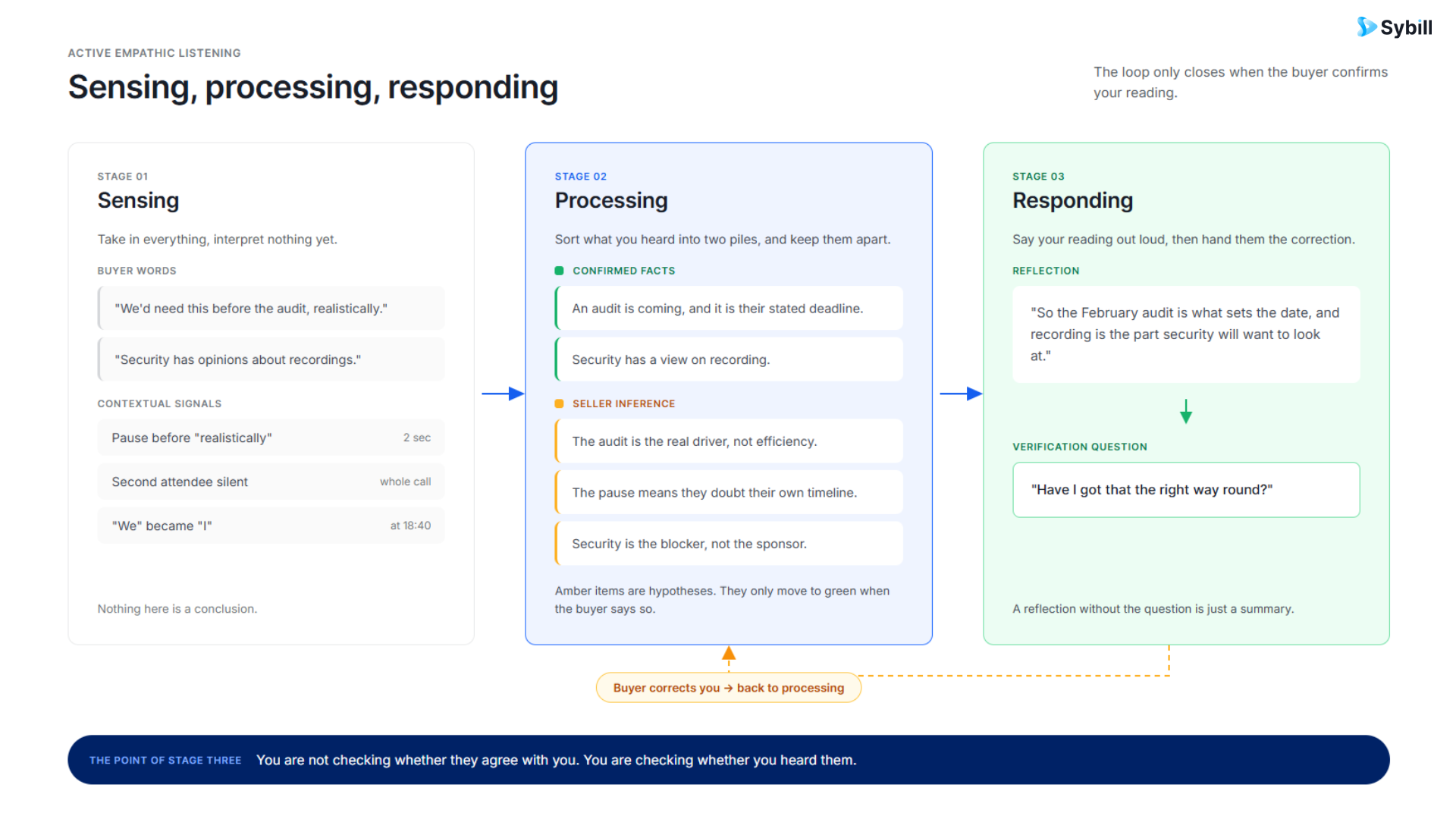
The Active Empathetic Listening Scale, developed by Tanya Drollinger, Lynne Comer and Patricia Warrington, organizes active empathic listening into three dimensions:
These dimensions provide a useful framework for sales conversations because they separate hearing, interpretation and visible response.
Sensing means paying attention to more than isolated words.
Listen for:
Tone, pauses and non-verbal behavior can provide context, but they should not be treated as proof of a particular emotion or intention.
A long pause may indicate concern. It may also indicate distraction, a poor connection or careful thinking.
The signal justifies attention, not certainty.
Processing means holding the buyer’s message long enough to understand it before preparing a response.
Ask yourself:
The last question matters.
Salespeople naturally connect buyer statements to the solution they sell. Empathetic processing requires the discipline to consider that the buyer may have a different problem, may not need the product or may not have enough reason to change.
Responding makes the listening visible.
A strong response can:
Useful response structures include:
“Let me check that I understood you.”
“It sounds like X may be a greater concern than Y. Is that accurate?”
“When you say the process is unreliable, what does that look like in practice?”
“You mentioned adoption twice. What happened during the previous rollout?”
“I may be connecting these incorrectly, but does the reporting problem affect confidence in the forecast?”
These phrases work because they make the seller’s interpretation testable.
Examples of empathic listening include reflecting the likely meaning of a buyer’s statement, acknowledging the concern without exaggerating it and asking a follow-up question that allows the buyer to confirm or correct the interpretation.
The difference becomes clearest when we compare an immediate sales response with an empathetic one.
None of the empathetic responses should be memorized and deployed automatically.
If every objection produces “It sounds like...” the technique will quickly feel scripted. The wording matters less than the discipline behind it:
Buyer: “Our managers spend Friday afternoons cleaning up deal records before the forecast call.”
Seller: “That sounds time-consuming. Is the larger problem the preparation effort, or that the team still does not trust the forecast after the cleanup?”
Buyer: “The trust problem. We can clean the fields, but we still do not know whether the rep’s close date reflects what the buyer said.”
The empathetic question separates the visible burden from the underlying business problem.
Buyer: “I do not want another tool that gives managers more data and reps more admin.”
Seller: “It sounds like the concern is not whether the tool can produce information. It is whether it creates another process that reps have to maintain.”
Buyer: “Exactly. We already have two systems that nobody updates properly.”
The seller has not argued with the objection. They have made it specific enough to address honestly.
Buyer: “Everyone likes it. We just need more time.”
Seller: “I may be reading this incorrectly, but it sounds like positive feedback has not yet become internal commitment. What is the team still uncertain about?”
The buyer may reject that interpretation. That is still useful. Correction produces more accurate information than polite ambiguity.
Empathetic listening improves through deliberate practice, not through reminders to “care more.”
Review the account, prior calls, stakeholders and open questions before the meeting.
Preparation should help you recognize continuity. It should not lock you into a theory about what the buyer needs.
Treat pre-call assumptions as hypotheses.
Question stacking makes it difficult to know which part the buyer answered.
Instead of:
“How does the process work today, what problems does it cause and who is responsible for fixing them?”
Start with:
“Can you walk me through what happens today?”
Use the answer to choose the next question.
Sellers frequently interrupt because they recognize a product use case and want to demonstrate relevance.
Write down the thought if necessary. Return to it after the buyer finishes.
A healthy sales talk-to-listen ratio can indicate whether the rep created room for the buyer. It cannot prove that the rep understood what was said.
Silence is an opportunity to listen. It is not evidence of listening quality.
After an important statement, identify:
This prevents seller assumptions from entering the CRM as buyer facts.
A useful reflection may include both:
“You are spending several hours consolidating the reports, and it sounds like the manual work also makes it harder to defend the numbers to leadership.”
The first part reflects content. The second interprets meaning.
The seller should then verify the interpretation.
Good listeners make it easy for buyers to say, “Not quite.”
Try:
Being corrected is not a discovery failure. It is evidence that discovery is becoming more accurate.
If the buyer calls the problem “forecast credibility,” do not immediately rename it “revenue intelligence.”
The seller can introduce category language later. During discovery, the buyer’s phrasing often provides better clues about how the problem is understood internally.
Do not use the buyer’s first mention of a problem as permission to begin a full product demonstration.
Confirm:
Then connect the solution only to what the buyer has established.
Before ending the meeting, summarize:
Ask the buyer to correct the summary.
This improves both empathetic listening and operational clarity.
No question is inherently empathetic.
A question demonstrates empathy when it follows what the buyer has shared and helps the seller understand the buyer’s perspective more accurately.
Useful questions include:
Compare these with a generic sequence of “pain questions.”
A seller who asks “How does that make you feel?” without a relevant reason may sound intrusive. A seller who asks “How is that affecting the team’s willingness to adopt another system?” is exploring a specific consequence the buyer has already introduced.
Empathy requires relevance, not emotional theatre.
Understanding a buyer’s position does not require endorsing every assumption or accepting every request.
A seller can say:
“I understand why a shorter implementation would feel safer. Based on the systems involved, promising two weeks would not be credible.”
That response acknowledges the concern without becoming dishonest.
“I understand” is a claim.
A reflection, summary or relevant follow-up demonstrates whether the seller actually understands.
Replace:
“I completely understand.”
With:
“It sounds like the previous vendor promised a simple rollout, but your team carried most of the implementation work. Is that the concern?”
Avoid:
Try:
Repeating the last three words of every answer is not empathy. Neither is copying the buyer’s tone, posture or phrasing so closely that it feels performative.
Reflect meaning when it helps the conversation.
A seller may genuinely have experienced a similar problem. Sharing that story too quickly can move attention away from the buyer.
Instead of:
“The same thing happened at my last company.”
Try:
“What effect did that have on the team?”
Share personal experience later if it serves the buyer’s decision.
Empathy is not a reason to avoid discussing budget, decision authority, competing priorities or risk.
In fact, empathetic listening should make difficult questions more relevant:
“You have described this as important, but it has been delayed twice. What is competing with it internally?”
A salesperson is not the buyer’s therapist.
The objective is to understand the human and organizational context required to evaluate a business decision. Respect personal boundaries and keep the exploration relevant to the buyer’s work and decision.
“Listen better” is not actionable coaching. Managers need observable behaviors they can inspect in call recordings and transcripts.
A practical call-review exercise can use five columns:
This makes hidden assumptions visible.
Managers should also look for moments when the rep:
Sybill’s guide to coaching sales reps with call recordings provides a broader process for turning recorded conversations into specific coaching.
Do not treat conversion rate, deal size or sales-cycle length as direct measures of empathy. Too many other factors influence those outcomes.
Begin with behavioral indicators:
Commercial outcomes can then be examined over time, with appropriate caution about causality.
AI cannot make a seller genuinely empathetic. It cannot reliably determine what a buyer feels, decide whether the seller truly cares or replace the human judgment required to interpret an ambiguous statement.
But AI can absolutely support the conditions for better listening.
Sybill’s Pre-meeting Briefs can bring together prior call history, email context, CRM information, attendees, open tasks and suggested agenda items before a meeting.
This helps the seller remember:
Preparation reduces the risk of asking buyers to repeat information they have already shared.
Taking detailed notes while listening can split the seller’s attention.
Sybill’s Magic Summary captures and organizes the meeting after it happens, allowing the seller to concentrate more fully on the conversation.
That does not excuse the rep from listening. It reduces one source of distraction.
Ask Sybill lets sellers ask questions across calls, emails, CRM records and other deal context.
A seller or manager could ask:
The output should support closer inspection, not replace direct validation with the buyer.
CRM Autofill can update standard and custom CRM fields from calls and emails.
Relevant fields might include:
The distinction between buyer evidence and seller inference should remain visible wherever possible.
The product principle is straightforward:
AI can preserve what buyers say and reduce the administrative work around the conversation. Empathy still depends on what the seller notices, verifies and does next.
Want to enter your next buyer conversation with the full deal history and fewer administrative distractions? Explore Sybill.
The test of empathetic listening is not whether the seller sounded considerate.
It is whether the buyer felt accurately understood and whether that understanding changed the quality of the conversation.
A strong empathetic listener:
That discipline improves discovery, makes objections more precise and prevents seller assumptions from masquerading as deal evidence.
AI can help sellers prepare, remember and document. It can bring previous interactions into the room and reduce the pressure to take notes while the buyer speaks.
AI cannot care on the seller’s behalf. The human skill is still the point.
No. Active listening focuses on paying attention, clarifying information and demonstrating that the message was received. Empathetic listening adds perspective-taking. The listener tries to understand what the situation means to the speaker, then verifies that interpretation rather than treating it as fact.
Yes. Sellers can improve through deliberate practice, call review, reflection and coaching. Useful practice focuses on sensing the complete message, processing it without rushing to judgment and responding in a way that lets the buyer confirm or correct the interpretation.
Acknowledge and accurately summarize the buyer’s perspective without endorsing every conclusion. For example: “I can see why the failed rollout would make the team cautious. Can we examine what would need to be different this time?” Understanding the concern does not require surrendering your own position.
Empathy seeks to understand the buyer’s situation from their perspective. Sympathy expresses concern or pity. In sales, empathy is generally more useful because it leads to better questions and more accurate understanding. Sympathy can sound patronizing if the seller focuses on feeling sorry for the buyer rather than understanding the business problem.
Useful questions include: “What makes this especially difficult now?”, “What happened the last time you tried to solve it?”, “Would it be fair to say the larger concern is risk rather than cost?” and “What am I missing?” The best question depends on what the buyer has already shared.
AI cannot create genuine care or reliably determine what a buyer feels. It can support better listening by reducing note-taking, preserving conversation history and helping sellers retrieve buyer-stated concerns, stakeholders and commitments. The seller must still interpret that evidence carefully and verify it with the buyer.
No. Active listening focuses on paying attention, clarifying information and demonstrating that the message was received. Empathetic listening adds perspective-taking. The listener tries to understand what the situation means to the speaker, then verifies that interpretation rather than treating it as fact.
Yes. Sellers can improve through deliberate practice, call review, reflection and coaching. Useful practice focuses on sensing the complete message, processing it without rushing to judgment and responding in a way that lets the buyer confirm or correct the interpretation.
Acknowledge and accurately summarize the buyer’s perspective without endorsing every conclusion. For example: “I can see why the failed rollout would make the team cautious. Can we examine what would need to be different this time?” Understanding the concern does not require surrendering your own position.