Find us at booth #83, join us for a harbor side happy hour, or catch Gorish’s talk.

Sept, 16-18 > Learn more


Tamanna Mishra

April 8, 2026
Every sales rep has heard some version of this advice:
“Don’t talk too much.”
It sounds right. It feels right. And it’s completely useless.
Because no one tells you what “too much” actually means in a real sales conversation.
So reps improvise. Some fill every second of silence because they think momentum equals control. Others swing the opposite way, asking question after question, hoping that counts as discovery. Most land somewhere in between, relying on instinct and hoping it works.
Meanwhile, the reality looks like this:
The problem isn’t effort. It’s clarity.
And that’s exactly what the sales talk-to-listen ratio gives you.
Not a vanity metric. Not a coaching cliché. But as a brutally honest answer to one question:
Are you actually having a conversation, or just performing one?
At its core, the sales talk-to-listen ratio measures how much time a rep spends speaking compared to how much they spend listening during a call.
The calculation is simple:
But what this metric reveals is anything but simple.
When a rep dominates the conversation, it often signals that the call is being driven by assumptions. The rep is filling space with explanations, features, and opinions instead of uncovering what actually matters to the buyer. On the other hand, when the balance shifts toward listening, the conversation becomes more buyer-led, more exploratory, and far more informative.
That shift has real consequences.
A balanced talk-to-listen ratio often correlates with stronger engagement, deeper discovery, and better alignment between what the buyer needs and what the rep presents . It also reduces one of the most common causes of lost deals: solving the wrong problem with the right product.
This is why the metric matters.
It doesn’t just tell you how much a rep is speaking. It tells you how much they are actually learning during the call.
If you search for the “perfect” talk-to-listen ratio, you’ll almost always land on the same number: 43:57.
This benchmark comes from large-scale analyses of sales conversations, where top-performing reps consistently spent more time listening than talking . It’s a useful reference point, but it’s often misunderstood as a rigid rule.
In reality, most reps don’t even get close to it.
Across teams, the average ratio tends to hover around 60:40, with many calls skewing even further toward rep-heavy conversations. In some cases, reps are speaking upwards of 70% of the time, which turns what should be a dialogue into a one-sided explanation .
But here’s where it gets interesting.
There isn’t a single “correct” ratio that works across every situation.
A discovery call requires a very different balance compared to a demo or a negotiation. In early-stage conversations, listening should dominate because the goal is to understand the buyer’s world. In later stages, especially during demos, the rep naturally needs more airtime to explain and position the solution.
A more practical way to think about it looks like this:
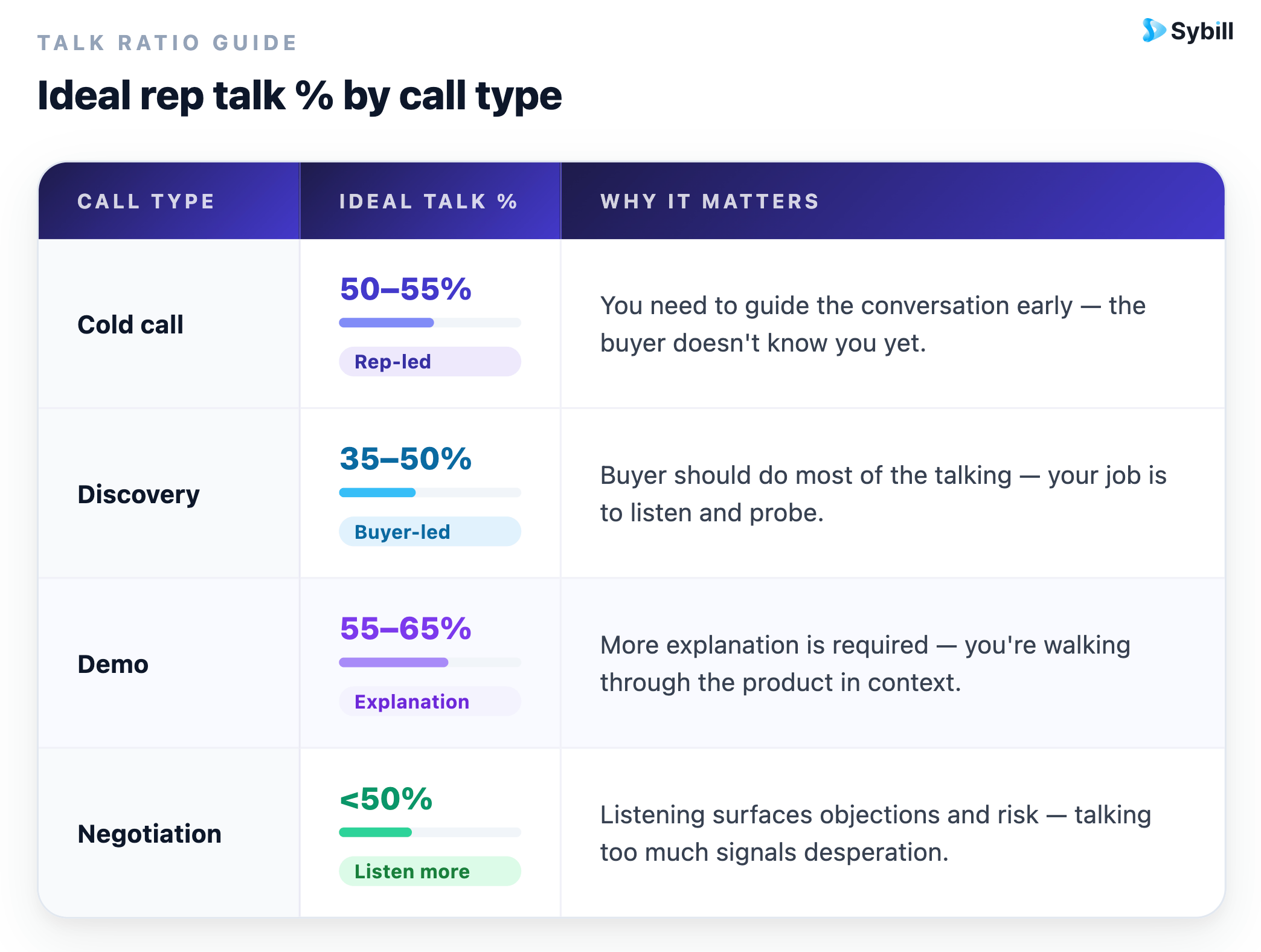
The takeaway is simple but important.
The problem isn’t that reps talk too much. It’s that they talk too much at the wrong moments.
Focusing only on the talk-to-listen ratio is like judging a movie by its runtime. It tells you something, but not what actually makes it good.
What separates high-performing sales conversations from average ones comes down to three deeper patterns.
Two calls can have the same ratio and feel completely different.
In winning calls, there’s a steady back-and-forth. The buyer responds, the rep adapts, and the conversation evolves naturally. In weaker calls, even if the ratio looks balanced, the interaction feels forced or fragmented.
High-performing reps consistently create more of these interaction moments, which keeps buyers engaged and invested .
One of the clearest patterns in lost deals is the presence of long, uninterrupted explanations.
These usually show up as:
The issue isn’t just that the rep is talking. It’s that they’re talking without checking whether the buyer is still with them.
And once engagement drops, it’s very hard to recover.
It’s tempting to think that asking more questions automatically improves a call. In practice, the opposite is often true.
Winning reps ask fewer but more thoughtful questions. Losing reps tend to ask more questions, but without building a coherent narrative, which makes the conversation feel like an interrogation.
Also read: 26 Product Led Sales Discovery Questions
Top performers don’t rely on instinct alone. They maintain a relatively stable talk-to-listen pattern across calls, regardless of deal outcome.
Lower performers, by contrast, tend to fluctuate. They over-talk when they’re nervous, over-question when they’re unsure, and react instead of guiding the conversation.
That inconsistency shows up clearly in the data.
Most teams assume they understand how their reps communicate. In reality, very few have accurate visibility.
Manually tracking this metric is nearly impossible. You would need to time every speaking segment, across dozens of calls, and then aggregate it into something usable. That’s not scalable, and it’s not reliable.
This is where AI changes the game.
Modern conversation intelligence systems follow a structured process:
The result is a clear, objective view of how conversations actually unfold, not how they’re remembered.
.png)
.png)
Sybill takes this a step further by turning raw metrics into usable coaching insights.
Instead of just showing percentages, it gives you:
This makes it easy to identify patterns at a glance. You can quickly see who tends to dominate conversations, who creates space for buyers, and where coaching is needed.
But the real value comes from how managers can interact with this data.
Rather than manually analyzing calls, managers can ask questions like:
.png)
Sybill then surfaces specific, contextual insights.
For example, it might highlight a rep who tends to deliver long pricing explanations without pausing for feedback. Or it might show another rep who consistently creates balanced, interactive conversations that lead to better outcomes.
It also translates these insights into clear recommendations. For example:
This is where the metric becomes actionable.
You’re no longer about tracking behavior. You’re changing it with precision.

Measuring the metric is one thing. Using it correctly is another.
.png)
A single call can be misleading. Context matters a lot.
Instead, look for patterns across:
That’s where meaningful insights emerge.
Applying the same benchmark to every call is one of the fastest ways to get this wrong.
Discovery, demos, and negotiations all require different conversational dynamics. If you don’t account for that, you’ll end up coaching reps in the wrong direction.
The talk-to-listen ratio becomes significantly more powerful when paired with:
This allows you to understand not just what happened, but why it mattered.
When teams turn this into a rigid performance metric, it backfires.
Reps start optimizing for percentages instead of conversations.
The goal is not to hit a number. The goal is to improve how conversations feel and function.
Improving this metric is not about talking less. It’s about communicating better.
.png)
Long explanations are the easiest way to lose a buyer’s attention.
Instead of delivering everything at once, break information into smaller segments and insert quick check-ins. This keeps the conversation interactive and ensures the buyer is following along.
The quality of your questions matters more than the quantity.
Open-ended questions invite deeper responses and give the buyer room to explain their context. This naturally improves your listening time without forcing it.
Silence feels uncomfortable, especially on calls. But it’s one of the most effective tools you have.
A short pause after the buyer speaks often encourages them to add more detail, which gives you richer information to work with.
Repeating back what you’ve heard is one of the simplest ways to demonstrate active listening.
It shows the buyer you’re paying attention and gives them a chance to clarify or expand. Over time, this builds trust and improves the overall quality of the conversation.
Aim for a steady rhythm of back-and-forth rather than long stretches of uninterrupted talking.
This keeps the buyer engaged and makes the conversation feel collaborative rather than transactional.
Most issues with this metric come from predictable behaviors.
Reps tend to over-talk when they:
They also disrupt the balance when they:
These behaviors are rarely intentional. But they have a compounding effect on how the buyer experiences the call.
And buyers notice.
For a long time, coaching conversations relied on memory, opinion, and occasional call reviews.
That approach doesn’t scale.
AI changes this by making every conversation measurable. Instead of relying on anecdotal feedback, teams can now analyze patterns across hundreds of calls and identify what actually drives outcomes.
This shift allows:
Tools like Sybill bring all of this together by connecting conversation behavior directly to performance. In practice.
You can track this using AI-powered conversation intelligence tools that analyze call recordings, identify speakers, and calculate talk versus listen time automatically. These tools also help identify patterns across calls, making it easier to coach reps based on real behavior.
The 3 3 3 rule typically refers to structuring conversations into three clear phases: opening, discovery, and closing. It helps reps maintain flow and avoid overloading any one part of the conversation.
The 70/30 rule suggests that reps should listen 70% of the time and talk 30%. While directionally helpful, real-world sales conversations often require more flexible ranges depending on the call type and context.
The idea that reps should listen 80% of the time is widely cited but rarely practical. In many cases, it can make conversations feel one-sided or interrogative. Balanced, interactive conversations tend to perform better .
The 10 3 1 rule refers to prospecting efficiency. For every 10 outreach attempts, you typically get 3 conversations and close 1 deal. It emphasizes the importance of making each conversation count once you have it.
You can track this using AI-powered conversation intelligence tools that analyze call recordings, identify speakers, and calculate talk versus listen time automatically. These tools also help identify patterns across calls, making it easier to coach reps based on real behavior.
The 3 3 3 rule typically refers to structuring conversations into three clear phases: opening, discovery, and closing. It helps reps maintain flow and avoid overloading any one part of the conversation.
The 70/30 rule suggests that reps should listen 70% of the time and talk 30%. While directionally helpful, real-world sales conversations often require more flexible ranges depending on the call type and context.