Find us at booth #83, join us for a harbor side happy hour, or catch Gorish’s talk.

Sept, 16-18 > Learn more


Mamta Tainwala

June 5, 2026
Most sales managers have a coaching problem they cannot name. They care about their reps. They do their 1:1s. They share feedback. But the feedback is often built on impressions, not evidence. "You sounded a bit uncertain on pricing" is not coaching. It is a vibe.
Call recordings change that. When you can actually hear what happened, coaching shifts from opinion to observation. And when AI is layered on top of those recordings, it stops being a process and starts being a system.
This guide walks you through exactly how to coach sales reps using call recordings, from the basics of what to look for, to building a repeatable coaching rhythm, to how Sybill does a significant chunk of the work for you automatically.
Before we get into the how, let us get clear on the why.
A typical sales manager oversees 6-10 reps. Each rep might run 3-5 calls a day. That is potentially fifty calls happening every week that the manager never hears. Coaching from that position means relying on rep self-reporting, CRM notes, and the occasional deal review. None of those are reliable proxies for what actually happened in the conversation.
Call recordings fix the observability problem. They give managers a window into conversations they were never in. More importantly, they give reps something concrete to react to during coaching. It is very hard to argue with your own voice.
The data backs this up. Reps who receive consistent, evidence-based coaching close more deals, ramp faster, and retain better. Yet according to the State of Sales Coaching 2026 Report, 73% of sales managers spend less than 5% of their time coaching. The bottleneck is not willingness. It is bandwidth.
That is where conversation intelligence platforms like Sybill come in. They do not just record calls. They analyze them, flag coachable moments, and deliver insights that would take a manager hours to surface manually.
Not all call feedback is created equal. Telling a rep "you talked too much" is technically feedback, but it does not give them anything to act on. Here is what to actually pay attention to.
The ideal ratio for a discovery call is roughly 40% rep, 60% prospect. When you flip that, you are pitching instead of learning. Sybill tracks talk-to-listen ratio automatically across every call, so you do not have to estimate or count.
Did the rep ask open-ended questions? Did they actually uncover pain, or did they skip straight to the demo? Weak discovery is the single biggest predictor of late-stage deal risk. You can train reps on the best discovery questions for sales, but recording review is how you confirm they are actually using them.
How did the rep respond when the prospect pushed back on price, timing, or competition? Did they panic and discount immediately, or did they engage with the concern? Strong objection handling is a learnable skill, and recording review makes the coaching extremely specific.
A call that ends without a clear next step is a call that is going to disappear. Reviewing recordings reveals whether reps are consistently confirming timelines, owners, and follow-up actions, or just ending calls with "I'll send you more info."
This one is harder to observe manually but critical. When did the prospect lean in? When did they go quiet? Sybill's behavioral AI analyzes non-verbal engagement signals during video calls, which means managers can see exactly where they lost the room.
You cannot coach from recordings you do not have. The first step is ensuring that all relevant call types, discovery calls, demos, renewals, and objection-heavy deals, are being recorded consistently.
This means configuring your call recording tool to auto-join meetings, and having a clear internal policy on consent and storage. Most enterprise sales organizations already have these protocols in place. If yours does not, create them before you begin.
Pro tip: Make call recording normal, not surveillance. When reps understand that recordings exist to help them improve and protect their context, not to catch them out, adoption follows.

This is where most coaching programs break down. A manager with ten reps simply cannot listen to fifty calls a week. The math does not work. AI changes the math.
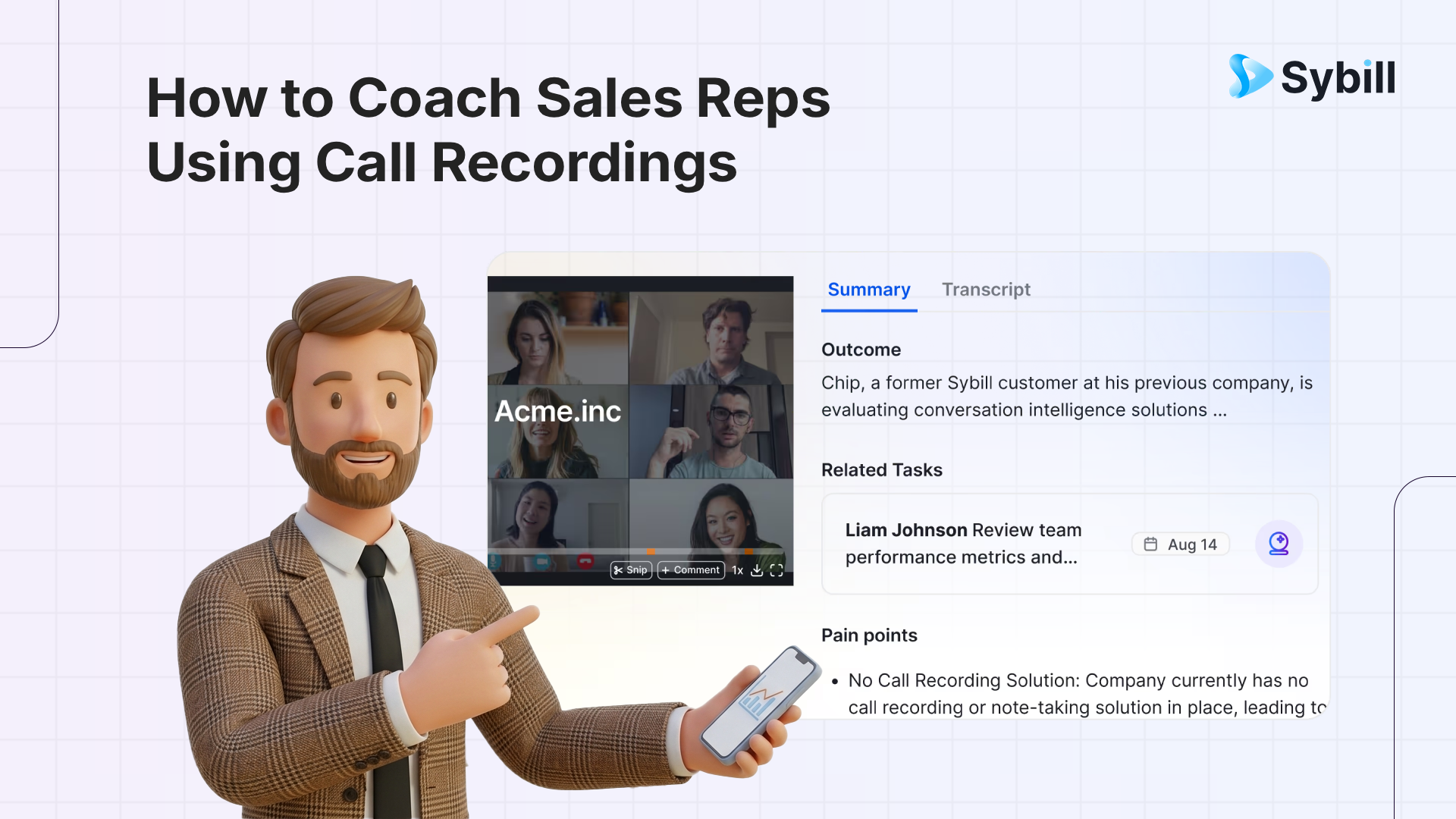
Sybill's Magic Summary generates a structured breakdown of every call within minutes of it ending. It captures pain points, objections raised, buyer signals, next steps, competitive mentions, and decision criteria, all formatted for sales context rather than generic meeting notes.
This means instead of listening to a 45-minute call, a manager can review a structured summary in three minutes, spot the gaps, and use that as the foundation for a coaching conversation. You can review 10x more calls in the same time.
More importantly, the summary itself is a coaching artifact. If the "Next Steps" section is vague, that tells you the rep did not close the call well. If "Pain Points" is thin, discovery was weak. The structure reveals the coaching opportunity without the manager having to diagnose it from scratch.
A great recording review is not "let me listen to this whole call." It is "let me jump to the moment the pricing objection landed and see what the rep did."
Sybill flags key moments in recordings automatically, from objection timestamps to moments of high or low buyer engagement. Managers can clip these moments, leave timestamped feedback, and build a coaching library from real conversations.
This is how call review in sales should work. You are not doing archaeology. You are jumping directly to the evidence.
Individual call review tells you what one rep did in one conversation. Pattern analysis tells you what separates your top performers from everyone else.
Sybill's win/loss analysis compares behaviors across closed-won and closed-lost deals at the team level. You can see that your top AE asks three times more open-ended questions than the bottom performer. That your best discovery calls average 58% prospect talk time. That deals with a clear next step confirmed on the call close at a 35% higher rate.
This is coaching with a benchmark, not just a vibe. It gives reps something specific to aim toward and managers something objective to measure against.
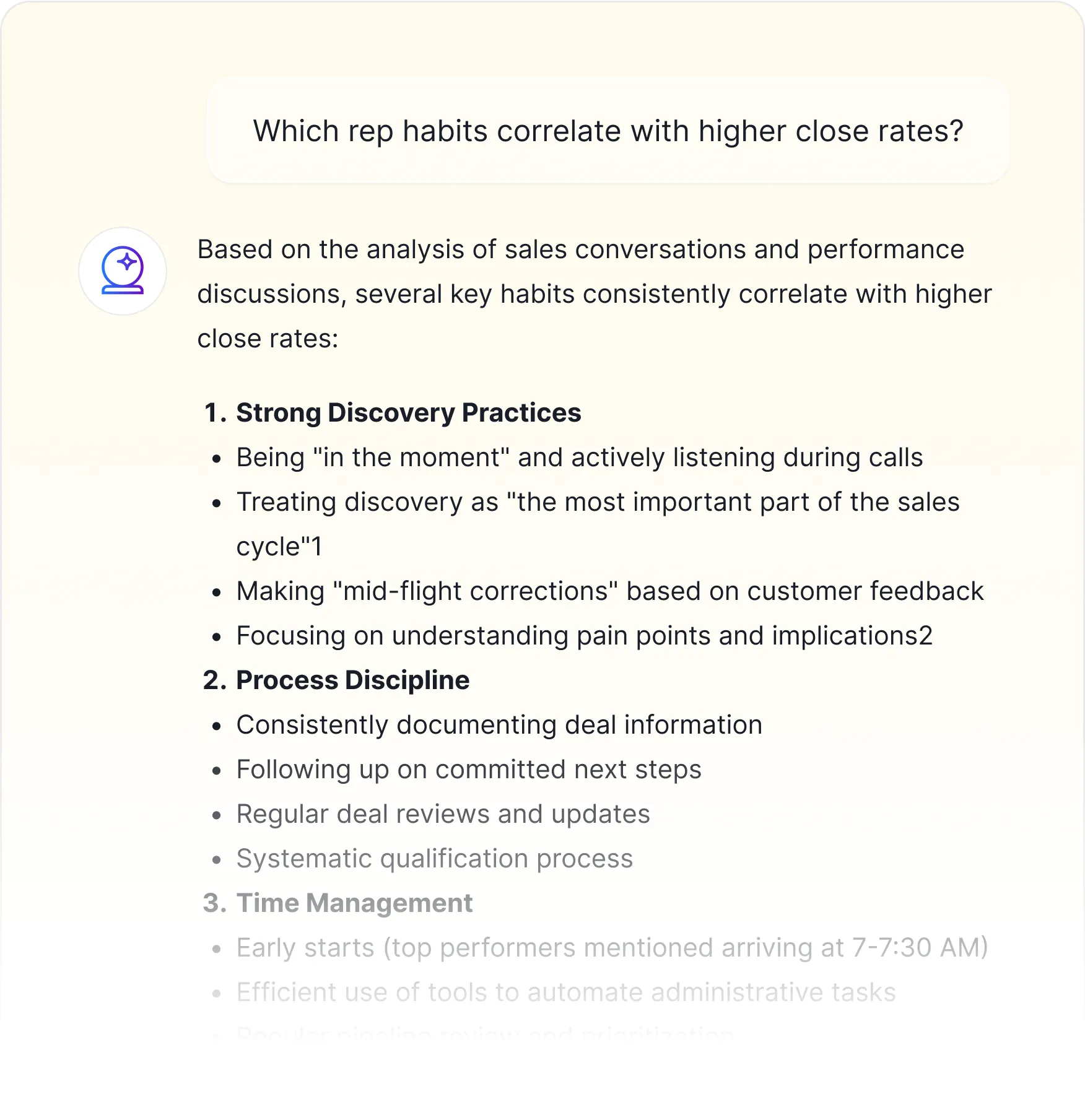
Here is where things get genuinely powerful. Instead of manually reviewing call libraries, managers and reps can ask Sybill plain-English questions about performance across all their calls.
"How did I handle pricing objections this month?" "Which of my calls had the lowest buyer engagement, and why?" "What do my closed-won deals have in common that my lost deals do not?"
Ask Sybill pulls from actual call data to answer these questions. It is not generic advice. It is pattern recognition at the deal and rep level, delivered in a format that is immediately actionable.
This also means reps can coach themselves between formal sessions. Self-coaching between 1:1s dramatically accelerates skill development because the feedback loop is tighter.
Now you get to the actual coaching conversation, and because you have done the analysis work, this is where you can spend the hour.
A good call recording coaching session follows this structure:
Before the 1:1: Pull the Magic Summary and flagged moments for two or three recent calls. Identify one or two specific coaching themes. This takes about five minutes with Sybill.
In the 1:1: Start with the rep's self-assessment. "What did you think went well on the Acme demo? Where did you feel like you lost them?" Then introduce the evidence. "Here is what I noticed at minute 22 when they raised the implementation timeline concern." Play the clip. Discuss specifically.
Close with commitment: What is the one behavior the rep will change or reinforce before the next call? Name it, write it down, and track it.
Sales coaching templates can help standardize this structure across your team so coaching sessions feel consistent regardless of which manager is running them.
Ready to turn your call recordings into a coaching system that actually scales? Get started for free with Sybill and see what coaching looks like when AI does the heavy lifting.
The best coaching is not just one manager working with one rep. It is a team-wide learning system.
When Sybill flags a particularly effective objection handle, or a discovery call that achieved exceptional buyer engagement, those moments can be clipped and organized into a shared library. New reps ramp faster when they learn from real conversations at your company, with your buyers, about your product, rather than role-play scenarios that never quite mirror reality.
Over time, this library becomes one of your most valuable enablement assets. AI sales coaching at its best is not replacing human judgment. It is preserving and distributing the institutional knowledge that currently lives only in your top performers' heads.

Coaching in isolation is one thing. Coaching that connects to deal outcomes is another.
Sybill ties together conversation intelligence and revenue intelligence, which means coaching insights are not separate from deal context. If a rep consistently fails to capture decision criteria in discovery, that shows up both as a coaching gap and as a risk signal in their pipeline.
This is what makes Sybill different from tools that simply transcribe calls and leave the analysis to you. The data flows from the call into CRM fields, deal health signals, and coaching insights automatically. Managers get a unified picture of where each rep needs development and which deals are at risk because of it.
Here is what a coaching week looks like for a sales manager using Sybill well.
Monday: Sybill has automatically summarized all calls from the prior week. Manager spends 20 minutes scanning summaries for coaching patterns across the team. No listening to recordings yet.
Tuesday: Manager uses Ask Sybill to surface which reps had the lowest talk-to-listen ratios last week and pulls the flagged moments from those calls.
Wednesday/Thursday: 1:1 coaching sessions, each anchored on one or two specific call moments. Reps are not hearing "you need to ask better questions." They are hearing "at minute 14 of the Apex call, you had an opportunity to dig deeper on their implementation pain. Here is the clip. What would you do differently?"
Friday: Manager adds two clips to the team coaching library. One great objection handle from a top performer. One near-miss that has a good lesson attached.
That is a week. It is specific, evidence-based, repeatable, and it took maybe two hours of actual coaching overhead. Compare that to the alternative: gut-feel feedback delivered in a vacuum.
Reviewing calls without a framework. Listening to a call and saying "that went pretty well" is not coaching. Know what you are looking for before you hit play.
Making it feel like surveillance. If reps think recordings are for catching them out rather than helping them grow, you will get compliance without buy-in. Frame recordings as an asset, not a monitoring tool. The myths around sales call recording usually fall apart the moment reps see their own data.
Coaching everything at once. Pick one or two themes per conversation. Feedback on ten things at once produces improvement on none of them.
Ignoring self-coaching. Managers cannot be the only source of coaching insight. Give reps access to their own data via Ask Sybill and let them identify their own patterns between formal sessions.
Coaching the call instead of the rep. The goal is not a perfect call. It is a rep who improves across dozens of calls. Keep the focus on skill development, not play-by-play critique.
What is the best way to use call recordings for sales coaching? The most effective approach is to use AI to surface coachable moments, talk ratios, and win/loss patterns automatically rather than manually reviewing recordings. Tools like Sybill generate structured summaries and flag timestamps where coaching opportunities occur, so managers can focus their time on the conversation itself rather than the analysis.
How many calls should a sales manager review per week? With AI assistance, a manager can effectively cover ten to twenty calls per week by scanning structured summaries rather than listening to full recordings. Sybill's Magic Summaries compress a 45-minute call into a three-minute review, which fundamentally changes the math on coaching coverage.
How does Sybill help with sales coaching specifically? Sybill records and transcribes calls, generates structured Magic Summaries, flags coachable moments by timestamp, tracks talk-to-listen ratios, and enables managers and reps to query performance patterns via Ask Sybill. It also connects coaching insights to deal health signals, so skill gaps show up as both development opportunities and pipeline risks.
Should reps be involved in reviewing their own call recordings? Yes, absolutely. Self-coaching via call review dramatically accelerates skill development. Sybill makes this practical by giving reps access to their own data, including structured summaries and the ability to query their own patterns through Ask Sybill.
How do I build a call recording coaching library? Clip high-value moments from recordings, organized by coaching theme (discovery, objection handling, closing discipline, buyer engagement). Sybill enables managers to clip and annotate timestamped moments and share them across the team. Over time, this library becomes a primary onboarding and enablement asset.
How is coaching with call recordings different from traditional sales coaching? Traditional coaching relies on rep self-reporting, manager observation, and CRM notes, all of which are incomplete and often inaccurate. Coaching with call recordings gives managers direct evidence from actual conversations, enabling specific, actionable feedback instead of general impression-based guidance.
Sales coaching is not broken because managers do not care. It is broken because the feedback loop is too slow and the evidence is too thin.
Call recordings fix the evidence problem. AI fixes the bandwidth problem. Together, they make the kind of coaching that was previously reserved for elite sales organizations accessible to any team willing to build the system.
The reps who get specific, consistent, evidence-based coaching outperform those who do not. And the managers who build that coaching culture become the ones who build great teams.
That is the compounding advantage of getting this right. It is worth building.
Get started for free with Sybill and turn every call recording into your next coaching opportunity.
The most effective approach is to use AI to surface coachable moments, talk ratios, and win/loss patterns automatically rather than manually reviewing recordings. Tools like Sybill generate structured summaries and flag timestamps where coaching opportunities occur, so managers can focus their time on the conversation itself rather than the analysis.
With AI assistance, a manager can effectively cover ten to twenty calls per week by scanning structured summaries rather than listening to full recordings. Sybill's Magic Summaries compress a 45-minute call into a three-minute review, which fundamentally changes the math on coaching coverage.
Sybill records and transcribes calls, generates structured Magic Summaries, flags coachable moments by timestamp, tracks talk-to-listen ratios, and enables managers and reps to query performance patterns via Ask Sybill. It also connects coaching insights to deal health signals, so skill gaps show up as both development opportunities and pipeline risks.