Find us at booth #83, join us for a harbor side happy hour, or catch Gorish’s talk.

Sept, 16-18 > Learn more

%20(1).avif)
Mamta Tainwala

July 1, 2026
%20(20).png)
Conversational Intelligence (C-IQ) is a leadership framework created by Judith E. Glaser in her 2013 book of the same name. It holds that conversations are not just information exchanges but biological events that trigger brain chemistry, releasing cortisol in distrust or oxytocin in trust. Glaser's model teaches leaders to shift conversations from "I-centric" to "WE-centric" to build trust and better results.
Note on terminology: "Conversational Intelligence" and "C-IQ" are trademarks of The CreatingWE Institute, founded by Judith E. Glaser. This article explains her framework and is not affiliated with or endorsed by the Institute.
Conversational Intelligence, abbreviated C-IQ, is a framework developed by executive coach Judith E. Glaser that treats conversations as the primary force shaping trust, relationships, and organizational culture. Its central claim is that how we talk to one another physically changes brain chemistry, and that leaders can learn to steer conversations toward trust and away from fear.
If you came here expecting software, hold that thought, because there are actually two very different things wearing the same name, and it is worth untangling them right at the top.
One is the human skill that Glaser defined: a leadership and communication discipline rooted in neuroscience. The other is a category of AI sales technology, conversation intelligence software, that records and analyzes calls. They share a name and, as it turns out, a core belief that conversations drive outcomes. But they are not the same thing, and most people searching Glaser's name want the first one. This article is mostly about that, and near the end I will show you exactly where the two ideas meet, because the connection is more useful than it first appears.
Glaser's big reframe is deceptively simple. We tend to think of a conversation as a transfer of information from my head to yours. She argued it is something far more powerful: a shared act that can build a relationship or quietly damage it, often through words that take only seconds to say.
Judith E. Glaser was an organizational anthropologist, executive coach, and author widely regarded as a leading authority on the role of conversations in leadership. She founded The CreatingWE Institute and Benchmark Communications, and wrote seven business books before her death in 2018.
Her best-known work, Conversational Intelligence: How Great Leaders Build Trust and Get Extraordinary Results, was published in 2013 and drew on roughly three decades of observing executives in real workplace interactions. Glaser's distinctive move was to fuse neuroscience with practical leadership coaching, translating what happens chemically in the brain during a conversation into tools a manager could actually use on a Monday morning.
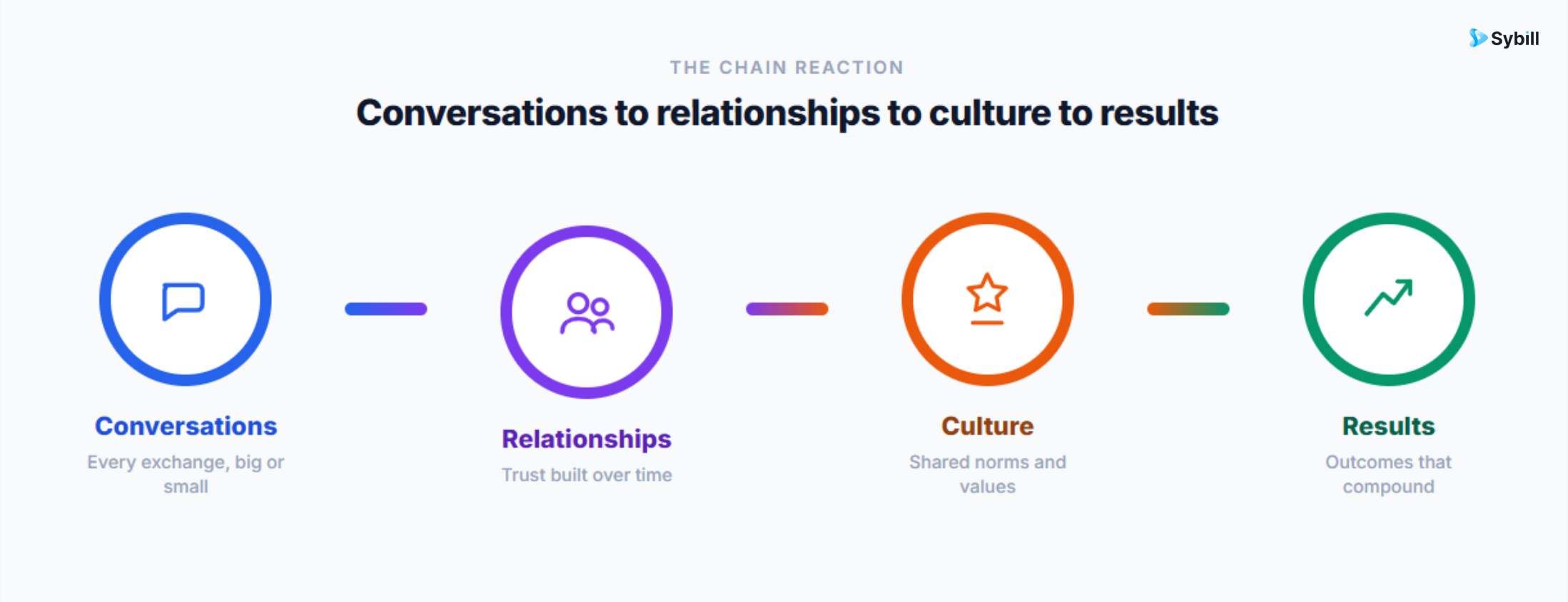
One line of hers captures the whole philosophy: to reach the next level of greatness, you depend on the quality of your culture, which depends on the quality of your relationships, which depends on the quality of your conversations. In her telling, everything happens through conversations. That single chain of dependencies is why her ideas resonated so widely with leaders.
The neuroscience behind C-IQ is that every conversation triggers a chemical response in the brain that either builds trust or provokes defensiveness. When a conversation feels threatening, the brain releases cortisol, the stress hormone, narrowing thinking and pushing us into self-protection. When it feels safe, the brain releases oxytocin and dopamine, which support trust, openness, and creative thinking.
This is the part of Glaser's work that made it stick, so let me make it concrete.
Picture a manager opening a one-on-one with "We need to talk about your numbers." For many people, that single phrase spikes cortisol before the rest of the sentence even arrives. The heart rate climbs, the thinking clouds, and the employee shifts into defending rather than listening. Nothing productive happens next, no matter how reasonable the manager's actual point.
Now picture the same manager opening with "I would love to understand how this quarter felt from your side." That invites rather than threatens. It nudges the brain toward oxytocin, and the person stays open enough to actually engage. Same goal, completely different chemistry, completely different outcome.
Glaser's argument is that leaders are, whether they realize it or not, constantly dosing the people around them with one chemistry or the other. C-IQ is the skill of doing it on purpose. She described several regions of the brain involved in this, from the threat-sensitive amygdala to the parts governing trust and higher judgment, and tied each to how we react in the moment of a conversation.
Glaser's three levels of conversation describe how interactions move from simple information exchange to genuine co-creation. Each level engages the brain differently and produces different outcomes, and the goal of C-IQ is to spend more time at the highest level.
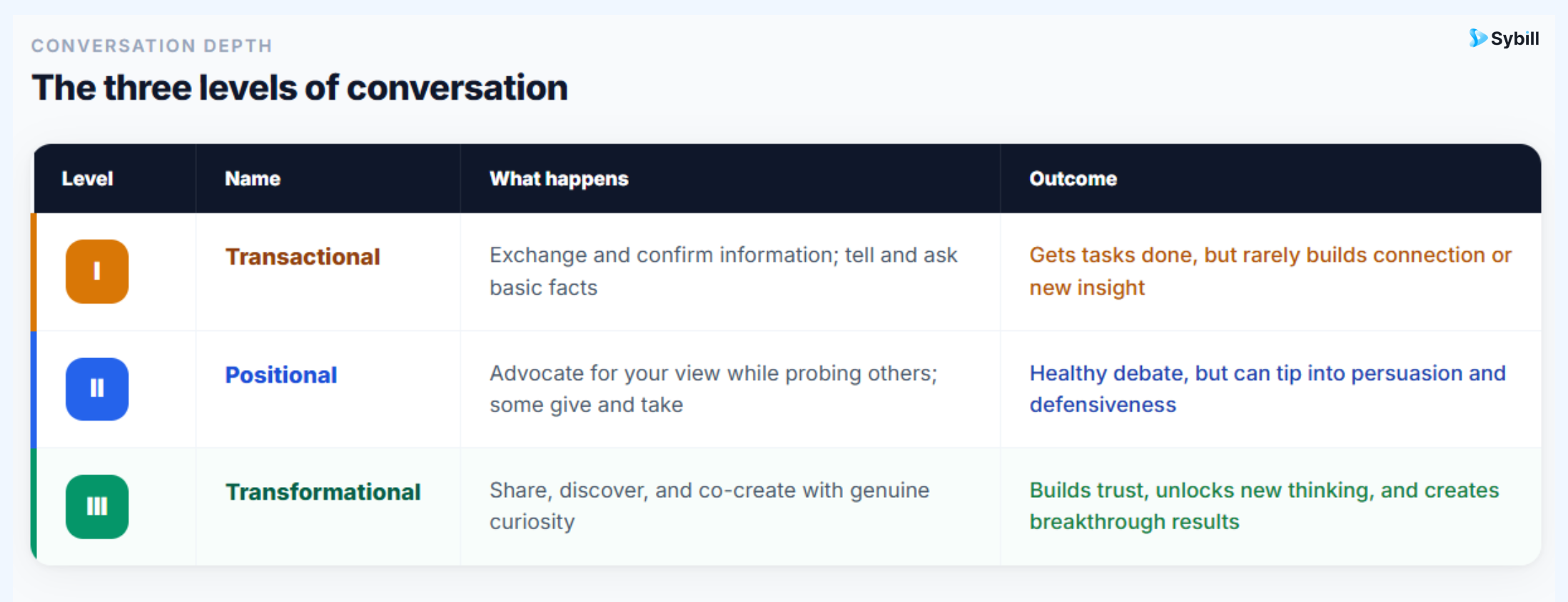
Most workplace conversations, Glaser observed, get stuck at Level I. Her early research famously found that the vast majority of verbal exchanges were "telling" statements, with genuine asking and quality listening surprisingly rare. The skill of C-IQ is recognizing which level you are operating at and deliberately climbing toward Level III, where trust and co-creation live.
Think of it like shifting gears. Level I keeps the conversation idling. Level III is where it actually moves somewhere neither person could have reached alone.
The TRUST model is Glaser's practical checklist for building the conditions that move a conversation toward trust and Level III. Each letter maps to a behavior leaders can consciously practice, targeting the brain's need for safety before it can engage openly.
In Glaser's framing, the components are:
The throughline of the whole model is Glaser's "I to WE" shift: moving from conversations centered on your own view and your own win toward conversations built around the relationship and a shared outcome. That shift, she argued, is what separates leaders people merely work for from leaders people trust.
You apply Conversational Intelligence in sales by treating each customer conversation as a trust-building event rather than a pitch, using Glaser's principles to lower a buyer's defensiveness and raise genuine engagement. In practice, that means more asking than telling, more listening than presenting, and framing the deal around the buyer's win rather than your quota.
This is where Glaser's leadership framework turns out to map almost perfectly onto modern selling. Consider the parallels:
The catch is that doing this consistently, across dozens of conversations and a whole team, is genuinely hard. A rep cannot perfectly track talk-to-listen ratio, notice every moment a buyer's tone shifted, or remember which questions actually opened the conversation up, all while staying present in the call itself. That is a real human limit. And it is exactly the limit that the other "conversational intelligence" steps in to address.
Glaser's C-IQ and conversation intelligence software share a name and a core belief, that better conversations drive better outcomes, but they operate at different layers. C-IQ is the human skill of having trust-building conversations. Conversation intelligence software is the technology that measures, analyzes, and improves those conversations at scale.
Here is the honest disambiguation, because the shared name confuses a lot of people:
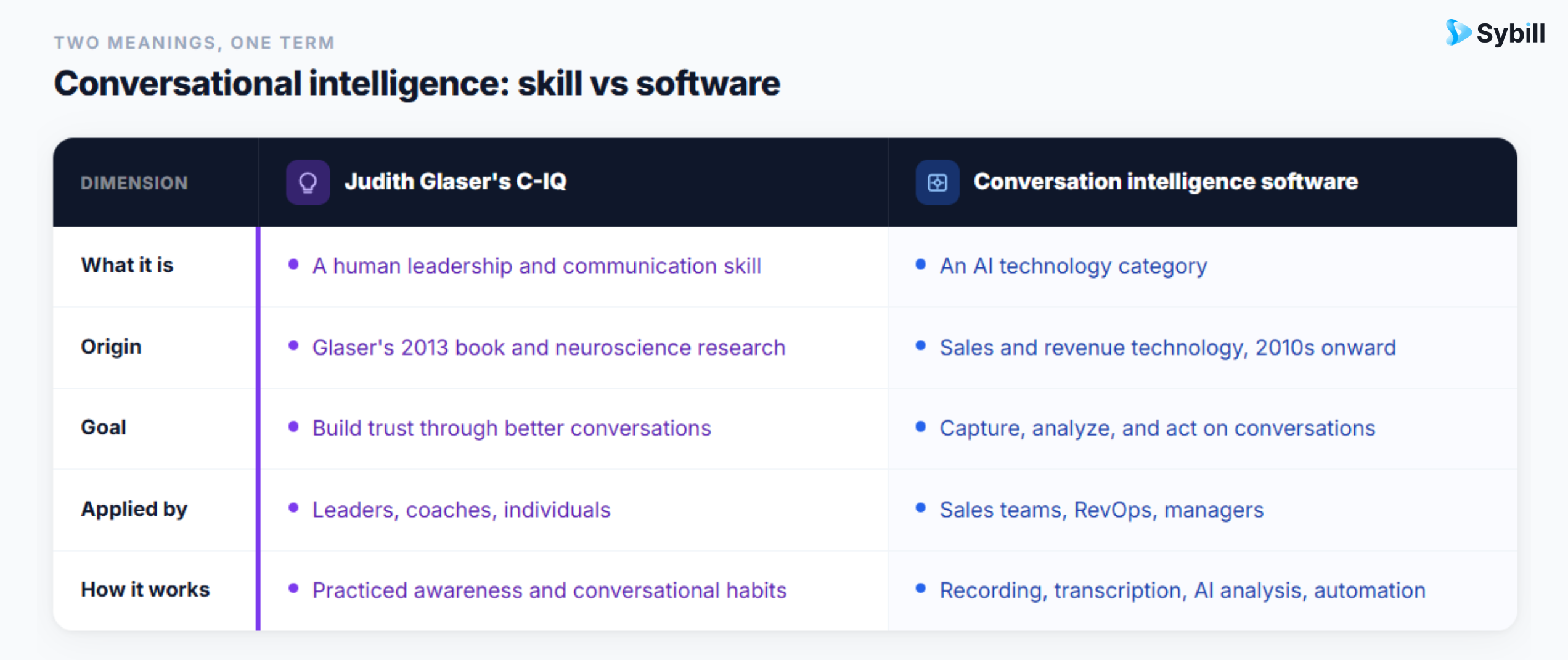
They are not competitors. If anything, they are two halves of the same insight. Glaser proved why conversations matter so much. Conversation intelligence software is what lets a sales team act on that truth across hundreds of calls a week, surfacing the talk-to-listen ratios, the moments trust was built or lost, and the next steps that move a deal forward.
This is the bridge worth crossing if you arrived here as a sales leader. You can train your reps in the spirit of Glaser's framework, more asking, more listening, more WE. But to know whether it is actually happening, and to scale coaching beyond the handful of calls a manager can personally review, you need the software layer. That is what conversation intelligence software does, and where a platform like Sybill comes in: it analyzes every conversation, shows you where reps are telling versus asking, and handles the follow-up work so reps can stay present and trust-focused in the conversation itself, exactly the state Glaser said produces the best outcomes.
In other words, Glaser gave us the why. Conversation intelligence software is the how, at scale. If you want to see what that looks like in practice, our guide to the best conversation intelligence tools is a good next step, and what conversation intelligence is covers the technology category in full.
Conversational Intelligence, the leadership framework abbreviated C-IQ, was created by Judith E. Glaser, an organizational anthropologist and executive coach. She introduced it in her 2013 book Conversational Intelligence: How Great Leaders Build Trust and Get Extraordinary Results, drawing on around 30 years of work with executives. "Conversational Intelligence" and "C-IQ" are trademarks of her CreatingWE Institute.
The main idea is that conversations are biological events, not just information exchanges. How we speak to others triggers brain chemistry that either builds trust, by releasing oxytocin, or provokes defensiveness, by releasing cortisol. Glaser argued that leaders can learn to steer conversations toward trust by shifting from telling to asking and from an "I-centric" to a "WE-centric" mindset.
Glaser defined three levels. Level I is transactional, exchanging and confirming information. Level II is positional, advocating for your view while probing others. Level III is transformational, sharing and co-creating with genuine curiosity. C-IQ teaches leaders to recognize which level they are in and deliberately move toward Level III, where trust and breakthrough thinking happen.
No. They share a name and a belief that conversations drive outcomes, but they are different things. Glaser's Conversational Intelligence (C-IQ) is a human leadership skill grounded in neuroscience. Conversation intelligence software is an AI technology that records, transcribes, and analyzes sales calls. One is a skill you practice; the other is a tool you deploy. The two are complementary rather than competing.
For leaders and anyone interested in communication and trust, the book is widely recommended for its blend of neuroscience and practical tools, though some readers find it repetitive and heavy on research references. Its frameworks, the three levels, the TRUST model, and the "I to WE" shift, are its most cited and lasting contributions, and remain useful even if you skim the supporting stories.
Sales teams apply the principles by treating conversations as trust-building events: asking more than telling, listening more than presenting, and framing deals around the buyer's success rather than the rep's quota. Doing this consistently at scale is hard, which is why many teams pair the mindset with conversation intelligence software that measures talk-to-listen ratios, surfaces trust signals, and frees reps to stay present in the conversation.
Conversational Intelligence, the leadership framework abbreviated C-IQ, was created by Judith E. Glaser, an organizational anthropologist and executive coach. She introduced it in her 2013 book Conversational Intelligence: How Great Leaders Build Trust and Get Extraordinary Results, drawing on around 30 years of work with executives. "Conversational Intelligence" and "C-IQ" are trademarks of her CreatingWE Institute.
The main idea is that conversations are biological events, not just information exchanges. How we speak to others triggers brain chemistry that either builds trust, by releasing oxytocin, or provokes defensiveness, by releasing cortisol. Glaser argued that leaders can learn to steer conversations toward trust by shifting from telling to asking and from an "I-centric" to a "WE-centric" mindset.
Glaser defined three levels. Level I is transactional, exchanging and confirming information. Level II is positional, advocating for your view while probing others. Level III is transformational, sharing and co-creating with genuine curiosity. C-IQ teaches leaders to recognize which level they are in and deliberately move toward Level III, where trust and breakthrough thinking happen.