Find us at booth #83, join us for a harbor side happy hour, or catch Gorish’s talk.

Sept, 16-18 > Learn more

%20(1).avif)
Mamta Tainwala

June 30, 2026
%20(17).png)
Conversation intelligence software is an AI tool that automatically records, transcribes, and analyzes sales and customer calls to extract insights like buyer intent, objections, and next steps. It then acts on those insights by updating the CRM, drafting follow-ups, and surfacing coaching opportunities, turning every conversation into structured, usable data.
Conversation intelligence software is an AI platform that captures voice and video conversations, transcribes them, analyzes them for meaning, and feeds the resulting structured data into your sales workflow. It is the technology that turns a recorded call from a file nobody opens into data your whole team can act on.
Here is the thing most buyers miss when they start shopping. They assume "conversation intelligence software" describes one kind of product. It does not. Underneath that single label sits a real fork in the road, and which side you land on decides whether the tool earns its keep or just adds another tab to your reps' day.
On one side are tools that record and analyze, then hand you the insights and wish you luck. On the other are tools that record, analyze, and then do the work, updating the CRM, drafting the follow-up, completing the task. Both call themselves conversation intelligence software. Only one of them gives your reps their evenings back. We will come back to that fork, because it is the most important decision you will make here. If you want the category definition before the software specifics, start with what conversation intelligence is.
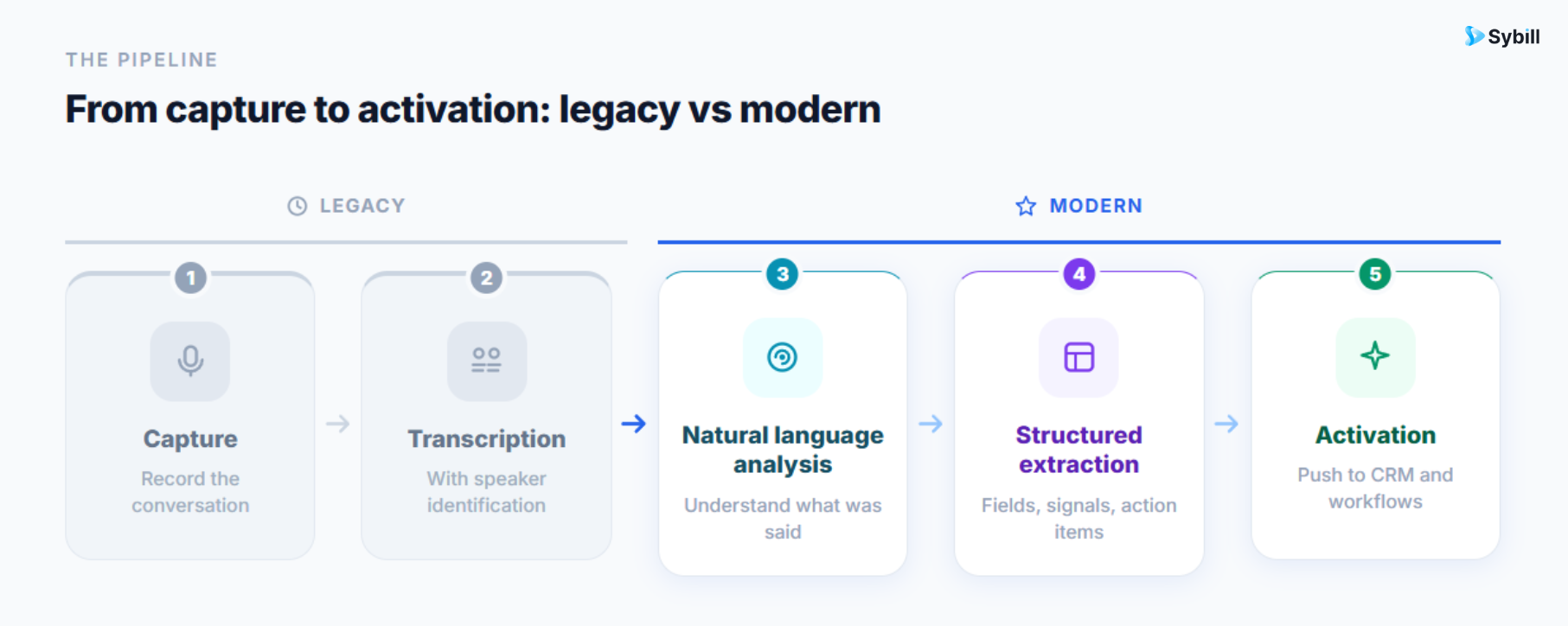
Conversation intelligence software works by running every call through an automated pipeline: it captures the conversation, transcribes it, analyzes the text with AI, extracts structured insights, and pushes them into your systems. The whole sequence runs on its own, which is exactly why it scales where manual review never could.
Walk through what happens to a single discovery call from the moment it starts:
Older software stopped at steps one and two. It recorded and transcribed, and called that intelligence. Modern conversation intelligence software runs all five steps, and the gap between "stops at step two" and "finishes step five" is precisely the fork I mentioned. The platforms worth your budget are the ones that complete activation reliably instead of leaving it on the rep's plate.
Strong conversation intelligence software needs five core capabilities: accurate transcription, AI-driven analysis, automatic CRM updates, follow-up drafting, and scalable coaching. Anything missing from that list pushes manual work back onto your team.
Use this as your demo checklist:
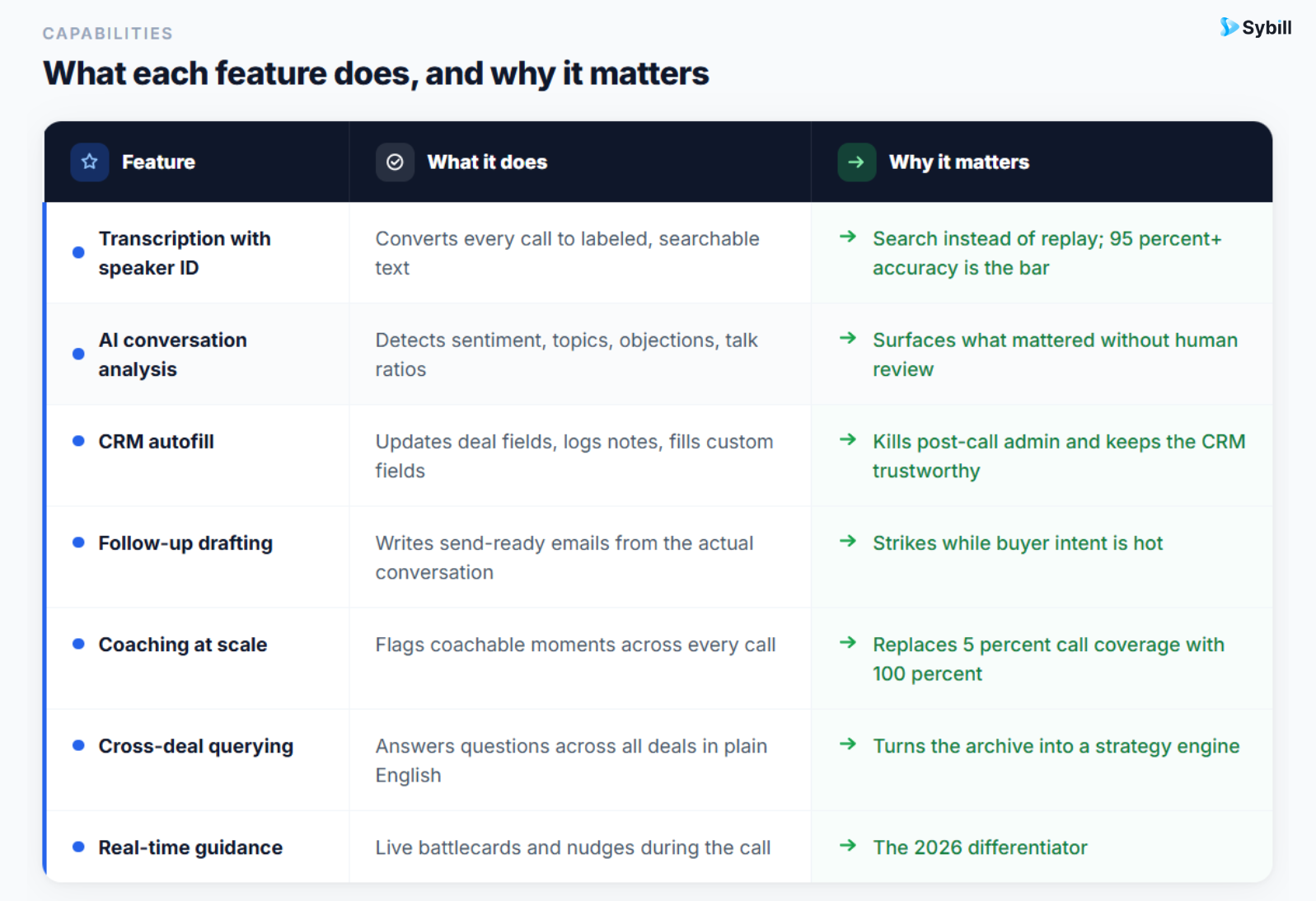
The features themselves are easy to list. The honest question is which ones a given platform actually executes versus merely displays. A tool that "identifies action items" and a tool that completes them are described almost identically on a feature page and feel nothing alike on a Tuesday afternoon.
Sybill covers this list end to end: Magic Summaries for the analysis, CRM Autofill for the updates, automated personalized follow-ups, Ask Sybill for cross-deal querying, and coaching and performance analysis built in.
The benefits of conversation intelligence software are reclaimed selling time, a CRM that stays accurate on its own, faster and sharper follow-ups, coaching that finally scales, and forecasts grounded in what buyers actually said. Every one of those traces back to a single root cause: removing manual work from the rep.
Let me make these concrete rather than aspirational:
The throughline is simple. Buyers expect more (according to Salesforce, 83% want reps who understand their needs) while reps have less time to deliver it. Conversation intelligence software closes that squeeze.
Conversation intelligence software ranges from free tiers to enterprise platform fees, with most paid plans landing between roughly $20 and $100-plus per user per month depending on depth and automation. The sticker price, though, is the least interesting number in the decision.
Here is the reframe that matters. The real cost of a tool is not its per-seat fee; it is the rep time it fails to save. A cheaper platform that stops at recording quietly bills you in lost hours, because your reps still do the notes, the CRM entry, and the follow-ups by hand. An execution-first platform prices that work into the product. Run the math on a single rep: five hours saved a week is roughly 20 hours a month redirected to selling. Against that, the seat price is rounding error.
Sybill offers a free tier with unlimited recording and transcription so you can measure the time savings before you spend anything. For the full tradeoff, our conversation intelligence vs call recording breakdown shows where the hidden costs hide.
The ROI of conversation intelligence software comes from reclaimed selling time, cleaner pipeline data, higher win rates, and faster rep ramp, not from the recordings themselves. The recordings are the input. The returned hours and better decisions are the output.
Across Sybill usage, the gains show up consistently:
Put a number on it. Ten reps each reclaiming eight hours a week is 80 selling hours back every week, roughly two extra full-time sellers' worth of capacity, with zero new headcount. That is the ROI story, and it is why the cheap-tool math so often loses.
You choose the right conversation intelligence software by matching its primary job to your team's primary problem, then testing whether it executes or merely suggests. The features lists look alike across vendors; the behavior after the call does not.
Take these questions into every demo:
By the end of that list, the right fit for your situation tends to separate itself. If you want the field already ranked, see our guide to the best conversation intelligence tools, and for the head-to-head most teams ask about, Sybill versus Gong.
It is AI that sits in on your sales calls, writes them down, works out what mattered, and then handles the busywork that follows, updating your CRM, drafting follow-ups, and flagging deals that are slipping. Instead of leaving you a recording to review later, it leaves you the finished work.
No. A meeting recorder captures and stores the call. Conversation intelligence software includes recording, then adds AI analysis, insight extraction, CRM automation, and coaching on top. A recorder gives you a file to replay; conversation intelligence software gives you analyzed data and completed actions. Recording is the foundation, not the product.
Yes. CRM integration is one of its most valuable functions. Leading platforms connect directly to Salesforce, HubSpot, and others, then autofill deal stages, log key points, update custom fields, and create tasks automatically. That is what keeps the CRM accurate without reps spending evenings on data entry.
Leading platforms hit 95 percent or higher accuracy in 2026, with automatic speaker identification. Accuracy can dip with heavy accents, background noise, or niche jargon, so test any platform on your own real calls before you commit rather than trusting a demo recorded in a quiet room.
Yes, and often more so. Small teams feel admin load hardest because each rep carries more accounts. Conversation intelligence software returns selling hours through automatic CRM updates and faster follow-ups, effectively adding capacity without adding headcount. Free tiers let lean teams prove the impact before spending a dollar.
Conversation intelligence focuses on the calls themselves: transcribing, analyzing, and acting on individual conversations. Revenue intelligence is broader, pulling conversation data together with CRM, email, and pipeline signals to forecast and manage revenue at the org level. Many platforms blend both. The practical question is still whether the tool executes work for reps or only reports to leadership.
It is AI that sits in on your sales calls, writes them down, works out what mattered, and then handles the busywork that follows, updating your CRM, drafting follow-ups, and flagging deals that are slipping. Instead of leaving you a recording to review later, it leaves you the finished work.
No. A meeting recorder captures and stores the call. Conversation intelligence software includes recording, then adds AI analysis, insight extraction, CRM automation, and coaching on top. A recorder gives you a file to replay; conversation intelligence software gives you analyzed data and completed actions. Recording is the foundation, not the product.
Yes. CRM integration is one of its most valuable functions. Leading platforms connect directly to Salesforce, HubSpot, and others, then autofill deal stages, log key points, update custom fields, and create tasks automatically. That is what keeps the CRM accurate without reps spending evenings on data entry.