Find us at booth #83, join us for a harbor side happy hour, or catch Gorish’s talk.

Sept, 16-18 > Learn more

%20(1).avif)
Mamta Tainwala

January 20, 2026
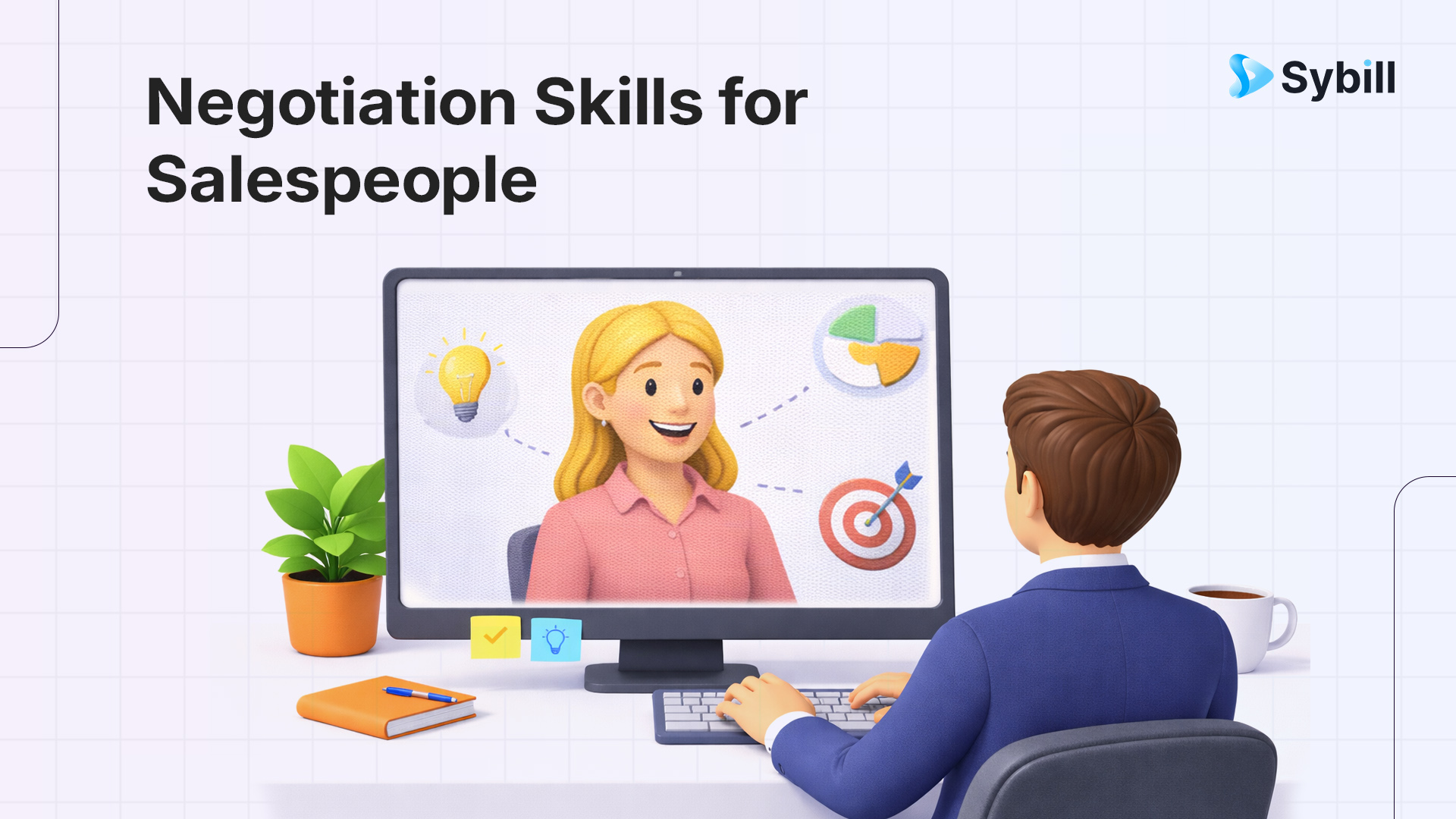
Great salespeople are great negotiators. The 10 essential negotiation skills include: active listening, preparation and research, understanding buyer psychology, objection handling, anchoring with confidence, value articulation, emotional intelligence, knowing when to walk away, strategic concessions, and mastering silence. Modern sales negotiation isn't about manipulation or aggressive tactics. It's about creating win-win outcomes where both sides feel they got value. The best negotiators use conversation intelligence to analyze past negotiations, identify what works, and continuously improve their approach.
You finally got the prospect to yes. They love the product. They see the value. The champion is on board. Legal reviewed the contract.
And then they hit you with it: "We need 30% off because we have had a sudden budget cut."
Your stomach drops. You worked this deal for three months. Your quota depends on it closing this quarter. You're already calculating what a 30% discount does to your commission.
What do you do?
If you cave immediately and give them the discount, you've just taught them that your pricing is negotiable and your margins are soft. If you hold firm without understanding what's really driving the request, you risk losing the deal entirely.
Welcome to sales negotiation, where most deals are won or lost not in the demo or the discovery call, but in the final stages when both parties are trying to get the best terms possible.
Here's the good news: negotiation is a skill, not a personality trait. You can learn it. You can practice it. You can get dramatically better at it.
And when you do, you'll close more deals, protect your margins, and build relationships that lead to renewals and referrals instead of buyer's remorse.
Let's break down the 10 essential negotiation skills every salesperson needs to master.
Sales negotiation is the process where buyer and seller discuss and agree on the terms of a deal. Price, contract length, deliverables, payment terms, implementation timelines, support levels; everything is on the table.
Too many salespeople treat negotiation as an adversarial battle they have to win. That's the wrong mindset. The best negotiations create win-win outcomes where both parties walk away feeling they got value.
Modern sales negotiation is collaborative, not combative. It's consultative, not manipulative. It's about understanding what the buyer truly needs (not just what they say they want) and structuring a deal that works for both sides.
According to RAIN Group's research on top performance in sales negotiation, the best negotiators are 12.5 times more likely to be satisfied with negotiation outcomes and 3.1 times more likely to achieve target pricing.
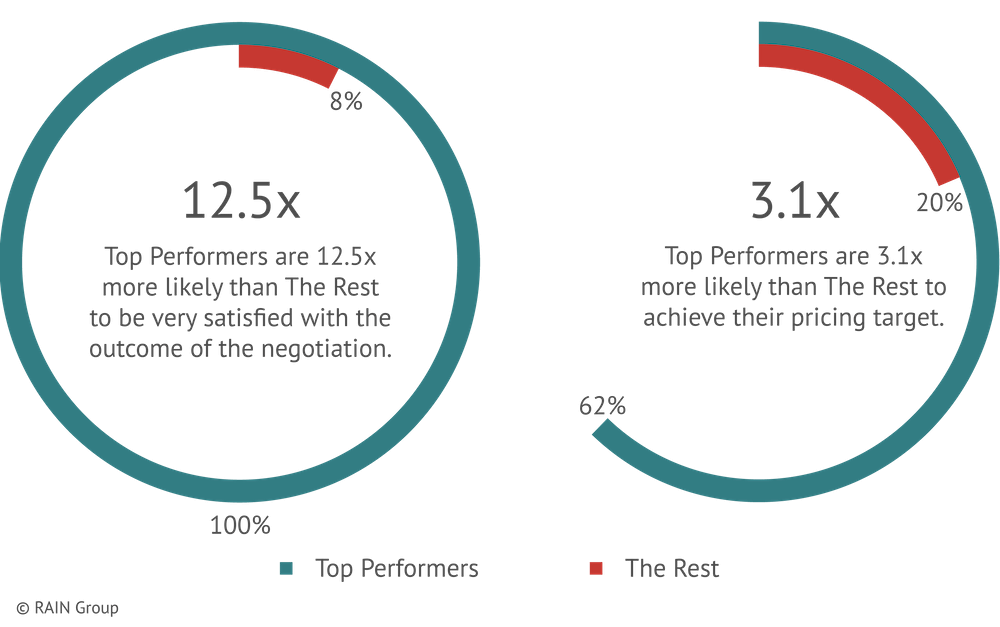
Think about what that means for your commission check.
When you combine higher close rates with better margins, elite negotiators generate massively more revenue than average reps. And the skills gap isn't about being more aggressive or pushy. It's about being more strategic, more prepared, and more emotionally intelligent.
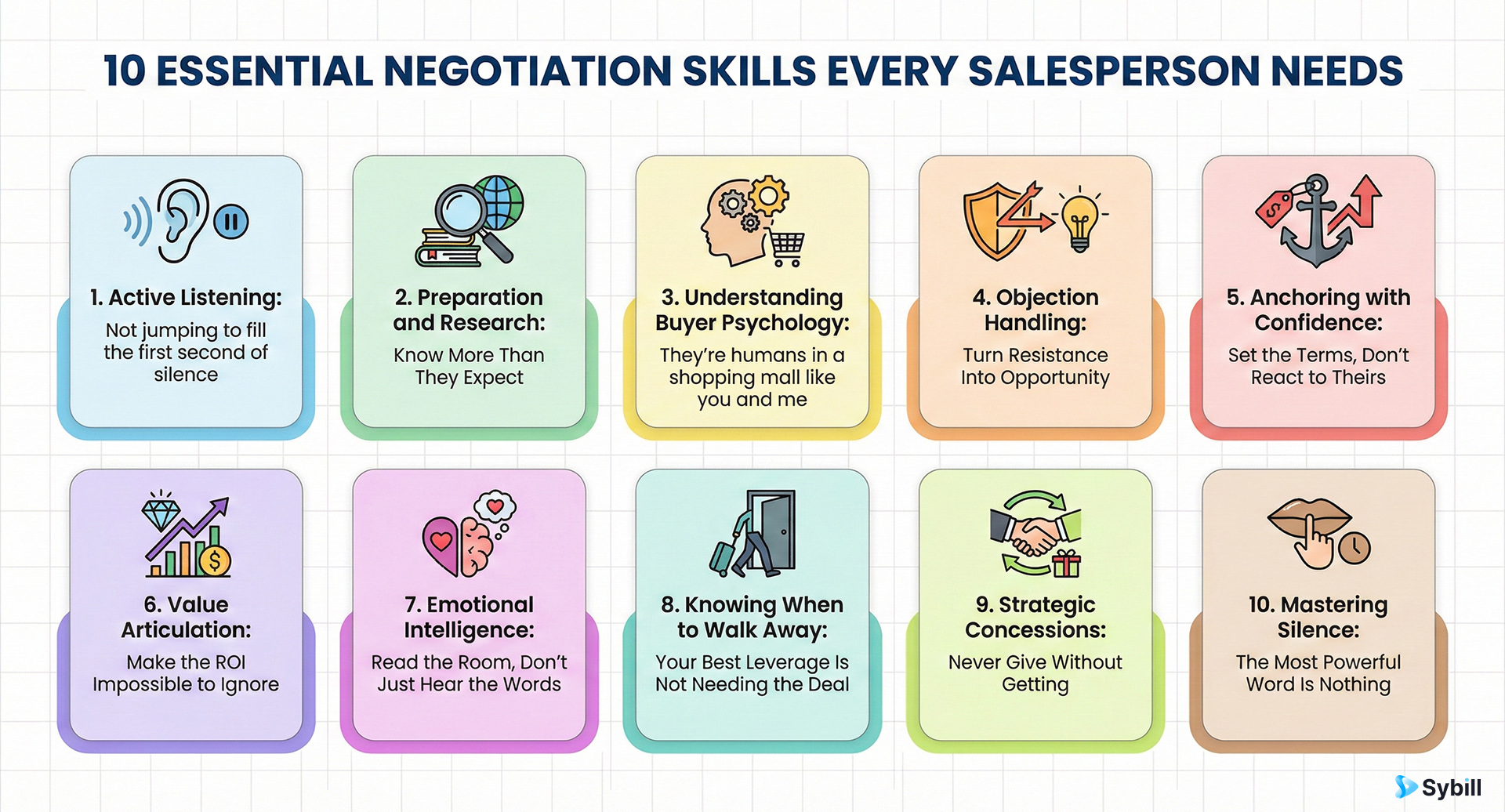
Let's get tactical. Here are the skills that separate negotiation masters from the reps who give away the farm every time a prospect pushes back.
Most salespeople don't actually listen. They wait for their turn to talk. They hear the words but miss the meaning. They're so focused on their next point that they miss critical information the buyer is giving them.
Active listening means:
When a buyer says "your price is too high," they're rarely making a simple factual statement. They might mean:
If you're not listening deeply enough to understand which of these is true, you can't respond effectively.
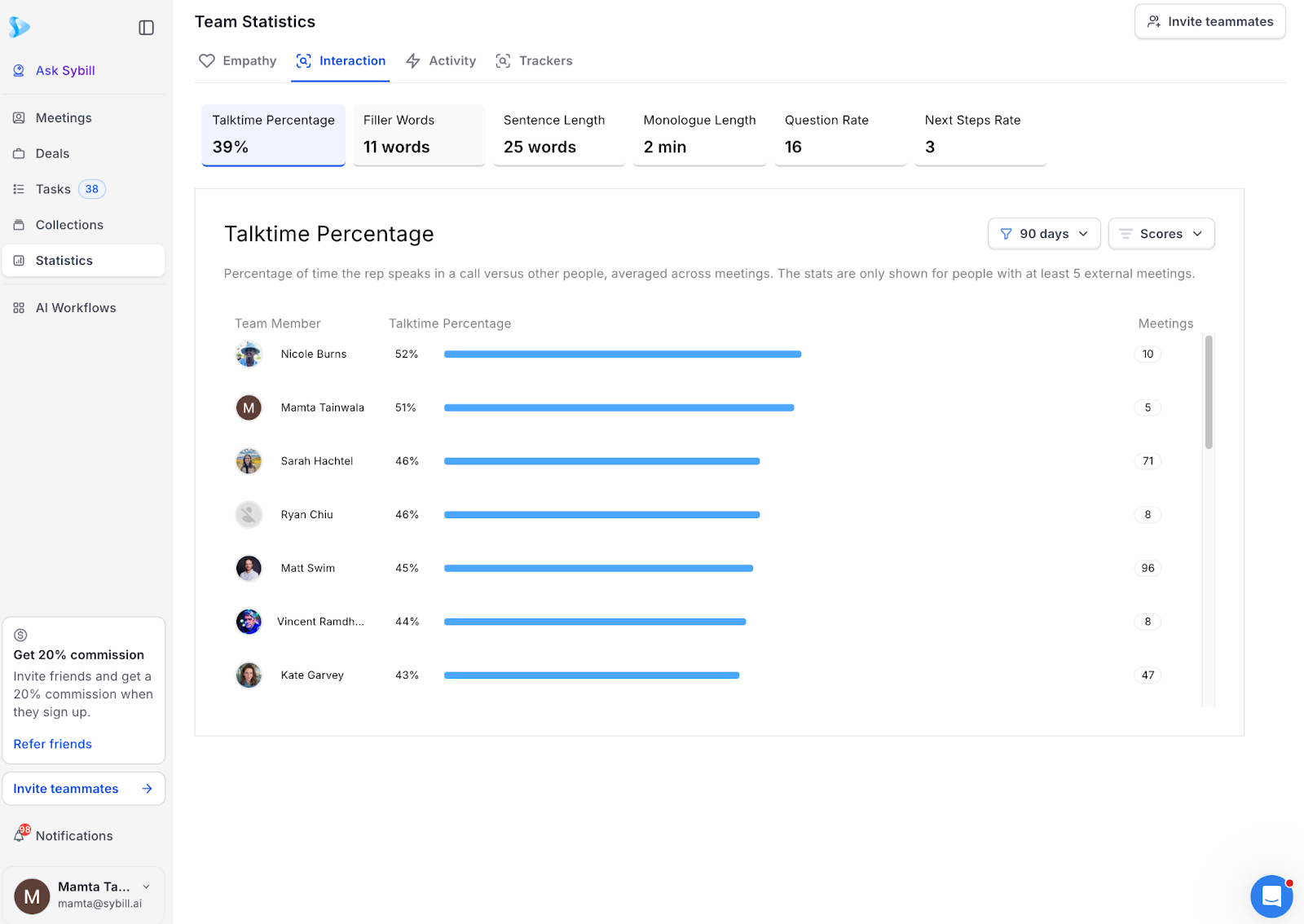
How to practice: Record your sales calls (with permission) and listen back. How much are you talking versus listening? When the prospect raises a concern, do you immediately jump to a rebuttal, or do you ask questions to understand what's really going on?
Tools like Sybill's conversation intelligence can analyze your talk-listen ratio and flag moments where you interrupted or missed buying signals. When you can see the data on your listening habits, you can actually improve them.
The worst negotiators wing it. The best negotiators prepare like they're going to trial.
Before entering any negotiation, you should know:
Preparation doesn't mean scripting every word. It means being ready for anything they throw at you. Sybill’s pre-call brief can help you pick a conversation at any point in the deal and prep for a new prospect within minutes. No scrambling for context.
Pro tip: Use conversation intelligence to analyze past negotiations. Which objections come up most frequently? What responses led to closed deals versus lost opportunities? What talk tracks did your top performers use when handling pricing pushback?
For structured frameworks on handling common objections, check out our objection handling guide.
Economics assumes people are rational. Sales knows better.
Buyers make decisions based on emotion and justify them with logic. Understanding the psychology behind how people evaluate offers gives you a massive advantage.
Key psychological principles for negotiators:
Loss aversion: People are more motivated to avoid losses than to achieve equivalent gains. Frame your offer in terms of what they'll lose by not moving forward, not just what they'll gain.
Anchoring: The first number stated in a negotiation sets a psychological anchor that influences everything after. Make sure you're the one setting the anchor, and make it strong.
Incremental losses, bundled gains: People prefer to receive good news all at once but absorb bad news in smaller chunks. When making concessions, split them into smaller pieces. When presenting value, bundle it together.
Reciprocity: When you give something, people feel obligated to give back. Use this strategically. Don't lead with discounts. Lead with value, then ask for something in return for any concessions you make.
Objections aren't roadblocks. They're opportunities to understand what the buyer actually cares about and to demonstrate that you're a partner, not just a vendor.
The most common objections in B2B sales:
Each of these is hiding a deeper concern. Your job is to uncover it.
The framework for handling any objection:
The key is not having a canned response to "price is too high." It's having the skills to dig into what's really driving the objection and addressing that specific concern.
Our guide on handling pricing objections goes deep on the specific tactics that work when buyers push back on cost.
In negotiation, the person who makes the first offer often controls the conversation. This is called anchoring.
When you anchor first with a strong number, the entire negotiation revolves around that anchor. When you let the buyer anchor, you're negotiating from their starting point.
The mistake: Reps fear that stating a price will scare the prospect away, so they dodge pricing conversations or wait for the buyer to name a number first.
The reality: Research from Gong shows that win rates are 10% higher when pricing is discussed on the first call. Avoiding price doesn't help you. It hurts you.
How to anchor effectively:
If you sound uncertain about your pricing, the buyer will be uncertain too. Confidence isn't arrogance. It's the belief that what you're selling is worth what you're asking.
Buyers don't pay for features. They pay for outcomes.
The better you are at articulating the specific, measurable value your solution delivers, the less price matters.
Weak value articulation: "Our software will save your team time."
Strong value articulation: "Based on what you shared about your team manually updating 50 CRM records daily, and each update taking an average of 8 minutes, you're spending 400 minutes per day on data entry. At your team's average loaded cost of $50/hour, that's $333 per day, or $86,000 annually. Our solution automates 90% of that, saving you approximately $77,000 per year. We're asking for $24,000 annually, which gives you a 3.2x ROI in year one, and even higher returns in years two and three."
See the difference?
The first version is vague and uncompelling. The second uses the prospect's own numbers to show concrete, quantified value that makes the price seem like a bargain.
How to build strong value articulation:
When the value is clear and compelling, price objections evaporate.
The best negotiators don't just hear what's being said. They sense what's happening beneath the surface.
Emotional intelligence in negotiation means:
This isn't about manipulation. It's about empathy. When you understand how the other person feels and what pressures they're under, you can structure a deal that actually works for them.
Pro tip: Sybill's behavioral AI captures non-verbal cues like body language, tone, and engagement levels during video calls. Instead of guessing how the prospect feels, you can see data on when they were confused, excited, or disengaged. This intelligence helps you refine your approach in real time and after the call.
Here's a hard truth: if you need the deal more than the buyer needs your solution, you have no leverage.
The willingness to walk away from a bad deal is the number one strategy that separates top-performing negotiators from everyone else.
What makes a deal "bad"?
Walking away doesn't mean being rude or burning bridges. It means politely explaining that you don't think you're the right fit and suggesting alternatives (or leaving the door open for them to come back with more reasonable terms).
Why this works: When buyers sense you're willing to walk, they often come back with better terms. And when they don't, you've avoided signing a customer who would have become a nightmare.
Set your walk-away line before you enter the negotiation. What's the minimum deal you can accept? What terms are non-negotiable? When you know this in advance, you won't make emotional decisions in the heat of the moment.
Concessions are inevitable in negotiation. The question is whether you give them away or trade them strategically.
The wrong way: Buyer asks for a discount. You immediately offer 15% off to keep the deal moving.
The right way: Buyer asks for a discount. You understand why they're asking, then structure a trade that protects your value while giving them something they want.
Examples of strategic trading:
The principles:
After you state your price, shut up.
After the buyer makes a demand, pause before responding.
Silence is uncomfortable. Your instinct will be to fill it. Resist that instinct.
Why silence works:
When to use strategic silence:
Silence feels like forever when you're the one holding it, but it's usually only a few seconds. Count to ten in your head before you speak. You'll be amazed how often the other person fills the silence with something that helps you.
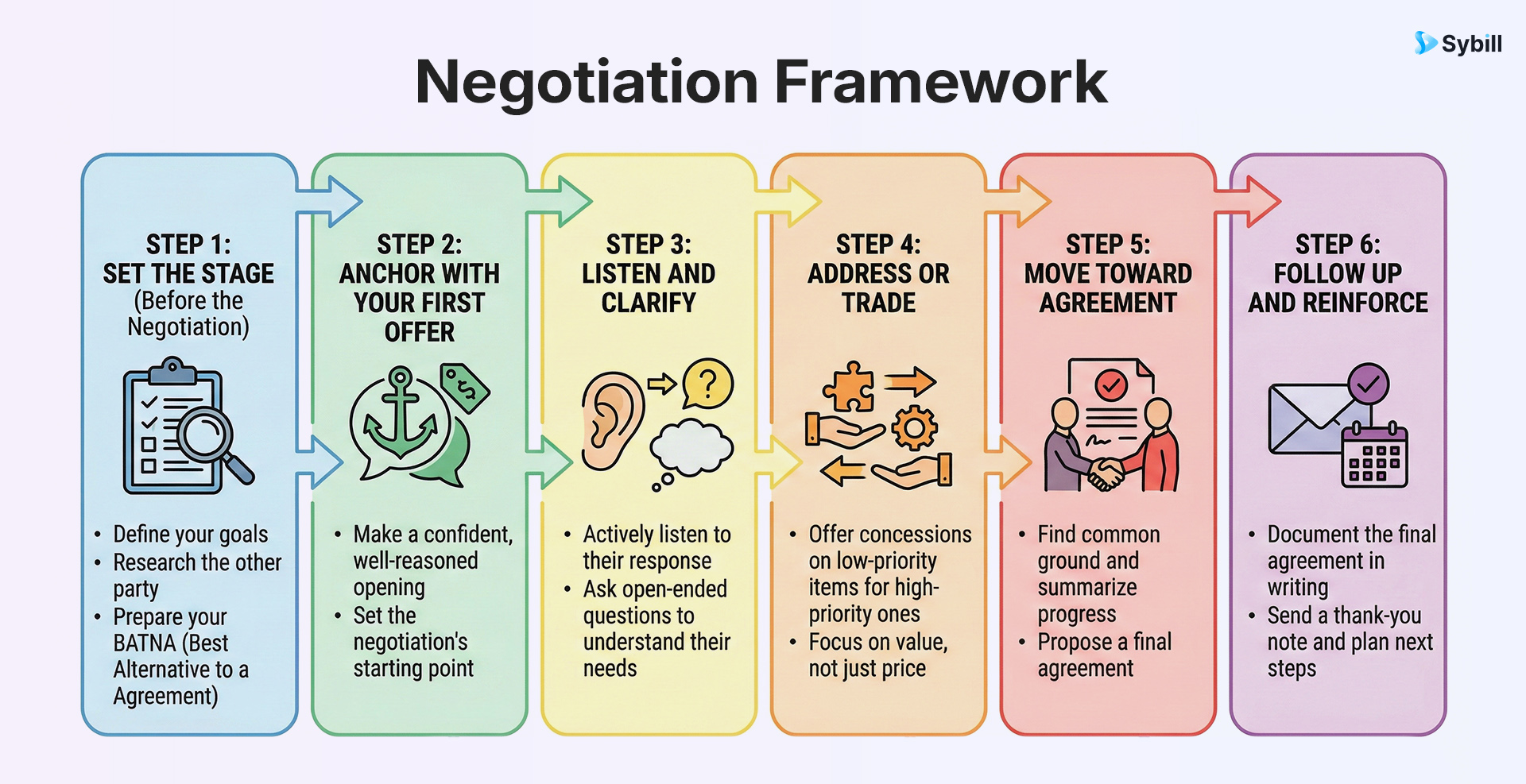
Knowing the skills is one thing. Applying them in sequence is another. Here's the framework for structuring any sales negotiation.
The negotiation doesn't start when the buyer says "let's talk about price." It starts the moment they enter your pipeline.
What to do early:
The better your discovery and the stronger the relationship, the easier the negotiation will be.
When it's time to present pricing, go first. State your number confidently.
Don't apologize, don't hedge, don't immediately offer alternatives. Present your standard pricing and the value it delivers.
Then stop talking.
When the buyer responds (and they will), listen carefully. Are they:
Before you respond, make sure you understand what's really going on. Ask clarifying questions. Get to the root of the objection.
Now you can respond. Either:
Never give concessions without getting something in return.
As you resolve objections and structure trades, move toward documenting the agreed terms.
Summarize what's been agreed, confirm alignment, and get commitment on next steps.
After the negotiation, send a clear summary of what was agreed and why this is a great deal for both parties.
Reinforce value. Confirm timeline. Make it easy to say yes.
Get started for free with Sybill to track objections across your deals, analyze what negotiation tactics work best for your team, and get AI-generated insights on buyer sentiment during pricing conversations.
Sales negotiation has evolved. What worked in 1995 doesn't work today. Here's what modern negotiators are doing differently.
The old-school approach to negotiation was adversarial. You vs. them. Winner and loser.
Modern negotiation is collaborative. You're working together to structure a deal that makes sense for both parties. This mindset shift changes everything.
Buyers have access to more information than ever. Pricing is often public or semi-public. Competitors are a Google search away.
Playing games with pricing or trying to hide information doesn't work anymore. The best negotiators are transparent about their pricing structure, why it's set that way, and where they have (and don't have) flexibility.
Top negotiators don't compete on price. They compete on value.
They invest time in discovery to understand the buyer's situation. They quantify the cost of the status quo. They show concrete ROI. And when the price comes up, they tie it back to that value.
The best sales teams don't just negotiate, they analyze their negotiations and get better over time.
What objections come up most often? Which responses work? What talk tracks lead to higher win rates? Where do deals stall?
Conversation intelligence platforms can surface this data automatically, turning every negotiation into a learning opportunity.
For example, you can ask questions like "Show me all deals where pricing objections came up and we still closed at full price. What did the rep say?" or "Compare my negotiation approach to our top performer's approach."
Sybill's Ask Sybill feature lets you query your entire deal history to find patterns and best practices. Instead of guessing what works, you can see the data.
Different situations require different approaches. Here are proven tactics for common negotiation scenarios.
Don't: Immediately discount to match.
Do: Understand what they're comparing and what they value.
"I appreciate you doing your research. Can I ask what you're comparing us to specifically? I want to make sure we're looking at apples to apples."
Then differentiate on value, not price. Show what they get with you that they don't get with the competitor. Quantify the difference.
If the competitor truly is a better fit, acknowledge it. But often, the "cheaper competitor" is missing critical features or service levels that matter to this buyer.
Don't: Ask "why" in a defensive tone or immediately say no.
Do: Understand the constraint and explore alternatives.
"Help me understand what's driving that request. Are you working within a specific budget for this quarter, or is there something about the value we've discussed that doesn't align with the investment?"
Then explore options:
The goal is to structure a deal that works financially for them without destroying your margins.
Don't: Try to please everyone by offering everything.
Do: Map out what each stakeholder cares about and structure your proposal accordingly.
The CFO cares about ROI and payment terms. The end user cares about ease of use and support. The VP cares about strategic alignment and vendor stability.
Your proposal should speak to all three, showing how this deal meets everyone's needs.
And if there's conflict between stakeholders, help them resolve it. Position yourself as a partner helping them make the right decision, not a vendor pushing for a signature.
Don't: Panic and send a discount to "sweeten the deal."
Do: Follow up with value reinforcement and ask what they need to move forward.
"I wanted to follow up on the proposal I sent last week. Based on our conversations, I believe this delivers significant value by [specific outcomes]. What questions can I answer to help you move forward?"
Often silence means they're busy, dealing with internal approvals, or need more information. It doesn't mean they need a discount.
Don't: Keep pushing the same points or make desperate concessions.
Do: Suggest taking a break or exploring a different approach.
"It sounds like we're not quite aligned yet. Can I suggest we pause on this for now and I'll go back to my team to see if there's a different way to structure this that might work better for both of us?"
This gives you time to regroup, consult with your manager, and come back with fresh ideas. It also shows the buyer that you're not just going to cave, you're working to find a real solution.
Our guide on using ChatGPT for objection handling roleplay walks through exactly how to practice negotiation scenarios until you've mastered them.
Here's where most negotiation training falls short: it teaches principles, but it doesn't give you feedback on your actual performance.
You can know that active listening matters, but do you know how much you're actually listening versus talking in your negotiations? You can understand anchoring theory, but are you confidently stating your number or hedging?
This is where conversation intelligence changes the game.
What conversation intelligence reveals:
Instead of guessing what works, you can see the data. And when you can measure it, you can improve it.
Sybill analyzes every sales conversation and surfaces the moments that matter. When a buyer raises a pricing objection, it flags it. When competitors are mentioned, it captures it. When you successfully handle resistance, it learns from it.
Over time, you build a library of what works - not theory from a book, but actual tactics that closed deals in your specific market with your specific buyers.
Get started for free with Sybill and turn every negotiation into a learning opportunity that makes you sharper for the next one.
Individual negotiation skills are great. Team-wide negotiation excellence is better.
The best sales organizations build playbooks that capture what works and make it accessible to everyone.
What to include in your negotiation playbook:
With conversation intelligence, you can build this playbook semi-automatically. Instead of relying on reps to manually document what worked, the system captures it from actual calls.
"Show me the top 10 deals where we overcame pricing objections and closed at full price. What did the rep say?"
"Which objection handling approach has the highest win rate when competing against CompetitorX?"
"Create a coaching playlist of the best examples of value articulation from this quarter."
This is how modern sales teams scale excellence.
For more on building structured sales processes that include objection handling and negotiation frameworks, see our guide on ICP and sales playbooks.
The most critical negotiation skills for salespeople are active listening, preparation and research, objection handling, value articulation, and knowing when to walk away. Active listening helps you understand the real needs behind stated demands. Thorough preparation gives you confidence and options during the negotiation. Strong objection handling turns resistance into opportunities to demonstrate value. Clear value articulation makes price objections less relevant by showing concrete ROI. And the willingness to walk away from bad deals gives you leverage and prevents you from accepting unprofitable terms. Master these five skills and you'll outperform 80% of sales reps.
Negotiate sales without discounting by focusing on value, not price, and by trading rather than conceding. First, build a compelling business case during discovery that quantifies the cost of the status quo and the ROI of your solution. When buyers request discounts, understand what's really driving the request - is it budget constraints, value uncertainty, or just testing to see if you'll budge? Then address the root cause: if it's budget, explore payment terms or phased implementation; if it's value uncertainty, provide more proof points and case studies; if they're testing, confidently reaffirm your pricing and the value it delivers. If you do make concessions, always trade for something valuable in return like longer contract terms, additional users, referrals, case study participation, or faster payment. Never discount for free.
The most effective B2B sales negotiation techniques are collaborative rather than adversarial. Start by anchoring the conversation with your first offer, presented confidently with clear value justification. Use constraint rationales when explaining your position rather than disparaging the buyer's concerns - frame limitations as external factors rather than rejecting their needs. Leverage loss aversion by showing what they'll lose without your solution, not just what they'll gain. Master strategic silence after stating your price or addressing objections; let the buyer process rather than filling uncomfortable pauses with concessions. Build multi-threading relationships with all stakeholders to understand different priorities and craft proposals that address each decision-maker's concerns. Most importantly, use conversation intelligence to analyze your negotiations, identify patterns in successful deals, and continuously refine your approach based on data rather than gut feel.