Find us at booth #83, join us for a harbor side happy hour, or catch Gorish’s talk.

Sept, 16-18 > Learn more


Tamanna Mishra

September 19, 2026
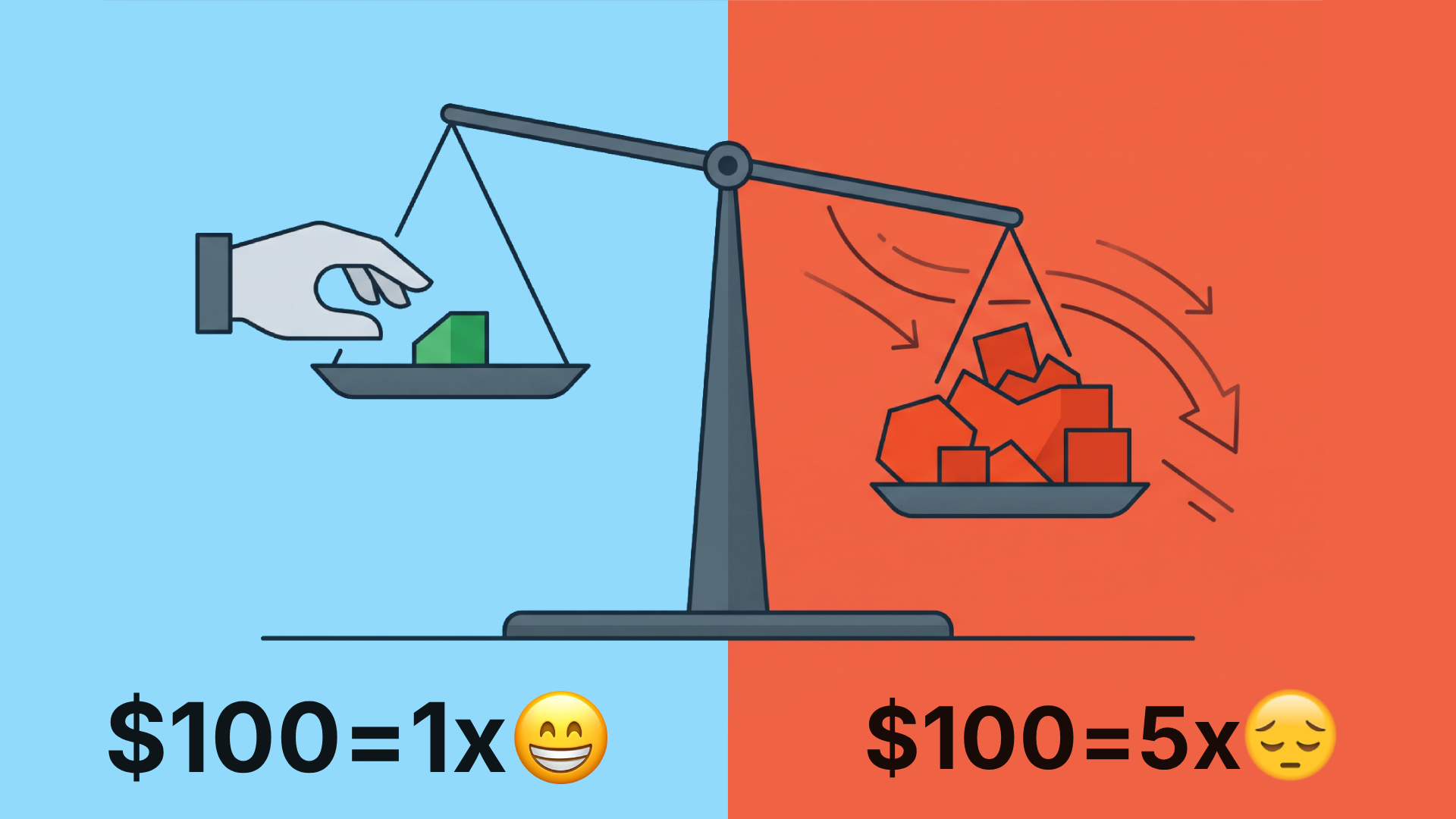
Loss aversion in sales is the tendency for possible losses to influence a decision more strongly than equivalent gains. A buyer may remain with an inadequate system because losing familiarity, budget, control, or professional credibility feels more immediate than the benefits of changing.
The usual sales advice is to quantify the cost of inaction, emphasize what the prospect could lose, and make the status quo feel intolerable. That advice tells only half the story.
Changing also creates potential losses, including implementation work, adoption problems, wasted budget, or accountability if the project fails. A seller who highlights only the cost of doing nothing is selectively framing the decision.
Loss aversion also affects salespeople. It can make a rep cling to an unwinnable deal, discount too quickly, or avoid disqualification. Used responsibly, loss aversion is a framework for making material risks visible, testable, and comparable.
Loss aversion is the idea that losses and disadvantages can affect decisions more strongly than comparable gains and advantages. It forms part of prospect theory, which explains how people evaluate outcomes relative to a reference point rather than only by their final value.
In sales, buyers may overvalue the apparent safety of their current approach because change exposes them to visible risks. Sellers may also become loss averse when they fear losing pipeline, commission, time already invested, or forecast credibility.
Ethical use of loss aversion means documenting the real cost of inaction while giving equal attention to the cost and risk of change. Every claim should be sourced, quantified transparently, validated by the buyer, and presented without artificial scarcity or certainty.
Loss framing is often presented as an urgency mechanism: show buyers what they are losing and they will act. But a B2B buyer is comparing at least two uncertain futures.
In one future, they maintain the status quo and continue absorbing its costs. In the other, they spend money, change established workflows, ask colleagues to adopt something new, and accept responsibility for the outcome. The second path can feel more dangerous because its losses are immediate and attributable.
This pressure is amplified in group decisions. Forrester’s 2026 buyer research found that the typical business purchase involves 13 internal stakeholders and nine external influencers, with even larger networks involved in complex or strategic purchases.
Forrester analyst Barbara Winters captures the environment succinctly:
“B2B buyers are under immense pressure to justify investments and minimize risk.”
Loss-aware selling must therefore do more than make inaction look expensive. It must make the complete decision safer to evaluate.
Loss aversion describes how outcomes below a person’s reference point can affect preferences more than comparable outcomes above it.
Daniel Kahneman and Amos Tversky developed prospect theory in 1979 to explain why real decisions under uncertainty often differ from the predictions of traditional expected-utility models. Their later work on reference-dependent choice described the central idea that losses and disadvantages can have greater influence than gains and advantages. The concept is commonly summarized as “losses loom larger than gains.”
The reference point is essential. A result feels like a gain or loss relative to what someone believes they have, expect, or are entitled to receive.
For a buyer, that reference point might be:
The same proposal can be a gain and a loss. Replacing a manual process may create capacity while threatening familiar routines and ownership.

No. The popular “twice as painful” rule is a simplification, not a universal psychological constant.
Researchers debate how consistently loss aversion appears. A 2018 review by David Gal and Derek Rucker questioned its generality. A subsequent five-sample study involving 17,720 participants found evidence for it while showing meaningful variation across people and circumstances.
The sales conclusion is that reference points and perceived losses can shape decisions, so sellers should investigate them instead of assuming them.
Loss aversion overlaps with several decision-making concepts, but they are not interchangeable or “types” of the same bias.
This distinction matters because each problem requires a different response. A buyer who fears implementation failure does not need more urgency. They need stronger proof and risk mitigation. A buyer protecting a sunk investment needs help evaluating future outcomes independently of past spending.
Imagine a RevOps leader evaluating a platform that could automate CRM updates and improve deal visibility.
Six sales managers each spend approximately four hours a week rebuilding pipeline information. Reps dislike manual data entry, and leadership does not trust several CRM fields.
The platform could reduce that work. Yet the RevOps leader hesitates because changing creates different potential losses:
A simplistic loss-aversion pitch would say:
“Every month you delay, your team loses thousands of dollars in productivity.”
That statement hides its assumptions and ignores the buyer’s concerns.
A stronger conversation would sound like this:
“You estimated that six managers spend about four hours each week rebuilding pipeline data. Does that remain the right baseline? We should compare that ongoing cost with the implementation time, subscription cost, and adoption risk your team would take on by changing.”
The second version makes inaction visible while giving the buyer control over the calculation and acknowledging the risk of purchasing.
Buyers may protect more than money. They can fear losing familiarity, autonomy, internal influence, stability, time, data, or credibility.
Finance may compare the proposal with current spending, IT with architectural stability, end users with familiar routines, and an executive sponsor with a promised target.
This is why multi-threading matters. One champion cannot reliably represent every stakeholder’s perception of gain and loss.
Sellers have their own reference points: quota, commission, pipeline coverage, time invested, and commitments made to leadership.
Loss aversion may appear when a rep:
A framework such as MEDDPICC cannot remove bias, but it can force the team to compare confidence with evidence.
Ethical loss framing starts with discovery and ends with buyer agency.
Understand what the buyer considers normal, expected, owned, or already committed. Ask:
Investigate what the problem affects in operational, financial, strategic, or human terms. Sybill’s guides to sales discovery questions and SPIN Selling cover the deeper process.
Do not translate inconvenience into a major loss without evidence. “CRM updates take time” does not prove millions in lost revenue.
Classify every consequence as confirmed, inferred, missing, or contradictory.
A seller may hypothesize that slow follow-up affects conversion. That is not a confirmed fact for this buyer. Ask what the organization has observed and what could validate the connection.
Show the inputs behind any cost-of-inaction calculation:
Use ranges when the evidence does not support precision. Gap Selling can help connect the current state to a measurable future state.
Compare the current-state loss with the buyer’s expected investment, implementation work, adoption risk, switching cost, and opportunity cost.
Legitimate urgency may come from a contract renewal, regulation, product launch, budget cycle, seasonal window, or implementation dependency. The seller’s quarter-end is not a buyer event. Neither is a discount that supposedly expires every Friday.
Ask whether the analysis is accurate. Invite disagreement. Show what would have to be true for staying with the current approach to be better.
Solution selling and Challenger Sales require the same judgment. Challenge assumptions with evidence, not the buyer’s intelligence or right to decide.
Before presenting a loss-framed argument, review it against these questions.

If the seller cannot show the source, assumptions, and counter-risk, the argument is not ready to present as fact.
Overcoming loss aversion does not mean ignoring risk. It means preventing one visible loss from dominating the complete decision.
The objective is a decision process that can survive emotional pressure.
Loss framing can discourage action when it:
It also damages trust when the seller appears to benefit from every calculation. A loss estimate is more defensible when the buyer helps create and challenge it.
AI should retrieve and inspect evidence, not diagnose buyer psychology or invent a more frightening message.
Sybill brings together context from calls, emails, and CRM activity. Magic Summaries can capture pain, objections, stakeholders, next steps, and coaching opportunities. Ask Sybill lets sellers query the account history instead of relying on memory.
Useful Ask Sybill questions include:

Deal Inspection can help teams examine qualification gaps and risks, while CRM Autofill can keep fields such as business impact, decision criteria, competitors, and next steps current.
This evidence discipline matters for seller bias too. In an Auditoria customer story, AE Stephanie Utesch explains that a post-deal review surfaced a buyer comment showing that a major opportunity was never likely to proceed as expected: “Sybill saw it and we totally missed it.”
That story shows why sellers need contradictory evidence when optimism or time invested makes a deal difficult to assess.
Loss aversion is not permission to make a buyer afraid. It is a reminder that people evaluate decisions relative to what they believe they may lose, and that those reference points can shape both action and inaction.
The responsible seller makes the current-state cost visible and compares it with the risks of change. They distinguish evidence from inference and give the buyer room to challenge the case.
The same discipline must be applied internally. Sales teams need to recognize when fear of losing pipeline or admitting uncertainty is keeping a weak opportunity alive.
AI can make the evidence easier to retrieve, but the judgment remains human. Explore Ask Sybill to see how complete account context can support better deal questions, risk reviews, and next steps.
Loss aversion means potential or actual losses can influence a decision more strongly than comparable gains. Its effect depends on the person’s reference point, context, and expectations, so it is not a universal mathematical rule.
Loss aversion bias is the tendency to give disproportionate weight to perceived losses. In sales, it may make buyers protect familiar systems or make sellers cling to weak deals because losing the opportunity feels especially painful.
A buyer may keep an inefficient platform because switching could consume budget, disrupt work, or damage their credibility if implementation fails. Those possible losses may feel more immediate than the future benefits of changing.
No. Loss aversion concerns gains and losses relative to a reference point. Risk aversion is a broader preference for more certain outcomes. They can interact but are not synonyms.
No. “Twice as powerful” is a popular simplification. Loss aversion varies across contexts and individuals, and scholars dispute its generality. Sellers should investigate the buyer’s decision rather than apply a fixed multiplier.
It becomes manipulative when a seller invents losses, exaggerates probabilities, hides purchase risks, or creates false urgency. It can be ethical when evidence is buyer-validated and the buyer remains free to disagree.
Compare realistic options, define the reference point, separate sunk costs from future outcomes, and examine action and inaction risks. Sellers should use qualification criteria and deal reviews to protect their judgment.
Yes. The current approach may be imperfect, but its limitations are familiar. A new solution creates visible costs, work, uncertainty, and accountability. Those potential losses may cause the buyer to retain the status quo.
Yes. Salespeople may avoid disqualifying weak opportunities, invest more because they have already invested heavily, discount prematurely, or resist lowering a forecast. Qualification, pre-mortems, and buyer-owned milestones can reduce these effects.
Loss aversion means potential or actual losses can influence a decision more strongly than comparable gains. Its effect depends on the person’s reference point, context, and expectations, so it is not a universal mathematical rule.
Loss aversion bias is the tendency to give disproportionate weight to perceived losses. In sales, it may make buyers protect familiar systems or make sellers cling to weak deals because losing the opportunity feels especially painful.
A buyer may keep an inefficient platform because switching could consume budget, disrupt work, or damage their credibility if implementation fails. Those possible losses may feel more immediate than the future benefits of changing.