Find us at booth #83, join us for a harbor side happy hour, or catch Gorish’s talk.

Sept, 16-18 > Learn more


Mamta Tainwala

June 16, 2026
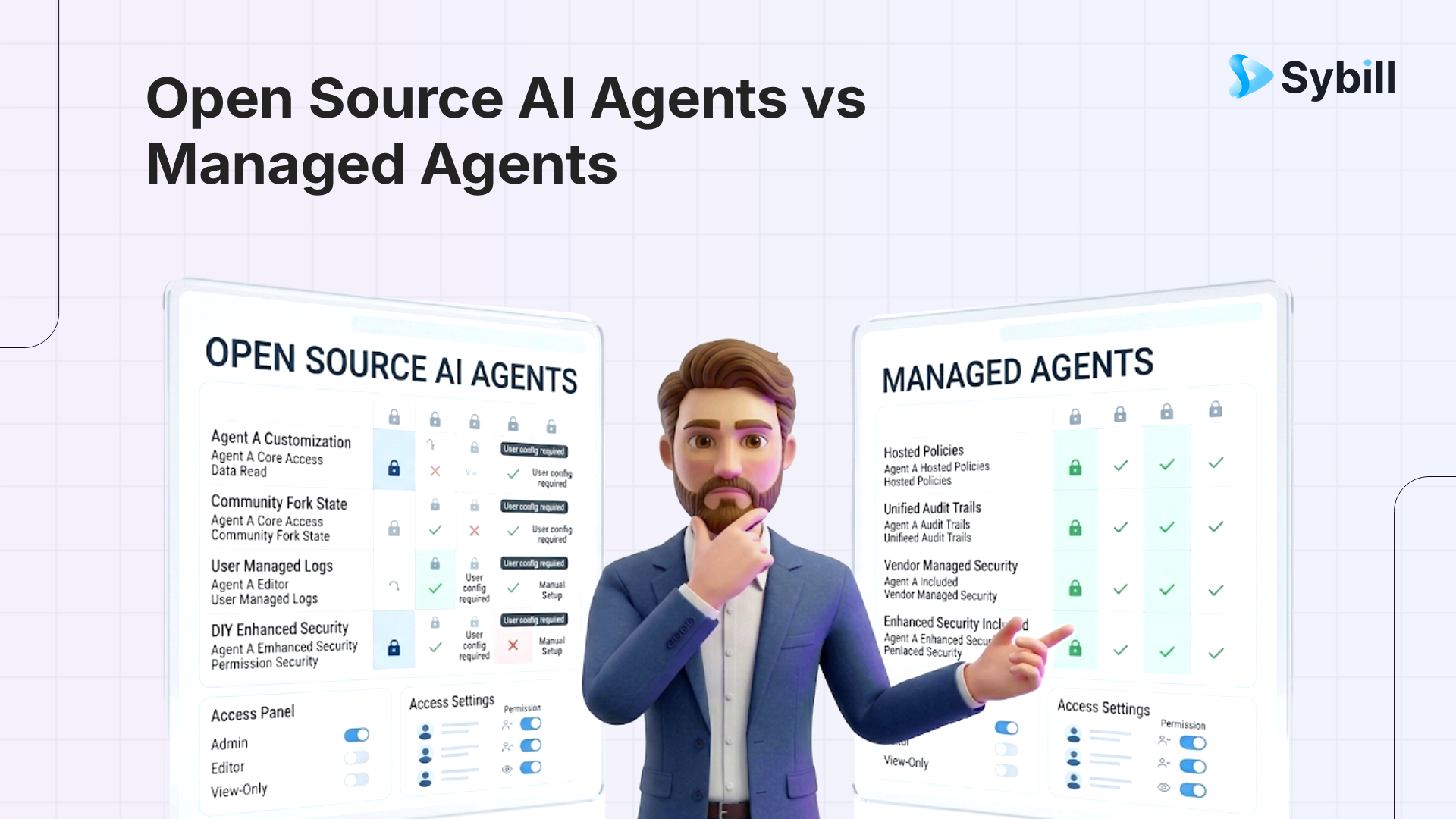
The most important thing to understand about this comparison is that open source and managed are not competing answers to the same question. They are answers to different questions depending on what you are trying to do, how much control you need, and how much setup time you are willing to invest.
The short version: open source agents give you full control over every component, every model, every memory structure, and every integration, at the cost of more setup and maintenance work. Managed agents give you faster time to value, built-in reliability, and purpose-specific design, at the cost of some flexibility and, in some cases, constraints on what you can customize.
Gorish Aggarwal, CEO of Sybill AI, who built his personal agent stack on OpenClaw (an open source framework), frames the space clearly: "OpenClaw is one of the most open models, which means you get control over what models to use, you get control over a lot of interfaces, there is no lock-in, you can build your own memory and your own skills. Other tools have launched their own managed agents and those have built specificity around certain vendors, and there are restrictions on top of each of these agents which sometimes will block you from completing the flow."
Neither option is categorically better. The right choice depends on your use case, your team's technical comfort, and whether you need the breadth of a custom build or the depth of a purpose-built platform.
This post breaks down both options honestly, including where each one fails, and gives GTM and sales teams a clear decision framework for which path to take.
An open source agent framework is a software layer that lets you build autonomous agents with full control over every component: which language model runs the agent, how memory is stored and retrieved, which tools the agent connects to, when and how the agent triggers, and what it is and is not allowed to do.
OpenClaw, which had over 400,000 GitHub stars as of early 2026 and is one of the fastest-growing repositories in GitHub's history, is the most prominent example. It runs locally on your hardware (or a remote machine), connects to any model via API, supports any MCP-compatible tool integration, and gives you complete visibility into everything the agent does.
The defining characteristics of an open source agent framework:
No model lock-in. You choose which model handles which task. Premium models for complex reasoning, cheap models for classification and routing. You can switch models without rebuilding the agent. For cost management, this flexibility is significant.
No interface lock-in. Your agent can operate through Slack, WhatsApp, email, iMessage, a web app, or any channel you configure. The interface is not determined by the platform.
Full memory control. You build and own the memory architecture: the file structure, the database schema, the write-back logic, the retrieval patterns. Nothing is abstracted away.
Full skill control. Every skill file is yours. You define the rules, the edge cases, the output formats, and the update process. Nothing is locked inside a platform you cannot inspect.
No usage restrictions on integrations. You connect what you need. If the tool has an MCP server or an API, the agent can use it.
The tradeoff is setup time, maintenance responsibility, and the need to think through security and permissions architecture yourself. Everything that a managed platform handles in the background, you handle explicitly.
A managed agent is one built and delivered by a platform vendor, designed for a specific set of use cases, running on the vendor's infrastructure, with pre-configured integrations, and a defined set of customization options within the platform's boundaries.
Claude's managed agents (Claude routines and project-based agent features), OpenAI's operator agents, and purpose-built platforms like Sybill for sales teams are all examples of managed agents at different levels of specificity.
The defining characteristics of a managed agent:
Faster time to value. The core functionality works out of the box. You configure rather than build. For most use cases, you are running in hours rather than days or weeks.
Infrastructure handled. The platform manages hosting, uptime, scaling, and security at the infrastructure level. You do not need to think about where the agent runs or whether it will be available when something triggers it.
Purpose-built for specific domains. Managed agents designed for sales, customer success, or recruiting bring deep domain-specific functionality that would take weeks to build from scratch. Sybill's deal inspection, buyer intelligence, and pre-meeting briefs are not generic agent capabilities. They are purpose-built features informed by how sales teams actually work.
Defined customization ceiling. The platform decides what you can customize and what is fixed. For some teams, the fixed components are exactly what they need. For others, they are constraints that prevent the agent from doing what the team requires.
Vendor dependency. Your agent's capabilities evolve on the vendor's roadmap, not yours. If the platform changes its pricing, access policies, or supported integrations, your agent is affected.

Open source wins in five situations.
1. You need flexibility across multiple domains. Gorish's six-agent personal setup, handling everything from personal scheduling to competitive intelligence to GTM workflows, would not be possible with a single managed platform. No single vendor covers all those domains with the depth needed. Open source lets you build purpose-fit agents for each domain and connect them with a shared memory architecture.
2. You need model cost control. The ability to tier models, routing classification tasks to a cheap model and complex reasoning to a premium one, is much easier to implement in an open source setup where you control every model call. Managed platforms are improving on this but most still have less granular model control than a custom build.
3. You are building memory that spans multiple domains. A shared memory architecture where a personal agent, a GTM agent, and a product agent all read from and write to a common context store requires controlling the memory layer directly. Most managed platforms maintain siloed memory within their product boundary.
4. You need integrations the managed platform does not support. If the tool you need is not in the platform's integration library, open source is the only path. OpenCLAW connects to any MCP-compatible tool, which as of 2026 covers the vast majority of business tools.
5. You want no vendor lock-in. Open source agents are portable. You own the soul files, the memory architecture, the skill files, and the codebase. If a model provider changes its pricing or a tool changes its API, you adapt without losing your accumulated context or your configuration.
Managed agents win in five situations too, and these situations describe most sales teams building their first AI capabilities.
1. You need to move fast and do not have time to build. A sales team that wants AI-assisted post-call workflows, deal reviews, and pre-meeting briefings operational within a week is not going to build a custom agent stack from scratch. Sybill handles all three out of the box. The alternative is three to six weeks of agent architecture, skill file writing, curation cycles, and tool connection work before the first call gets processed.
2. The domain requires deep, pre-built context about how the work actually operates. A generic agent applying a MEDDPICC skill file will produce useful deal reviews. Sybill's deal inspection produces better ones because it is built specifically around how sales conversations work, what signals appear in call recordings, how CRM data maps to deal progression, and what patterns across thousands of sales interactions predict outcomes. That domain depth cannot be built in a weekend.
3. Your team is not technical. Open source agent frameworks require comfort with configuration files, terminal commands, API keys, and at minimum a working knowledge of how software systems connect. Managed platforms abstract all of that. For a sales team without engineering support, the difference between configuring a Sybill integration and building an OpenClaw setup is the difference between a few hours and several weeks.
4. Compliance and data handling requirements need platform-level guarantees. If your industry has specific requirements around data residency, encryption, audit trails, or access controls, a managed platform with enterprise security certifications is significantly easier to deploy than a custom build that requires security review from scratch.
5. You want the platform to handle the agent improvement loop. Managed platforms improve their capabilities over time on the vendor's roadmap. A sales team on Sybill benefits from every improvement to the summarization model, the deal inspection logic, and the CRM sync quality without doing any work to get it. In an open source setup, those improvements require active maintenance.
The most sophisticated teams in 2026 are not choosing between open source and managed. They are running both in a layered architecture.
The managed platform, whether Sybill or another purpose-built tool, handles the heavy data capture, domain-specific intelligence, and pre-built workflows. It is the context layer and the execution layer for the work it is specifically designed for.
The open source agent layer sits on top, connected to the managed platform via MCP, using the intelligence the platform has already captured as the foundation for custom workflows the platform does not natively support. A custom GTM agent that reads Sybill's deal intelligence, cross-references it with competitive news from a web monitoring agent, and delivers a morning briefing that combines both is doing something neither Sybill nor a generic agent could do alone.
Gorish's own setup reflects this logic. He uses Sybill as the call intelligence and deal context layer for his sales workflows, while running OpenCLAW agents for the personal and cross-domain tasks that no single managed platform covers.
The Sybill MCP connector is specifically designed to enable this hybrid architecture. It makes Sybill's call intelligence, deal context, and CRM data available to any external agent setup, so custom agents built on OpenCLAW or other frameworks start with organizational memory rather than from scratch.
For teams ready to go deeper on the open source side, the AI agent components breakdown and how to build your first AI agent cover the foundational architecture. For understanding what the managed platform layer brings, AI agents for sales teams covers the use case map in detail.

Use this framework to determine where to start.
Start with a managed platform if:
Start with an open source framework if:
Build a hybrid if:
One practical note on timing: most teams start with managed, because faster time to value is genuinely valuable and the learning curve for open source is real. After running a managed platform for three to six months, the teams that want more customization have a much clearer picture of exactly what they need to build, which makes the open source investment much more focused.
"Open source is only for technical teams." Gorish built his entire six-agent setup without writing a single line of code. The soul files, skill files, and memory architecture are text files. The hardest technical step is connecting MCP integrations, which typically requires following a documented setup process rather than writing code. Teams without engineering support can get further than they expect, though the learning curve is real.
"Managed agents are just simpler, weaker versions of custom agents." For their specific domains, managed agents are often more capable than a custom build. Sybill's call intelligence is not a simplified version of what you could build from scratch with a generic agent. It is purpose-built functionality informed by deep domain knowledge that would take months to replicate.
"Open source is always cheaper." Open source eliminates platform fees but introduces token costs that are entirely your responsibility to manage. A managed platform may include features that would cost significantly more in tokens if built from scratch and run at scale. The cost comparison requires accounting for both, not just the platform subscription.
"Once you choose one, you are locked in." The hybrid architecture described above is specifically how teams avoid this. The memory and configuration in an open source setup is portable. The intelligence captured by a managed platform can be accessed via MCP by external agents. The two are composable, not exclusive.
What is the difference between open source AI agents and managed AI agents?
Open source agents give you full control over every component: model choice, memory architecture, tool connections, and skill definitions. Managed agents are built and maintained by a platform vendor for a specific domain, offering faster setup and built-in domain expertise at the cost of some flexibility.
Is OpenCLAW better than Claude's managed agents?
They serve different purposes. OpenCLAW is better for custom, multi-domain, no-lock-in setups where you need full control. Claude's managed agents and purpose-built platforms like Sybill are better for specific domains where you want pre-built functionality and faster deployment. Most advanced teams run both in a hybrid architecture.
Do I need to know how to code to use an open source agent framework?
Not necessarily. Gorish Aggarwal built a six-agent setup on OpenCLAW without writing any code. The configuration work is primarily text files. MCP integrations follow documented setup processes. That said, the learning curve is real and the troubleshooting process is more hands-on than using a managed platform.
Can I use Sybill as the data layer for an open source agent?
Yes. Sybill's MCP connector makes call intelligence, deal context, and CRM data available to any external agent setup. An OpenCLAW agent connected to Sybill via MCP starts with organizational memory already in place rather than building data capture from scratch.
What is the best AI agent setup for a sales team?
For most sales teams, the fastest path to value is a managed platform like Sybill for the core sales workflows (post-call admin, deal reviews, pre-meeting briefings), extended with a custom open source agent layer for workflows the platform does not natively support. Start with managed, add open source as you identify specific needs that require custom builds.
Is there vendor lock-in with managed agents?
For the configuration and workflows built within the platform, yes. For the data and intelligence captured by the platform, it depends on whether the platform exposes a data export or MCP connection. Sybill's MCP connector specifically addresses this by making call and deal intelligence available to external systems.
The open source vs managed question is not about which is more powerful in the abstract. It is about what you need right now, what you have the capacity to build and maintain, and how much domain-specific depth your use case requires.
For sales teams starting their AI agent journey, managed platforms like Sybill deliver the fastest path to working intelligence on the use cases that matter most: post-call workflows, deal reviews, coaching, and pipeline visibility. For teams ready to extend beyond what any single platform covers, an open source layer on top, connected via MCP, is how the most advanced setups are built in 2026.
Explore what Sybill handles out of the box or book a demo to see the managed platform layer in action before deciding how much to build on top.
Open source agents give you full control over every component: model choice, memory architecture, tool connections, and skill definitions. Managed agents are built and maintained by a platform vendor for a specific domain, offering faster setup and built-in domain expertise at the cost of some flexibility.
They serve different purposes. OpenCLAW is better for custom, multi-domain, no-lock-in setups where you need full control. Claude's managed agents and purpose-built platforms like Sybill are better for specific domains where you want pre-built functionality and faster deployment. Most advanced teams run both in a hybrid architecture.
Not necessarily. Gorish Aggarwal built a six-agent setup on OpenCLAW without writing any code. The configuration work is primarily text files. MCP integrations follow documented setup processes. That said, the learning curve is real and the troubleshooting process is more hands-on than using a managed platform.