Find us at booth #83, join us for a harbor side happy hour, or catch Gorish’s talk.

Sept, 16-18 > Learn more


Tamanna Mishra

February 16, 2026
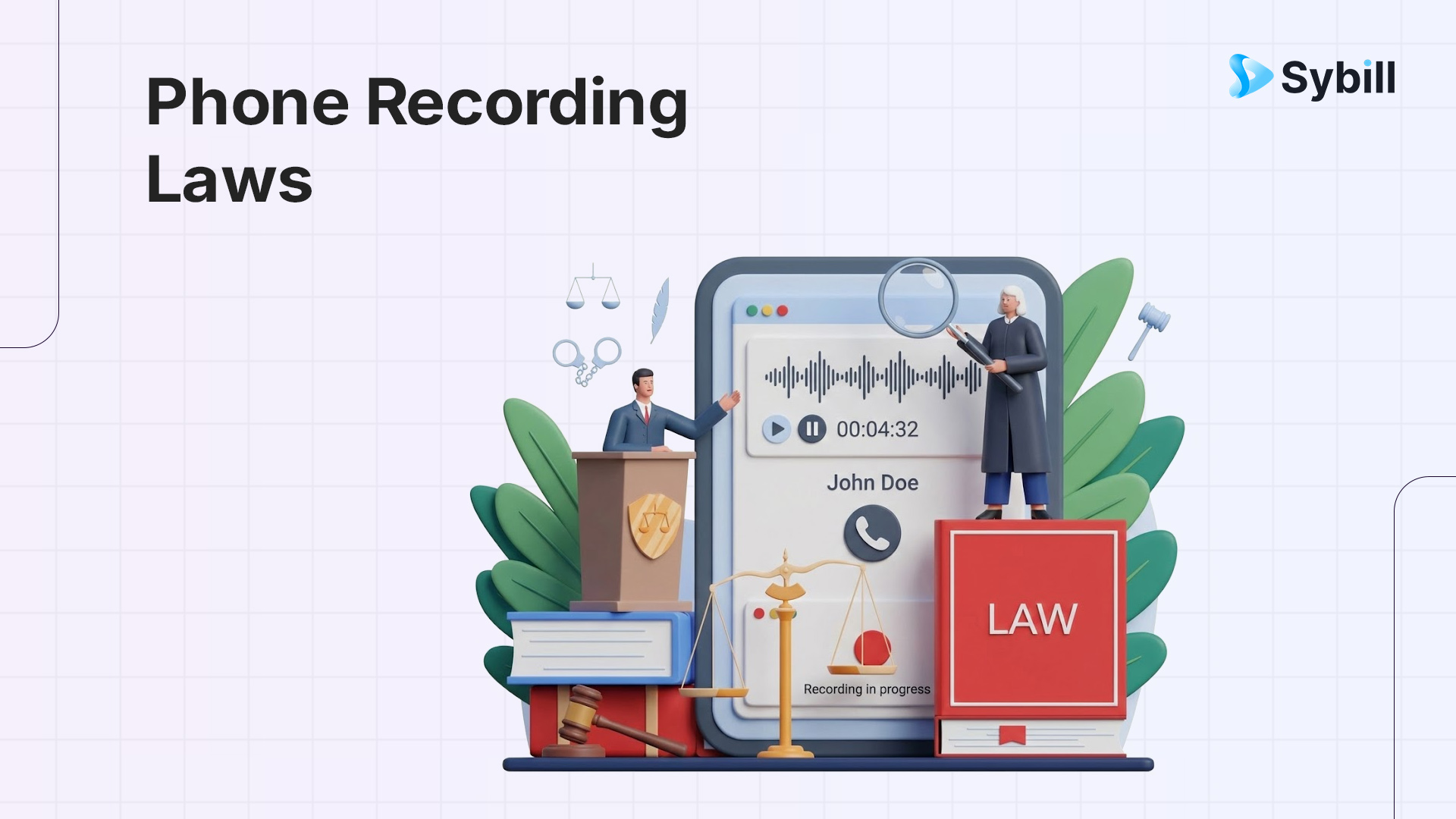
For years, call recording sat in the background of sales. Nice to have. Used occasionally. Easy to ignore. That era is over.
Today, call recording is default behavior. Sales calls are recorded automatically. Demos are stored. Discovery calls are transcribed. Follow-ups are generated by AI. Coaching libraries are built from real conversations. What used to be an edge case is now core infrastructure. And that shift has dragged phone recording laws into the spotlight.
AI note takers, revenue intelligence platforms, and sales coaching tools have fundamentally changed the risk profile. Teams are no longer recording a handful of calls for quality checks. They are capturing, storing, sharing, and analyzing thousands of conversations at scale. That scale matters. A lot. Because phone recording laws were written for a very different world. One where recording was intentional, manual, and rare.
The phone recording law did not evolve at the pace of sales tech. And that gap is where problems start.
One bad assumption can trigger serious consequences. Recording without proper consent. Applying the wrong state rule. Assuming internal use is safe. Forgetting that buyers sit in different jurisdictions. Under recorded phone call laws, these mistakes can lead to fines, lawsuits, lost deals, and reputational damage that is hard to undo.
Sales teams are not trying to break the law. Most simply do not realize how exposed they are. Recording is now automated, always on, and deeply embedded into workflows. That makes compliance a systems problem, not a rep problem.
This guide exists to close that gap. We break down what is legal, what varies by state and country, where teams get tripped up, and what sales teams actually need to operationalize compliance without slowing down revenue. Because in modern sales, recording calls is easy. Recording them legally is the real challenge.
Phone recording laws define when, how, and under what conditions a phone conversation can be legally recorded. In simple terms, they govern who is allowed to record a call, whether consent is required, how that consent must be obtained, and what can be done with the recording afterward. These rules apply to both personal and business conversations, and in many cases, the standards for businesses are higher, not lower.
At the center of most phone call recording laws is a single question: did the people on the call knowingly agree to be recorded?
How that agreement is defined and enforced varies by jurisdiction, but the principle itself is consistent. Recording a conversation is treated as an intrusion into privacy, not a neutral technical action.
A recorded phone call is not limited to traditional phone lines. Voice calls on mobile phones, VoIP calls, and conference calls are all covered. If audio from a live conversation is captured in any form, whether for playback, transcription, analysis, or training, it generally qualifies as a recording under phone recording laws.
This distinction matters because many teams assume only stored audio files are regulated. In reality, the moment a system captures live audio, even temporarily, legal obligations can apply.
Another common misconception is that transcription or AI-generated summaries are legally different from recordings. In practice, they are not. If a transcription is produced from captured audio, the original act of recording still triggers consent requirements. Storage introduces additional obligations around access, retention, and deletion, but it does not replace the need for lawful recording in the first place.
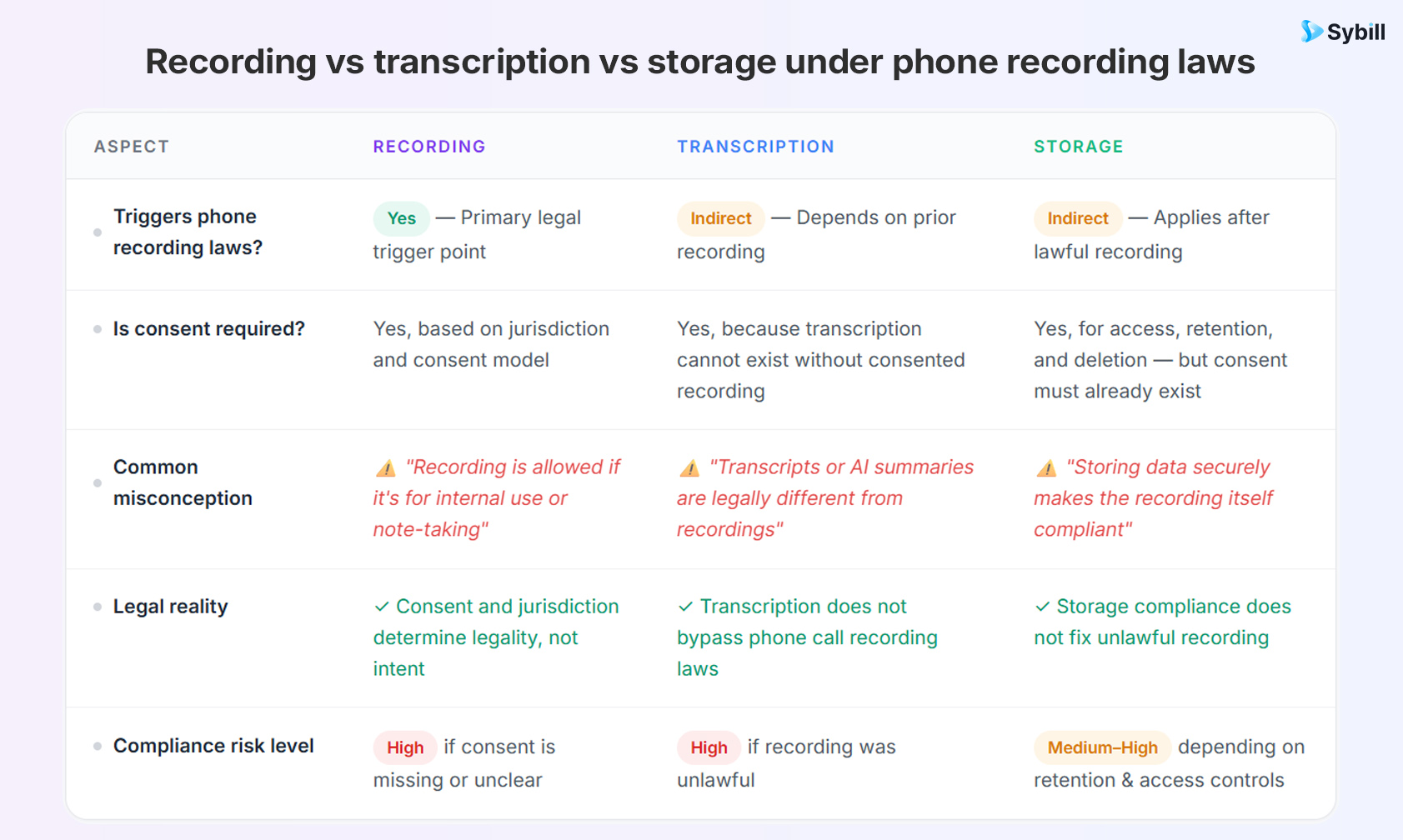
Intent also does not override consent. Recording a call for note-taking, quality assurance, or internal coaching does not make it automatically legal. Under phone recording laws, legality is determined by consent and jurisdiction, not by how helpful or harmless the purpose may seem.
Understanding these fundamentals is critical. Once call recording becomes automated, compliance stops being a judgment call and starts being an architectural decision.
Most call recording laws come down to one decision point: who needs to consent before a call can be recorded. Everything else flows from this.
The risk appears when sales teams assume one rule applies everywhere.
They do not.
Consent is not a rep-level judgment call. Once recording is automated, compliance has to be designed into the workflow.
In the US, call recording laws by state sit on top of a federal baseline. That is where most confusion starts and where most compliance mistakes happen. Federal law sets the floor. States decide how much higher the bar goes.
Under US federal law, call recording generally follows a one-party consent model. That means if at least one participant on the call consents, recording may be legal.
States are allowed to be stricter. Many are.
This is why sales teams cannot rely on a single rule. Phone call recording laws are ultimately governed by state law, not just federal guidance.
One-party consent is common. It is not universal. And it is not portable across state lines.
All-party consent states require that everyone on the call is informed and agrees to the recording. If even one participant out of two in total is unaware, recording can be illegal.
California is the most cited example because it is one of the strictest and most frequently violated.
Several other states follow similar all-party consent rules. While specifics vary, the core requirement remains the same: all participants must know and agree.
Multi-participant calls increase risk. One missing disclosure is enough to create a violation.
None of these assumptions hold up under California phone recording laws.
This is where most violations occur.
Jurisdiction is not always obvious or predictable.
Understanding call recording laws by state is not about memorizing a list. It is about recognizing that geography controls legality. And sales workflows must be designed with that reality in mind.
Once sales conversations cross borders, phone recording laws by country become significantly more complex. Unlike the US, where consent models are largely framed around state-level rules, many countries regulate call recording through national privacy frameworks that govern not just consent, but purpose, usage, retention, and individual rights.
This is where US-first assumptions break down. Call recording laws outside the US often treat recorded conversations as personal data from the moment audio is captured, not just when it is stored or shared.
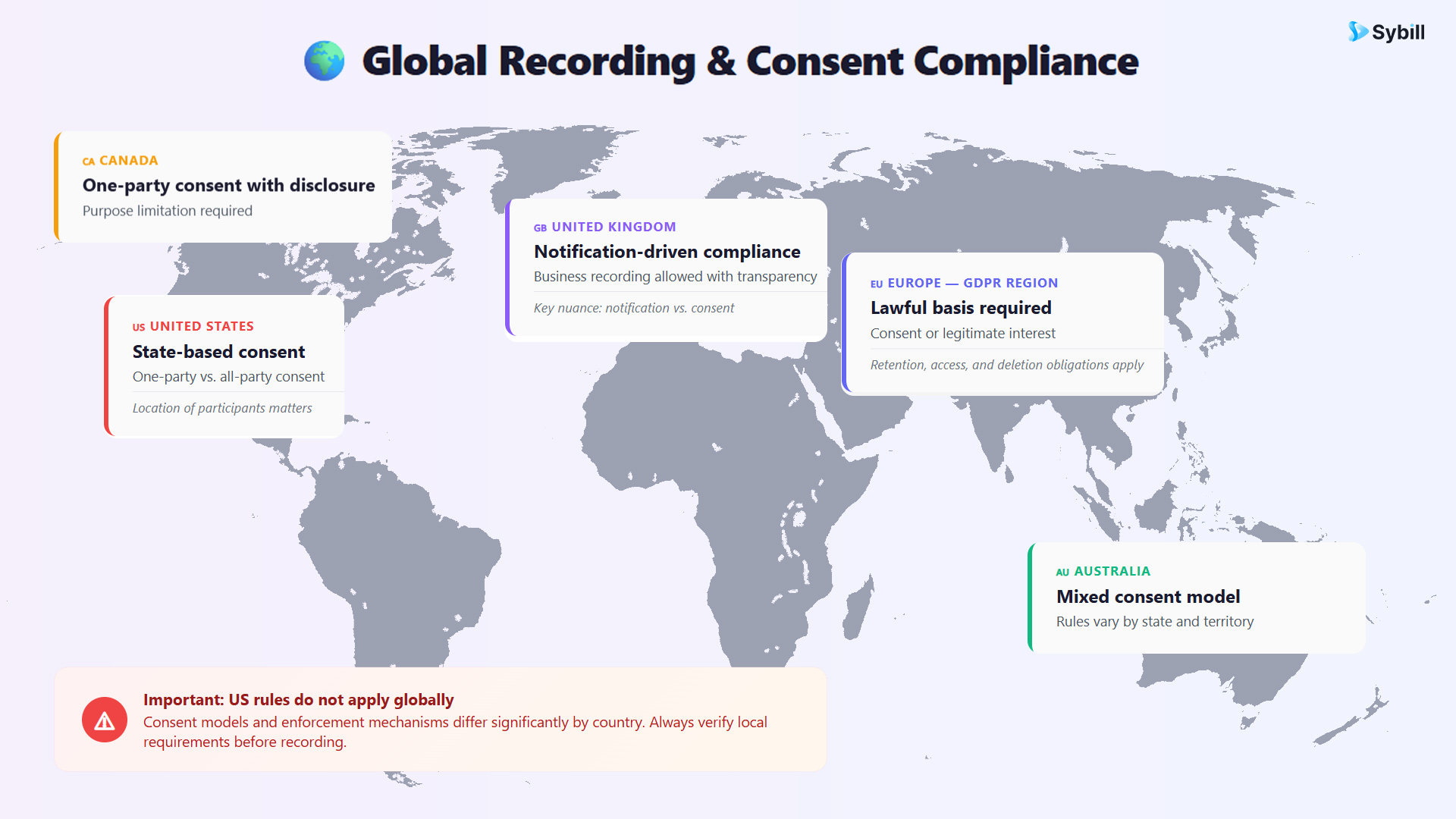
In Europe, call recording is governed primarily by the General Data Protection Regulation. GDPR does not use the same one-party versus all-party consent framing common in the US. Instead, it focuses on whether there is a lawful basis to process personal data.
Consent is one lawful basis, but it is also the most misunderstood.
Under GDPR, consent must be freely given, specific, informed, and revocable. In sales contexts, that bar is difficult to meet. Power imbalance, implied pressure, or lack of alternatives can invalidate consent. This is why many organizations rely on other lawful bases rather than explicit consent alone.
Recording for “legitimate interest” is often cited, but it is not a shortcut. Legitimate interest requires a balancing test. The business must show that recording is necessary, proportionate, and does not override the rights of the individual being recorded. This assessment must be defensible, documented, and revisited over time.
Beyond consent, GDPR introduces ongoing obligations. Recorded calls and transcripts are subject to retention limits, access controls, and deletion requirements. Individuals have the right to know their data is being processed, request access to it, and ask for it to be erased under certain conditions. Recording legally is only the first step. Managing the data responsibly is equally critical.
The UK follows a similar structure, but with its own regulatory interpretation and enforcement posture. Call recording is generally allowed for business purposes, including training and quality assurance, but transparency is mandatory.
A key nuance is the difference between notification and consent. In many UK business scenarios, clear notification that a call is being recorded can be sufficient if the recording aligns with a lawful business purpose. That said, notification must be meaningful. It cannot be hidden, rushed, or implied.
Where recordings are used beyond the original purpose, such as analytics, coaching libraries, or AI-driven insights, additional justification may be required. As with GDPR, data handling obligations around retention and access still apply.
In Canada, call recording is generally permitted under a one-party consent framework, but with strict expectations around purpose limitation and disclosure. Recording must be connected to a reasonable business need, and individuals must be informed.
Australia allows call recording under certain conditions, but consent rules vary by state and territory. Some regions require all-party consent, while others allow one-party consent with notification. This patchwork mirrors US complexity but operates under a different legal philosophy.
The common thread across regions is this: global sales teams cannot rely on US logic. Consent models, privacy expectations, and enforcement standards differ materially. Treating call recording as a purely operational feature rather than a regulated activity creates real exposure.
International compliance is not about memorizing every law. It is about designing systems that assume variation, prioritize transparency, and respect jurisdiction by default.
The short answer is sometimes. The long answer is more complicated, and it is where most teams get exposed under recorded phone call laws.
Whether it is against the law to record phone calls depends on three factors that always work together: jurisdiction, consent model, and disclosure. Change any one of these, and the legality of the same recording can flip.
If any of these conditions are not met, recording can be illegal even when the intent is harmless.
The law focuses on the act of recording, not how useful the recording may be.
Recording calls is easy. Recording them legally requires understanding where the call happens, who is on it, and what the law requires before the recording starts.
Violating phone recording laws is not a technical slip. Under recorded phone call laws, it can trigger legal, financial, and commercial consequences that extend far beyond the individual call.
The real risk is not just penalties. It is losing credibility at the moment buyers are deciding whether to trust your business with their data.
Sales teams record more calls than any other function in the business. Discovery calls, demos, follow-ups, and internal reviews are routinely captured by default. That makes sales the front line of exposure under call recording laws.
AI magnifies that exposure. Automated recording, transcription, and analysis scale usage instantly, which means any compliance gap is repeated across hundreds or thousands of calls. Under phone recording laws, scale increases risk, not just efficiency.
Buyers are also far more privacy-aware than they were even a few years ago. Questions about recording, data usage, and consent now surface in sales conversations and procurement reviews. Compliance has become part of trust.
Legal missteps in call recording do not just create regulatory risk. They stall deals, fail security reviews, and erode confidence faster than a bad demo ever could.
Sybill is designed for sales teams that operate in complex environments. Compliance with call recording laws is built into the system, not left to individual reps to remember.
Sybill makes lawful call recording automatic, scalable, and sales-friendly.
Click here for a deeper dive into Sybill’s privacy and data protection posture.
Recording calls is no longer optional in modern sales. It is foundational. What separates high-performing teams is not whether they record calls, but whether they do so in line with phone recording laws.
Compliance with call recording laws is a system problem, not a rep problem. The right tools make legality invisible, automatic, and consistent across regions. When recording workflows are designed correctly, sales velocity and legal safety do not compete.
Tools like Sybill prove that teams can move fast, stay compliant, and earn buyer trust at the same time. Click here to try for free.
Whether it is legal to record a conversation depends on the consent model and the geography involved. Laws vary by state and country, and the strictest applicable rule often applies.
The legality of recording is determined by location and consent, not by the context or intent of the conversation.
In many jurisdictions, yes. Whether disclosure is required depends on how consent is defined under local law.
Under call recording laws, transparency is essential for valid consent.
In limited cases, recording on a phone without explicit consent may be legal, but only under specific conditions.
Under phone recording laws, consent rules are shaped by geography, not convenience.
Whether it is legal to record a conversation depends on the consent model and the geography involved. Laws vary by state and country, and the strictest applicable rule often applies. In phone conversations, consent requirements are defined by local call recording laws. In-person conversations may be governed by different privacy statutes than phone calls. Business conversations are not exempt from consent rules simply because they are work-related. Personal conversations are also subject to recorded phone call laws when recording occurs. The legality of recording is determined by location and consent, not by the context or intent of the conversation.
In many jurisdictions, yes. Whether disclosure is required depends on how consent is defined under local law. Notification means informing participants that recording is taking place. Consent means participants knowingly agree to the recording. Some regions allow notification to satisfy legal requirements, while others require explicit consent. Adequate disclosure must be clear, timely, and understandable to all participants. Buried disclaimers or rushed announcements increase legal risk rather than reduce it. Under call recording laws, transparency is essential for valid consent.
In limited cases, recording on a phone without explicit consent may be legal, but only under specific conditions. One-party consent laws allow recording when at least one participant agrees to the recording. Recording can still be illegal if another participant is located in an all-party consent jurisdiction. Cross-border and interstate calls increase complexity and risk. Assuming your own location controls legality is a common mistake. Under phone recording laws, consent rules are shaped by geography, not convenience.