Find us at booth #83, join us for a harbor side happy hour, or catch Gorish’s talk.

Sept, 16-18 > Learn more

%20(1).avif)
Mamta Tainwala

March 7, 2026
What you'll learn:
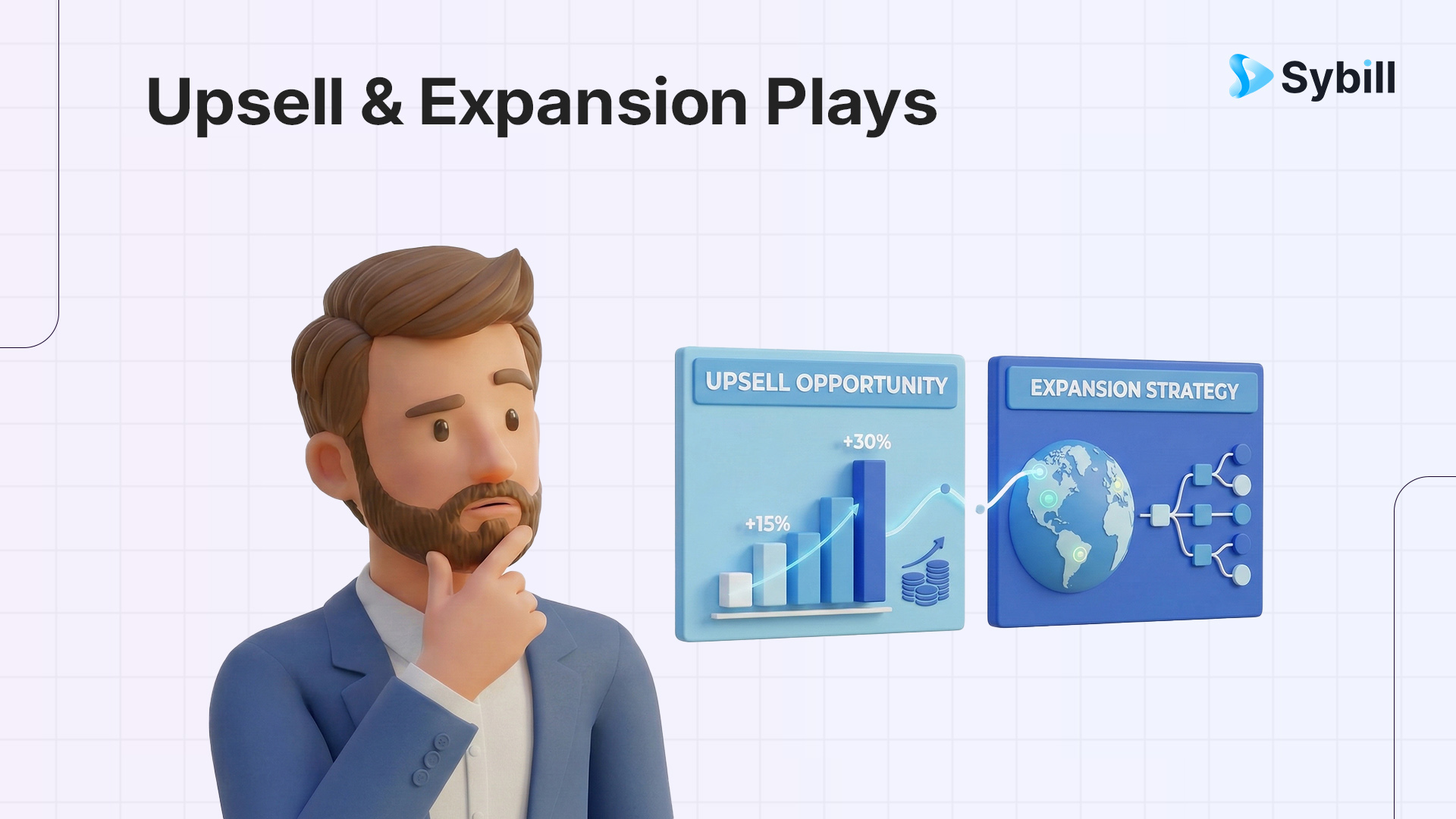
Here is something that gets buried in most sales org conversations: acquiring a new customer costs five times more than growing an existing one. Five times. And yet most revenue teams spend eighty percent of their energy chasing new logos while their current accounts quietly sit there, underserved and under-expanded, waiting for someone to ask the right question.
Upselling and expansion are not aggressive sales tactics. Done right, they are a service. When you know a customer has outgrown their current tier, or when you can see that a product they have not tried yet would directly solve a problem they mentioned six months ago, offering that is genuinely helpful. The rep who brings a solution before the customer even asks for it does not feel like a salesperson. They feel like an advisor. And advisors are very hard to churn.
This guide covers the expansion plays that consistently deliver, the signals worth tracking, and how AI is changing the game by surfacing those signals before they disappear into a forgotten call transcript.
Expansion revenue, meaning the additional revenue generated from existing customers through upsells, cross-sells, seat additions, and tier upgrades, is the engine behind healthy Net Dollar Retention (NDR). And NDR is the metric investors look at when they want to understand whether a SaaS business actually delivers value.
The math is straightforward. If your NDR is above 100%, your existing customer base is growing even if you close zero new deals this month. That is a business with compounding momentum. If your NDR is below 100%, you are running on a treadmill: winning new accounts just to replace the ones you are losing.
The rep who masters expansion plays is not just hitting a quota. They are building the kind of recurring revenue that makes the whole company more valuable.
Before any play, there is a signal. The best expansion conversations are not cold asks. They are responses to something the customer has already told you, either directly or through their behavior.
Here is what to watch for:
The Quarterly Business Review is one of the most underutilized upsell moments in B2B sales. Most teams treat QBRs as a recap session. The best teams use them as a structured expansion conversation.
The formula is simple: start by showing what the customer has achieved with your product. Quantify it wherever possible, pipeline influenced, hours saved, deals closed. Then bridge to what they could achieve with the next tier, additional seats, or an adjacent product. The customer's own success is your pitch.
The key is preparation. Walking into a QBR without knowing the customer's usage data, their recent business wins, and what they mentioned wanting in the last call is how you end up presenting a generic slide deck to a room full of people who stopped paying attention on slide three. Sybill's pre-meeting briefs pull all of that context together automatically before you walk in.
This one is a strategy, not just a single play. The idea is to win a smaller, lower-friction deal with one team or one use case, deliver undeniable value, and then use that proof point to expand into adjacent departments or a larger deployment.
It works especially well in enterprise accounts where a single large deal requires six months of procurement. Instead of fighting that battle upfront, you land a team-level deal, build internal advocates, and let the results sell the larger commitment.
The discipline here is in nurturing those high-value accounts from day one with the expansion in mind. That means mapping stakeholders across the org, tracking which teams could benefit from what you already deliver, and maintaining relationships beyond the original deal champion.
This is where conversation intelligence earns its keep.
Imagine a customer says during a renewal call, "We are also trying to figure out our onboarding workflow for new reps. It is a bit of a mess right now." That sentence, buried in a 45-minute recording, is a direct invitation to introduce a product or feature you have not discussed with them yet.
Most teams never act on it because nobody reviewed the transcript. With Sybill's Magic Summaries, those signals are automatically surfaced and logged to your CRM. Your next touch with that account can open with, "Last time we spoke, you mentioned the rep onboarding challenge. We actually have something for that." The customer feels heard. You look prescient.
When a champion moves internally, gets promoted, or joins a new company, you have one of the warmest possible outreach opportunities in sales. They already know your product works. They do not need convincing. They need context about how your product maps to their new situation.
The play is to stay connected to champions throughout their careers, not just during the sales cycle. A quick congratulations message on a promotion is not just good manners. It is pipeline. This is why tracking champion signals and using Sybill's deal workspace to maintain deal context across every touchpoint is a competitive advantage that compounds over time.
The renewal conversation is the most natural upsell moment in the customer lifecycle, and also the most wasted. Most renewal conversations go like this: "We would like to renew. Here is the invoice. Great, see you next year."
The Renewal-Plus flips that. Before you present the renewal, you identify one specific upgrade, add-on, or tier change that is directly relevant to where the customer is now, not where they were when they signed. You frame it as the natural next step in the roadmap you are building together.
To do this well, you need clean, current deal context, especially what the customer said about their goals and pain on every call in the past twelve months. That is exactly what Sybill's CRM Autofill is keeping structured and searchable for you.
For per-seat SaaS products, one of the clearest expansion signals is when the rep count you sold to has grown. The customer is not trying to hide this from you. They are just busy. Nobody called to say "hey, we hired twelve more AEs and should probably add seats."
The play is to monitor for headcount changes, either through your own usage data or through external signals like LinkedIn, job postings, or funding news. Then reach out proactively. "We noticed your team has grown significantly since you first joined. Here is how we can update your plan to match." That conversation is fast, friendly, and almost never rejected because you are solving a problem that already exists.
This play runs almost entirely in the background until the moment is right.
Set usage thresholds. When a customer hits 80% of their plan limit, that is the trigger. An automated alert or a personal outreach from their CSM or AE kicks off a conversation about what the next tier unlocks and why now is the right time. You are not creating urgency. The urgency already exists. You are just responding to it before the customer gets frustrated by the limit.
Sybill's AI tasks can handle the trigger and the initial outreach, surfacing the right account at the right time so your team is acting on data, not guesswork.
Ready to stop leaving expansion revenue on the table? Get started for free with Sybill and let AI surface the upsell signals your team is currently missing.
Knowing the plays is half the equation. The other half is knowing what derails them.
Expanding before the customer has seen value. An upsell conversation that happens before the customer has experienced a clear win from their current tier feels predatory, not helpful. The sequence matters. Deliver value first. Expand second.
Leading with product, not with their goal. "We have a new feature" is a terrible opening for an expansion conversation. "Based on what you told us about your goal last quarter, there is something we built specifically for that" is a great one. The difference is whether the rep has done the prep work to connect the product to the customer's world.
Ignoring the buying committee. In many B2B accounts, the person you talk to regularly is not the person who approves budget. Expansion deals stall because reps never mapped the economic buyer. Understanding who the actual decision-makers are, which is something Sybill's deal inspection tracks continuously, is as important for expansion as it is for new business.
Missing the timing window. Expansion opportunities are not permanent. A customer who mentioned a new initiative in March but heard nothing from you by June will have solved that problem another way, possibly with a different vendor. Speed to signal matters.
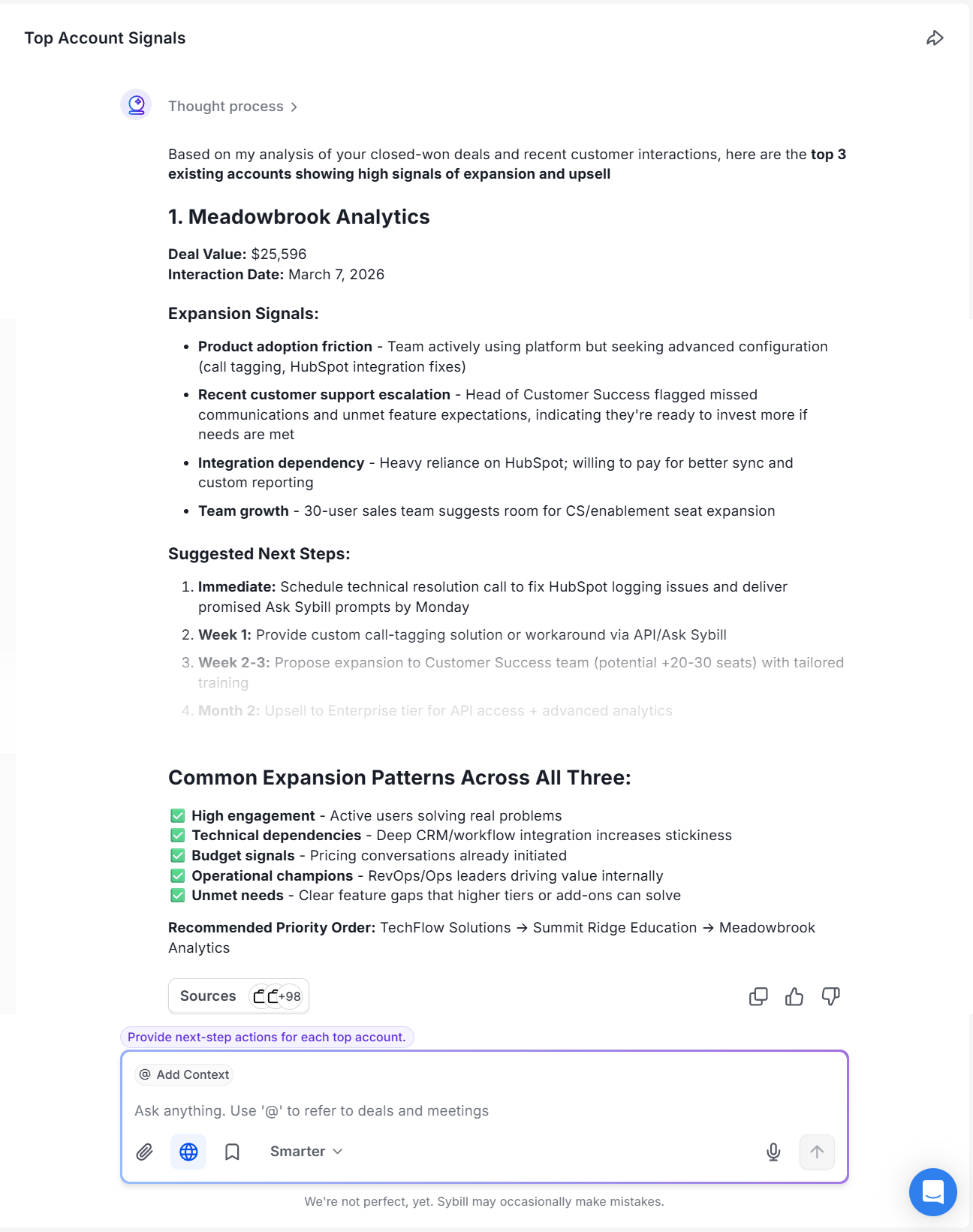
The biggest structural challenge in upsell and expansion is not strategy. Most teams know what plays to run. The challenge is execution at scale, making sure the right signal reaches the right person at the right time across a portfolio of dozens or hundreds of accounts.
That is exactly the gap Sybill closes.
It captures what customers actually say. Every call, every mention of a new initiative, new hire, or future need gets logged. Not buried in a transcript somewhere, but surfaced as a structured insight in your CRM. Your CSMs and AEs are not mining through recordings hoping to catch something useful. The insight comes to them.
It keeps the full account story in one place. The Sybill deal workspace holds every interaction, decision, and stated goal for an account. When a rep prepares for a renewal or QBR, they are not starting from scratch. They have the full arc of the customer relationship at their fingertips.
It drafts the follow-up that moves the expansion forward. After a call where an upsell opportunity surfaces, Sybill drafts a personalized follow-up email using the actual conversation as context. The message sounds like a human wrote it, because it is grounded in what the customer actually said, not a template.
It helps managers coach on expansion, not just on new business. Sybill's coaching and performance tools let managers see how their team is handling expansion conversations, where reps are missing signals, and where specific coaching is needed. Expansion is a skill. Great reps are not born knowing how to do a QBR upsell. They are coached into it.
For customer success teams, this means fewer accounts falling through the cracks. For RevOps, it means expansion data is structured and reportable, not locked in a rep's memory. For the sales leader, it means visibility into which accounts are ready to grow and which need attention before they churn.
You can also use Ask Sybill to query across your entire account portfolio in plain language: "Which accounts mentioned expansion interest in the last 90 days?" or "Which customers are approaching their seat limit?" Answers in seconds. Not after two hours in a spreadsheet.
What is the difference between an upsell and a cross-sell?
An upsell is when you move a customer to a higher tier, larger quantity, or premium version of what they already have. A cross-sell is when you introduce a different product or add-on that complements their current purchase. Both are expansion plays. The best reps run both, depending on where the customer is in their journey and what signal triggered the conversation.
When is the right time to introduce an upsell?
The right time is after the customer has experienced clear, measurable value from their current commitment. A good rule of thumb: if they could not articulate two or three specific wins from your product, the expansion conversation is premature. Usage milestones, QBR success reviews, and champion promotions are all reliable triggers.
How do you upsell without being pushy?
The key is leading with the customer's goal, not the product. When an upsell is framed as "here is how you get more of the outcome you told us you wanted," it does not feel like a sales pitch. It feels like a service. The reps who consistently expand accounts do so because they listen carefully and follow up on what they hear.
What is Net Dollar Retention and why does it matter for expansion?
NDR measures the percentage of revenue retained from existing customers over a period, including expansions, contractions, and churn. An NDR above 100% means your existing customer base is growing. Expansion plays are the primary lever for improving NDR. For B2B SaaS, an NDR above 110% is generally considered strong.
How does AI help with upsell and expansion?
AI helps in two ways. First, it captures and organizes the signals that indicate expansion readiness, things customers say in calls, usage patterns, and engagement changes, that humans frequently miss. Second, it speeds up execution by drafting follow-ups, updating CRM fields, and surfacing the right accounts at the right time. The result is a more consistent, scalable expansion motion across the entire customer portfolio.
New logos are exciting. There is a reason sales teams celebrate new business with bells and slack notifications. But the most durable revenue you will ever build is sitting in your existing customer base, waiting for someone to show up prepared, ask the right questions, and offer the right next step at the right moment.
The teams winning on expansion right now are not doing something radically different from everyone else strategically. They are executing the same plays, with better information, faster. That is the operational advantage Sybill gives you: every signal captured, every account story preserved, every expansion moment turned into an action rather than a missed opportunity.
Get started for free with Sybill and start running expansion plays on every account in your portfolio, not just the ones your best rep happened to remember.
An upsell is when you move a customer to a higher tier, larger quantity, or premium version of what they already have. A cross-sell is when you introduce a different product or add-on that complements their current purchase. Both are expansion plays. The best reps run both, depending on where the customer is in their journey and what signal triggered the conversation.
The right time is after the customer has experienced clear, measurable value from their current commitment. A good rule of thumb: if they could not articulate two or three specific wins from your product, the expansion conversation is premature. Usage milestones, QBR success reviews, and champion promotions are all reliable triggers.
The key is leading with the customer's goal, not the product. When an upsell is framed as "here is how you get more of the outcome you told us you wanted," it does not feel like a sales pitch. It feels like a service. The reps who consistently expand accounts do so because they listen carefully and follow up on what they hear.