Find us at booth #83, join us for a harbor side happy hour, or catch Gorish’s talk.

Sept, 16-18 > Learn more


Tamanna Mishra

March 31, 2026
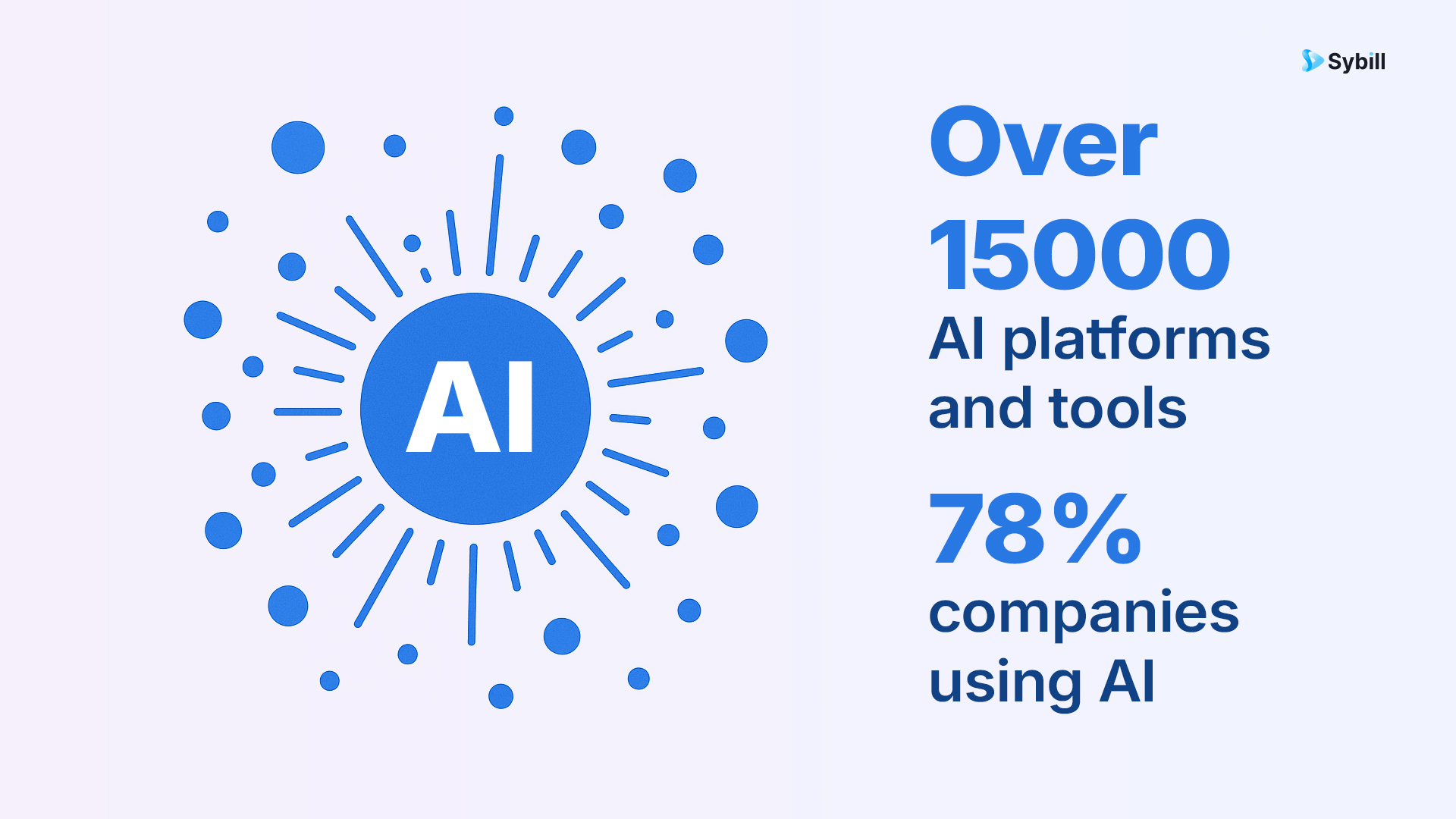
Asking which AI platform is the best is like asking which car is the best. It depends on whether you’re racing Formula 1, driving your kids to school, or going off-road. In 2025, the AI universe has exploded: companies now estimate there are over 15,000 specialized AI platforms and tools in the market, spanning verticals like content, sales, analytics, workflow automation, and more. Meanwhile, 78% of companies report using AI in at least one business function. Yet despite this abundance, no single platform rules all use cases. Yes, not even ChatGPT.
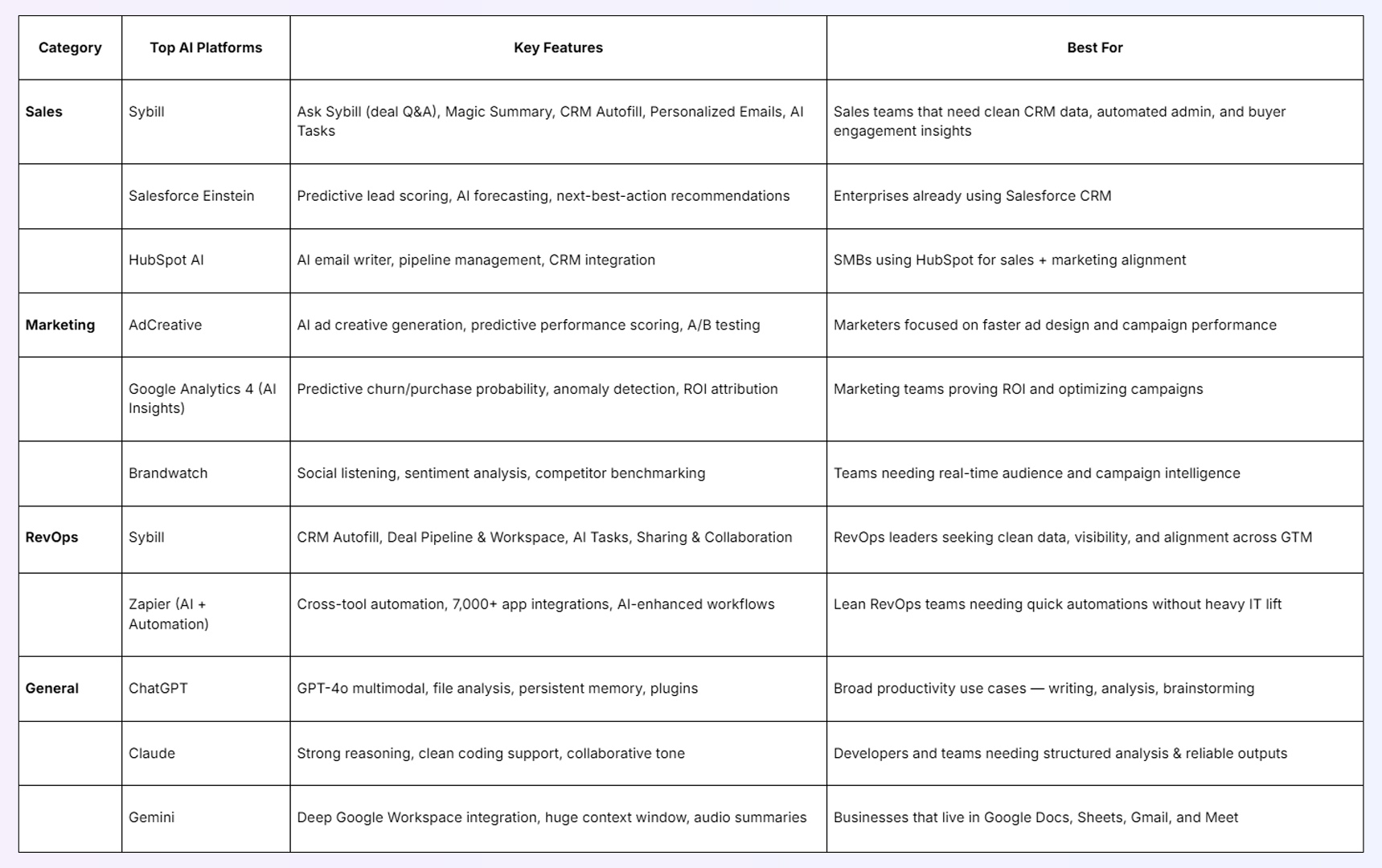
The best AI platform depends on your use case: for sales, Sybill leads with AI-powered call summaries, CRM autofill, deal intelligence, and one-click follow-ups purpose-built to improve quota attainment, followed by Salesforce Einstein for enterprise CRM-embedded AI and HubSpot Breeze for SMB sales and marketing alignment. For marketing, AdCreative excels at AI-generated ad variations, GA4 with AI Insights leads on measurement and ROI attribution, and Brandwatch dominates audience intelligence and sentiment analysis. For RevOps, Sybill provides automated CRM hygiene, pipeline visibility, and deal health tracking, while Zapier connects 7,000+ apps for lean team automation. For general-purpose use, ChatGPT is the most versatile and widely adopted, Claude excels at structured reasoning and coding, and Gemini integrates deeply with Google Workspace.
The “best AI platform” for you will depend heavily on your goals, data ecosystem, and team needs. That’s why this guide takes a use-case driven approach. We’ll walk through the top AI platforms for Sales, for Marketing, for RevOps, and for general-purpose tasks, recommending the top three AI platforms in each vertical.
If you’re here to figure out which AI platform is the best for sales, the truth is that sales AI isn’t a “nice-to-have” anymore. In 2025, reps still spend just 28% of their time actually selling, with the rest eaten up by CRM updates, admin, and chasing information across tools. Organizations worldwide lost up to $1 trillion due to productivity losses and leads that go poorly managed.
That’s why the best AI platforms for sales are the ones that give you time back, surface real buyer intent, and sharpen your productivity edge.
Let’s break down the top AI platforms for sales today:
Core features:
Sybill isn’t trying to be a general-purpose assistant. It’s laser-focused on sales productivity. Every feature is designed to remove friction from the rep’s workflow. No toggling between meeting notes, email drafts, and CRM fields. By automating all of that, Sybill lets sales teams spend their time actually selling.
The real differentiator is Sybill’s best-in-class accuracy combined with Behavior AI. Sybill captures exact buyer engagement signals (tone, hesitation, objections, excitement) that most AI platforms miss. That means reps don’t just know what was said, they know how it was said. In a market where deals hinge on subtle buyer cues, that’s a game-changer.
Bottom line: If you want an AI platform for sales that directly improves quota attainment, Sybill is your best bet.
Core features:
If your organization already lives inside Salesforce, Einstein is the natural extension. It brings AI capabilities directly into the CRM environment you already use. That means less context switching and more data staying in one place.
Where Salesforce Einstein shines is scale. Large enterprises with complex data structures can unlock predictive insights without bolting on third-party tools. For global sales teams, Einstein adds AI muscle without forcing a new platform into the stack.
But without clean, consistent CRM usage (something reps often resist), the predictions can fall flat. That’s why many companies still layer specialized tools like Sybill CRM Autofill on top to capture richer buyer signals with best-in-class accuracy.
Core features:
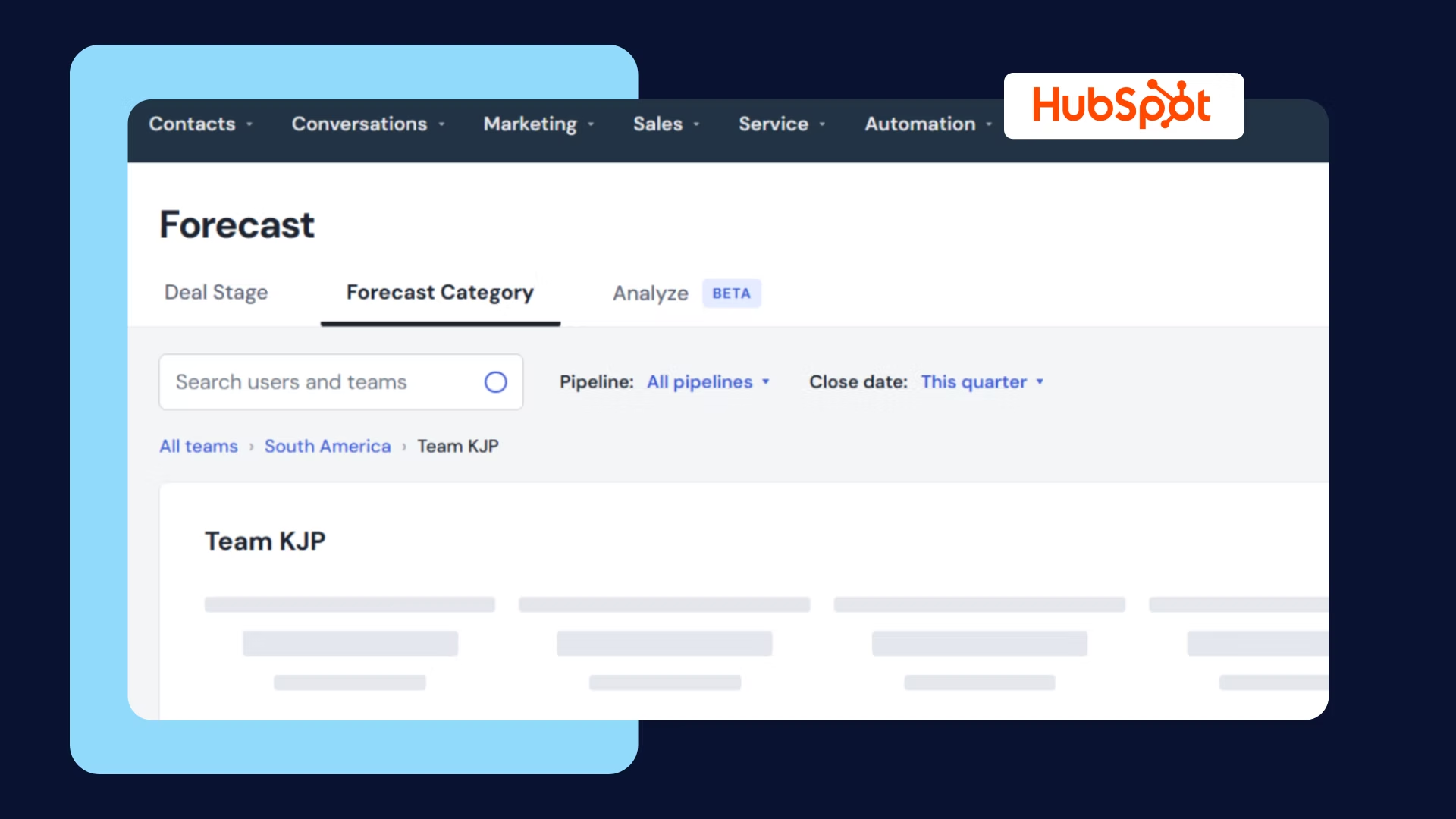
For small and mid-sized businesses, HubSpot’s AI suite strikes the perfect balance between ease of use and integrated functionality. HubSpot also doubles as a bridge between sales and marketing. If your sales team needs to align closely with demand-gen campaigns, HubSpot’s AI gives you that end-to-end visibility.
But like Einstein, HubSpot AI is best if you’re already inside the HubSpot ecosystem. Its AI is strongest when all your customer data lives in HubSpot.
If you’re an enterprise deeply embedded in Salesforce, Einstein is the obvious choice. If you’re an SMB running on HubSpot, its AI suite is a natural fit. But if you want an AI platform built for sales and one that captures real buyer signals, automates CRM, and accelerates deals, Sybill is the clear front-runner.
In 2025, sales success isn’t about working harder, it’s about working smarter. And the top AI platforms for sales are the ones that let reps do just that.
Marketers in 2025 don’t just ask which AI platform is the best. They ask, which one makes my campaigns more effective without blowing up the budget? The pressure is relentless: generate more leads, hit pipeline targets, and prove ROI while consumer behavior shifts by the week.
That’s why the best AI platforms for marketers don’t just crank out boring, generic content. They optimize creatives, measure outcomes, and listen to audiences in real time.
Here are the three that matter most right now.
Core features:
If you’ve ever stalled a campaign waiting on creative, you know the pain. AdCreative eliminates that bottleneck. Within minutes, you can generate dozens of ad variations and test them against each other.
For marketing teams under pressure to deliver faster results, AdCreative is the best AI platform for advertising. It shortens the creative cycle and makes data-driven ad design the new default.
Core features:
Creating campaigns is only half the battle. The bigger challenge is proving they worked. GA4’s AI insights engine is built exactly for that. It automatically flags unusual spikes or drops, predicts where users are most likely to convert, and connects ad spend directly to revenue.
Instead of drowning in vanity metrics, marketers get clear ROI visibility across channels. For teams tasked with defending every dollar of budget, GA4’s predictive AI makes it the best AI platform for marketing measurement and optimization.
Core features:
Marketers can’t afford to fly blind on audience sentiment. With Brandwatch, you know not just what your target audience does, but what it feels about your brand, your campaign, and your competitors. That intelligence is gold when planning campaigns or adjusting mid-flight.
From trendspotting before a launch to post-campaign debriefs, Brandwatch is the best AI platform for marketing intelligence. It turns noisy online chatter into actionable data your team can actually use.
It depends on your requirement:
Together, these platforms tackle the holy trinity of modern marketing: creative, measurement, and audience intelligence. That’s what makes them the top AI platforms for marketers in 2025.
Revenue Operations (RevOps) has officially graduated from buzzword to boardroom priority. In 2025, high-growth companies know that aligning Sales, Marketing, and Customer Success under a single revenue engine is the difference between predictable growth and pipeline chaos. That’s why the search for the best AI platforms for revenue operations is heating up. Because humans alone can’t wrangle the volume of data, workflows, and handoffs RevOps demands.
In 2025, busywork and lack of visibility remain RevOps’ biggest challenges. The right platforms automate that busywork, surface insights you’d never spot in a spreadsheet, and keep every GTM motion on the same page. Let’s break down the top AI platforms for RevOps.
Core features for RevOps:
Sybill does for RevOps what Salesforce did for CRM. It standardizes and simplifies what was once messy and manual. Instead of relying on after-the-fact CRM audits, Sybill fixes data hygiene at the source. Every meeting, every email, every call gets automatically logged into the CRM, keeping deal records clean without chasing reps.
For pipeline visibility, Sybill is unmatched. RevOps leaders can instantly see which deals are stuck, which reps are struggling, and where late-stage slippage is threatening the forecast. With Behavior AI layered in, Sybill doesn’t just track activity. It captures buyer sentiment (objections, hesitation, excitement) to help predict which deals are truly winnable.
The payoff is tangible.
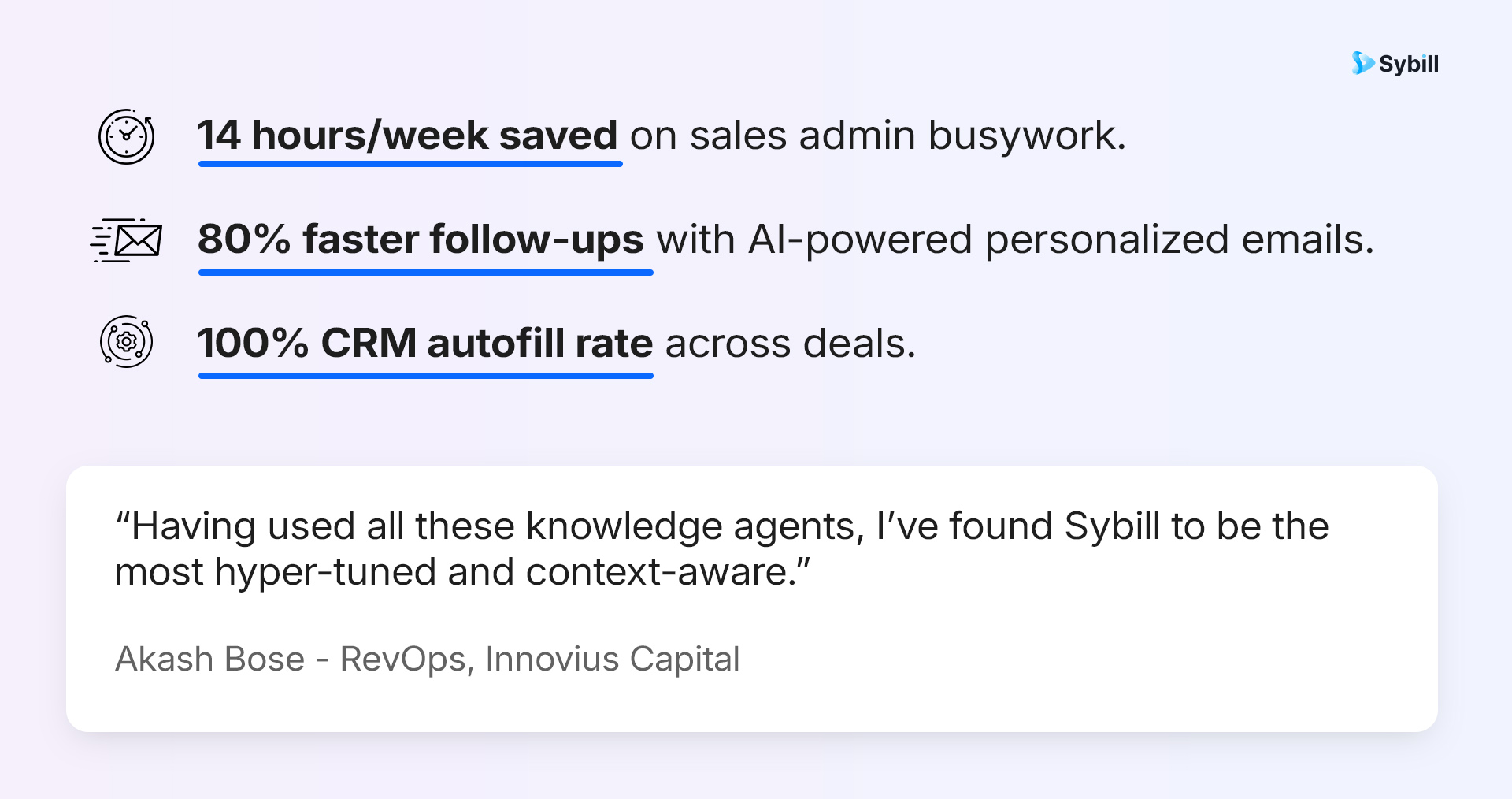
Bottom line: If you want RevOps to stop being the team that cleans up after Sales and instead become the engine that drives revenue predictability, Sybill is the platform to bet on.
Core features:
Not every company can afford a fully integrated tech stack. That’s where Zapier shines. It acts as the duct tape for RevOps, connecting CRM, marketing automation, customer success platforms, and billing systems into one automated flow.
With the addition of AI, Zapier now builds workflows faster (suggesting automations in plain English) and adapts them as your processes evolve. For lean teams that don’t have engineers on call, Zapier is the easiest way to scale RevOps without scaling headcount.
If you’re a lean team trying to glue together a messy stack, Zapier is the low-code savior. But if you want a purpose-built AI assistant that keeps your CRM clean, your pipeline transparent, and your GTM teams aligned, Sybill is hands down the best AI platform for revenue operations in 2025.
RevOps wins by making Sales, Marketing, and CS work smarter, and the top RevOps AI tools are the ones that do just that.
Not every team needs an AI tool tuned for Sales, Marketing, or RevOps. Sometimes what you need is a flexible, all-around assistant, something that can draft emails one minute, summarize a PDF the next, and troubleshoot code the minute after that. That’s where general-purpose AI platforms come in.
These are the tools that dominate headlines because they’re broad, versatile, and accessible to both individuals and enterprises. If you’re asking which AI platform is the best for general use, it comes down to three leaders in 2025: ChatGPT, Claude, and Gemini.
Core features:
If you’re looking for the most broadly capable AI, ChatGPT is still the default choice. It can serve as a writing assistant, data analyst, brainstorming partner, or even a lightweight coding helper. Its multimodal ability means you can drop in an image or file and have it analyzed on the fly, making it a true Swiss Army knife among AI assistants.
It’s also the most widely adopted, which means integrations, tutorials, and community support are everywhere. For most individuals and businesses, ChatGPT remains the best AI platform for general use.
Core features:
Claude has carved out a niche as the top AI platform for coding and structured tasks. Developers favor it for reliability - fewer hallucinated variables, clearer documentation, and code that tends to “just work.” But it’s not just for engineers. For business users, Claude excels at working through multi-step reasoning processes, explaining logic, and collaborating in a way that feels more conversational.
But Claude is less flexible for creative or multimodal tasks compared to ChatGPT. But if your use case leans heavily toward problem-solving and analysis, Claude is often the sharper tool.
Core features:
For teams already running on Google, Gemini is the most seamless fit. It can draft and edit directly inside Google Docs, analyze Sheets data, or summarize Gmail threads without leaving your workspace. Its large context window also makes it uniquely capable of digesting lengthy documents or data-heavy reports without losing context.
That said, Gemini is still evolving compared to ChatGPT’s polish or Claude’s reliability. But if your workflows live inside Google Workspace, Gemini is the best AI platform for general productivity.
If you want the most versatile and widely adopted option, go with ChatGPT. If structured reasoning and coding reliability matter most, Claude is your winner. And if your business already runs on Google, Gemini is the most natural extension of your daily tools.
Together, these three form the top AI chatbots and general-purpose AI platforms of 2025, each excelling in a different dimension of everyday productivity.
By now, you’ve seen just how crowded the AI landscape is - from specialized sales assistants like Sybill to all-purpose tools like ChatGPT. Which raises the real question: how do I choose an AI platform for my business without drowning in options?
Here’s a simple framework to keep you out of analysis paralysis:
Don’t start with the tool, start with the problem. Are you trying to boost sales productivity, tighten up your marketing campaigns, align RevOps workflows, or just need a general-purpose assistant? The best AI platform for your business is the one that directly maps to your goals, not the one with the flashiest demo.
Pro tip: If your main challenge is wasted rep time and messy CRMs, Sybill will give you ROI from day one. If it’s ad creatives, AdCreative is your best friend. If it’s team-wide productivity, ChatGPT or Gemini might be all you need.
An AI platform is only as good as its integrations. Ask: does this tool play nicely with my CRM, email, calendar, or data stack? A “best in class” AI that forces your team to juggle five tabs and duplicate work isn’t really best at all.
That’s why tools like Sybill (for Salesforce/HubSpot users) or Gemini (for Google Workspace users) feel like plug-and-play. They slot right into what you’re already running.
The AI hype cycle means every platform loves to flaunt 100+ features. But do you really need them? Focus on the core features that solve your top pain points. Extra features can add complexity, slow adoption, and drive up cost.
A good test: if your reps, marketers, or ops leads can’t explain in one sentence why they use the platform, it’s probably bloated.
Your AI platform should grow with you, not against you. Can it handle higher data volumes, larger teams, and stricter compliance needs down the road?
Equally important: where does your data live, and how secure is it? Data privacy is the backbone of customer trust.
At the end of the day, there’s no universal answer to which AI platform is the best. The truth is, the “best” depends entirely on your use case. A marketing team hungry for fresh ad creatives will thrive with a platform like AdCreative. A Google-first business will get unmatched efficiency from Gemini. And sales and RevOps teams that need clean CRM data, accurate forecasts, and less admin drag? That’s where Sybill shines as one of the top AI platforms for revenue growth.
It depends on your use case. Claude often outperforms ChatGPT in coding tasks and structured reasoning. Gemini is better if you’re deep in the Google ecosystem (Docs, Sheets, Gmail). And if you’re in Sales or RevOps, Sybill is a better choice because it’s designed to clean your CRM, capture buyer signals, and accelerate deals. These are things ChatGPT isn’t built for.
There’s no one-size-fits-all. The most effective AI is the one that aligns with your team’s workflow. For general productivity, ChatGPT leads. For coding and reasoning, Claude is more effective. For revenue operations, Sybill is one of the top AI platforms because it eliminates admin bloat and keeps data clean.
Start with your use case. Define the problem you want AI to solve, check if the tool integrates with your stack, cut through feature bloat, and evaluate scalability and data privacy. The best AI platform for your business is the one that delivers measurable ROI without forcing you to overhaul your processes.