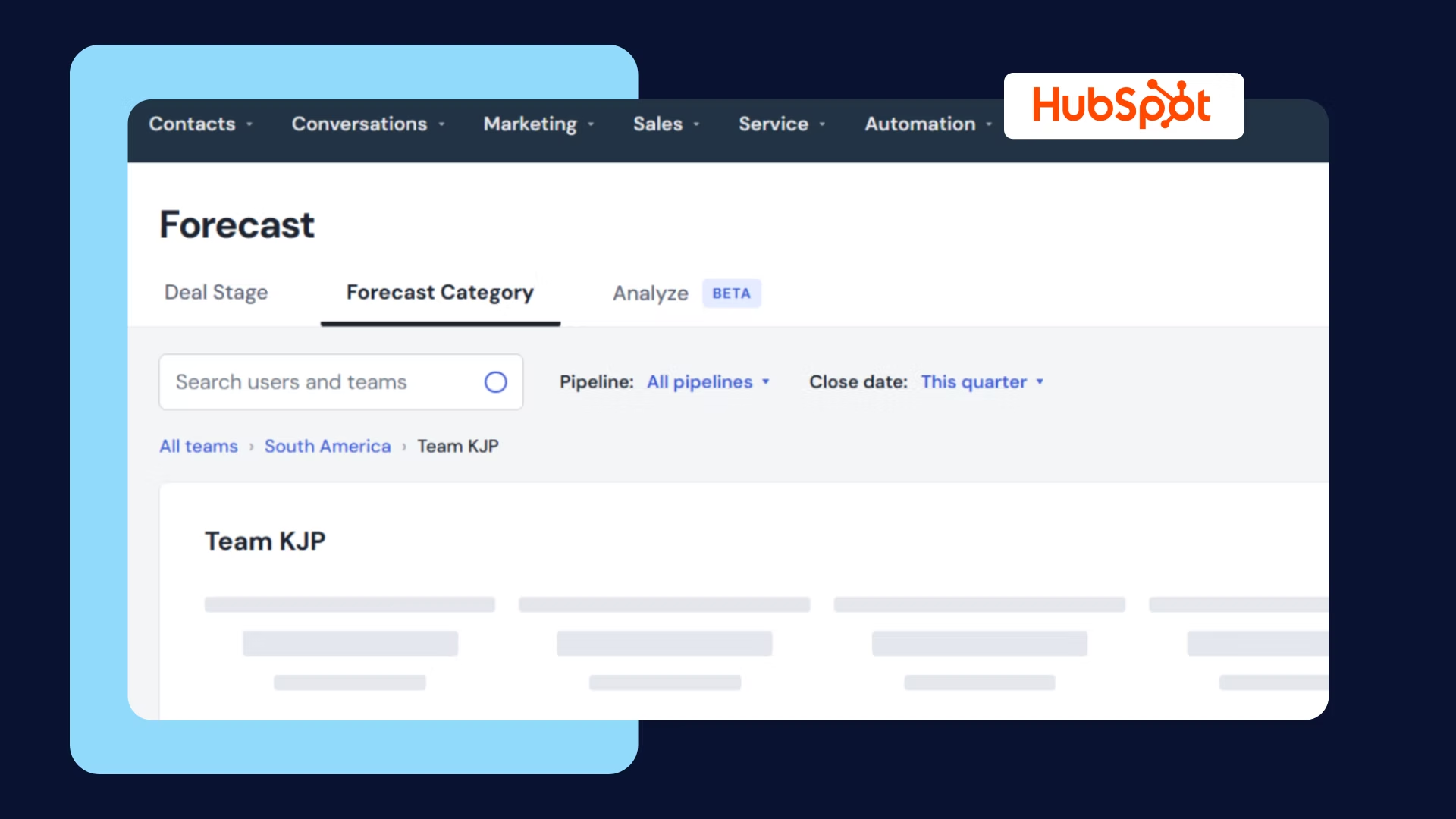
Find us at booth #83, join us for a harbor side happy hour, or catch Gorish’s talk.

Sept, 16-18 > Learn more


Tamanna Mishra

September 3, 2026
%20(87).png)
AI can help you generate more leads. It can also help you contact the wrong people faster, fill your CRM with unreliable data and send thousands of messages that no buyer remembers.
The difference is not whether you use AI. It is where you use it, what data you give it and whether the system learns from the opportunities that eventually win or lose.
AI lead generation uses artificial intelligence to identify or attract potential buyers, enrich their records, prioritize them, personalize engagement, qualify responses and improve the process using conversion data. The strongest systems do not depend on one all-purpose AI tool. They connect specialized tools across the buyer journey and preserve context as a lead becomes a sales opportunity.
That last part matters more than most AI lead-generation guides acknowledge. Finding a contact or booking a meeting is not the same as generating a qualified pipeline.
A contact database can give you names. A generative AI tool can draft messages. An intent platform can tell you that an account may be researching your category.
None of these signals independently proves that a company should buy from you.
A complete AI lead-generation system must answer five different questions:
Most lead-generation stacks are strong at the first three questions and weak at the final two. Marketing and sales-development tools generate a lead, assign a score and initiate contact. Once the meeting begins, the original source, scoring rationale and personalization evidence often disappear into separate systems.
If the eventual outcome never makes its way back, the AI cannot distinguish between an activity that produced a reply and one that produced revenue.
B2B buyers increasingly use generative AI before they speak to sales. In its research involving nearly 4,000 B2B buyers, 6sense found that 94% used large language models during their buying process. The same research found that the winning vendor was already on the buyer's initial shortlist 95% of the time.
As 6sense Head of Research Kerry Cunningham put it:
"The real urgency for revenue teams is to influence those early journeys before buyers reach out."
That early influence is starting to surface in Sybill's own sales conversations.
Sybill has processed more than 33 million sales calls. For this article, Sybill Research examined a smaller, explicitly defined sample drawn from Sybill's own new-business sales corpus.
In one August 2026 conversation, a prospect explained:
"The president said check out Sybill because Claude recommended you guys."
The prospect's company entered a proof of concept with Sybill.
A second prospect said that a generic AI chatbot had led them to Sybill. A third deal was marked as originating from ChatGPT in Sybill's CRM.
These examples tell us something narrow and useful: AI-led vendor discovery is no longer hypothetical. Buyers are asking AI assistants which tools they should evaluate, and named recommendations can lead to real sales conversations.
AI cannot rescue a vague ideal customer profile. It will simply scale it.
Start with customers and opportunities that provide evidence about fit:
Look beyond industry, geography and employee count. Analyze the problems buyers were trying to solve, the trigger that created urgency, the incumbent process, the buying committee and the conditions that made implementation successful.
The Sybill ICP guide explains how to build this profile. Your lead-generation workflow should translate it into criteria an AI system can apply consistently.
Separate criteria into:
Do not ask AI to “find companies that need our product.” Give it an evidence-based profile and a defined output format.
AI can accelerate both inbound and outbound lead generation.
For outbound, AI can search contact databases, research companies and identify events such as:
For inbound, AI can help identify and act on:
The useful question is not merely “Did this account generate a signal?” It is “Why does this signal matter for our ICP and offer?”
For a deeper account-finding workflow, see Sybill's guide to AI for sales prospecting.
Lead enrichment fills gaps in a record using company, contact, technology and behavioral data.
Platforms such as Apollo combine B2B contact data, intent signals, scoring and outreach. Clay can run enrichment waterfalls across multiple providers and use AI research to find information that conventional databases may not store.
But enrichment is not just about completing more fields. Every field should have an operational purpose.
Ask:
A filled field is not necessarily a trustworthy field. Preserve the source and confidence level, especially when an AI agent infers information rather than retrieving it directly.
A single lead score can hide more than it reveals.
A useful model separates:
A company may have excellent fit and no current intent. A frequent website visitor may show engagement but lack purchasing authority. A low-scoring inbound lead may still describe an urgent, high-value problem during the first conversation.
Start with transparent rules if your historical conversion data is thin. Predictive scoring becomes more useful when you have enough accurate outcomes to show the model what qualified pipeline and closed revenue look like.
Our B2B lead-scoring guide covers the scoring process, while this comparison of AI lead-scoring tools can help you evaluate platforms.
AI has made it inexpensive to create text that looks personalized. It has not made every message relevant.
Good personalization connects a verified account signal to a business problem your company can credibly solve.
Weak:
Congratulations on your recent funding. We help innovative companies like yours grow.
Stronger:
You are hiring 18 account executives across two regions. Teams at that stage often struggle to keep qualification and CRM practices consistent as managers take on more reps. Is that part of what the expansion needs to solve?
The second message contains a hypothesis. It gives the buyer something concrete to confirm or reject.
Use this editorial test:
If the sentence could be sent to another company unchanged, it is not meaningful personalization.
A human should review high-value outreach for factual accuracy, tone and judgment. The goal is to reduce repetitive research and drafting, not remove accountability from the sender.
AI can qualify inbound visitors through forms, conversational interfaces and product activity.
For example, HubSpot's AI lead-capture workflow combines inbound engagement, qualification, lead scoring and meeting routing. An orchestration platform such as Zapier can connect form submissions, enrichment, scoring, CRM creation and rep notifications.
Design the workflow around the buyer's need, not only your routing rules.
Capture:
Pass that context to the rep. A fast response that forces the buyer to repeat everything is not a good handoff.
This is where most lead-generation systems lose context.
The prospecting platform knows why an account was selected. The enrichment tool knows which fields it added. The engagement platform knows which message received a reply. The CRM knows a meeting was booked.
But after the meeting, someone still needs to determine:
This is where conversation intelligence becomes part of the lead-generation learning loop.
Sybill can prepare the rep with a pre-meeting brief, capture buyer needs and qualification evidence in the meeting summary, draft a contextual follow-up and use CRM Autofill to update the relevant deal fields.
Teams can then use Ask Sybill to examine patterns across calls, emails, CRM records and deal outcomes:
That intelligence can change the next audience, score, campaign and sales play.
There is no universally best AI lead-generation tool. The right choice depends on the bottleneck you are solving.
A contact database cannot replace a CRM. A CRM cannot necessarily provide deep external research. An outreach platform does not automatically understand what happened in later sales conversations. A conversation intelligence platform should not be presented as a prospect database.
Use the following table to identify the job you need a tool to perform.
Before buying anything, answer:
Buying several overlapping tools without defining these responsibilities creates more automation and less clarity.
Technical teams increasingly build their own sales workflows using tools such as n8n, Claude, ChatGPT, spreadsheets and CRM APIs.
This can be the right choice when:
But the maintenance burden is easy to underestimate.
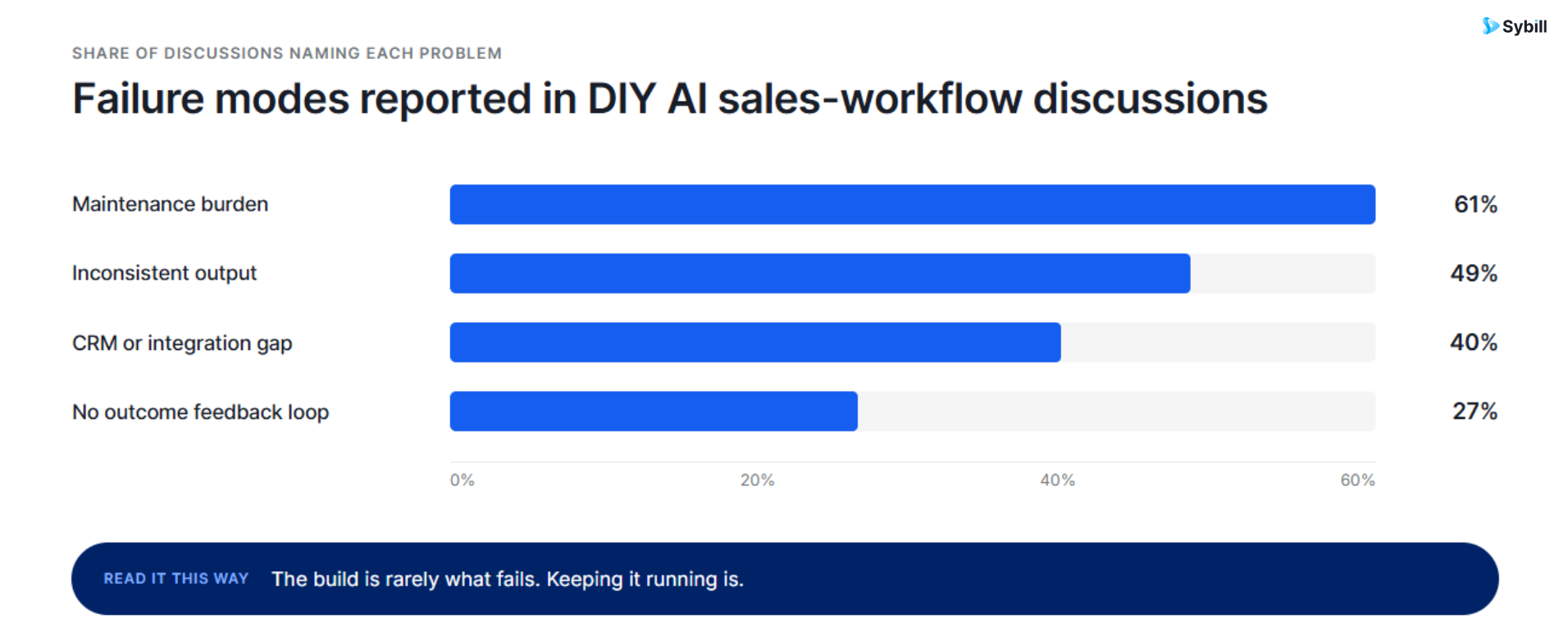
In the Sybill Research corpus, buyers expressed explicit complaints about a DIY AI sales-intelligence workflow. Among the DIY workflow discussions, they mentioned:
The concentration of these failure discussions is consistent with more teams experimenting with custom AI workflows.
One prospect described the underlying problem clearly:
"Our n8n and Claude pipeline doesn't update when deal outcomes change. There's no learning loop."
Another described the cost of maintaining the stack:
"Custom Claude and Salesforce pipelines require ongoing engineering to maintain as the prompts and data structures change."
This is the real build-versus-buy calculation. The cost of a DIY workflow includes more than model tokens and automation subscriptions. It includes prompt maintenance, schema changes, integration failures, monitoring, permissions, testing and internal ownership.
A booked meeting is a useful conversion event. It is not yet pipeline.
Once a buyer enters a conversation, the team needs evidence about:
Sybill begins where many AI lead-generation stacks become blind: the first real buyer conversation.
The workflow can look like this:
That creates a shared memory between lead generation and revenue execution.
Darren Gooding, an account executive at Sopro, describes the operational effect simply:
"My CRM notes went from terrible to perfect."
Better records do more than save rep time. They give marketing, sales development and RevOps better evidence about which leads deserve to be generated next.
Try Sybill free to see what happens when your lead-generation system learns from real buyer conversations.
Do not judge AI lead generation only by how many contacts it finds or how many emails it sends.
Measure the complete path to qualified pipeline.
Review metrics by:
Do not attribute a performance change to AI merely because AI was present. Compare against a baseline or controlled cohort, and account for changes in list quality, offer, channel, sales capacity and market conditions.
Choose one constrained stage and document current performance.
Examples:
Do not attempt to automate the full funnel in the first pilot.
Define:
Test the workflow on historical examples before exposing it to prospects.
Use a manageable sample. Keep the offer, target segment and channel reasonably consistent.
Record:
Compare the test with the baseline.
Ask:
Scale only after the workflow proves it can improve a revenue outcome without creating unacceptable data, brand or compliance risk.
AI can find more contacts, analyze more accounts and produce more messages than a person working manually. That scale is only valuable if the system knows what a good lead looks like, preserves context across the first sales conversation and learns from eventual outcomes.
Build your AI lead-generation stack around the complete revenue path:
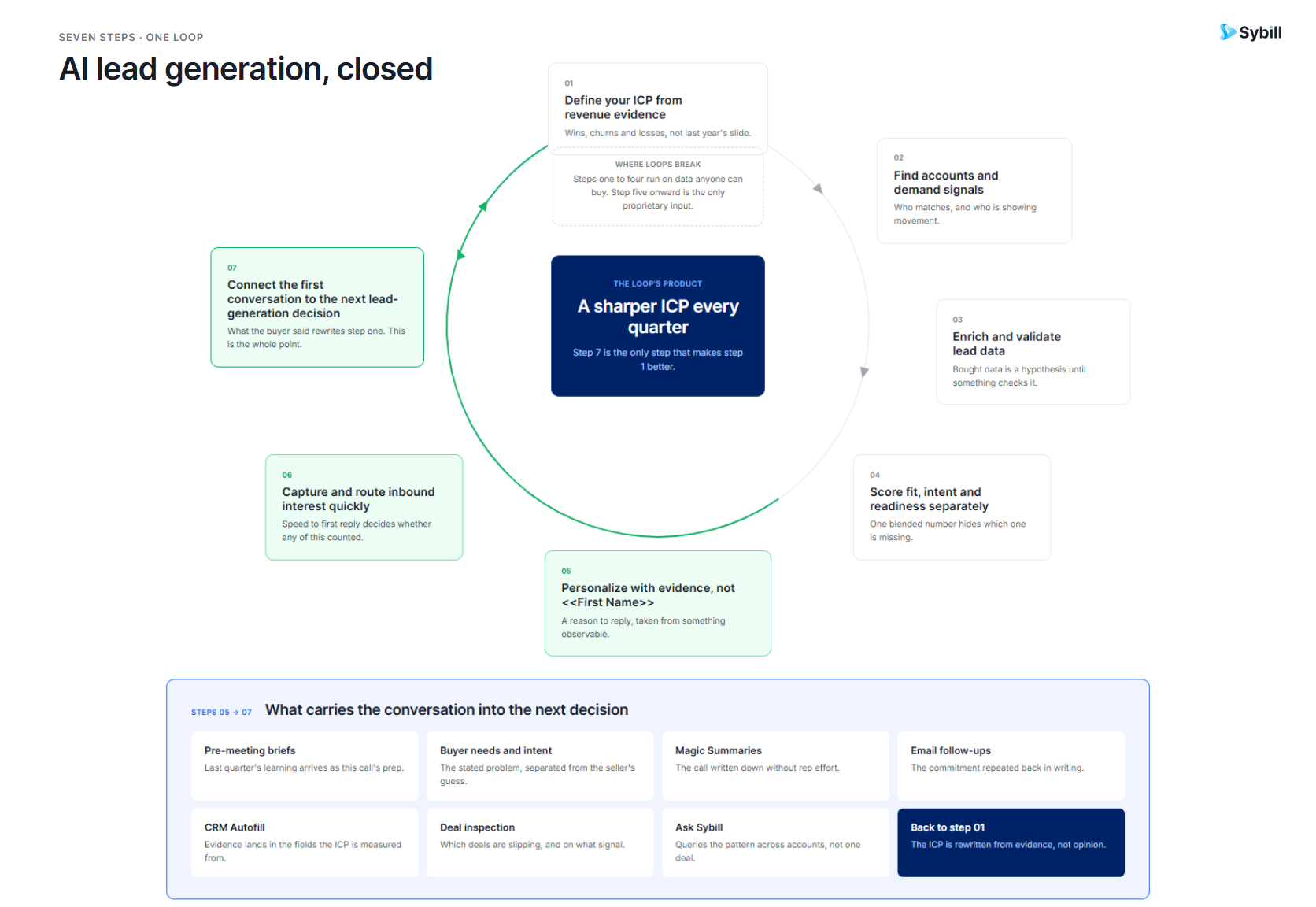
Targeting -> discovery -> enrichment -> prioritization -> engagement -> qualification -> outcome -> learning
Sybill connects the part of that system most lead-generation platforms cannot see: what buyers actually say, what the CRM needs to know and what your wins and losses should change next.
Get started with Sybill and turn buyer conversations into better qualification, execution and lead-generation decisions.
AI lead generation is the use of artificial intelligence to identify, attract, enrich, prioritize, engage and qualify potential customers. It can support prospect research, contact discovery, lead scoring, website engagement, personalized outreach, routing, follow-up and performance analysis.
B2B teams can use AI to define ICP criteria, find relevant accounts, enrich company and contact records, detect buying signals, score leads, personalize outreach, qualify inbound visitors, route leads and analyze which sources and segments become qualified opportunities.
The best tool depends on the job. Apollo supports contact discovery and engagement, Clay supports research and enrichment, 6sense focuses on account intent, HubSpot connects lead capture and CRM workflows, Regie.ai supports outbound execution, Zapier connects tools, and Sybill turns sales conversations into qualification, CRM updates and revenue intelligence.
ChatGPT can help research markets, define selection criteria, analyze supplied account information and draft outreach. By itself, it does not provide a continuously verified B2B contact database, reliable intent data or complete attribution. It becomes more useful when connected to trusted data sources and controlled workflows.
AI can automate substantial parts of research, enrichment, scoring, routing, drafting and follow-up. People should still define the market, approve consequential decisions, verify uncertain information, manage exceptions and handle complex buyer conversations. Salesforce's 2026 State of Sales similarly describes the emerging model as a partnership between human and digital sellers.
Compare the full cost of the AI tools, data, implementation and human oversight with the qualified pipeline or revenue they influence. Track cost per qualified opportunity, meeting-to-opportunity conversion, pipeline per 1,000 leads and eventual win rate. Do not calculate ROI from time saved or lead volume alone.
AI lead generation is the use of artificial intelligence to identify, attract, enrich, prioritize, engage and qualify potential customers. It can support prospect research, contact discovery, lead scoring, website engagement, personalized outreach, routing, follow-up and performance analysis.
B2B teams can use AI to define ICP criteria, find relevant accounts, enrich company and contact records, detect buying signals, score leads, personalize outreach, qualify inbound visitors, route leads and analyze which sources and segments become qualified opportunities.
The best tool depends on the job. Apollo supports contact discovery and engagement, Clay supports research and enrichment, 6sense focuses on account intent, HubSpot connects lead capture and CRM workflows, Regie.ai supports outbound execution, Zapier connects tools, and Sybill turns sales conversations into qualification, CRM updates and revenue intelligence.