Find us at booth #83, join us for a harbor side happy hour, or catch Gorish’s talk.

Sept, 16-18 > Learn more


Tamanna Mishra

July 3, 2026
%20(22).png)
Sales has always had an imagination problem.
“Picture this machine on your factory floor.”
“Imagine this couch in your office.”
“Think about how this medical device would work in your procedure room.”
“Visualize this configuration across your retail space.”
That is a lot of unpaid mental labor for a buyer who already has procurement breathing down their neck, finance asking for ROI, and three internal stakeholders waiting to say, “Interesting, but can we see another option?”
This is where AR in sales becomes useful.
Augmented reality in sales helps buyers see a product, configuration, environment, or experience in their own context before they commit. It can turn a flat product page into a virtual try-on, a brochure into a 3D product walkthrough, or a remote demo into something closer to an in-person experience.
But let’s be clear. AR is not automatically useful because it looks futuristic. Sales teams do not need more shiny demos wearing a headset and pretending to be Tony Stark. They need tools that help buyers understand faster, compare better, reduce uncertainty, and make decisions with more confidence.
That is the real promise of AR in sales. Not spectacle, but clarity.
AR in sales is the use of augmented reality to add digital product information, visuals, 3D models, instructions, or simulations into a buyer’s real-world environment.
A simple way to think about it: AR lets buyers see digital objects in their physical space.
Salesforce describes augmented reality in ecommerce as a way to overlay digital information and virtual objects onto the real world, often through a smartphone camera. In sales, that can mean letting a buyer place a sofa in their living room, see an industrial machine on a plant floor, compare paint finishes on a wall, or explore a product configuration on a tablet.
The key phrase is “in context.”
A product photo shows what something looks like.
A video shows how it moves.
A sales deck explains why it matters.
AR shows how it might fit into the buyer’s world.
That distinction matters because many purchase decisions are not blocked by lack of information. They are blocked by uncertainty.
Will this fit?
Will this work in our space?
Will stakeholders understand it?
Will the final product match what we expect?
Will this choice create regret later?
AR can help answer those questions when the product is visual, spatial, configurable, complex, or hard to experience remotely.
AR and VR often get thrown into the same “immersive tech” bucket, which is a great way to confuse everyone in the room.
Virtual reality replaces the user’s environment. The buyer enters a fully digital space, usually through a headset.
Augmented reality adds digital elements to the real environment. The buyer still sees the actual room, desk, factory floor, store, or showroom, but with digital objects layered on top.
For most sales use cases, AR is easier to adopt because it can often work through phones, tablets, or web-based experiences. A buyer does not always need a headset. A sales rep does not need to turn the demo into an escape room.
Buyers do not just need more information. They need better decision support.
The average buyer already has more PDFs, case studies, comparison pages, product videos, competitor claims, and internal opinions than they can reasonably process. The problem is not a shortage of content. The problem is that a lot of sales content still asks buyers to translate abstract information into real-world confidence.
AR helps because it makes the product easier to evaluate.
For example, a facilities leader can see whether equipment fits into a specific physical layout. A retail buyer can visualize an in-store display before approving it. A homeowner can see whether a piece of furniture ruins the room or saves it. A medical device buyer can understand the mechanics of a product without waiting for an on-site demonstration.
That is not just “engagement.” Engagement is a slippery word. People are also engaged when watching bad reality TV. The better question is: does AR help the buyer make a more confident decision?
When used well, yes.
Shopify’s Rebecca Minkoff case study found that shoppers who interacted with products in 3D were 44% more likely to add an item to cart, and customers who interacted with a product in 3D were 27% more likely to place an order. Visitors who used AR were 65% more likely to place an order. That does not mean AR magically boosts every sales motion. It does show that when product visualization matters, richer product experiences can influence buying behavior.
Research also points in the same direction. A 2024 PLOS ONE study on AR online shopping found that AR shopping experiences can affect purchase intention through factors such as perceived usefulness, ease of use, immersion, and interactivity.
Translation: buyers do not respond to AR because it is cute. They respond when it helps them understand, evaluate, and trust what they are buying.
AR can make the demo more visual. It cannot tell the sales team what the buyer really meant.
That matters.
After an AR demo, the selling work is not done. The rep still needs to understand what the buyer cared about, which stakeholder was excited, who raised concerns, what objection came up, what configuration mattered, what next step was promised, and whether the deal actually moved.
This is where Sybill fits into the sales workflow around AR.
AR helps buyers see the product. Sybill helps sales teams capture what happened in the conversation around that product.
With Magic Summaries, teams can capture buyer intent, pain points, outcomes, next steps, and areas of interest after a demo. With CRM Autofill, important details from calls and emails can be pushed into CRM without forcing reps into admin purgatory. With Deal Workspace, managers and reps can inspect objections, buying intent, unresolved concerns, and deal movement across the pipeline.
That is especially useful after an AR-heavy sales motion because visual engagement can be misleading. A buyer may love the demo and still have budget concerns. A champion may understand the product but struggle to sell it internally. A stakeholder may interact with three configurations and still prefer the cheapest option.
AR gives the buyer a better way to experience the product. Sybill helps the sales team understand what that experience means for the deal.
AR in sales works best when the product is hard to explain through static content. That is why the strongest use cases tend to show up in categories where buyers need to understand fit, space, scale, movement, configuration, or visual outcome.
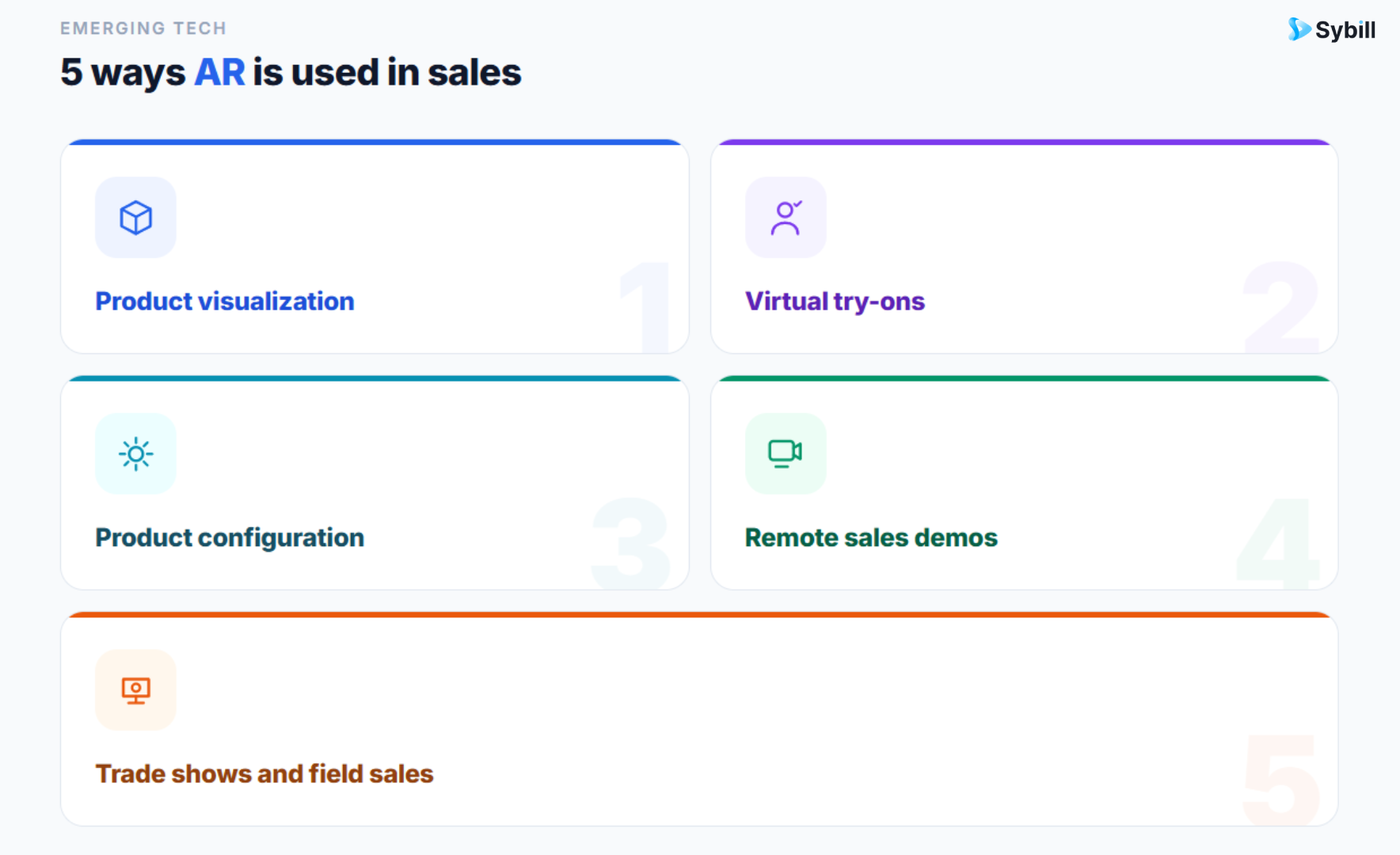
This is the most obvious use case.
A buyer can place a digital version of a product in their real environment. Furniture brands use this to show how a couch, table, or lamp might look in a room. Appliance brands can show how a refrigerator or washing machine fits into a space. Office design teams can show layouts before anyone commits to a purchase order.
The value is simple: buyers no longer have to guess.
That matters because uncertainty kills momentum. If the buyer is not sure whether the product will fit, look right, or work in their environment, the deal slows down.
Virtual try-ons are common in fashion, beauty, eyewear, accessories, and cosmetics. Buyers can see how a product looks on them before buying.
This is not just a fun ecommerce trick. It solves a real buying problem. Products that depend on personal fit and appearance are harder to evaluate online. AR reduces that gap.
A lipstick shade, pair of glasses, or watch can look great in a product image and completely wrong in real life. AR helps buyers narrow choices before purchase.
AR becomes especially powerful when buyers need to compare versions.
Think of cars, modular furniture, machinery, equipment, retail displays, or complex B2B products. Buyers can change colors, sizes, parts, layouts, or configurations and see the impact immediately.
This is useful in sales because buyers often do not know what they want until they see the difference. A configurable AR experience can help them move from vague preference to specific requirement.
It also helps sales reps avoid the classic demo disaster: talking through five options while the buyer silently loses the will to live.
Remote selling made product demos more scalable, but not always more persuasive. Screenshare is fine for software. It is less effective when the product needs spatial understanding.
AR can make remote demos more tangible. A buyer can scan a room, place a product, rotate it, inspect details, and compare variations without waiting for a physical sample or on-site visit.
For distributed buying committees, this can be useful. One stakeholder can experience the product in context and share that experience with others. The demo becomes easier to understand outside the original meeting.
For teams preparing for complex demos, it also helps to research stakeholder priorities before deciding what to show. This guide on how to research multiple stakeholders before a demo is useful. The CFO, end user, technical buyer, and executive sponsor may care about completely different parts of the experience.
AR is useful at trade shows when the product is too large, expensive, fragile, or complex to bring physically.
Instead of showing a brochure or looping video, teams can let prospects explore the product in 3D. They can show internal mechanics, configurations, installation requirements, or before-and-after scenarios.
For field sales, AR can also support more consultative conversations. A rep can walk into a buyer’s environment, show how a product fits, and discuss trade-offs in real time.
That is much better than saying, “I’ll send you a PDF,” which is where momentum goes to quietly retire.
AR is not equally useful for every sales team. It is strongest when the buyer has to evaluate something visual, physical, spatial, configurable, or difficult to imagine.
Retail and ecommerce are the most mature use cases for augmented reality in sales. AR helps buyers visualize products before purchase, especially in furniture, beauty, eyewear, home improvement, accessories, and fashion.
The benefit is not just novelty. It can reduce the gap between online browsing and physical evaluation. Buyers get more confidence before adding to cart or placing an order.
Industrial products often require buyers to understand size, installation, workflow, safety, and maintenance.
AR can help a buyer see where a machine would sit, how it connects to existing systems, how components work, or what maintenance might involve. This is especially useful when the physical product is too large to transport or when the buying committee includes people who will never attend an on-site demo.
A 2025 study on extended reality in B2B sales interactions found that XR technologies may strengthen sales interactions by helping simplify product understanding and support more customer-centered conversations.
That is the B2B sales case in one line: make the complex easier to understand.
Automotive sales has obvious AR potential. Buyers can explore models, colors, interiors, features, accessories, and configurations without needing every variation on the showroom floor.
For sales teams, this can extend the showroom experience. For buyers, it makes comparison easier.
In real estate, architecture, and construction, AR can help buyers understand spaces that are not yet finished or physically accessible.
A buyer can see furniture placement, room finishes, layouts, materials, or renovation possibilities. For commercial real estate, AR can help teams visualize offices, retail layouts, or facility changes before signing off.
Medical device sales often involves complex products, clinical workflows, and high-stakes buying committees. AR can help explain anatomy, product mechanics, procedures, installation, and training scenarios.
Of course, healthcare AR needs more rigor than a furniture app. Accuracy, compliance, privacy, and clinical context matter. The bar is higher because the consequences are higher.
Field sales teams can use AR when they need to show buyers how a product fits into a real environment. This can apply to construction materials, industrial equipment, retail displays, energy systems, office infrastructure, and more.
The best AR field sales experiences are practical. They help the buyer answer, “Can this work here?”
The benefits of AR in sales should always be tied to real sales problems. Otherwise, it becomes an innovation theater. And nobody needs another “future of selling” deck that somehow says nothing.
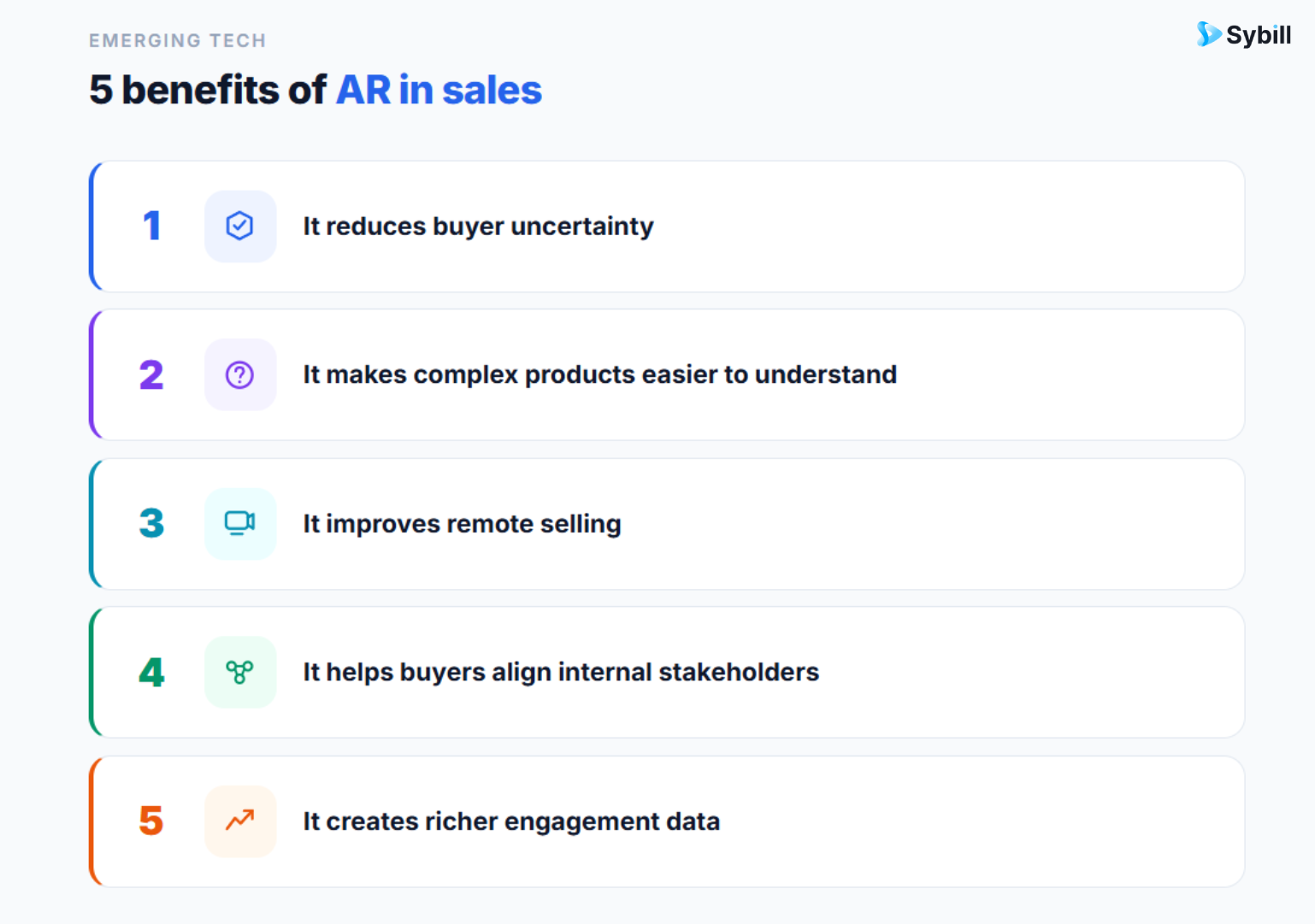
Uncertainty is expensive. It slows deals, creates internal objections, increases stakeholder questions, and makes buyers postpone decisions.
AR reduces uncertainty by helping buyers see products in context. They can understand size, fit, configuration, and visual impact before purchase.
This is especially valuable in considered purchases where the buyer has to justify the decision internally.
Some products are hard to explain in slides. They have moving parts, technical layers, physical constraints, or multiple configurations.
AR can simplify that complexity by showing how the product works instead of asking the buyer to imagine it.
That can improve sales conversations because the rep spends less time explaining the basics and more time discussing fit, value, constraints, and next steps.
Remote selling works beautifully for some sales motions and terribly for others.
If the product is software, a screen share can work. If the product is physical, spatial, or experiential, remote selling becomes harder.
AR can help bridge that gap. It gives buyers a way to interact with the product without requiring travel, samples, or a physical showroom.
Buying committees are messy. One person attends the demo. Another controls budget. Another cares about implementation. Another appears late and asks a question everyone answered three weeks ago.
AR can help because it creates a more shareable product experience. A champion can show internal stakeholders what they saw, not just describe it.
This matters in sales because deals often stall when the champion cannot explain the product clearly inside their own organization.
If connected properly, AR can show what buyers explored, configured, repeated, compared, or ignored.
That data can be useful, but only if sales teams interpret it carefully. A buyer spending five minutes with an AR model may be highly interested. Or they may simply be stuck. Engagement data is a clue, not a conclusion.
This is where sales teams should connect AR activity with conversation intelligence, CRM data, follow-up engagement, and pipeline movement. For example, after a high-engagement AR demo, teams can use Ask Sybill to understand what buyers cared about most, whether objections changed, and which next steps are still unresolved.
Not every product needs AR.
AR may be a bit much when the product is simple, the buyer does not need spatial context, the sales cycle is short, the cost of 3D assets is too high, or the experience adds novelty without improving understanding.
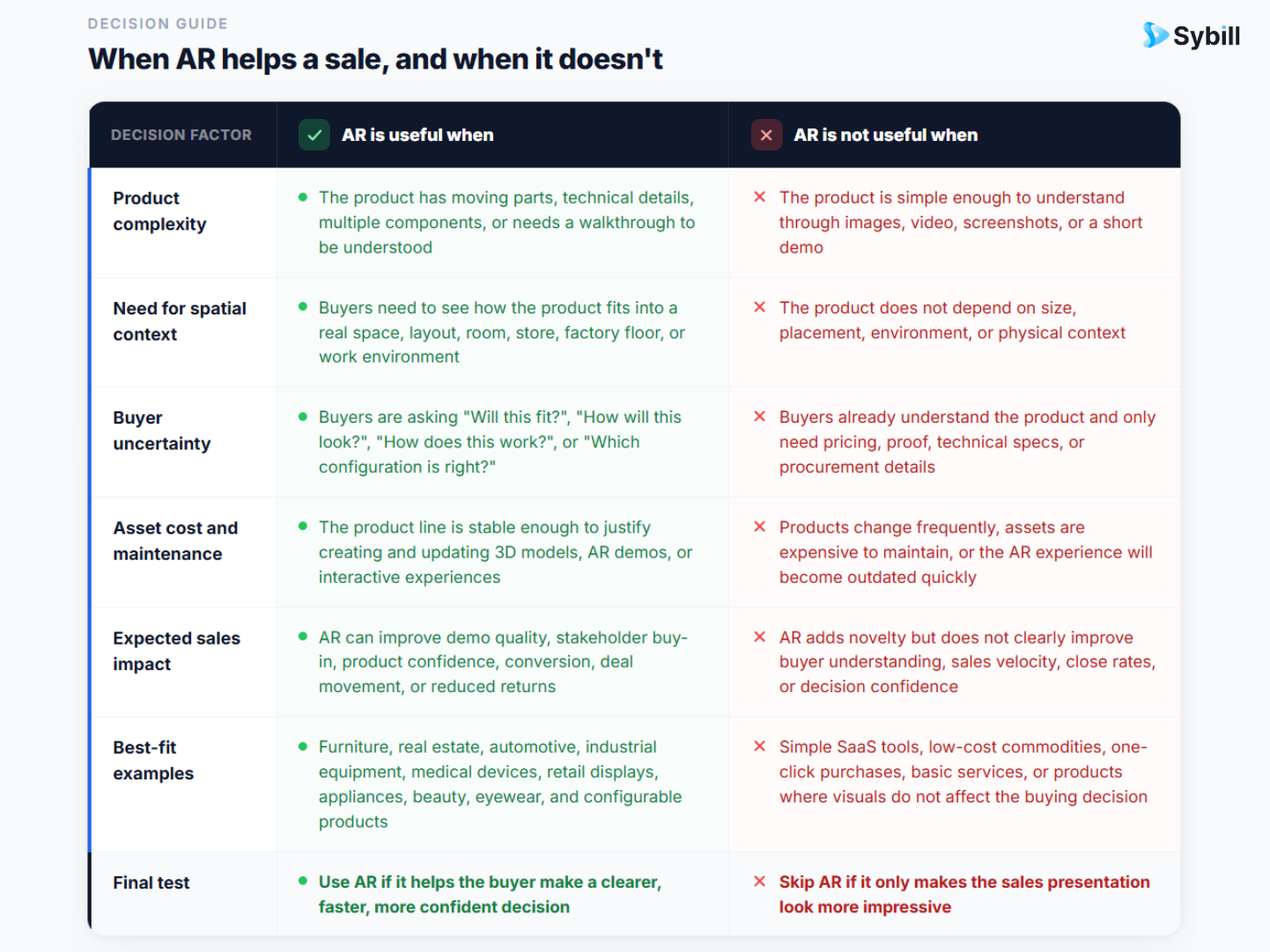
If a screenshot, short video, calculator, interactive demo, or clear sales call can answer the buyer’s question faster, use that instead.
AR is not a strategy. It is a medium.
Use augmented reality in sales when it makes the buying decision easier. Skip it when it only makes the sales presentation look expensive.
AR can be powerful, but implementation is not a casual Friday project.
Good AR needs good assets. That may mean 3D models, product scans, animations, technical documentation, configuration logic, and ongoing updates.
If the product changes often, the AR experience has to change too. Otherwise, reps may show outdated information, which is a very efficient way to lose buyer trust.
AR that lags, glitches, fails to load, or requires too many steps can hurt the sale.
Buyers do not care that the technology is sophisticated. They care whether it works. If the experience is clunky, the buyer may blame the product, not the AR vendor.
A strong AR demo still needs a strong sales conversation.
Reps need to know when to use AR, what to show, how to connect the experience to buyer priorities, and how to move from visualization to business value.
Otherwise, the demo becomes a toy tour.
AR metrics can be tempting but shallow.
Views, clicks, rotations, and time spent are useful, but they do not prove revenue impact by themselves. Sales teams should connect AR engagement to opportunity creation, demo conversion, stakeholder sharing, sales cycle movement, close rates, deal size, and objections captured after the demo.
If AR gets attention but does not move the deal, it is a nice experience. Not a sales asset.
Some buyers will see AR as a gimmick, especially if it is poorly connected to their decision.
The fix is not to make the AR more dramatic. The fix is to make it more useful.
Do not open with, “Look how cool this is.”
Open with, “Let’s see how this would work in your actual environment.”
Completely different conversation.
Before investing in AR for sales, ask these questions:
The most important question is this: will AR help the buyer make a better decision?
If the answer is yes, explore it. If the answer is “it will make us look innovative,” please step away from the headset.
Sales teams should measure AR in sales across three levels: usage, buyer impact, and revenue impact.
Usage metrics include AR demo views, model interactions, configurations created, products placed in-room, repeat visits, and stakeholder shares.
Buyer impact metrics include demo engagement, product understanding, internal sharing, follow-up questions, objection quality, and confidence after the demo.
Revenue impact metrics include demo-to-opportunity conversion, sales cycle length, close rate, average deal size, return rate, product configuration accuracy, and forecast confidence.
The important part is connecting AR activity to deal reality.
A buyer who spent 12 minutes with an AR product model may be interested, confused, or comparing you with a competitor. Sales teams need the conversation layer around that behavior.
That is why AR should not sit alone as a disconnected experience. It should connect to the sales workflow: the demo, the follow-up, the CRM, the next step, the manager review, and the pipeline inspection.
For example, after a high-stakes demo, Sybill can help teams capture the buyer’s language, draft follow-ups, update CRM fields, and inspect whether the opportunity is moving or just glowing politely. This also connects to the broader discipline of spotting risk early. Here is a useful guide on how to spot deal risk before forecast review.
Body image idea: A workflow graphic showing AR demo, buyer questions, Sybill summary, follow-up email, CRM update, and deal inspection.
Alt text: Augmented reality in sales workflow showing how AR demos and AI sales tools capture buyer signals and follow-ups.
The future of augmented reality in sales is not every rep wearing a headset and conducting holographic pipeline reviews.
Thank goodness.
The more realistic future is quieter and more useful. AR will become part of product pages, sales demos, ecommerce journeys, field sales conversations, training environments, and buyer enablement flows. It will show up where buyers need to understand something faster than static content allows.
AI will also play a larger role around AR. Not necessarily by making the AR experience flashier, but by making it more personalized and actionable.
AI can help recommend which product configuration to show, summarize buyer reactions after the demo, identify objections, draft follow-ups, and connect engagement to pipeline risk. Generic AI tools can help with research and prep, as covered in this guide on how to use Claude for sales research. But for live sales execution, teams need AI that understands deal context, buyer history, CRM fields, follow-ups, and pipeline movement.
That is the bigger point: AR can improve the buying experience, but sales teams still win or lose based on how well they execute after the experience.
A dazzling demo followed by a vague follow-up is still a weak sales motion.
The best use of AR in sales is not to impress buyers. It is to help them decide.
That sounds less glamorous, but it is much more valuable.
AR works when it helps buyers see a product in context, compare options, understand complexity, align stakeholders, and move from “I think this could work” to “I can see how this works for us.”
It fails when it becomes a gimmick, a novelty demo, or a very expensive way to avoid having a clear sales conversation.
For sales teams, the smart play is not AR alone. It is AR connected to the rest of the revenue workflow.
Use AR to make the product easier to understand. Use tools like Sybill to capture what buyers said, what they cared about, what objections surfaced, what needs to happen next, and whether the deal actually moved.
Because seeing the product is powerful.
Knowing what the buyer really thinks about it is what closes the loop.
AR in sales is the use of augmented reality to place digital product experiences into a buyer’s real-world context. It can help buyers visualize products, compare configurations, explore features, or understand how something would look or work in their environment. Common examples include virtual try-ons, 3D product demos, furniture placement, automotive configuration, industrial equipment walkthroughs, and real estate visualization.
Augmented reality is used in sales to make products easier to understand before purchase. Sales teams use AR for product visualization, remote demos, trade shows, virtual try-ons, product configuration, buyer education, and field sales. It is especially useful when buyers need to understand size, fit, layout, design, movement, or technical complexity.
Examples of AR in sales include a furniture buyer placing a sofa in their living room, a car buyer customizing a vehicle, a manufacturer showing machinery on a factory floor, a cosmetics buyer trying on lipstick virtually, a real estate buyer viewing finishes in a room, or a medical device company showing how a device works inside a clinical workflow.
AR adds digital objects or information to the buyer’s real-world environment. VR replaces the real environment with a fully digital one. In sales, AR is often easier to adopt because buyers can use phones or tablets. VR can be useful for fully immersive training, simulations, or virtual showrooms, but it usually requires more hardware and setup.
AR can increase sales when it helps buyers make better decisions, especially in categories where visualization, fit, configuration, or product confidence matters. However, AR does not automatically improve sales. It works best when it solves a real buyer problem, connects to the sales process, and is measured against meaningful business outcomes like conversion, deal progression, close rate, or reduced returns.
Industries that use AR for sales include retail, ecommerce, furniture, beauty, fashion, automotive, manufacturing, industrial equipment, real estate, construction, healthcare, medical devices, and field sales. The strongest use cases usually involve products that are visual, physical, configurable, expensive, complex, or difficult to evaluate remotely.
The main challenges of using AR in sales include the cost of 3D asset creation, device compatibility, poor user experience, sales rep training, buyer adoption, data privacy, content maintenance, and ROI measurement. AR also carries a gimmick risk if the experience looks impressive but does not help the buyer understand the product or make a decision.
Sales teams can measure AR ROI by tracking usage, buyer behavior, and revenue impact. Useful metrics include AR demo views, product interactions, configurations created, stakeholder shares, demo-to-opportunity conversion, sales cycle length, close rate, deal size, return rates, and CRM-captured objections after AR demos. The goal is to measure whether AR improves decision confidence and deal movement.
Yes, AR can be useful for B2B sales when the product is complex, physical, technical, spatial, or configurable. It can help buyers understand equipment, layouts, workflows, installation requirements, and product value without relying only on decks or videos. However, AR is not necessary for every B2B sales motion. It should be used when it improves buyer understanding.
AI can support AR in sales by helping personalize demos, recommend product configurations, analyze buyer behavior, summarize sales conversations, generate follow-ups, and update CRM fields. AR helps buyers see and explore the product. AI helps sales teams understand the deal signals around that interaction and decide what to do next.
AR in sales is the use of augmented reality to place digital product experiences into a buyer’s real-world context. It can help buyers visualize products, compare configurations, explore features, or understand how something would look or work in their environment. Common examples include virtual try-ons, 3D product demos, furniture placement, automotive configuration, industrial equipment walkthroughs, and real estate visualization.
Augmented reality is used in sales to make products easier to understand before purchase. Sales teams use AR for product visualization, remote demos, trade shows, virtual try-ons, product configuration, buyer education, and field sales. It is especially useful when buyers need to understand size, fit, layout, design, movement, or technical complexity.
Examples of AR in sales include a furniture buyer placing a sofa in their living room, a car buyer customizing a vehicle, a manufacturer showing machinery on a factory floor, a cosmetics buyer trying on lipstick virtually, a real estate buyer viewing finishes in a room, or a medical device company showing how a device works inside a clinical workflow.