Find us at booth #83, join us for a harbor side happy hour, or catch Gorish’s talk.

Sept, 16-18 > Learn more

%20(1).avif)
Mamta Tainwala

April 9, 2026

Sales engagement platforms are supposed to give reps time back. But according to Salesforce's State of Sales report, reps still spend only 28% of their week actually selling. The rest disappears into CRM updates, email sequencing, follow-up admin, and toggling between tools that were supposed to simplify everything.
Salesloft has been a category leader for years, and for good reason. Multi-channel cadences, performance analytics, and call tracking made it the default for outbound-heavy teams. But the landscape has shifted. Salesloft merged with Clari in 2025, pricing has crept higher, and many teams are discovering that their needs have outgrown what a traditional sales engagement platform can offer on its own.
Whether you are evaluating alternatives because of budget constraints, integration friction, missing AI capabilities, or the realization that engagement without intelligence is just noise, this guide breaks down 11 Salesloft competitors worth your attention in 2026.
In this guide, you will find:
Before you dig into the details, here is a snapshot of every alternative covered in this guide and who each one serves best.
.png)
Now, let us get into the details.
Before jumping to the tools, it helps to understand the common reasons revenue teams start looking beyond Salesloft.
Pricing that scales faster than value. Salesloft does not publish transparent pricing, but industry reports put the Advanced plan around $125 to $180 per user per month. The dialer is a separate add-on. For a 50-person team, annual costs can easily exceed $100,000 before you factor in implementation and training.
Feature bloat after the Clari merger. Salesloft now bundles sales engagement, conversation intelligence, deal management, and forecasting. That sounds comprehensive until your team only needs two of those four capabilities and is paying for all of them.
CRM sync limitations. While Salesloft integrates with Salesforce, HubSpot, and Dynamics, teams frequently report that the data flow is shallow. CRM hygiene suffers when engagement platforms log activities without capturing the context behind them.
The intelligence gap. Salesloft tells reps what to do next in a sequence. It does not tell them what the buyer actually said, what objections surfaced, or what deal risks are building underneath the surface. That intelligence layer is what separates activity from outcomes.
Best for: Revenue teams that want conversation intelligence, automated CRM updates, AI-generated follow-ups, and deal visibility without replacing their existing engagement stack.
G2 Rating: 4.8/5
Sybill is not a direct Salesloft replacement. It is the intelligence and execution layer that Salesloft (and most engagement platforms) are missing.
Here is the difference. Salesloft manages your outbound sequences. It tells reps when to send an email and when to make a call. But after those interactions happen, someone still needs to update the CRM, write the follow-up, capture the objections, and flag the deal risks. That is where the workflow breaks.
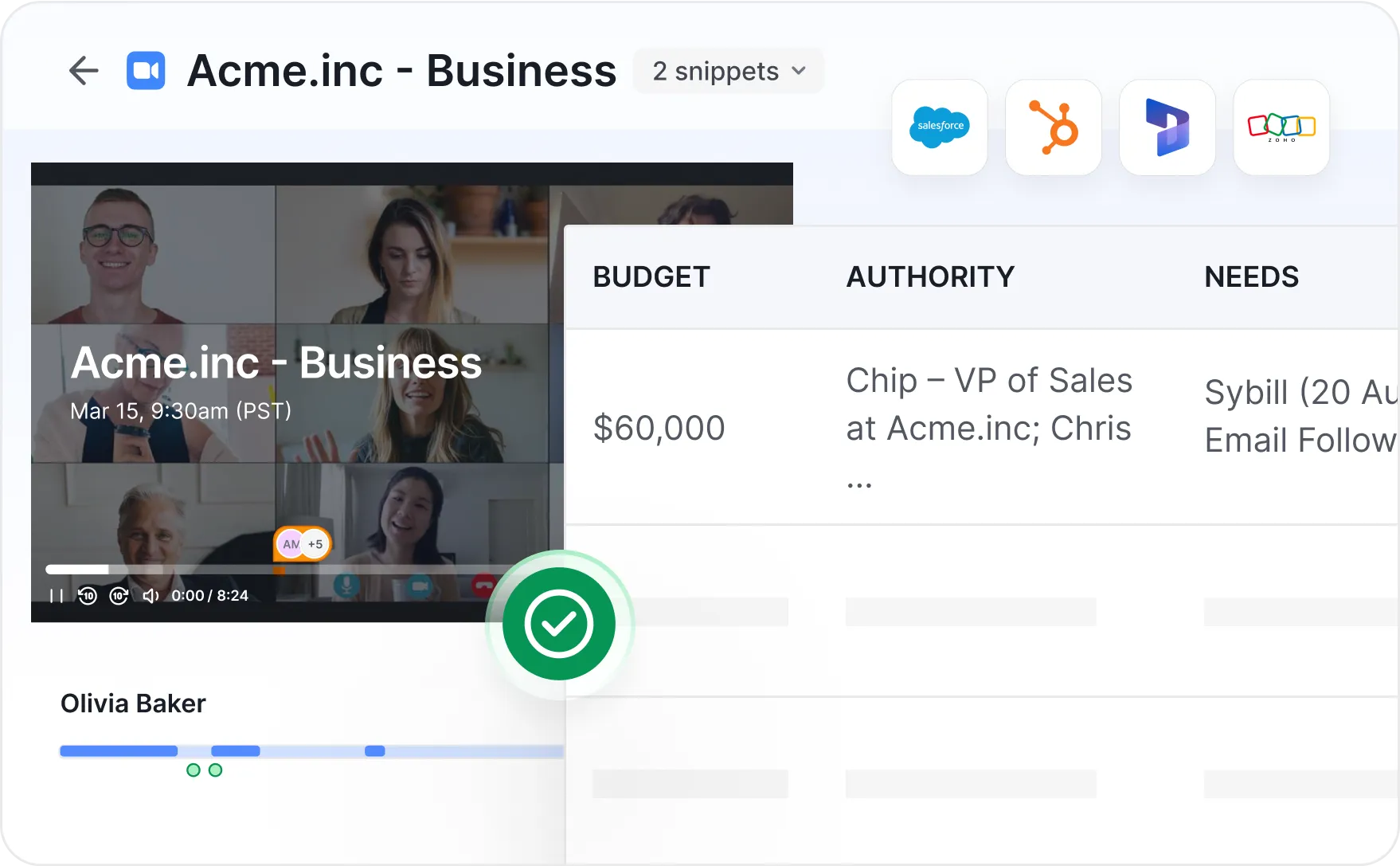
Sybill automates everything that happens after the conversation. It records sales calls without an intrusive bot, generates detailed meeting summaries that capture pain points, objections, and buying signals, then writes personalized follow-up emails in the rep's own tone. Its CRM Autofill populates 30+ fields after every interaction, including qualification framework data like MEDDPICC, BANT, and SPICED, without the rep touching a single field.
The Deal Workspace centralizes risks, blockers, stakeholder mapping, and multithreading status for every opportunity. Ask Sybill lets reps and managers query their entire pipeline in natural language: "Which deals have stalled this week?" or "Where did pricing objections come up in the last 10 calls?"
Key capabilities:
Invisible meeting recording (no bot joining the call), Magic Summaries with verbal and non-verbal cue analysis, one-click personalized follow-up emails, CRM Autofill across 30+ fields with 99% fill rate, Deal Workspace for pipeline visibility, Ask Sybill for cross-deal intelligence, pre-call briefs that aggregate buyer history, and native integrations with Salesforce, HubSpot, Slack, and all major meeting platforms.
Pricing: Free trial available. Paid plans start at $19 per user per month.
.png)
Where it fits in your stack: Sybill works alongside Salesloft, Outreach, Apollo, or any engagement platform. It is not an either-or decision. Teams that pair an engagement tool with Sybill get the outbound automation they need plus the intelligence and execution layer that turns conversations into closed deals.
Get started for free with Sybill.
Best for: Enterprise and mid-market sales teams that need advanced multi-channel cadences, AI-guided daily actions, and embedded conversation intelligence.
G2 Rating: 4.3/5
Outreach is the closest direct competitor to Salesloft and the first name most teams consider when switching. The platform manages multi-step cadences across email, phone, and LinkedIn, with Rhythm, an AI productivity engine that recommends daily actions and prioritizes tasks.
Outreach Kaia provides embedded conversation intelligence with meeting summaries and post-call recommendations. This gives managers coaching visibility without requiring a separate CI tool.
Where Outreach falls short is similar to where Salesloft struggles: post-call execution. Kaia captures conversations, but reps still need to manually update CRM fields, craft follow-ups, and track deal health across opportunities. Teams that pair Outreach with a tool like Sybill eliminate that gap entirely, keeping the cadence engine while automating everything downstream.
Pricing: Custom pricing based on seat count and feature tier. Expect enterprise-level investment.
Best for teams that: Already run complex multi-channel outbound motions and need a mature, proven cadence platform with strong analytics.
Read the full breakdown: Salesloft vs Outreach
Best for: SMB and mid-market teams that want a contact database and sequencing tool in a single platform at a fraction of Salesloft's cost.
G2 Rating: 4.7/5
Apollo is the value play in this category. It combines a 275M+ contact database with email sequencing, a built-in dialer, LinkedIn integration, and basic CRM functionality. For teams that currently pay separately for prospecting data and engagement automation, Apollo consolidates both.
The platform's intent data and buying signal detection help sellers identify prospects showing purchase readiness. Automated follow-up workflows, personalization tokens, and A/B testing are all included.
The trade-off is depth. Apollo's conversation intelligence, deal management, and enterprise features are not as mature as Salesloft's or Outreach's. For teams running complex enterprise sales cycles, Apollo may not provide enough pipeline visibility on its own.
Pricing: Free plan available. Paid plans from $59/user/month (Basic) to $149/user/month (Organization).
Best for teams that: Need prospecting and outreach in one affordable tool and sell primarily through email and LinkedIn sequences.
Best for: Sales organizations that prioritize call recording, deal analytics, rep performance insights, and coaching at scale.
G2 Rating: 4.8/5
Gong is not a sales engagement platform. It is a conversation intelligence and revenue intelligence platform that records, transcribes, and analyzes every customer interaction.
Where Salesloft focuses on the outbound motion (what you send and when), Gong focuses on what happens during the conversation (what the buyer said, what objections surfaced, what topics predicted wins or losses). Gong's coaching dashboards, deal health scores, and competitive insights give revenue leaders visibility that no cadence tool can match.
The limitation is that Gong does not execute. It surfaces insights, but reps still need to write follow-ups, update CRM, and take action based on what the platform reveals. Gong is also priced for enterprise buyers, and smaller teams may find the ROI harder to justify.
Pricing: Custom pricing. Primarily designed for mid-market and enterprise organizations.
Best for teams that: Need deep analytics on sales conversations and coaching at scale, and already have a separate engagement platform handling outbound.
Explore alternatives: Gong alternatives
Best for: Teams already using HubSpot CRM that want native engagement features without adding another vendor.
G2 Rating: 4.4/5
HubSpot Sales Hub bundles lead management, email automation, sequences, and performance analytics into a familiar interface that connects directly to HubSpot's marketing and service tools. For organizations already running HubSpot as their CRM, adding Sales Hub is the path of least resistance.
Predictive lead scoring, cross-functional reporting, and automated follow-up sequences are all built in. The free CRM tier makes it accessible for teams that are not ready to commit to enterprise pricing.
The limitation is ceiling. HubSpot's sequencing and call features are less sophisticated than dedicated engagement platforms. Enterprise sales teams running complex multi-threaded deals may outgrow Sales Hub's capabilities.
Pricing: Free CRM tier available. Paid Sales Hub starts at $15/user/month and scales to Enterprise.
Best for teams that: Already use HubSpot CRM and want to consolidate engagement features under one roof without managing multiple vendors.
Read more: Best HubSpot integrations
Best for: Large organizations that want engagement, CRM, forecasting, and AI agents unified on a single platform.
G2 Rating: 4.4/5
Salesforce is not just a CRM anymore. With Agentforce, it now offers AI sales agents that handle prospecting, lead qualification, and meeting scheduling autonomously. Sales Cadences guide reps through multi-channel outreach, and enterprise-grade analytics provide pipeline visibility at every level.
The advantage is consolidation. Teams get engagement, forecasting, pipeline management, and renewals in one platform with thousands of AppExchange integrations. The disadvantage is complexity. Salesforce requires dedicated admin support, and the sheer volume of features can overwhelm teams that just need reliable outreach automation.
Pricing: Starting at $25/user/month, scaling significantly with feature tiers.
Best for teams that: Already run Salesforce as their CRM and want to consolidate engagement natively rather than adding third-party tools.
Best for: Sales and marketing teams that need verified B2B contact data, intent signals, and engagement workflows in one platform.
G2 Rating: 4.6/5
ZoomInfo combines prospect data, intent tracking, and outreach automation. Its verified contact database gives sellers access to direct dials and emails they can trust, while intent data identifies accounts showing buying signals.
The Chorus integration adds conversation intelligence for post-call analysis and coaching. Together, the data layer and engagement layer create a prospecting workflow that starts with who to target and ends with how the conversation went.
The challenge is pricing. ZoomInfo's tiered model (SalesOS, MarketingOS, Chorus) can add up quickly, and teams that only need one module still face pressure to bundle.
Pricing: Custom pricing based on data access and product modules.
Best for teams that: Rely heavily on outbound prospecting and need a data-first approach with verified contacts and intent signals.
Best for: SMB sales teams and outbound marketers focused on automating personalized email sequences and multi-channel follow-ups.
G2 Rating: 4.5/5
Reply.io uses AI to generate and optimize outreach messaging for each contact. The platform supports email sequencing, LinkedIn touchpoints, and calls within one workflow, along with A/B testing and lead scoring.
For teams where cold email is the primary outbound channel, Reply.io offers a strong balance of personalization and automation at a price point well below Salesloft. The AI writing assistant helps reps craft contextual messages without starting from scratch.
Pricing: Tiered pricing starting from $49/month.
Best for teams that: Run email-heavy outbound motions and want AI assistance with personalization without enterprise overhead.
Best for: Agencies and teams running high-volume cold email campaigns who need unlimited mailboxes and simple warmup automation.
G2 Rating: 4.7/5
Instantly has carved out a niche as the go-to tool for teams sending at volume. Unlimited email accounts, built-in warmup, and flat-rate pricing make it dramatically cheaper than Salesloft for pure email outreach.
The trade-off is clear: Instantly does not offer calling, conversation intelligence, deal management, or meaningful CRM integration. It is a cold email tool, and it does that one thing very well.
Pricing: Starting at $37/month for sending plus warmup. Lead database starts at $47/month.
Best for teams that: Send high volumes of cold email and care more about deliverability and cost than multi-channel orchestration.
Best for: Mid-market sales teams that want email, dialer, and LinkedIn automation in a single intuitive platform.
G2 Rating: 4.6/5
Outplay integrates email, voice, and LinkedIn messaging into unified sequences with strong analytics and CRM integration. For teams that find Outreach too complex and Salesloft too expensive, Outplay hits a middle ground.
The analytics are clean and actionable, and the interface is straightforward enough that reps adopt it quickly. The platform integrates with major CRMs for data synchronization.
Pricing: Tiered pricing starting around $79/user/month.
Best for teams that: Want multi-channel engagement without enterprise complexity or pricing.
Best for: Salesforce users who want cadence management, task automation, and calling without leaving CRM.
G2 Rating: 4.7/5
Conquer operates entirely inside Salesforce, eliminating the data sync issues that plague most third-party engagement tools. Reps manage calls, emails, and tasks in a single environment, and every activity is logged natively.
For organizations that prioritize CRM data integrity above all else, Conquer's native architecture is compelling. The trade-off is ecosystem. Teams using non-Salesforce CRMs have no use for it, and the feature set is narrower than standalone platforms.
Pricing: Custom pricing based on seat count and configuration.
Best for teams that: Run Salesforce exclusively and want zero-sync-gap engagement automation inside their CRM.
.png)
The right choice depends on what problem you are actually solving. Here is a framework:
If your primary problem is cost, Apollo.io, Reply.io, and Instantly offer the strongest value at lower price points. Each makes trade-offs on feature depth, but for teams where budget is the binding constraint, they deliver meaningful outbound capability.
If your primary problem is CRM data quality, the engagement platform is not the fix. Engagement tools create activity. CRM automation tools like Sybill capture the intelligence from those activities and write it into your CRM accurately. Pairing any engagement platform with Sybill solves the data quality problem at the source.
If your primary problem is coaching and deal visibility, Gong remains the gold standard for conversation analytics. Sybill provides similar conversation intelligence with the added benefit of post-call execution (follow-ups, CRM updates, deal workspace), making it a stronger fit for teams that want insights and action in the same tool.
If your primary problem is platform consolidation, Salesforce Sales Cloud or HubSpot Sales Hub let you reduce vendor count by bringing engagement into your CRM. The trade-off is that native engagement features rarely match the depth of dedicated platforms.
If your primary problem is outbound volume, Outreach and Salesloft remain the leaders for complex multi-channel cadences. But volume without intelligence is just noise. The teams winning in 2026 are pairing engagement platforms with AI sales intelligence to ensure every touchpoint is informed by what the buyer actually said.
Here is what most Salesloft alternatives articles will not tell you: switching from one engagement platform to another solves the wrong problem.
The bottleneck for most revenue teams is not which tool sends the email. It is what happens after the conversation. Reps spend hours every week on post-call admin: updating CRM, writing follow-ups, prepping for the next meeting, piecing together deal context from scattered notes. According to industry research, reps waste five to six hours per week on manual CRM updates alone.
This is the execution gap. And it exists regardless of whether you use Salesloft, Outreach, Apollo, or any other engagement platform.
Sybill was built specifically to close that gap. It does not replace your engagement tool. It makes whatever engagement tool you use dramatically more effective by automating the intelligence and execution layer that sits between the conversation and the closed deal.
Sales coaching improves when managers can query cross-deal patterns instead of reviewing individual calls. Pipeline management improves when CRM data is accurate and complete without rep effort. Forecast accuracy improves when deal signals come from buyer behavior, not seller optimism.
That is the stack modern revenue teams are building: engagement for outbound execution, intelligence for everything that follows.
The best Salesloft alternative is not always a replacement. Sometimes it is an addition. The teams closing the most revenue in 2026 are not debating which engagement platform to use. They are building stacks where engagement and intelligence work together, where every conversation turns into action, and where the CRM reflects reality instead of optimism.
Get started for free with Sybill and see what your sales workflow looks like when conversations actually drive outcomes.
What is the best free alternative to Salesloft?
Apollo.io offers the most capable free plan, with access to its contact database, basic email sequencing, and CRM integration. HubSpot Sales Hub also provides a free CRM tier with limited engagement features. For AI-powered conversation intelligence and CRM automation, Sybill offers a free trial so teams can evaluate the platform before committing.
Is Salesloft the same as a CRM?
No. Salesloft is a sales engagement platform, not a CRM. It manages outbound sequences, cadences, and communication workflows, but it relies on integration with a CRM like Salesforce, HubSpot, or Dynamics for customer data management and pipeline tracking.
Can I use Sybill with Salesloft?
Yes. Sybill integrates with any meeting platform and CRM, so it layers directly on top of a Salesloft workflow. Salesloft handles the outbound cadence. Sybill handles the post-conversation intelligence: meeting summaries, follow-up emails, CRM autofill, and deal insights. Teams using both get the best of engagement automation and AI-driven execution.
What should I look for in a Salesloft alternative?
Focus on five dimensions: CRM integration depth, AI and automation capabilities, pricing transparency, ease of adoption, and whether the tool helps after the conversation ends (not just before it). The best sales engagement tools in 2026 go beyond sequencing to address the full revenue workflow.
Who are Salesloft's biggest competitors?
Salesloft's primary competitors in the sales engagement space are Outreach, Apollo.io, HubSpot Sales Hub, and Salesforce Sales Cloud. In the conversation intelligence space, Gong and Sybill serve overlapping buyer needs. The competitive landscape has shifted toward platforms that combine engagement with intelligence, rather than treating them as separate categories.
How do I know if my team has outgrown Salesloft?
Common signals include: reps spending more than four hours per week on manual CRM updates, managers lacking visibility into deal health beyond CRM stages, follow-ups that take hours instead of minutes, and sales forecasts based on gut feel rather than behavioral data. If any of those sound familiar, it is worth evaluating whether a complementary intelligence layer like Sybill can solve the problem without a full platform migration.
Apollo.io offers the most capable free plan, with access to its contact database, basic email sequencing, and CRM integration. HubSpot Sales Hub also provides a free CRM tier with limited engagement features. For AI-powered conversation intelligence and CRM automation, Sybill offers a free trial so teams can evaluate the platform before committing.
No. Salesloft is a sales engagement platform, not a CRM. It manages outbound sequences, cadences, and communication workflows, but it relies on integration with a CRM like Salesforce, HubSpot, or Dynamics for customer data management and pipeline tracking.
Yes. Sybill integrates with any meeting platform and CRM, so it layers directly on top of a Salesloft workflow. Salesloft handles the outbound cadence. Sybill handles the post-conversation intelligence: meeting summaries, follow-up emails, CRM autofill, and deal insights. Teams using both get the best of engagement automation and AI-driven execution.