Find us at booth #83, join us for a harbor side happy hour, or catch Gorish’s talk.

Sept, 16-18 > Learn more


Tamanna Mishra

March 26, 2026
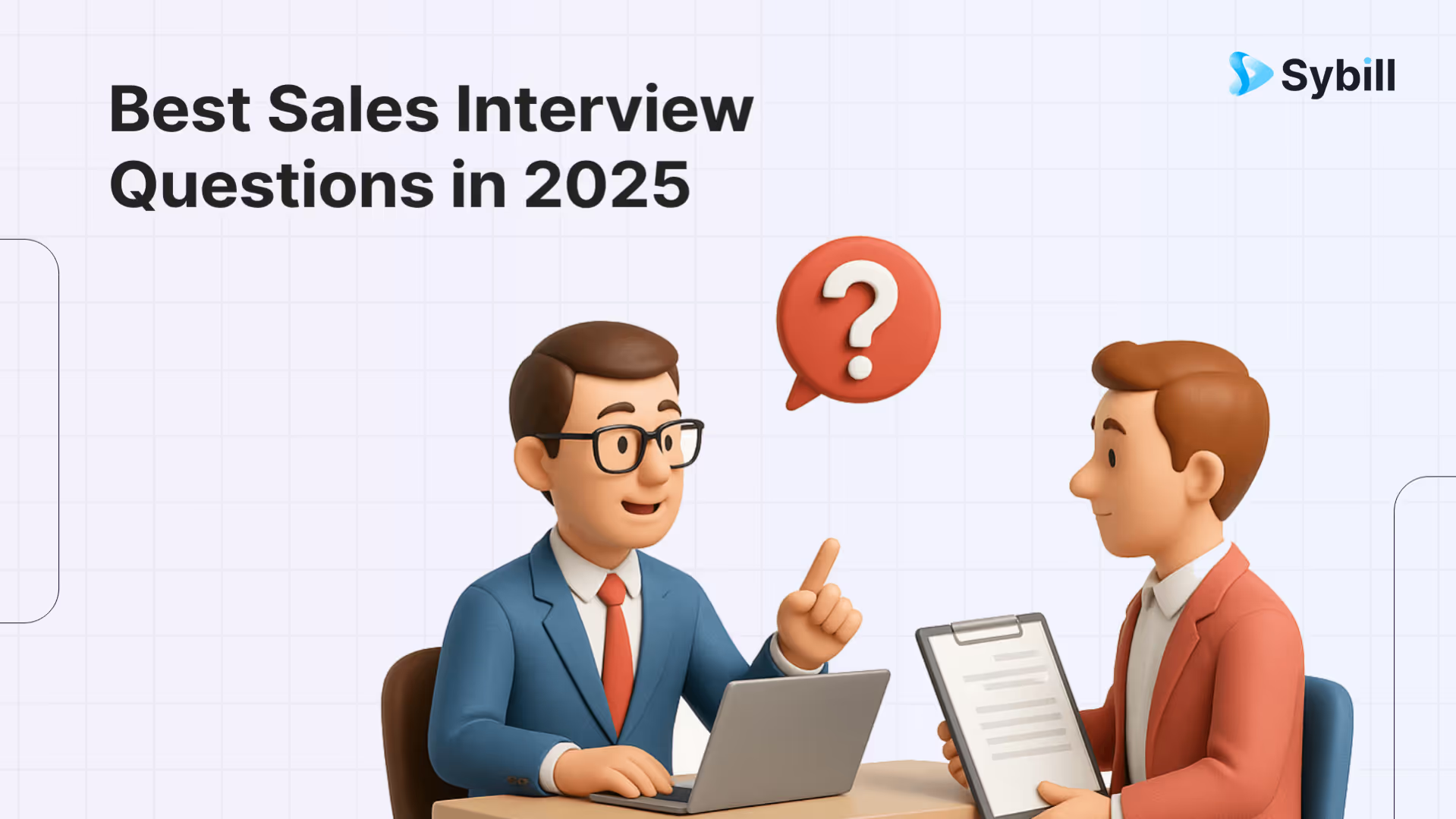
If you’ve sat in a sales interview in the last decade, chances are someone has tossed you the tired “Sell me this pen” line. Once a clever test of persuasion, it now feels like something out of Wolf of Wall Street reruns.
But that question doesn’t cut it anymore. Today’s buyers have AI-powered research at their fingertips, sales cycles are complex, and interviewers need sharper, more relevant ways to identify who can thrive in this environment.
The best sales interview questions in 2025 test for AI-era competencies, not just traditional selling skills. They include: “Walk me through how you research a prospect before a first call — what tools and data do you use?” (tests modern prep habits), “Tell me about a deal you lost and what the data told you afterward” (tests analytical thinking), “How do you use AI tools in your current sales workflow?” (tests tech fluency), “Describe a time you had to sell to a buying committee of 5+ stakeholders” (tests multi-threading ability), and “What’s your process for following up after a discovery call?” (tests post-call execution). The strongest candidates in 2025 demonstrate both human relationship skills and comfort with AI-augmented selling.
That’s why the best sales interview questions in 2025 don’t just measure charm or hustle. They’re designed to test how well a candidate navigates an AI-driven sales landscape.
How the candidate uses data.
How they personalize at scale, and still maintain the human touch.
And so much more.
Whether you’re hiring an SDR, a BDR, or a seasoned sales manager, the right sales job interview questions will reveal adaptability, empathy, and the ability to work with tech rather than be replaced by it.
Getting sales interview questions wrong in 2025 doesn’t just mean a bad hire. It can tank pipeline health, drag down team morale, and erode revenue momentum. In other words, your interview process is now a frontline defense for both your culture and your bottom line.
In this blog, we unpack what makes a good question, share a master list of sales interview questions tailored for the AI age, and show you how to evaluate answers effectively.
Related read: For a broader roadmap on building a sales career in 2025 and beyond, check out our full Sales Career Guide.
What makes a good sales interview question in 2025? It’s not about testing whether someone can “wing it” in front of a customer anymore. The strongest questions cut deeper, uncovering traits that signal long-term success in an AI-driven sales environment.
.png)
It’s not 1970. Today’s reps need more than grit and gumption. They need to prove they can use tools that accelerate pipeline visibility, automate follow-ups, and surface buying signals. Smart sales interview tips include asking:
These kinds of sales job interview questions reveal not only competence but curiosity. And that’s a must-have in modern sales.
If you want to explore what adaptability to technology really looks like, our Sales Skills in the AI Age Guide highlights why “AI fluency” is now table stakes. The ability to adopt and adapt to new tools is no longer optional. It’s the difference between reps who thrive and reps who stall.
In 2025 and beyond, the best sales interview questions don’t just identify closers. They spotlight future-proof sales talent.
For entry-level roles like SDRs and BDRs, questions should be situational and resilience-focused. These reps live in the world of rejection and repetition, so the goal is to test how they handle pressure, objections, and change.
Examples:
These SDR interview questions and BDR interview questions reveal grit, perseverance, and adaptability. And these are traits you can’t train from scratch. In short, the right sales representative interview questions will tell you if someone has the stamina to succeed in high-volume outreach.
Hiring for a sales manager role is different. Here, you’re not just testing individual selling skills. You’re testing leadership, coaching, and the ability to make AI-informed decisions that drive the team forward.
Examples:
These sales manager interview questions dig into leadership style and tech fluency. If you want more context on what great management looks like in 2025, check out our Sales Team Management in the AI Age Guide. It highlights how expectations of managers have evolved alongside technology.
Finally, there are questions that apply no matter the role. These probe for culture fit, learning agility, and how candidates handle rejection or uncertainty.
Examples:
These interview questions for sales roles uncover how someone thinks, learns, and responds to challenges. And these are qualities that define not just good reps, but great teammates.
When it comes to hiring sales talent, asking the right questions is half the battle. Tough sales interview questions show how candidates think, act, and adapt. Below is a master list of 20+ sales interview questions organized by themes that matter in 2025.
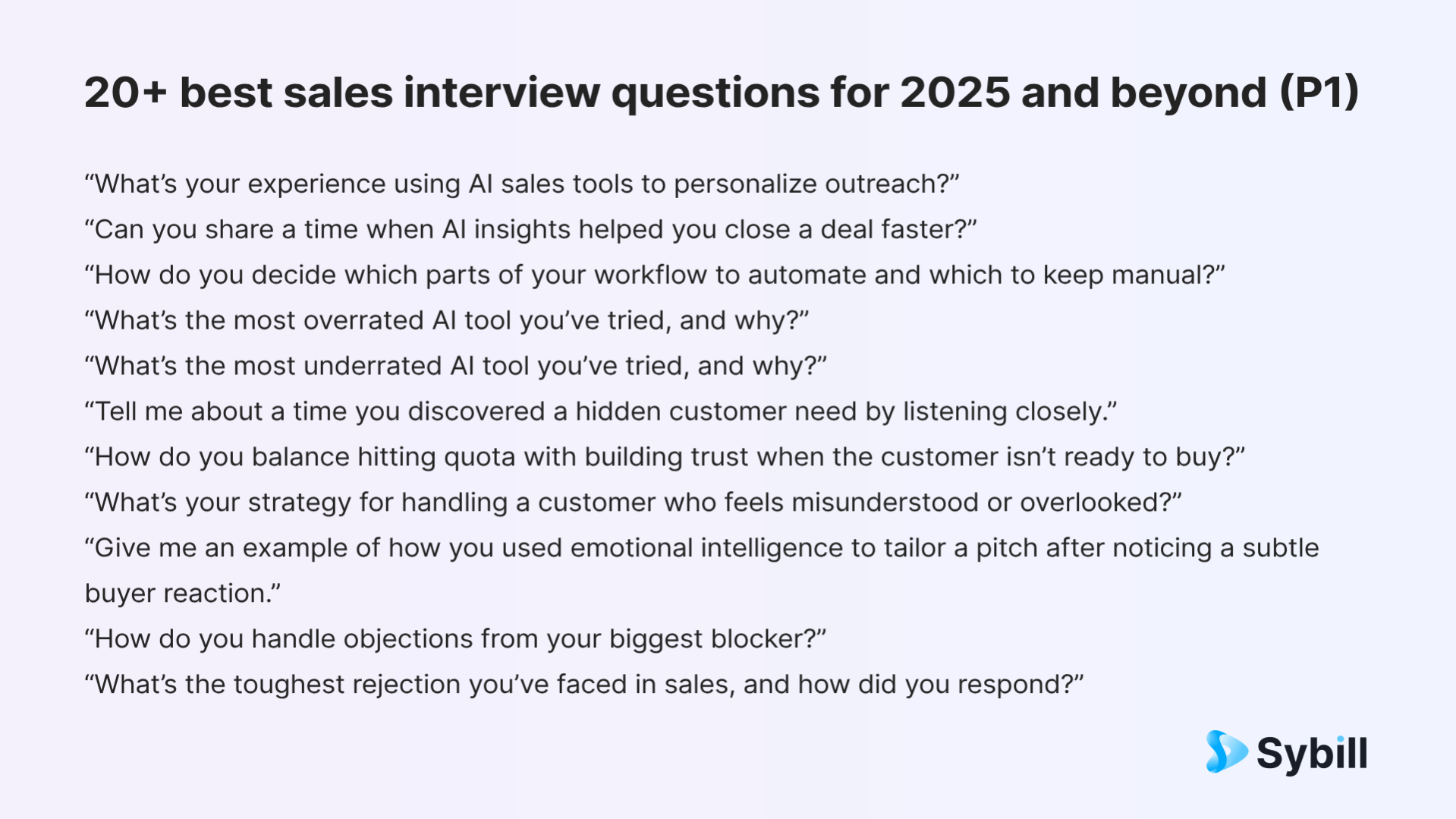
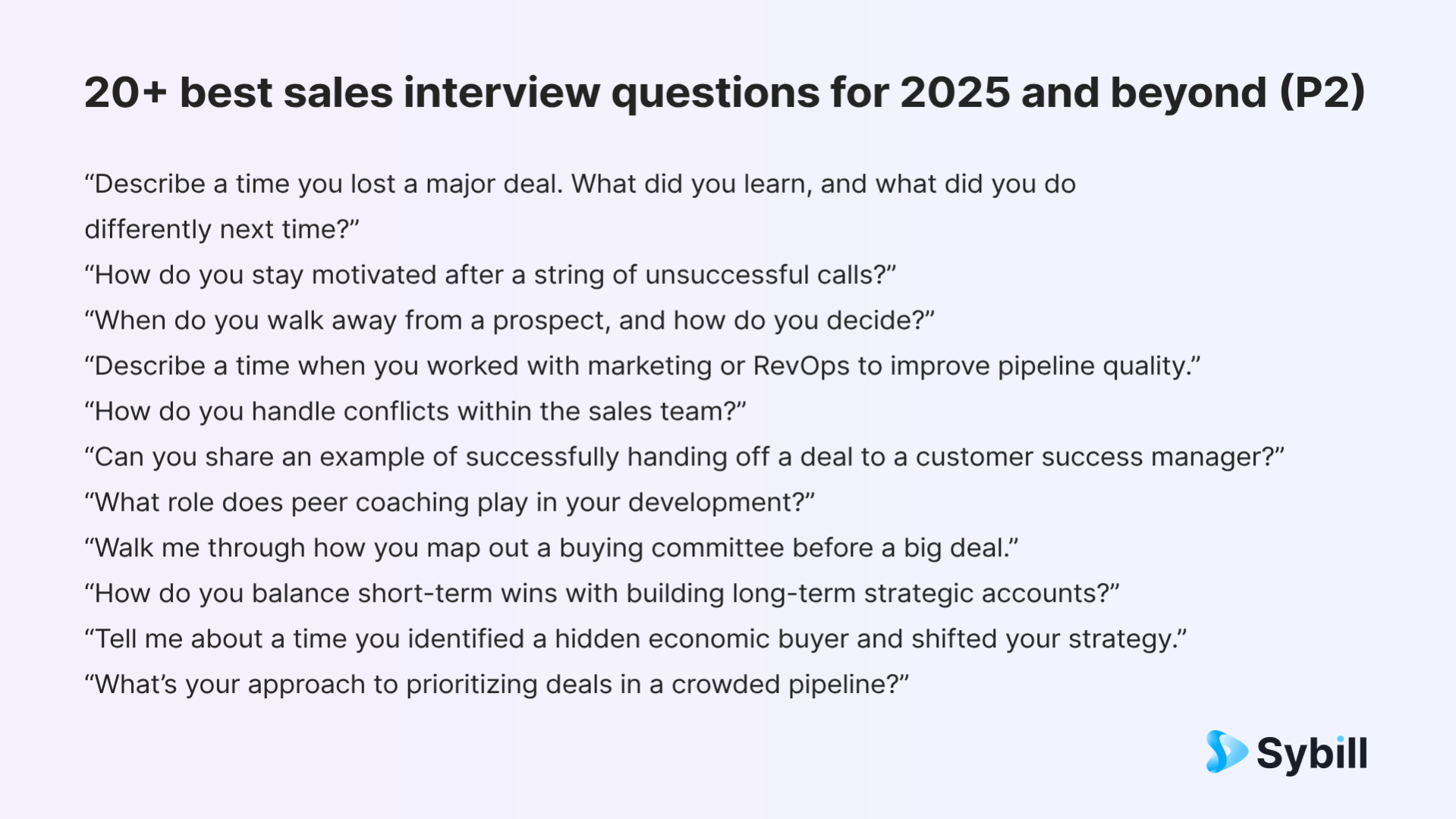
And a quick note: the strongest answers usually follow the STAR methodology for sales interview questions. That means candidates structure responses with:
Encouraging candidates to answer in STAR format helps you separate vague talkers from those who’ve actually delivered results.
Modern sales is about how effectively you use tools that improve productivity. These questions uncover whether a candidate can integrate AI into their workflow:
These probe for both curiosity and judgment. Great candidates don’t adopt tech blindly. They know how to separate hype from value.
AI can surface signals, but empathy is what seals deals. These questions test how well candidates understand buyers and respond with genuine value:
Candidates who shine here use STAR answers that highlight real interactions, not theoretical best practices.
Rejection is the tax you pay in sales. The key is how candidates process it and bounce back. Use these best sales interview questions to dig in:
Look for STAR responses where the Result shows growth, not bitterness. A red flag is when candidates blame external factors without owning part of the outcome.
Even the best reps can’t succeed alone. Today’s sales cycles involve marketing, RevOps, and customer success. Collaboration is non-negotiable. These questions reveal how candidates play with the team:
STAR responses should show not only teamwork but tangible impact like smoother handoffs, reduced churn, or stronger pipeline velocity.
Sales leaders and senior reps are expected to think beyond their patch. These questions probe for strategy, foresight, and commercial awareness:
Here, STAR answers should show not just tactical moves but business acumen. By the end of it, you should know they connected dots across stakeholders, data, and market conditions.
If you use these sales interview questions with STAR framing, you’ll uncover far more than surface-level selling skills. You’ll see how candidates think, how they learn, and how they adapt to the realities of AI-driven sales. The interview process is your best chance to spot who’s future-proof and who’s still stuck in “sell me this pen” land.
Asking the right questions is only half the battle. The real skill lies in how you evaluate the answers. Too often, interviewers get dazzled by smooth talkers who give canned responses. The goal isn’t to hire the best storyteller. Eventually, you want to hire the rep or manager who can actually deliver.
Encourage candidates to frame answers using the STAR methodology for sales interview questions:
This structure keeps responses specific and makes it easier to separate fluff from facts.
As you listen, evaluate answers through the 3Ps:
Together, STAR + 3Ps offer a reliable framework for making judgment calls.
Strong candidates will also ask smart questions back. Some great things to say at an interview include:
These show curiosity, coachability, and alignment - qualities every sales leader should prize.
Not every candidate who dazzles in the room will deliver on quota. Spotting red flags early saves you from costly mis-hires - especially in sales, where the wrong person can derail pipeline and morale.
Beware of candidates who throw around terms like “predictive analytics” or “AI-powered outreach” without offering a concrete example of how they’ve used these tools. In the AI age, fluency is valuable—but empty jargon is not.
Sales is still about people. If a candidate talks exclusively about their numbers and personal wins, but never mentions how they solved a customer problem or built trust, that’s a warning sign. Great reps balance ambition with empathy.
Ask about setbacks. If a candidate can’t describe a tough loss or rejection - and more importantly, what they learned - it suggests they haven’t built the grit needed to weather real-world selling. Vague, polished answers are a signal to dig deeper.
Red flags matter even more in senior roles where stakes and salaries are higher. As we broke down in our Sales Career Salary Guide, the top-paying sales positions come with high high salaries and OTE. They must come with high accountability too.
Hiring in sales has always been high stakes. But in the AI age, the margin for error is razor thin. Leaders can no longer rely on cookie-cutter prompts like “Sell me this pen.” The best sales interview questions today are those that uncover resilience, adaptability, empathy, and AI-readiness. Because tomorrow’s top performers will be those who can blend technology with human connection.
Don’t just hire the most charming closers. Hire future-proof pros who can thrive as the sales landscape evolves. Structure your interviews with STAR methodology, watch for the right signals, and never ignore the red flags.
And here’s a shortcut: Sybill can help you reflect on your own hiring playbook. With Ask Sybill, you can pull up the best (and most tired) interview questions you’ve asked in the past, and see what really worked. What did you ask your biggest closers when you hired them? How did they respond? And much more.
The best sales interview questions aren’t one-way. Strong candidates also ask thoughtful questions back because curiosity signals coachability and long-term potential. Here are five great examples candidates can ask hiring managers: “How does your team balance AI-driven insights with human selling skills?” “What sales tools or platforms are core to daily workflows here?” “How do you measure success in the first 90 days for a new SDR or BDR?” “What does career progression look like from sales representative to sales manager?” “How do sales and customer success collaborate post-sale?”
The STAR methodology for sales interview questions helps candidates structure their answers around: Situation, Task, Action, and Result. Five common STAR-style prompts include: “Tell me about a tough failure and how you handled it.” “Describe a time when you used data or AI tools.” “Give an example of a conflict with a teammate and how you resolved it.” “Walk me through how you overcame a missed quota.” “Share a time when you identified a customer need that others overlooked.”
If you’re prepping as a candidate, here are five great things to say at an interview: “What’s the biggest change AI has brought to your strategy?” “How do top performers here stand out?” “What opportunities exist for career growth?” “What’s the culture like - competitive, collaborative, or both?” “How do you coach your people through challenges?”