Find us at booth #83, join us for a harbor side happy hour, or catch Gorish’s talk.

Sept, 16-18 > Learn more

%20(1).avif)
Mamta Tainwala

February 22, 2026
A sales horror story that happens more often than anyone admits: A rep spends 45 minutes on a discovery call with a prospect who checks every box on paper: right industry, right company size, right title. But by the end of the call, it is obvious they are never going to buy. Wrong priorities. Wrong timeline. Wrong pain. The rep logs it as a loss, shrugs, and moves on.
Now multiply that by your entire team. Across a quarter. That is not a pipeline problem. That is a buyer persona problem.
A buyer persona is supposed to prevent exactly this. Not just a job title and a company size on a slide, but a genuine, data-backed picture of the person your product is built for: what they care about, what keeps them up at night, how they make decisions, and what would make them say yes. When it is built right, a buyer persona is the most useful document a sales team has. When it is built from assumptions, it is just expensive fiction.
This guide breaks down what a buyer persona actually is, how to build one that reflects reality, and how modern sales teams are using AI to make them sharper than ever.
A buyer persona is a research-based profile of your ideal customer that goes beyond demographics to capture motivations, challenges, and decision-making behavior. Here is what you need to know before you read further:
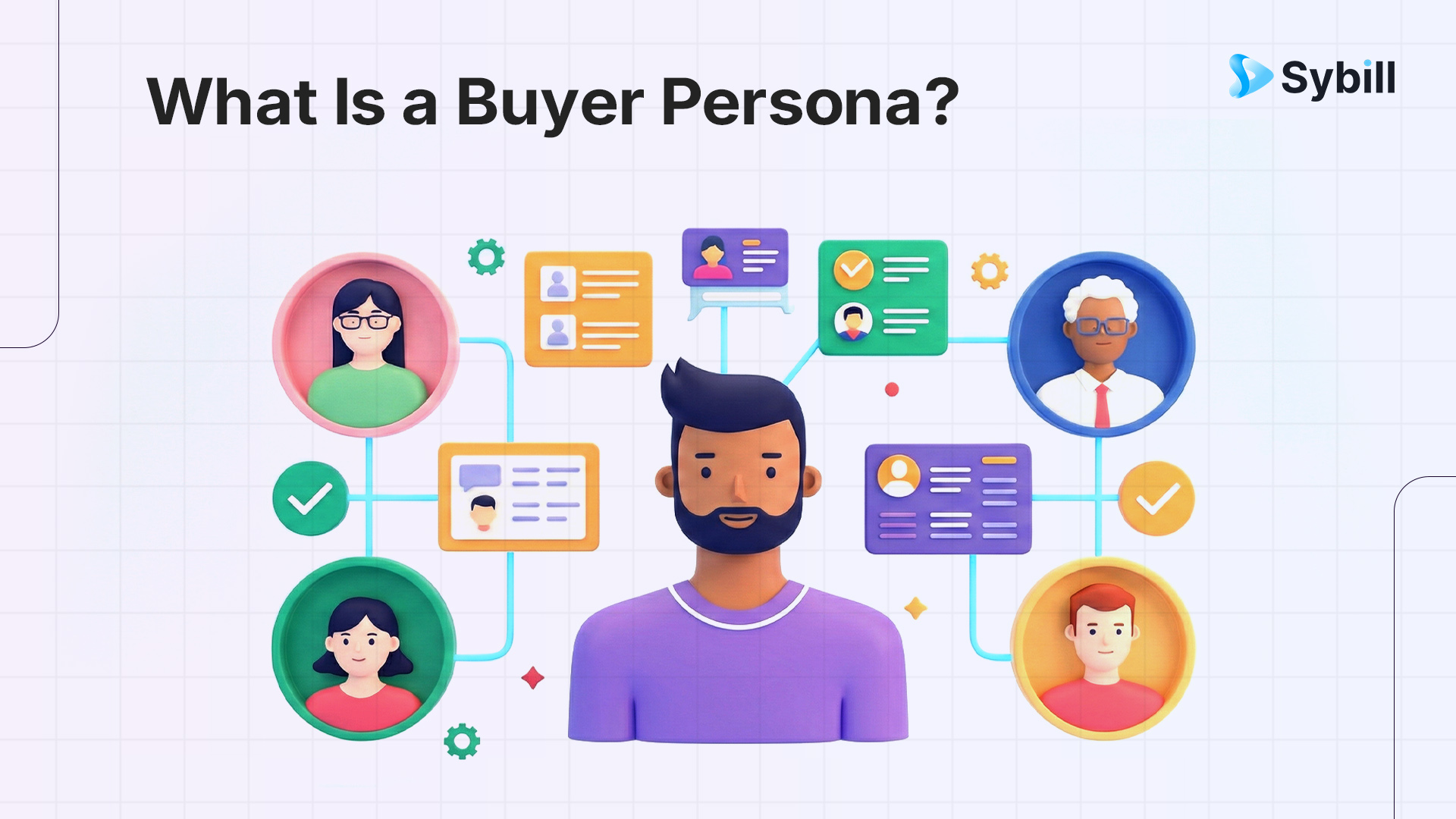
A buyer persona is a semi-fictional representation of your ideal customer, built from a combination of real data, customer interviews, and market research. It goes beyond surface-level demographics like job title and industry to capture the psychological layer underneath: what motivates this person, what challenges block them, how they evaluate solutions, and what success looks like from their seat.
The "semi-fictional" part matters. The persona itself is a composite, a constructed character representing a pattern in your real customer base, not a single real person. But every element in it should be grounded in something real: a pattern you noticed in call data, a theme that came up in ten customer interviews, a behavior you observed repeatedly in your CRM.
Buyer personas come in two flavors worth keeping in mind:
This is where most sales teams get tangled. The terms are often used interchangeably, but they answer completely different questions.
Your Ideal Customer Profile (ICP) describes the company. It is firmographic: industry, company size, revenue range, tech stack, geography, growth stage. The ICP tells you which building to walk into.
Your buyer persona describes the person inside that building. It is individual-centric: their role, their goals, their daily frustrations, their decision-making style, what they read and trust, and what it takes to win them over.
You need both, and you need to build them in the right order. Start with your ICP to identify which companies to target. Then build buyer personas to understand who within those companies you are actually selling to and what to say to them.
A sales team without a clear ICP and buyer persona is essentially spray-and-praying with a very expensive spray bottle.
Most B2B deals involve more than one person. The rep who only maps one persona is usually the one blindsided when a deal they thought was closed suddenly "needs more stakeholders involved." Understanding the full cast of characters in a typical deal is what separates reps who close consistently from those who are always surprised.
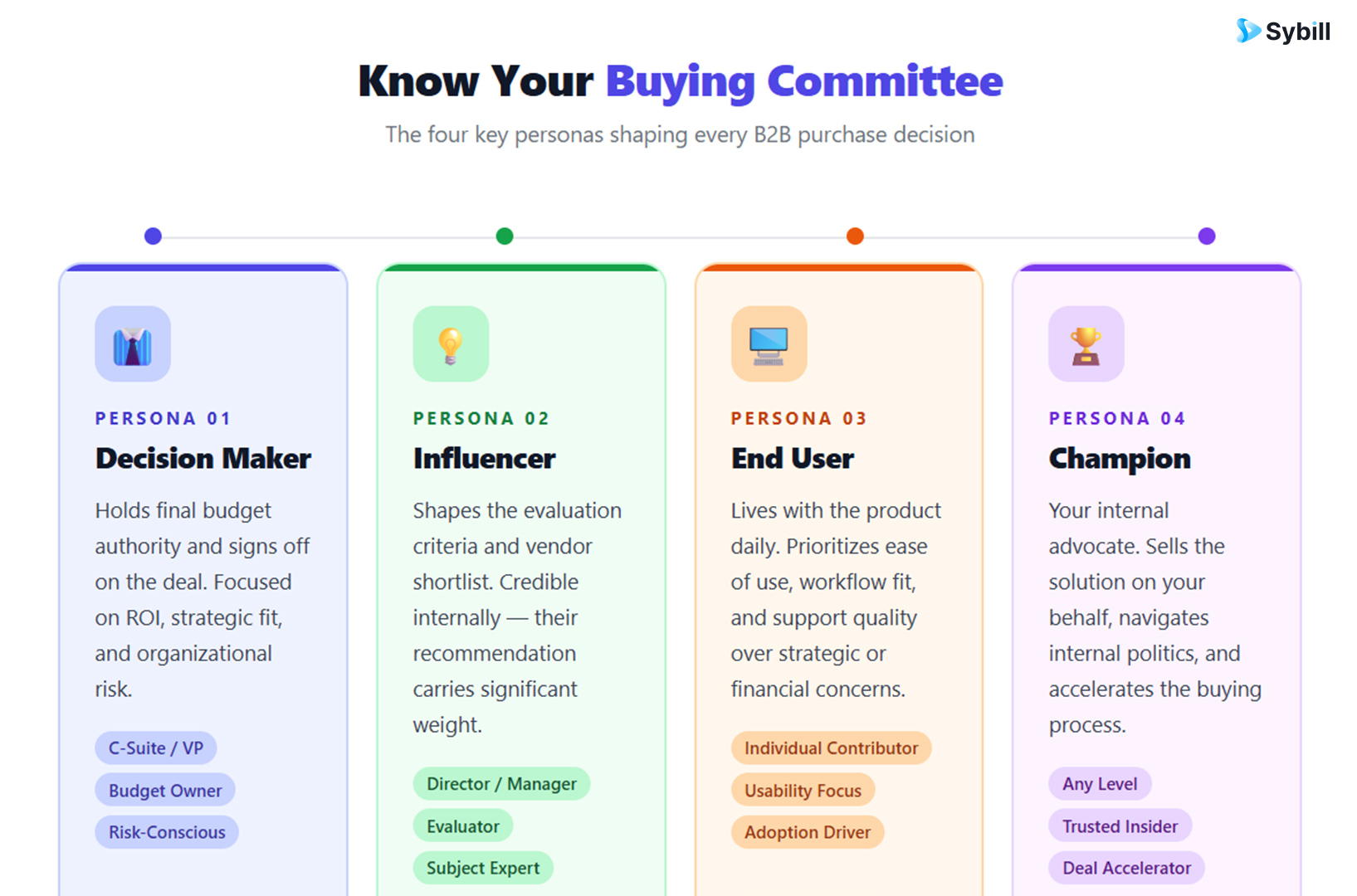
The Decision Maker is the person who signs or approves. They are focused on business impact, ROI, and risk. They often show up late in the deal and ask the hardest questions. Your job is to make sure everything they hear before they arrive in the room has already answered those questions.
The Influencer does not hold the budget but shapes the decision. They might be a trusted advisor to the decision maker, a department head with strong opinions, or a technical evaluator. Winning the influencer early often determines whether the deal moves or stalls.
The End User is the person who will live with your product every day. They care about usability, workflow fit, and whether this is going to make their job harder or easier. If they resist adoption, even a closed deal can unravel during implementation.
The Champion is your internal ally. They believe in your product, they advocate for it internally, and they help you navigate the organization. Champions do not always have formal authority, but they have informal influence, and cultivating one early is often the difference between a deal that moves and one that dies quietly in procurement.
The mistake most teams make is building buyer personas in a conference room. A marketing lead, a sales manager, and a product person sit down, discuss their assumptions, and produce a document that reflects their collective guesses rather than their customers' actual reality.
The process below is built from the outside in: real data first, synthesis second.
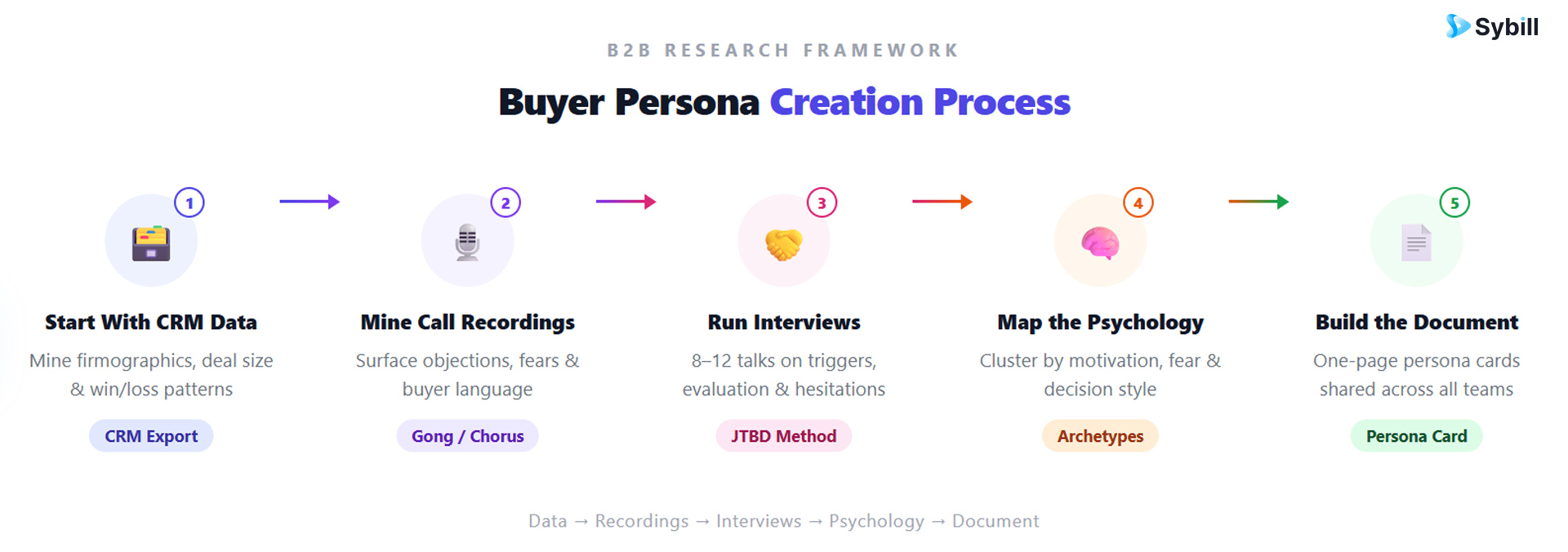
Your CRM is the first place to look. Filter your closed-won deals from the last 12 to 18 months and look for patterns: What roles were most commonly involved? What industries closed fastest? What company sizes had the best retention? What did your highest-LTV customers have in common?
If your CRM is reasonably clean, this step surfaces a lot of signal fast. If it is not, this is also a good moment to recognize that your persona-building process has a data quality problem at its foundation, which is exactly the kind of thing automated CRM hygiene is designed to prevent.
Beyond CRM data, layer in anything else you have: win/loss reports, support ticket themes, customer success notes, and product usage data if available. You are looking for patterns, not outliers.
Demographic data tells you who your buyer is. Call recordings tell you who they really are. The language they use to describe their pain. The moment they lean in with genuine interest. The objection they keep coming back to. The thing that made them say "that's exactly what we're dealing with."
This is where most persona-building processes fall short, because listening back through hours of calls manually is not realistic at scale. Tools like Sybill's Magic Summary change the economics of this completely. Every call is automatically analyzed for pain points, buying signals, objections, and key topics the prospect engaged with most. Over time, patterns emerge across your entire call library without anyone spending a weekend with a spreadsheet.
Ask Sybill takes it even further: you can query across all your calls at once. "What pain points come up most with VP of Sales personas?" "What objections are we seeing most from mid-market CFOs?" The answers come back in seconds, built from the actual conversations your team has had.
That is not a guess. That is a buyer persona built from evidence.
Data tells you what happened. Interviews tell you why. Schedule 30-minute conversations with ten to fifteen of your best customers, ideally people who match the patterns you spotted in step one and two. Your goal is to understand three things:
The language your customers use in these interviews is gold. When someone tells you their team was "drowning in CRM updates every Sunday night," that phrase is more useful than any demographic data point. It is the exact language that should show up in your outreach, your sales scripts, and your personas.
Also recruit people who churned or did not buy. Their answers are often more illuminating than your happy customers'.
This is the layer most personas skip, and it is the one that makes the biggest difference in how reps actually use them. Demographics and job titles are table stakes. What you really need to understand is:
Sybill's buyer intelligence features surface engagement signals, attentiveness patterns, and emotional responses across calls, giving you a window into how different personas actually react in real time, not just what they say they want.
A buyer persona that lives in a Google Slide deck that no one opens is not a persona. It is a graveyard for good research.
Build your persona in a format that is easy to scan and reference before a call, not a 12-page document requiring a coffee and a reading block. A single page or a clean template works best. Include:
Here is a compact example:
"CFO Charlie": Chief Financial Officer, B2B SaaS company, 200 to 800 employees. Charlie is measured on EBITDA and burn rate. He joined six months ago and inherited a tech stack he did not choose. He is skeptical of shiny tools and deeply allergic to anything that requires a six-month implementation before delivering value. He respects data above everything and has been burned before by vendors who overpromised. He evaluates new purchases based on three things: proven ROI from companies like his, speed to value, and whether it reduces headcount needs rather than adding to them. He will not respond to cold outreach that leads with features. He will respond to a one-paragraph email that leads with a specific cost or time savings number.
The traditional approach to buyer personas takes weeks: data pulls, interview scheduling, synthesis workshops, design work. And by the time the finished document lands in the sales team's hands, the market may have already shifted.
AI compresses that timeline dramatically and improves the quality of what comes out the other end. Here is how forward-thinking teams are using it:
Surfacing patterns at scale. Instead of manually reviewing call recordings, tools like Sybill automatically extract pain points, objections, buying signals, and engagement patterns from every call. Run a query across 200 calls with VP of Operations titles and you will see patterns in minutes that would have taken weeks to identify manually.
Generating richer psychological profiles. Generative AI for personalization in sales lets teams build much deeper persona layers: communication style preferences, likely objection trees, and even tone and framing recommendations for different persona types.
Keeping personas current. The biggest failure mode for buyer personas is that they are built once and then slowly go stale as the market evolves. AI-powered tools can flag when patterns in your call data start diverging from your documented personas, signaling that an update is overdue before it starts costing you deals.
Enabling hyper-personalized outreach. Once the persona is built, AI can use it in real time. Sybill's pre-meeting briefs pull persona-relevant context from your deal history before every call, so your rep walks in knowing exactly who they're talking to and what matters to that person that day.
Get started for free with Sybill and start building buyer personas from real conversation data, not conference room assumptions.
A persona is not a research project. It is a sales tool. Here is how to put it into active use:
Before every call, your rep should scan the relevant persona and identify the two or three things most likely to matter to this specific person in this specific conversation. Sybill's pre-meeting briefs automate this step by pulling deal history, recent interactions, and persona-relevant context into a single brief before the calendar invite even appears on your screen.
During the call, the persona guides the discovery questions. If you know CFO Charlie is allergic to implementation risk, you address it proactively rather than waiting for him to raise it as an objection in week three.
After the call, review what resonated and what did not against the persona. Over time, this feedback loop is how personas get sharper. Every call is data. Every pattern is signal. With Sybill capturing and analyzing every interaction, that feedback loop becomes automatic rather than something that requires a quarterly workshop to operationalize.
The fastest path to shortening your sales cycle is not more calls. It is better-prepared reps who understand their buyers deeply enough to make every conversation count.
Try Sybill free today and see how real call intelligence transforms the quality of your buyer personas and the conversations built around them.
What is a buyer persona in sales?
A buyer persona is a research-based profile of your ideal customer that captures their role, goals, challenges, motivations, decision-making behavior, and communication preferences. It goes beyond demographic data to help reps understand the psychological core of who they are selling to and why that person buys.
What is the difference between a buyer persona and an ICP?
An ICP (Ideal Customer Profile) describes the target company using firmographic data: industry, company size, revenue, tech stack. A buyer persona describes the individual within that company: their role, motivations, pain points, and buying behavior. You need your ICP first to identify which companies to target, and then buyer personas to understand who to talk to and what to say.
How many buyer personas should a sales team have?
Most sales teams work well with three to five active personas. Start with the roles most commonly involved in your deals: the decision maker, the champion, and the end user are the minimum useful set for most B2B sales motions. Add more as new segments or buying patterns emerge.
Can AI help build better buyer personas?
Yes, significantly. AI tools like Sybill can analyze call recordings at scale to surface pain points, objections, and engagement patterns across large numbers of conversations. This replaces the manual review process and produces persona insights grounded in real data rather than internal assumptions.
What is a negative buyer persona?
A negative buyer persona describes a customer type that consistently underperforms: high churn, poor fit, difficult to work with, or unlikely to buy despite looking good on paper. Documenting negative personas helps reps disqualify faster and focus time on deals that are actually likely to close.
How often should buyer personas be updated?
At minimum once per year, but ideally reviewed quarterly and updated whenever significant patterns shift: new product lines, market changes, or noticeable swings in your win/loss data. Buyer personas that are not updated regularly become fictional rather than functional.
What should a buyer persona include?
A complete buyer persona includes: a name and brief biographical sketch, role and company context, primary goals and motivations, top pain points, common objections, decision-making style, preferred communication channels, and a short "day in the life" description. Optional additions include tech stack usage, content consumption habits, and triggers that initiate a buying process.
How do buyer personas improve sales conversations?
When a rep understands a buyer's motivations and challenges before the call, they ask better discovery questions, anticipate objections before they are raised, frame the product in terms that resonate with that specific person, and avoid wasting time on points the buyer does not care about. The result is shorter sales cycles and higher close rates.
A buyer persona is a research-based profile of your ideal customer that captures their role, goals, challenges, motivations, decision-making behavior, and communication preferences. It goes beyond demographic data to help reps understand the psychological core of who they are selling to and why that person buys.
An ICP (Ideal Customer Profile) describes the target company using firmographic data: industry, company size, revenue, tech stack. A buyer persona describes the individual within that company: their role, motivations, pain points, and buying behavior. You need your ICP first to identify which companies to target, and then buyer personas to understand who to talk to and what to say.
Most sales teams work well with three to five active personas. Start with the roles most commonly involved in your deals: the decision maker, the champion, and the end user are the minimum useful set for most B2B sales motions. Add more as new segments or buying patterns emerge.