Find us at booth #83, join us for a harbor side happy hour, or catch Gorish’s talk.

Sept, 16-18 > Learn more

%20(1).avif)
Mamta Tainwala

July 5, 2026
%20(25).png)
A conversation with artificial intelligence is a real-time, back-and-forth exchange between a person and an AI system using natural language. Powered by large language models and natural language processing, the AI interprets what you say, generates a relevant response, and maintains context across turns. These conversations now range from consumer chatbots to business tools that analyze and act on sales calls.
A conversation with artificial intelligence is an interactive exchange in which a person communicates with an AI system in natural language and the system responds in kind. Rather than clicking buttons or writing code, you simply talk or type as you would to another person, and the AI interprets your meaning and replies.
A decade ago this felt like science fiction. Today you have probably had one before finishing your morning coffee, asking a voice assistant for the weather, typing a question into a chatbot, or watching a support widget answer before a human ever joins. The technology moved from novelty to normal fast, and it is worth understanding what is actually happening when you talk to a machine that seems to talk back.
It helps to know there are really two broad worlds of AI conversation, because they get lumped together and they should not be. One is the consumer world: chatbots and assistants you converse with directly. The other is the business world, where AI conversation increasingly means systems that understand and act on human conversations, not just hold their own. This guide covers both, but leans into the business side, because that is where AI conversation is quietly reshaping how real work gets done.
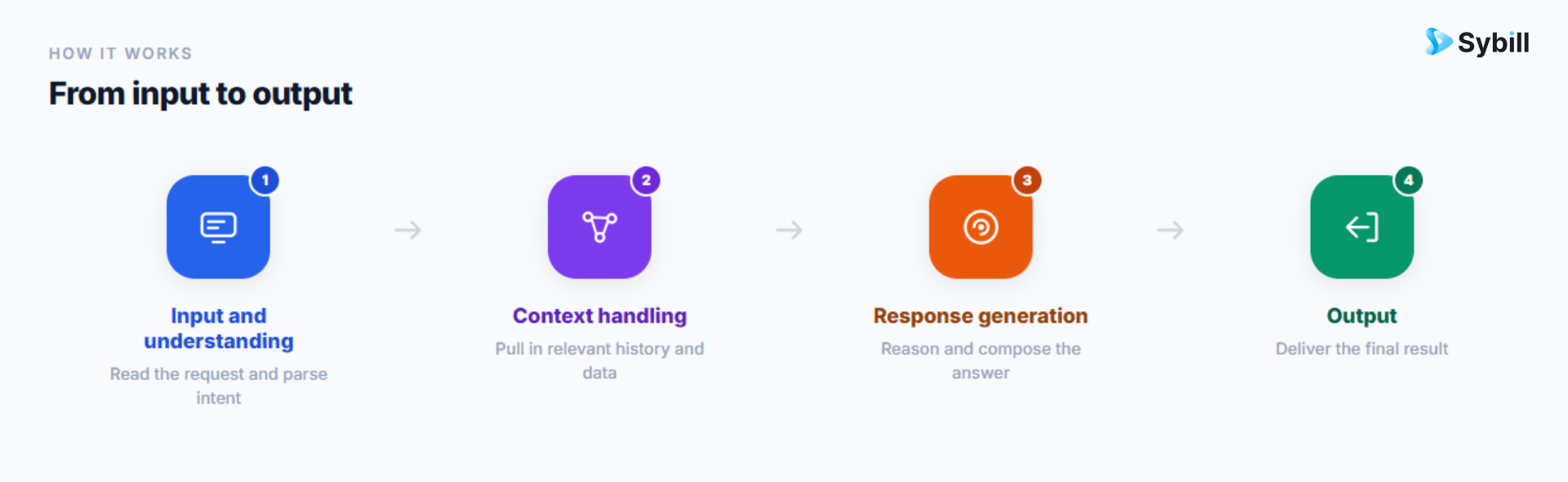
A conversation with AI works by converting your words into data the system can process, interpreting the intent behind them, generating a relevant response, and keeping track of context so the exchange flows across multiple turns. Modern systems do this using large language models trained on vast amounts of text.
Under the hood, a single exchange moves through a few stages:
The leap that made conversations with AI feel natural was the shift from rigid, rule-based bots (which only handled pre-scripted paths) to large language models that generate flexible, context-aware language. That is why talking to a modern AI feels less like navigating a phone menu and more like, at least on the surface, a conversation.
AI can carry on a conversation that feels remarkably real, maintaining context, adjusting tone, and responding relevantly across many turns. Whether that counts as a "real" conversation depends on what you mean by real, because the AI produces fluent, appropriate language without actually understanding it the way a human does.
This is the honest nuance most hype skips, so let me be straight about it.
On the surface, yes. A modern AI can follow a thread, remember what you said three messages ago, pick up on tone, and respond in a way that is often indistinguishable from a person in short exchanges. For many practical purposes, that is a real conversation.
Underneath, though, the AI is predicting likely language, not comprehending meaning or holding beliefs, intentions, or feelings. It has no lived experience behind its words. That gap matters in two directions. It is why AI can be so useful (it scales fluent language endlessly) and why it can fail in subtle ways (it can state something wrong with total confidence, because it is generating plausible text, not consulting understanding).
So the useful answer is: real enough to be genuinely helpful, not so real that you should treat it as a person. Holding both of those at once is the key to using AI conversation well, especially in business, where the cost of mistaking fluency for understanding can be concrete.
The pros of conversing with AI include constant availability, instant responses, effortless scale, and consistency, while the cons include a lack of genuine understanding, the risk of confident errors, privacy considerations, and the danger of over-reliance. Whether the trade is worth it depends heavily on the task.
Here is the balanced view, laid out plainly.
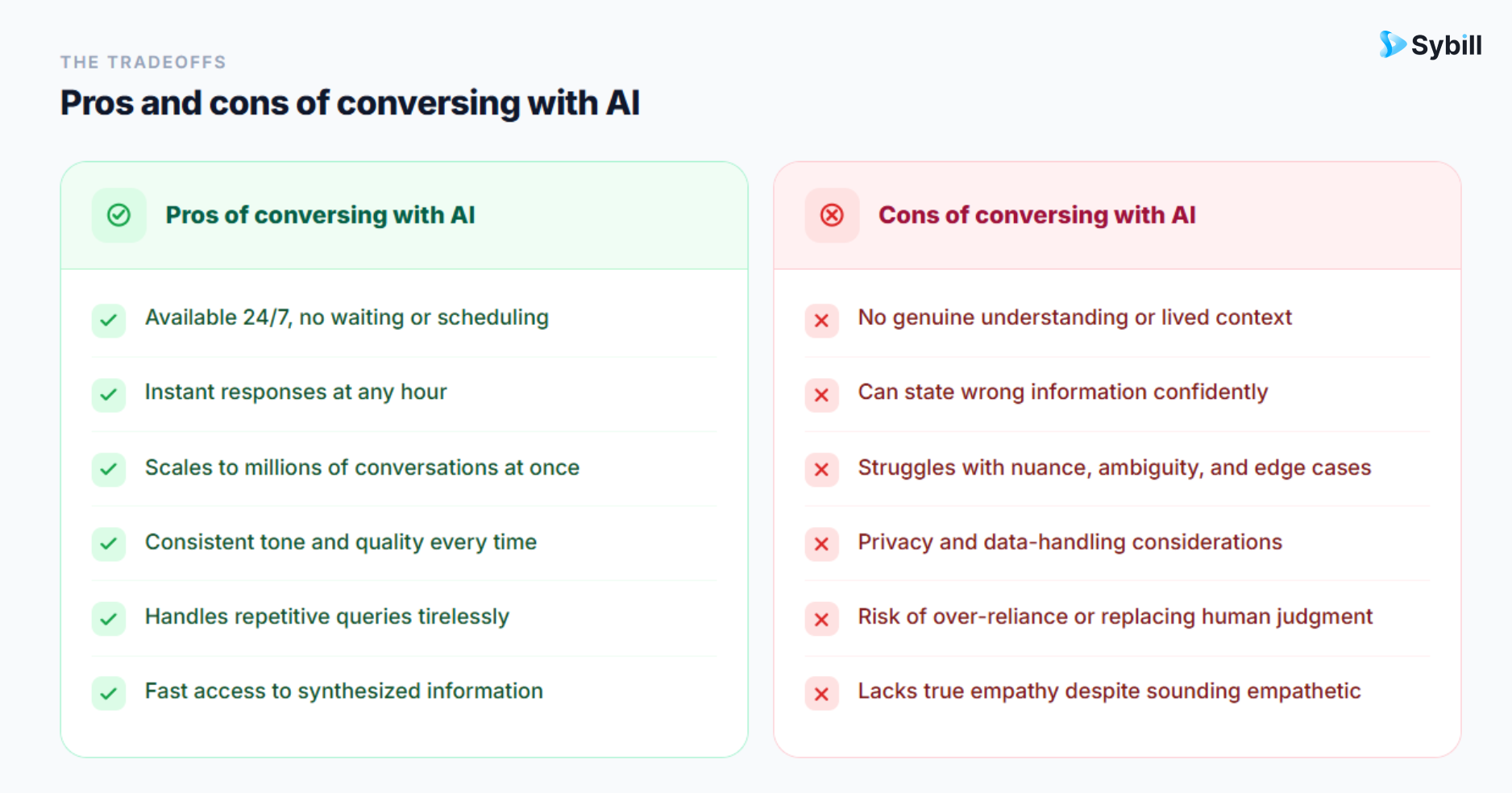
The practical takeaway is that AI conversation is excellent at breadth, speed, and repetition, and weaker at depth, judgment, and genuine understanding. The smartest use, in life and especially in business, plays to the strengths and guards against the weaknesses: let AI handle scale and speed, keep humans in the loop for judgment and relationships.
That framing, AI for scale, humans for judgment, is exactly how the best business applications are designed. Which brings us to where AI conversation is actually earning its keep.
Businesses use conversations with AI in three main ways: customer-facing chatbots and assistants that handle queries, internal assistants that help employees work faster, and, increasingly, systems that analyze the conversations humans have with customers. The first two are AI talking; the third is AI listening and acting.
The common uses break down like this:
That third category is where AI conversation gets genuinely interesting for revenue teams, because the value is not a chatbot that talks to customers. It is an AI that understands the human-to-human conversations already happening and turns them into something useful. That is the category known as conversation intelligence, and it flips the usual model on its head.
In sales, AI conversation mostly means AI analyzing human conversations rather than replacing them. Instead of a bot talking to your buyer, an AI system listens to the real call between a rep and a customer, then transcribes it, extracts intent and objections, updates the CRM, and drafts follow-ups automatically.
This is an important distinction, and it is where the "conversation with AI" idea matures from novelty into real business value.
The consumer version of AI conversation is you talking to a machine. The sales version is a machine helping you have better conversations with actual people. The AI is not pretending to be human; it is amplifying humans by handling everything around the conversation that used to eat their time. A rep still builds the relationship, reads the room, and earns the trust. The AI captures what was said, works out what mattered, and takes care of the follow-through.
Concretely, conversation intelligence software analyzes each sales call and produces a summary, updates deal fields, flags risks, and drafts the next email, so the rep can stay fully present in the conversation instead of scribbling notes. It plays exactly to the strengths and weaknesses we mapped earlier: AI for scale, speed, and consistency, humans for judgment, empathy, and relationships. A platform like Sybill is built on precisely this division of labor.
So when people ask what a conversation with artificial intelligence really looks like in a serious business setting, this is often the truest answer. Not a chatbot standing in for a person, but an intelligence layer that makes the humans better. For how that category compares to older approaches, see conversation intelligence versus call recording, and for the leading tools, our guide to the best conversation intelligence tools.
It is a natural-language exchange between a person and an AI system, where you communicate as you would with another person and the AI interprets your input and responds. Powered by large language models and natural language processing, the AI maintains context across turns. These conversations span consumer chatbots, virtual assistants, and business tools that analyze real human conversations.
AI can carry on a conversation that feels real, maintaining context and responding relevantly across many turns, often indistinguishably from a person in short exchanges. The nuance is that it generates fluent language by predicting likely responses rather than truly understanding meaning. So it is real enough to be genuinely useful, but it does not comprehend, feel, or hold intentions the way a human does.
The main pros are 24/7 availability, instant responses, effortless scale, and consistent quality. The main cons are the lack of genuine understanding, the risk of confident errors, privacy considerations, and the danger of over-reliance. AI conversation excels at breadth, speed, and repetition, and is weaker at depth, judgment, and empathy, so the best uses pair AI's scale with human judgment.
It depends on the platform and how it handles data. Some services process and store conversations to improve their models, while enterprise tools often offer stronger privacy controls, data residency, and options to exclude data from training. If privacy matters, especially for business or sensitive information, check the provider's data-handling and security policies before use rather than assuming a given standard.
In business, AI conversation appears as customer-service chatbots, internal virtual assistants, and, notably in sales, conversation intelligence that analyzes real calls between reps and buyers. In sales specifically, the AI does not talk to the customer; it listens to the human conversation, transcribes it, extracts insights like intent and objections, updates the CRM, and drafts follow-ups, so reps stay present while the busywork is handled.
For routine, repetitive interactions, AI increasingly handles the load, and that trend will continue. For relationship-driven, high-stakes, or nuanced conversations, especially in sales, AI is far more valuable as an amplifier than a replacement. The prevailing model pairs AI's scale and consistency with human judgment and empathy, using AI to handle everything around the conversation so people can focus on the conversation itself.
It is a natural-language exchange between a person and an AI system, where you communicate as you would with another person and the AI interprets your input and responds. Powered by large language models and natural language processing, the AI maintains context across turns. These conversations span consumer chatbots, virtual assistants, and business tools that analyze real human conversations.
AI can carry on a conversation that feels real, maintaining context and responding relevantly across many turns, often indistinguishably from a person in short exchanges. The nuance is that it generates fluent language by predicting likely responses rather than truly understanding meaning. So it is real enough to be genuinely useful, but it does not comprehend, feel, or hold intentions the way a human does.
The main pros are 24/7 availability, instant responses, effortless scale, and consistent quality. The main cons are the lack of genuine understanding, the risk of confident errors, privacy considerations, and the danger of over-reliance. AI conversation excels at breadth, speed, and repetition, and is weaker at depth, judgment, and empathy, so the best uses pair AI's scale with human judgment.