Find us at booth #83, join us for a harbor side happy hour, or catch Gorish’s talk.

Sept, 16-18 > Learn more


Tamanna Mishra

May 27, 2026
.png)
Gong is strongest for conversation intelligence, call analysis, and coaching. Clari is strongest for forecasting, pipeline inspection, and revenue leadership visibility. Sybill is strongest for sales teams that want deal intelligence plus execution, including summaries, CRM Autofill, Personalized Emails, AI Tasks, Ask Sybill, and coaching insights.

One tells you where things are going. One shows you what happened on the ride. Both are useful. Neither guarantees you will avoid a pile-up.
That is the problem with most Gong vs Clari comparisons. They stop at the obvious: Gong is better for call intelligence, Clari is better for forecasting. True. Also incomplete.
Because in 2026, the real sales problem is not “we need one more dashboard.” Sales teams have dashboards. They have recordings. They have CRM reports. They have enough tabs open to qualify as air traffic control.
The real problem is execution.
Did the CRM get updated after the call? Did the follow-up go out while the buyer still remembered the conversation? Did the rep capture the actual objection? Did the manager know what to coach before the deal went sideways? Did RevOps trust the pipeline data, or did everyone perform forecast theater on Friday?
That is where the old revenue intelligence debate starts to wobble.
Gong helps you understand conversations. Clari helps you inspect pipeline. Sybill helps sales teams turn deal context into action.
Gong and Clari now overlap in many places, which is why buyers get confused. Both use AI. Both talk about revenue intelligence. Both connect to CRM. Both want a bigger slice of your sales stack.
But their DNA is different.
Gong started as a conversation intelligence platform. Its strength is recording, transcribing, analyzing, and coaching from real sales conversations. Clari started as a revenue forecasting and pipeline management platform. Its strength is helping revenue leaders inspect pipeline movement and forecast risk.
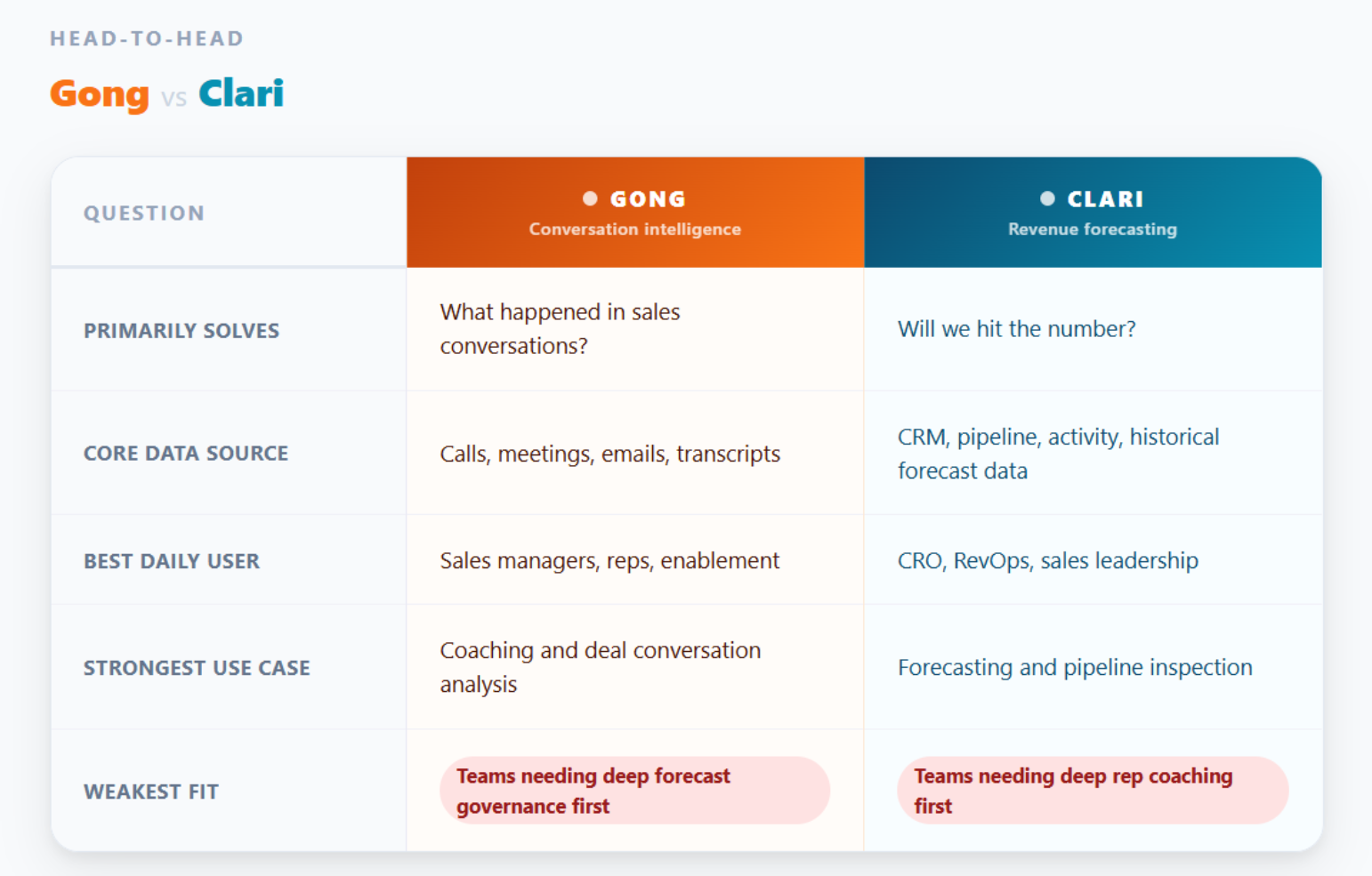
So, the simple answer is:
Choose Gong if your biggest gap is call coaching and conversation analysis.
Choose Clari if your biggest gap is forecast visibility and pipeline governance.
But choose Sybill if your biggest gap is turning sales conversations into CRM updates, follow-ups, next steps, deal insights, and coaching actions.
Gong is one of the oldest tools in the conversation intelligence software category. It records sales calls, transcribes conversations, surfaces topics, tracks competitor mentions, analyzes rep behavior, and helps managers coach from real buyer conversations.
That matters because sales reps are famously unreliable narrators. Not because they are dishonest, but because they are human.
A buyer says, “We are still evaluating options and need legal to review budget impact.”
The CRM says, “Positive call. Next step: follow-up.”
Gong helps close that gap by showing what actually happened.
Gong is useful when sales leaders need answers to questions like:
For sales managers, Gong can make coaching more evidence-based. Instead of asking, “How did the call go?” and getting a polished monologue, managers can inspect the actual moment where the rep handled an objection, missed a buying signal, or forgot to confirm next steps.
That is valuable.
But Gong can still create a “now what?” problem.
Knowing that the buyer raised a pricing objection is useful. Automatically turning that context into CRM fields, follow-up emails, tasks, and next-step guidance is where teams get execution leverage.
Clari is built for sales forecasting software, pipeline inspection, and revenue leadership visibility.
It helps CROs, RevOps leaders, and sales executives understand pipeline movement, deal slippage, commit, best case, forecast risk, and revenue coverage. For larger teams with multiple regions, segments, managers, and product lines, this can be a major upgrade over spreadsheet-driven forecast calls.
Clari is not primarily about improving what reps say on calls. It is about helping leadership understand whether the business is on track to hit the number.
Clari is useful when sales leaders need answers to questions like:
If your Monday forecast call feels like a courtroom drama with less evidence and more vibes, Clari can bring structure.
But Clari has a dependency problem: forecast quality depends on data quality.
If CRM is stale, if reps skip fields, if next steps are vague, if close dates are fantasy fiction, the forecast layer inherits that mess. Clari can inspect pipeline, but it cannot magically make bad inputs good without strong CRM discipline.
That is where execution-first AI becomes interesting.
The better comparison is not “which platform has more features?” That is how teams end up buying expensive software nobody uses properly.
The better question is: which platform solves the workflow problem you actually have?
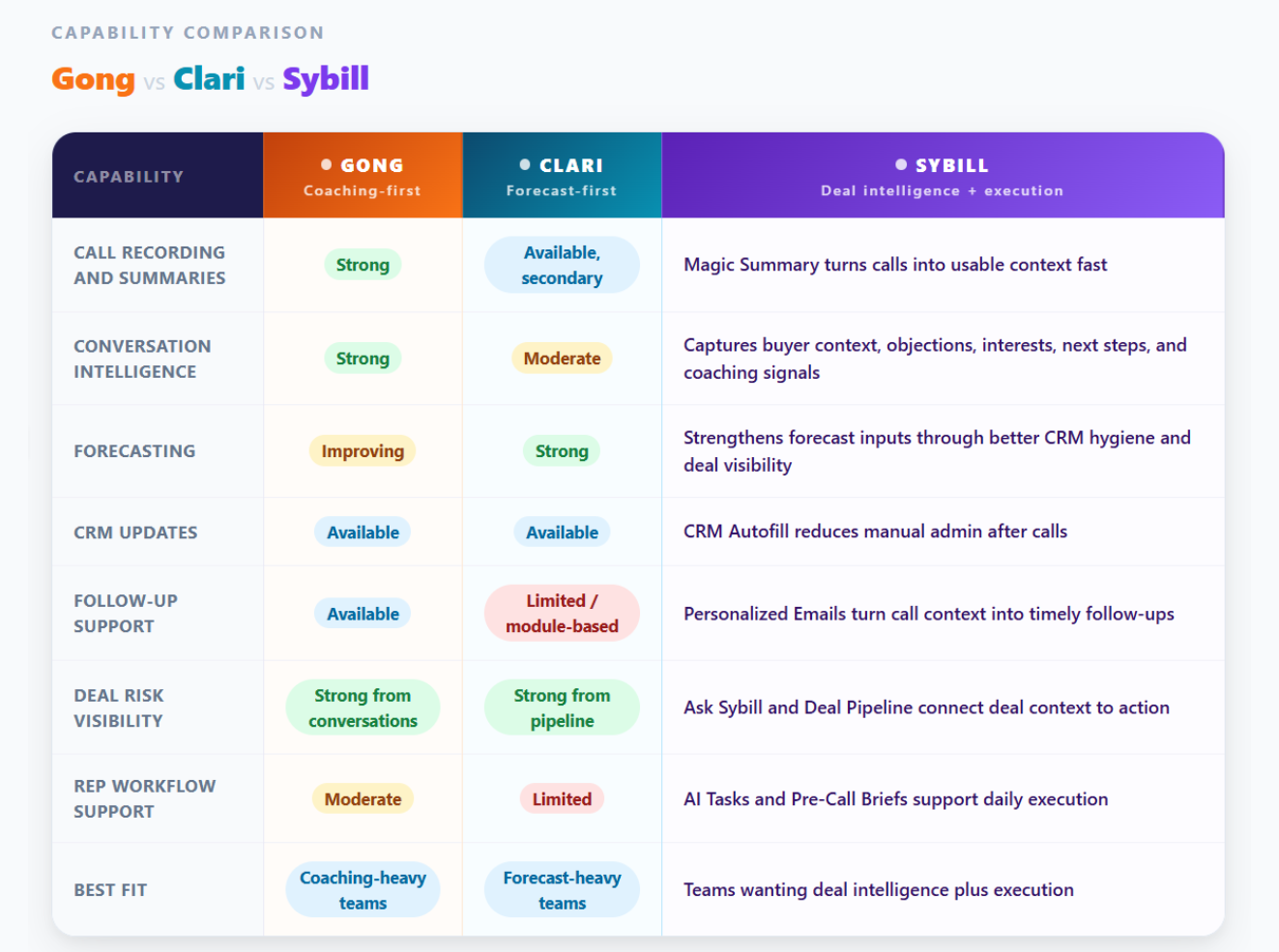
Gong wins this round.
Its core strength is call capture, transcription, call review, coaching workflows, and conversation analytics. Clari has conversation intelligence capabilities, but they are not the center of gravity.
If your team’s biggest challenge is improving rep behavior on sales calls, Gong is the more obvious fit.
Clari wins this round.
It was built for forecast calls, pipeline reviews, rollups, and revenue governance. Gong has forecasting capabilities, but Clari’s architecture is more deeply tied to pipeline inspection.
If your CRO needs a cleaner view of commit, best case, slippage, and forecast risk, Clari is the stronger option.
This is where both tools become less clear.
Both Gong and Clari can integrate with CRM and push data back. But the day-to-day question is not “does it sync?” The real question is:
Does it reduce the rep’s admin burden enough to make CRM useful again?
This is where Sybill’s CRM Autofill becomes a major differentiator. It captures relevant deal details, buyer pain points, objections, stakeholders, next steps, and qualification data without making reps reconstruct the conversation from memory.
Cleaner CRM inputs create better deal reviews. Better deal reviews create better forecasts. Shocking, yes. Also true.
Gong gives you conversation insights. Clari gives you pipeline insights. But sales execution happens in the messy middle:
Neither Gong nor Clari is known for simple, transparent, swipe-your-card pricing. Competitor SERP pages repeatedly reference custom pricing, platform fees, implementation costs, module-based packaging, and enterprise buying cycles.
But pricing pages are only the visible part of the iceberg.
The real cost of a revenue intelligence platform includes:
The most expensive platform is not always the one with the highest quote. It is the one your reps avoid, your managers half-use, and your RevOps team has to keep duct-taping into the workflow.
Before buying Gong or Clari, ask:
The answer may still be Gong. It may still be Clari. For many teams, though, the better answer is an AI sales assistant that actually supports daily selling work.
Yes. Many enterprise teams can and do use Gong and Clari together.
Gong handles conversation intelligence. Clari handles forecasting and pipeline inspection. On paper, that stack makes sense.
In practice, it can create a lot of operational drag.
You may end up with conversation insights in one system, forecast insights in another, CRM data in Salesforce, follow-up tasks in email, deal conversations in Slack, and managers asking reps for updates anyway.
That is not a revenue intelligence strategy. That is a scavenger hunt with procurement approval.
Using both Gong and Clari can work for mature enterprise teams with budget, RevOps capacity, and clear governance. But it does not automatically solve the execution problem.
More visibility does not guarantee more action.
A lot of platforms are very good at showing you what is broken.
Your pipeline is weak. Your forecast is risky. Your rep talked too much. Your competitor came up. Your champion went quiet. Your next step is vague.
Great. Now what?
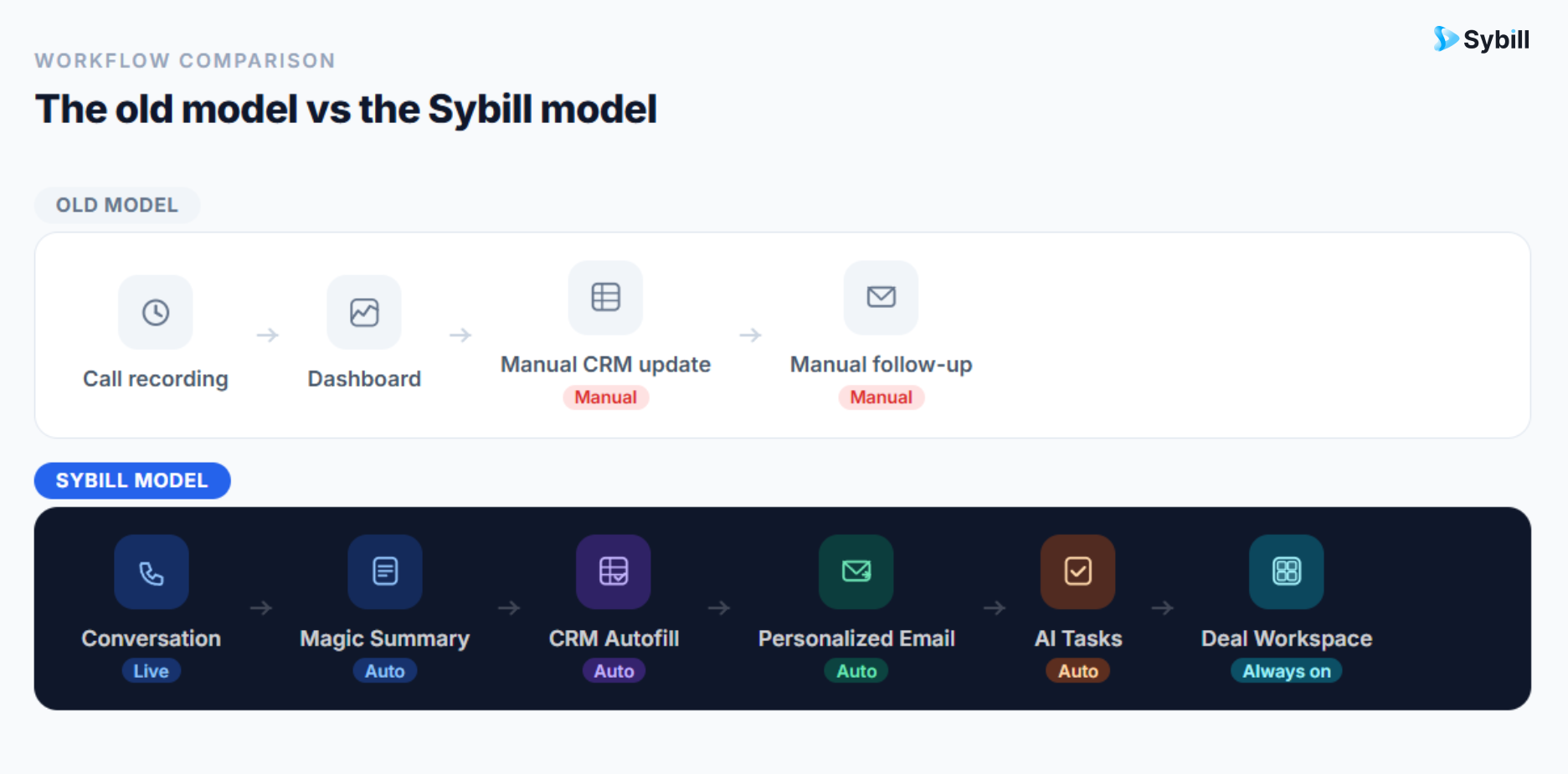
This is the gap between revenue intelligence and revenue execution.
The old sales tech stack was built for inspection. Managers inspected calls. CROs inspected forecasts. RevOps inspected dashboards. Reps inspected their calendars and wondered when they were supposed to sell.
The new AI sales stack has to do more.
It should help reps prepare before meetings. It should capture what happened during calls. It should update CRM after calls. It should draft contextual follow-ups. It should surface coaching moments. It should track next steps. It should help managers understand deal risk without making them watch every recording like a detective in a prestige crime drama.
That is why AI sales tools need to be evaluated on execution, not just intelligence.
Sybill is not just another Gong alternative or Clari alternative. It is better understood as a deal intelligence and execution platform for sales teams that need AI to support the entire selling workflow.
Gong helps you understand what happened on calls. Clari helps you understand what is happening in the forecast. Sybill helps you understand the deal and move it forward.
That is the difference.
Sales calls are packed with useful information: pain points, buying intent, objections, stakeholders, timelines, urgency, risks, and next steps.
The problem is that most of this context dies in transcripts, scattered notes, or rep memory.
Sybill’s Magic Summary gives reps a clean, accurate summary of what happened on the call, so they do not have to dig through recordings or reconstruct the conversation later. It captures the details that matter for selling, not just a generic recap.
That means reps can move faster while the conversation is still fresh.
Forecasting depends on CRM quality. Pipeline reviews depend on CRM quality. Coaching depends on CRM quality. Yet CRM is often treated like a punishment ritual reps must complete after every meeting.
Sybill’s CRM Autofill helps fix that.
It captures deal details, buyer pain points, objections, stakeholders, next steps, and qualification fields from real conversations. Instead of asking reps to manually type everything after every call, Sybill turns meeting context into structured CRM data.
That matters because better CRM inputs improve everything downstream.
Clari can inspect pipeline more effectively when CRM data is clean. Managers can coach better when deal context is accurate. Reps can follow up better when key details are not buried in memory.
The best follow-up emails are specific.
They do not say, “Great speaking today.” They say, “You mentioned onboarding delays are slowing the enterprise rollout, and your team needs clearer adoption reporting before the June review.”
That level of specificity is hard to write when a rep has three back-to-back calls and a calendar that looks like a ransom note.
Sybill’s Personalized Emails draft follow-ups based on the actual conversation, including pain points, objections, action items, and buyer priorities.
This is where Sybill moves beyond insight. It helps reps act.
Sales teams do not need more places to click. They need faster answers.
With Ask Sybill, reps and managers can query deal context directly. Instead of digging through transcripts, CRM notes, email threads, and call recordings, they can ask:
This is a huge shift from dashboard navigation to conversational deal intelligence.
Deals often do not stall because the buyer said no. They stall because the seller forgot to send the deck, missed the procurement cue, delayed the follow-up, or failed to confirm the next step.
Sybill’s AI Tasks helps turn commitments into action items, so reps can keep momentum without relying on memory, sticky notes, or heroic Friday afternoon catch-up sessions.
This is especially useful for busy sales teams managing multiple active opportunities at once.
Gong is strong for call coaching, but not every manager has time to inspect hours of recordings.
Sybill’s Personal Coach helps surface coaching insights and patterns from real sales conversations. It helps managers understand where reps need support, whether that is discovery depth, objection handling, talk balance, stakeholder mapping, or next-step discipline.
The goal is not more surveillance. The goal is better coaching with less manual review.
Modern selling is not a single call. It is a messy chain of meetings, emails, stakeholders, objections, internal conversations, and next steps.
Sybill’s Deal Pipeline and Deal Workspace help teams see deal context, risks, buyer priorities, and movement in one place. Sharing & Collaboration helps teams align without forwarding five links and asking, “Wait, what did procurement say again?”
That is why Sybill is stronger for teams that want deal intelligence plus execution.
Gong is strong when you want to understand calls. Clari is strong when you want to inspect forecasts. Sybill is stronger when you want sales teams to act on deal intelligence every day.

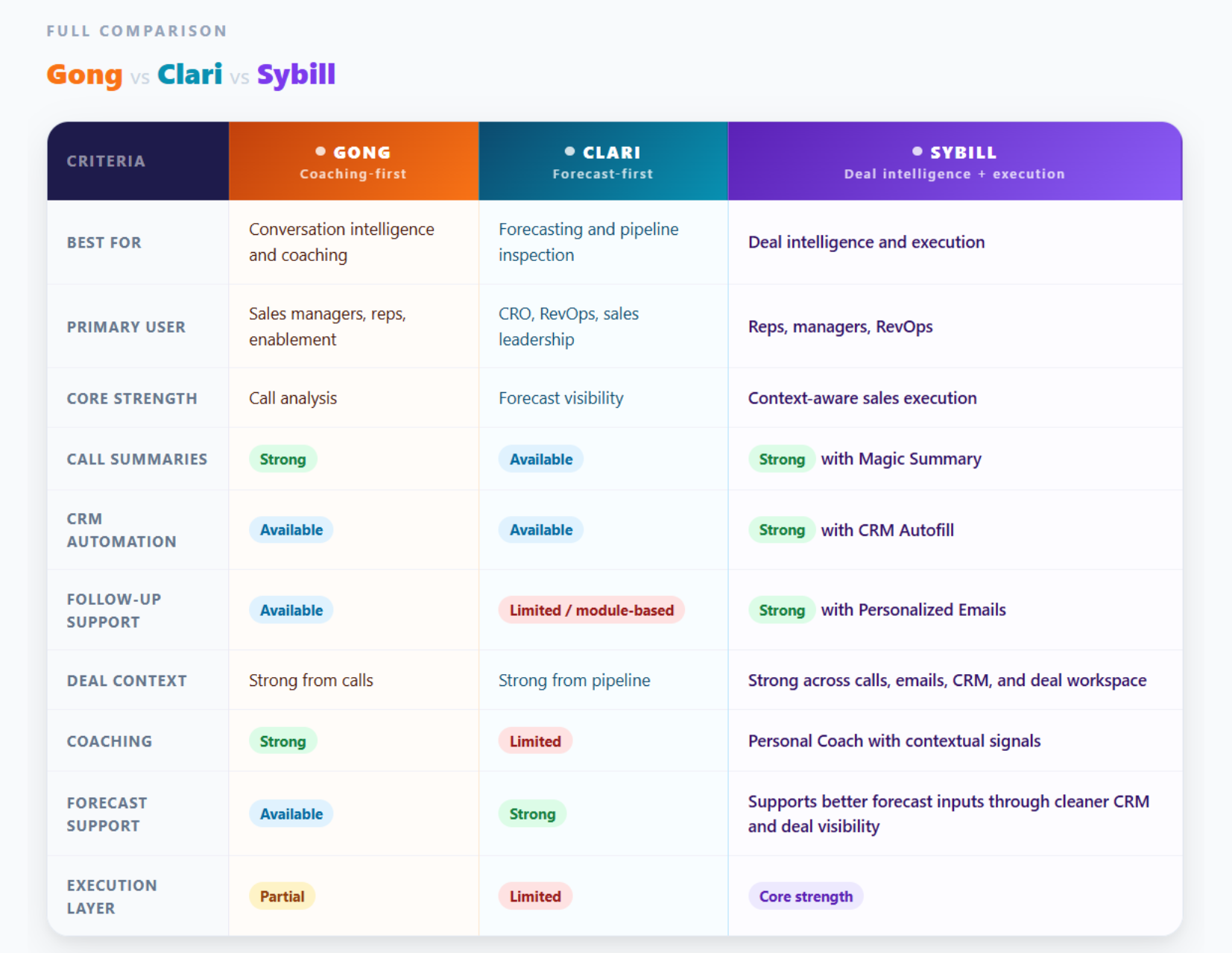
Choose Gong if your main problem is improving rep performance through call coaching.
Gong is a strong fit when:
Gong makes sense when the sales conversation itself is the biggest performance lever.
Choose Clari if your main problem is forecast accuracy, pipeline inspection, and revenue governance.
Clari is a strong fit when:
Clari makes sense when leadership needs a clearer view of whether the business will hit the number.
Choose Sybill if your main problem is sales intelligence and execution.
Sybill is a strong fit when:
Choose Sybill if your problem is not “we need another dashboard.”
Choose Sybill if your problem is: our best deal context never turns into action fast enough.
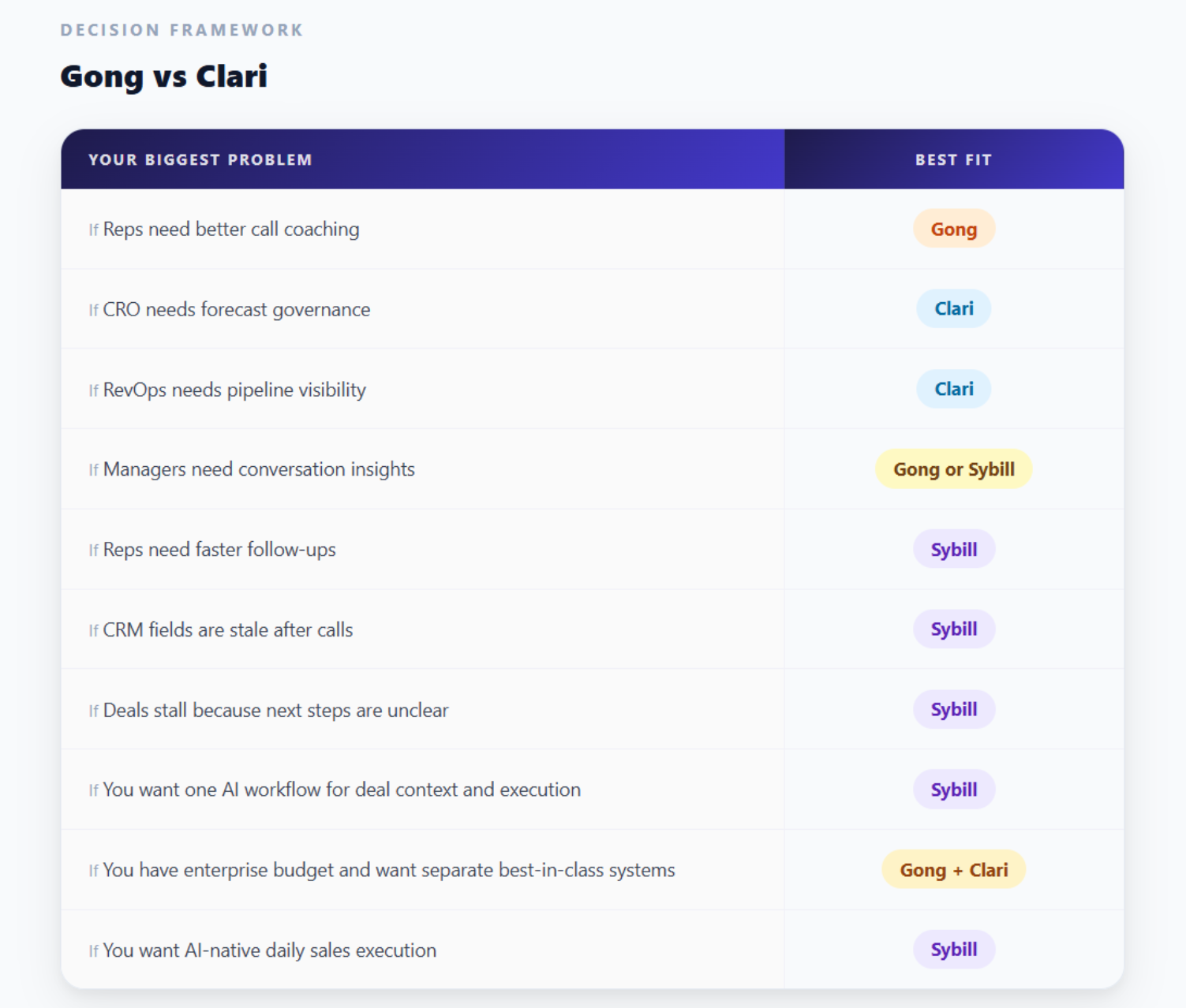
Gong and Clari are both strong platforms. But the classic comparison is starting to feel a little like 2021.
The better question is not, “Do we need conversation intelligence or forecasting?”
The better question is, “How quickly can our team turn buyer context into the next right action?”
Because that is where revenue is won or lost.
Not in the dashboard. Not in the recording library. Not in the forecast call where everyone says “commit” with the confidence of a Marvel villain five minutes before defeat.
Revenue moves when reps prepare better, capture better context, update CRM, follow up fast, coach smarter, and keep deals moving.
That is what Sybill is built for.
If you want deal intelligence that does not die in a dashboard, Sybill helps sales teams turn every buyer conversation into CRM updates, follow-ups, tasks, coaching insights, and next steps.
Gong is primarily a conversation intelligence platform. It helps sales teams record calls, analyze buyer conversations, coach reps, and surface deal signals from meetings. Clari is primarily a revenue forecasting and pipeline inspection platform. It helps CROs and RevOps teams inspect pipeline movement, forecast risk, and revenue performance.
Gong is better if your priority is call analysis, coaching, and conversation intelligence. Clari is better if your priority is forecasting, pipeline governance, and revenue leadership visibility. Neither is automatically better for every team. The right choice depends on whether your biggest gap is rep performance, forecast accuracy, or sales execution.
Yes, Clari is generally stronger for structured forecasting workflows because forecasting is its core strength. Gong has forecasting capabilities, but Gong’s original strength is conversation intelligence. If your primary need is forecast rollups, pipeline inspection, and board-level revenue visibility, Clari is usually the better fit.
Yes. Some enterprise teams use Gong for conversation intelligence and Clari for forecasting. This can work well for large teams with enough budget and RevOps support. The downside is cost, complexity, tool overlap, and workflow fragmentation.
For teams that want deal intelligence plus execution, Sybill is a strong alternative to Gong and Clari. It combines Magic Summary, CRM Autofill, Personalized Emails, AI Tasks, Ask Sybill, Pre-Call Briefs, Personal Coach, Deal Pipeline, Deal Workspace, and Sharing & Collaboration to help sales teams act on deal context, not just analyze it.
Gong is primarily a conversation intelligence platform. It helps sales teams record calls, analyze buyer conversations, coach reps, and surface deal signals from meetings. Clari is primarily a revenue forecasting and pipeline inspection platform. It helps CROs and RevOps teams inspect pipeline movement, forecast risk, and revenue performance.
Gong is better if your priority is call analysis, coaching, and conversation intelligence. Clari is better if your priority is forecasting, pipeline governance, and revenue leadership visibility. Neither is automatically better for every team. The right choice depends on whether your biggest gap is rep performance, forecast accuracy, or sales execution.
Yes, Clari is generally stronger for structured forecasting workflows because forecasting is its core strength. Gong has forecasting capabilities, but Gong’s original strength is conversation intelligence. If your primary need is forecast rollups, pipeline inspection, and board-level revenue visibility, Clari is usually the better fit.