Find us at booth #83, join us for a harbor side happy hour, or catch Gorish’s talk.

Sept, 16-18 > Learn more


Mamta Tainwala

June 13, 2026
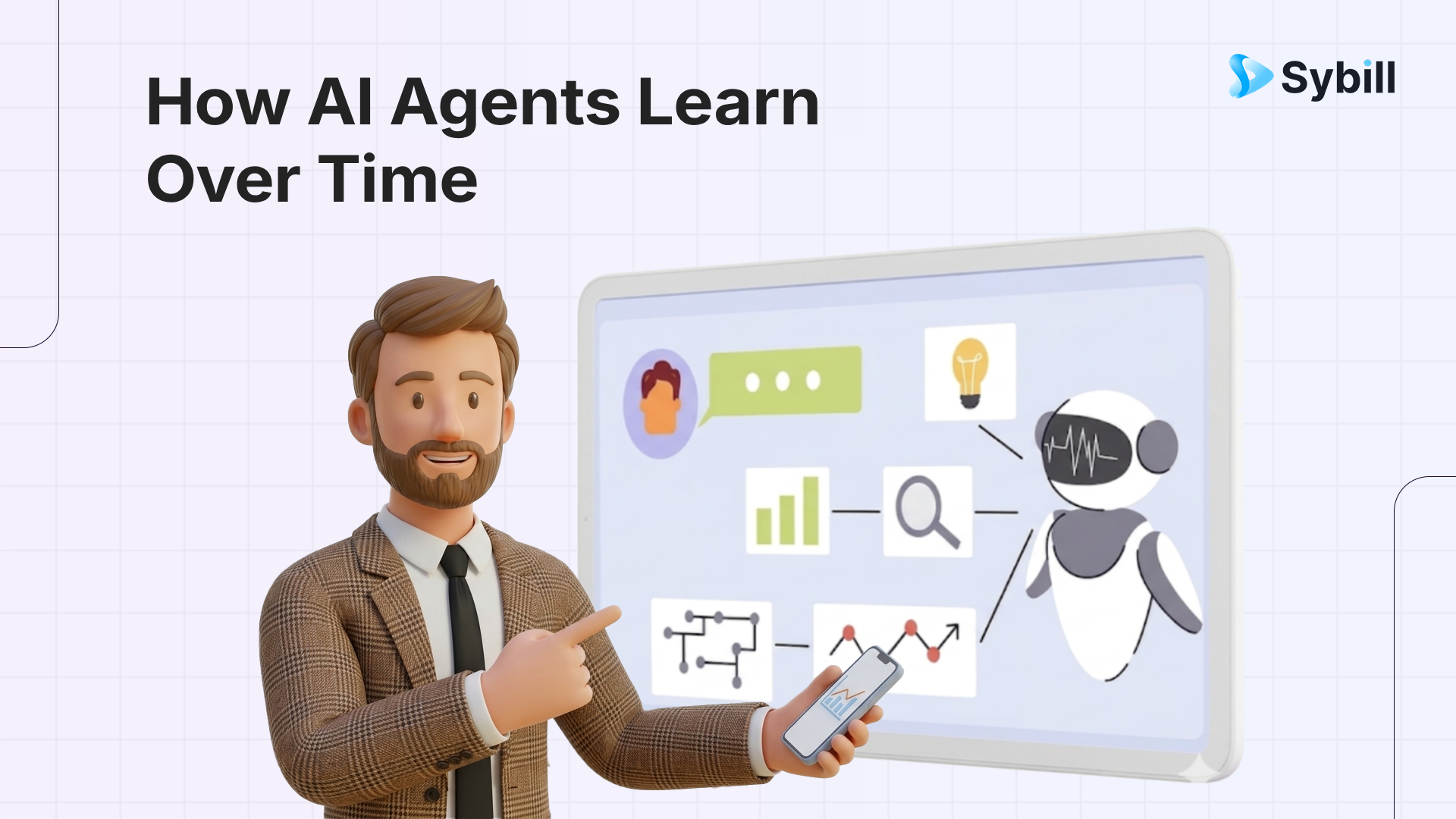
When people talk about AI agents getting smarter over time, there is often confusion about what that actually means technically. It does not mean the underlying model is retraining itself on your data. The model weights are fixed. What changes is the context the agent operates with.
An AI agent learns by accumulating context in persistent memory, refining its skill files through correction, and improving its output quality through deliberate curation. Every interaction adds information. Every correction updates a rule. Every completed task either adds to the memory store or reveals a gap in the skill file. Over time, the agent has more to work with and produces better output.
This distinction matters because it shapes how you build agents that actually improve versus agents that stay mediocre indefinitely. The model is not the lever. The context architecture is.
Gorish Aggarwal, CEO of Sybill AI, who has run a personal six-agent setup for months, describes the dynamic clearly: "Agents are not simply tools that save you time. They essentially compound smartness over a period of time. I have certain agents that are way smarter about my life than the one I had when I started out building because it now knows almost everything."
That knowledge accumulation is not accidental. It is the product of a deliberate architecture that captures, stores, and applies context systematically. This post explains how that architecture works, what drives the improvement over time, and how sales teams can build it intentionally.
Agent learning is not a single process. It happens through four distinct mechanisms working together. Understanding each one is what allows you to build agents that compound versus agents that plateau.
The most fundamental learning mechanism is the write-back loop. After every task the agent completes, it writes what it learned to the relevant memory file or database. This is what makes each subsequent interaction start from a better position than the last.
Without write-back, the agent has to rediscover the same context every time. With write-back, context accumulates continuously. A contact memory file that starts with "Sarah Chen, VP Sales at Acme" grows over months into a rich record of Sarah's communication preferences, her current priorities, the history of every interaction, what was agreed, what is still open, and what has changed over time.
The write-back does not happen automatically in most agent setups. It has to be explicitly instructed in the soul file or the relevant skill file. The agent needs to know: after completing this type of task, write these categories of information to this memory location. Without that instruction, the context evaporates after each session.
Gorish's scout agent is responsible for write-back across his entire system. After every interaction it processes, from a LinkedIn message to a call recording, it routes the relevant information to the correct memory file for the correct agent. This continuous routing and writing is what keeps all six of his agents current without requiring manual maintenance.
Skill files are not written once and left alone. They improve through use. Every time the agent's output on a skill-governed task requires correction, that correction is information about what the skill file is missing or getting wrong.
The improvement loop works as follows: the agent executes a task using the skill file, the human reviews the output, identifies what is wrong or imprecise, and updates the skill file with the corrected rule. The next time the agent handles the same task type, it reads the updated skill file and produces better output.
This is a deliberate human-in-the-loop process in the early stages of any agent setup. As the skill file accumulates corrections and becomes more comprehensive, the output quality improves and the correction rate drops. Eventually, the skill file is comprehensive enough that the agent handles the task consistently without requiring review.
Gorish describes the curation investment: "I did not write a single line of code at all. The entire three weeks was essentially going back and for some of the tasks, using much cheaper models, reviewing output, identifying what was wrong, and adding that context to the right file."
The skill file for scheduling, for example, might start with eight rules. After fifty scheduling interactions and corrections, it might have twenty-two rules covering edge cases that were not anticipated at setup. Each additional rule represents a situation the agent now handles correctly without human input.
As the agent accumulates memory and the memory files grow, the context it has available for any given task expands. This expansion is gradual but compounding.
In week one, the scheduling agent knows your default preferences. By month two, it also knows that a specific investor always responds better to evening slots, that a particular enterprise prospect has rescheduled three times and warrants a human judgment call before proposing again, and that your Fridays are protected through the end of the quarter.
None of this required you to explicitly tell the agent. It came from processing real interactions, writing what happened to memory, and having that context available the next time those relationships came up. The breadth of context the agent has access to is directly proportional to how long it has been operating with a write-back loop in place.
For sales teams, this is the organizational equivalent of what Sybill builds automatically. Every call processed through Sybill, every Magic Summary generated, every field updated via CRM Autofill expands the shared context layer that any AI system operating on that data has access to. The intelligence available for deal inspection in month six is categorically richer than what was available in month one, without any additional manual input from reps.
As output quality improves through the first three mechanisms, the permission tier model evolves. Actions that started in Tier 2 (require human confirmation before executing) graduate to Tier 1 (execute autonomously) once the output has been reliably correct for long enough.
This graduation is deliberate and evidence-based, not automatic. When the scheduling agent has produced twenty consecutive correct invites without edits, it is reasonable to move invite creation from Tier 2 to Tier 1 for internal meetings. When the follow-up email draft has been sent without changes fifteen times in a row, it may be appropriate to graduate certain follow-up types to autonomous sending.
Each graduation reduces the human time required to oversee the agent and extends the scope of what it handles without intervention. The agent becomes more useful not because it is doing different things, but because it is doing the same things with less human involvement.
This is how "set it and forget it" actually works with agents: not as a starting assumption, but as an earned state that results from months of curation.

The improvement in agent performance is not linear. It follows a curve that is shallow early and steeper later, and it has distinct phases that most builders experience regardless of the use case.
Weeks 1 to 2: Calibration
This is the highest-effort phase. The agent has minimal context and the skill files are in their first draft. Output quality is inconsistent and requires frequent correction. Every correction goes back into the skill file or memory. The agent is learning the rules of your world, and those rules are still being articulated.
This phase is where most people give up, incorrectly concluding that agents do not work. The output in week one is not representative of what the agent will produce in month three. The calibration phase is the necessary investment.
Weeks 3 to 6: Stabilization
Skill files have been through multiple correction cycles and are covering the most common scenarios reliably. Memory files have enough content to provide useful context for recurring relationships and tasks. Output quality on the core use case is now consistently good enough to act on with minimal edits. Tier 2 actions are beginning to look like candidates for Tier 1 graduation.
This is when the time savings become clearly visible. The daily administrative burden on the covered task drops noticeably.
Month 2 to 3: Compounding
The agent has processed enough interactions that its memory is rich and its skill files are comprehensive. It is handling edge cases correctly because enough of them have appeared and been corrected. Proactive behaviors begin to emerge: the agent surfaces things you did not ask for because the context tells it something is relevant. A deal that has gone quiet for two weeks. A contact who has sent three messages without a reply. A commitment from a call three weeks ago that has not been followed up on.
At this stage, the agent's value is no longer just time saved on the specific task it was built for. It is catching things that would otherwise fall through the cracks.
Month 4 and beyond: Institutional Memory
The agent has accumulated enough context that it functions as genuine institutional memory for the domains it covers. It knows the history of your key relationships better than you remember it consciously. It knows the pattern of which deal stages require which types of action. It knows which contacts behave in which ways.
This is the state Gorish describes when he says his agents are "way smarter about my life" than they were when he started. The model has not changed. The context has accumulated to a point where the agent's judgment within its domain is genuinely reliable.

Not all agent setups compound at the same rate. Several common patterns actively slow the learning loop or stop it entirely.
No write-back instruction in the soul or skill file. If the agent is not explicitly told to write context to memory after completing a task, it will not do it. This is the single most common reason agents plateau. Every soul file should have a clear instruction: after completing any interaction with an external person, write the interaction summary and any new context to that person's memory file. After completing any task in a given domain, update the relevant memory record.
Corrections that never make it back to the skill file. When the agent produces wrong output and you fix it manually without updating the skill file, the agent will make the same mistake next time. The correction only improves future output if it is codified. Every time you edit an agent's draft, ask whether this correction should become a rule. If yes, add it to the skill file immediately.
Memory files that are never pruned. Memory that is outdated or irrelevant adds noise to every retrieval. A contact file that contains three-year-old context about a relationship that has fundamentally changed is worse than no context. Set a quarterly review cadence for memory files covering active relationships and deals, and archive anything that is no longer current.
Trying to improve the model instead of the context. When agent output is poor, the instinct is often to switch to a better or newer model. This rarely solves the problem. Poor output is almost always a context or skill file issue, not a model issue. Before changing models, audit what the agent knows and what rules it is operating with. Fixing those will produce more improvement than a model upgrade.
Skipping the curation phase. Moving to autonomous execution before the output is reliably correct means the agent is producing and sending substandard output without human review. This is counterproductive in two ways: it damages the quality of the work going out, and it eliminates the feedback loop that drives improvement. Stay in curation mode for each new use case until the output is consistently correct, then graduate selectively.
Everything described above applies to individual agent setups. Organizational memory, where many people's interactions feed into a shared context layer, follows the same principles but compounds faster and with broader impact.
When a single rep's post-call context accumulates in a personal memory file, that context helps one person. When every rep's post-call context accumulates in a shared organizational layer, it helps everyone: the manager doing a deal inspection, the new rep ramping on an existing account, the sales leader running a pipeline review, and any AI system that needs context to act on behalf of any team member.
This is the architectural difference Sybill is built around. Every call captured, every summary generated, every CRM field updated contributes to a shared intelligence layer that gets richer with every interaction across the entire team. Ask Sybill lets any team member query that accumulated context in natural language. Buyer intelligence surfaces patterns across all accounts. Sales plays applies win-loss patterns from the full deal history to active deals.
The compounding is not just faster at the organizational level. It is qualitatively different. No individual's memory can capture what a team of thirty reps has collectively learned across two years of deals. An organizational memory layer can.
For the practical implications of this for rep development and team knowledge transfer, see how to ramp new sales reps faster with AI and how to coach sales reps using call recordings.
Do AI agents actually learn on their own?
Not in the sense of model retraining. Agent learning means accumulating context in persistent memory, refining skill files through corrections, and gradually earning greater autonomy as output quality improves. The model weights do not change. The context the model operates with does.
How long does it take for an AI agent to get noticeably better?
For most use cases, output quality stabilizes and becomes consistently reliable within three to six weeks of active use with a proper curation loop. The more proactive and contextual behaviors, where the agent surfaces things you did not ask for, typically appear by month two or three.
What is the most important thing I can do to make my agent learn faster?
Build and maintain the write-back loop. Make sure the agent writes what it learned to memory after every interaction, and make sure you update the skill file immediately every time you correct the output. These two habits drive more improvement than any other change.
Can an AI agent forget things?
Yes, if memory files are deleted or pruned. Within a session, in-context memory resets when the session ends. Persistent memory in files and databases persists until explicitly removed. This is why memory hygiene matters: outdated memory that is not pruned becomes noise that degrades output rather than improving it.
Is there a point where the agent stops improving?
Practically, the improvement curve flattens as the skill files become comprehensive and the memory files cover all common contexts. The agent reaches a state of reliable, consistent performance within its defined scope. Continued improvement then requires either expanding the scope or encountering genuinely novel situations that generate new learning.
How does organizational memory differ from individual agent memory?
Individual memory helps one person's agents. Organizational memory, built from the interactions of an entire team, helps every team member and every AI system that operates on that data. It compounds faster and reaches a level of pattern recognition and historical depth that no individual's memory can match.
The agents that deliver compounding value are not the ones with the best models or the most integrations. They are the ones built with deliberate memory architecture, actively maintained skill files, and a curation discipline that turns every correction into a permanent improvement.
The investment is front-loaded. The calibration phase is real work. But the return on that work is an agent that becomes more capable every month without requiring proportional additional effort. That is the compounding that makes agent-based automation qualitatively different from every static productivity tool that preceded it.
For sales teams looking to start building on top of an already-rich organizational context layer, Sybill provides the memory foundation that makes every agent action more accurate from day one. Get started for free or book a demo to see how the intelligence layer works.
Not in the sense of model retraining. Agent learning means accumulating context in persistent memory, refining skill files through corrections, and gradually earning greater autonomy as output quality improves. The model weights do not change. The context the model operates with does.
For most use cases, output quality stabilizes and becomes consistently reliable within three to six weeks of active use with a proper curation loop. The more proactive and contextual behaviors, where the agent surfaces things you did not ask for, typically appear by month two or three.
Build and maintain the write-back loop. Make sure the agent writes what it learned to memory after every interaction, and make sure you update the skill file immediately every time you correct the output. These two habits drive more improvement than any other change.