Find us at booth #83, join us for a harbor side happy hour, or catch Gorish’s talk.

Sept, 16-18 > Learn more


Mamta Tainwala

June 15, 2026
The honest answer is: more than most people expect when they start, and less than it needs to be once they optimize.
Gorish Aggarwal, CEO of Sybill AI, who runs a six-agent personal setup handling scheduling, deal reviews, LinkedIn inbox management, competitive intelligence, and more. It could range from $7K to $15K for a month.
Those numbers are from a high-autonomy, always-on multi-agent setup running across six domains simultaneously. For most sales teams building their first one or two agents, the cost profile looks very different. But the structure of what drives those costs, and how to reduce them, is the same regardless of scale.
This post breaks down what AI agent costs consist of, what drives them up, how to reduce them intelligently, and what the ROI calculation looks like when you factor in the administrative work that gets displaced.
AI agent costs are primarily token costs, with some additional costs depending on the tools and infrastructure you use.
Every time an agent calls a language model, it pays for the tokens it sends (input tokens) and the tokens the model generates in response (output tokens). Input tokens include the context the agent sends with the request: the soul file, the relevant memory files, the skill file for the current task, any documents or transcripts being processed, and the conversation history. Output tokens are the response the model generates.
The more context the agent sends with each call, the more expensive each call is. A well-built agent with comprehensive soul files, rich memory, and detailed skill files sends more tokens per call than a bare-bones agent with minimal context. This is the core cost tension in agent design: the context that makes the agent useful is also what drives the cost up.
Token pricing varies significantly by model. As of mid-2026, approximate input/output token pricing across the major models:
The model choice matters less for quality on complex tasks and matters a great deal for cost on high-volume simple tasks.
For agents running through Claude's web interface or similar managed platforms, infrastructure costs are bundled into the token pricing. There is no separate server cost.
For agents running on custom infrastructure (OpenCLAW setups, self-hosted orchestration), infrastructure costs depend on the setup. A personal laptop running a local agent has no additional cost beyond electricity. A cloud server for remote agent operation costs between $20 and $200 per month depending on specs and usage. For most personal or small-team setups, this is a minor component of total cost.
Most MCP integrations are free to connect. Some third-party tools used for specific agent capabilities carry their own costs. For example, Gorish uses Uniile for LinkedIn inbox access, which has its own pricing. Email and calendar connections through Gmail or Outlook MCP are free.
For sales teams, Sybill itself is the primary tool cost in an AI-assisted sales workflow. The platform handles call recording, summarization, CRM sync, and the intelligence layer that agent-based deal reviews and qualification workflows draw from. Its pricing is separate from model token costs and is covered on the Sybill pricing page.
Understanding cost drivers is the prerequisite for reducing them intelligently. There are five primary factors that make agent costs higher than they need to be.
The most common and most expensive mistake in agent cost management is routing every task through the most capable and expensive model. Premium models like Claude Opus or GPT-4o are warranted for tasks that require complex reasoning, nuanced judgment, or high-stakes output. They are not warranted for classification, routing, summarization, or other high-volume, lower-complexity tasks.
Gorish describes his model tiering strategy directly: "For anything action related I still use the best model which in my mind is Claude. But anything non-action related which is simply hey this information needs to be added or this needs to get categorized goes through the cheaper ones."
The practical segmentation: use a premium model for drafting external communications, generating deal assessments, and producing any output a human will act on directly. Use a cheap, fast model for classifying messages, routing inputs to the right agent, extracting structured data from transcripts, and any task where the output feeds into a subsequent step rather than going directly to a human.
This tiering alone typically reduces token costs by 40 to 60 percent without any meaningful quality degradation on the tasks that matter.
A common architectural mistake is loading all memory files into the context window of every model call. If your agent has fifty contact memory files and it loads all of them before drafting a single email, the token cost of that email includes fifty files worth of context that was not relevant to the task.
The right approach is selective memory retrieval: the agent identifies which memory files are relevant to the current task and loads only those. A scheduling request from Sarah at Acme should trigger the retrieval of Sarah's contact file and the Acme deal file, not the full memory store.
This requires a small routing layer that matches the task to the relevant context before calling the main model. That routing call is cheap (use a fast model for it) and the savings on the main model call are significant.
For tasks that run many times per day, every unnecessary line of context multiplies across every call. A soul file that is 3,000 tokens longer than it needs to be costs 3,000 extra input tokens on every single model call. At 50 calls per day, that is 150,000 extra tokens per day across the soul file alone.
Periodic audits of soul files and skill files for verbosity pay real dividends at scale. The goal is precision: say exactly what the agent needs to know, in as few tokens as possible, without sacrificing clarity. Remove redundant explanations, collapsed examples, and context that has been superseded by more recent instructions.
Agents that continuously poll for new inputs (new emails, new messages, new CRM changes) generate token costs even when nothing meaningful has happened. An agent that checks the LinkedIn inbox every five minutes and runs a full classification model call on "no new messages" or trivial notifications is burning tokens on nothing.
Adding a lightweight pre-filter before the main model call eliminates most of this waste. A cheap model or a simple rule-based filter determines whether the new input is worth processing before the main model is called. If the input is a delivery notification or an automated system message, it gets discarded without touching the premium model.
Without monitoring, costs drift upward invisibly. Memory files grow. New skills get added. Agent scope expands. Each individual change looks minor, but the cumulative effect on daily token spend can be significant.
Setting up a simple cost tracking log, even a manual one that checks the API usage dashboard weekly, catches drift before it becomes a finance conversation. Gorish's finance team flagging the $15,000 monthly cost is a version of catching this late. The monitoring habit catches it early.
For teams that have agents running and want to reduce costs without degrading output quality, here is the sequence that delivers the most impact in the least time.
Step 1: Audit which tasks are using which models. Map every agent task to the model it currently uses. Identify every task that is currently on a premium model but is primarily classification, routing, extraction, or summarization. Move those tasks to a cheap, fast model. This is the single highest-leverage action and typically delivers 40 to 60 percent cost reduction immediately.
Step 2: Implement selective memory retrieval. Replace full memory store loading with task-matched retrieval. Build a lightweight routing step that identifies which memory files are relevant before the main model call. This reduces input token count per call significantly on any agent with rich memory.
Step 3: Trim soul files and skill files for verbosity. Review every soul file and skill file for redundant content. Remove explanations that restate what has already been said, examples that are no longer needed because the skill file is mature, and instructions that have been superseded. Tighter files reduce input tokens on every call.
Step 4: Add pre-filters to always-on agents. For any agent that triggers on incoming messages or events, add a lightweight pre-filter that discards trivial inputs before the main model is called. System notifications, automated messages, and obvious non-events should never reach the premium model.
Step 5: Set up weekly cost monitoring. Check the API usage dashboard weekly. Track cost per agent and per task type. When a cost increase appears without a corresponding increase in output value, investigate what changed in that agent's context or call volume.
Following these five steps in order typically reduces a mature agent setup's monthly token cost by 30 to 50 percent without any reduction in the quality of outputs that matter.

Agent costs look different when they are set against the work they displace.
For sales teams, the most quantifiable displacement is post-call administrative work. At the industry average of 15 to 30 minutes of admin per call, five calls per day, and an average fully-loaded rep cost of $80,000 to $120,000 per year, the administrative time cost per rep is between $15,000 and $30,000 annually.
An AI agent handling post-call CRM updates, follow-up email drafting, and task creation, running at optimized token costs, costs roughly $100 to $300 per month per rep in token fees, depending on call volume and context size. Against $15,000 to $30,000 in displaced admin cost, the ROI on token spend alone is between 40x and 100x.
The scheduling use case follows a similar math. A rep spending two hours per week on scheduling coordination at the same cost basis is burning roughly $5,000 to $7,500 per year on calendar management. A scheduling agent running at $30 to $60 per month in token costs displaces that entirely.
The cost conversation for AI agents, framed correctly, is not "is $100 to $150 per day expensive?" It is "what is $100 to $150 per day buying, and what would it cost to buy that same output through other means?"
For Gorish, the answer was that his six-agent setup replaced a significant portion of his hiring plan. The cost that his finance team flagged was real, but so was the work that was not being hired to do.
For sales teams using Sybill, the ROI equation is built into the platform's value proposition. The post-call admin, the deal review prep, the pre-meeting briefings, and the CRM hygiene that Sybill automates would otherwise be done by reps or not done at all. The platform cost is weighed against those two options.
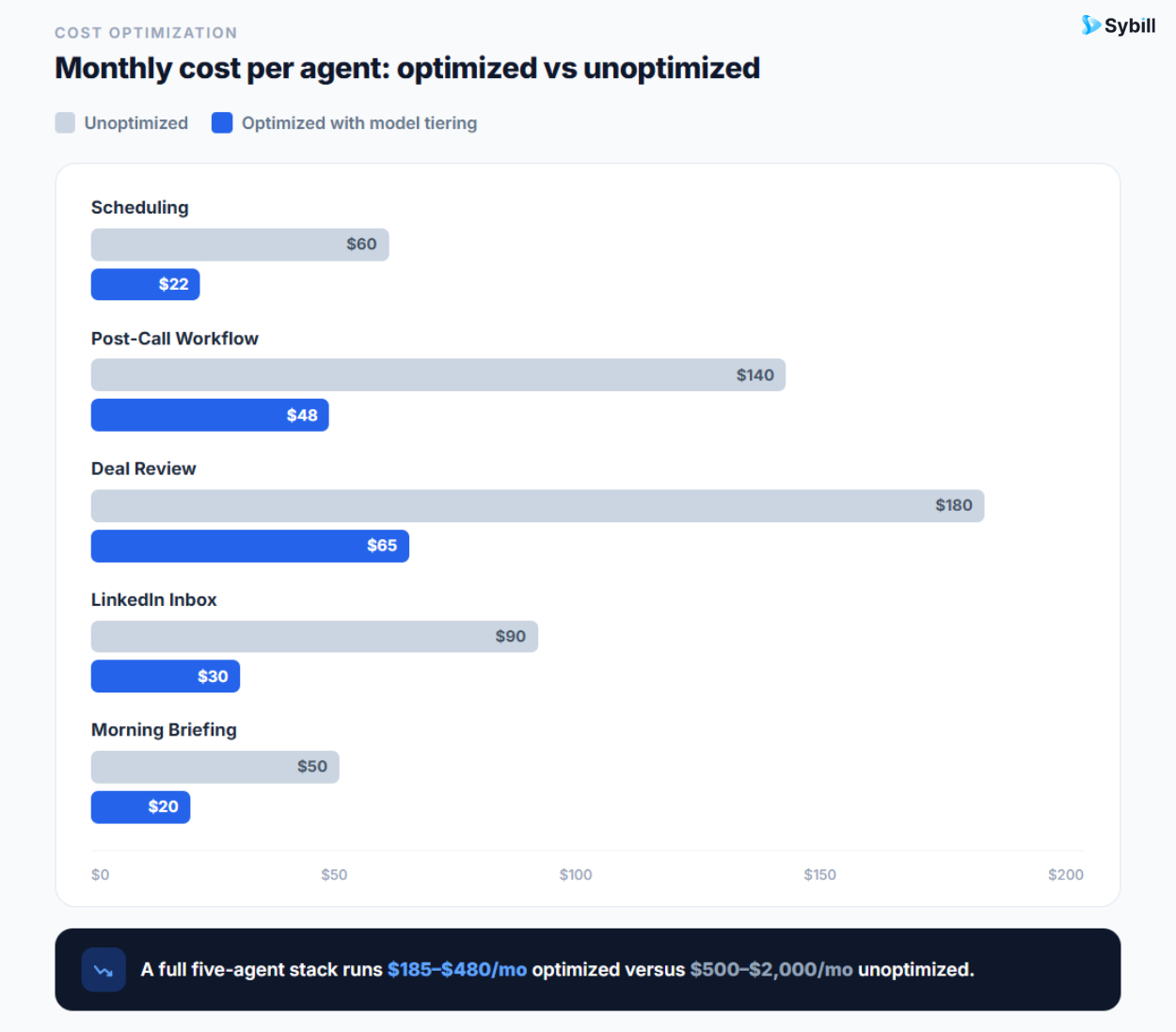
These are approximate monthly token cost ranges based on typical usage patterns, using a mixed model tier setup (premium for action tasks, cheap for classification and routing).
Scheduling agent (personal): 30 to 80 scheduling interactions per month, selective memory retrieval, soul and skill files loaded per call. Approximate range: $15 to $40 per month.
Post-call workflow agent (one rep, 5 calls per day): ~100 call processing events per month, transcript analysis, CRM field extraction, email drafting. Approximate range: $80 to $180 per month, depending on transcript length and model tier split.
Deal review agent (10 active deals, weekly review): 4 full pipeline review passes per month, selective deal memory loading, qualification and risk assessment generation. Approximate range: $40 to $120 per month.
LinkedIn inbox agent (moderate volume): 200 to 400 message classification events per month, draft generation for high-priority responses. Approximate range: $20 to $60 per month.
Morning briefing agent (daily, 5 days per week): ~22 briefing generation events per month, news retrieval, calendar and task summary, deal alert compilation. Approximate range: $30 to $80 per month.
Full personal stack (all five above, optimized): Total approximate range: $185 to $480 per month with model tiering and selective memory retrieval in place.
Without optimization (all tasks on premium model, full memory loading on every call), the same stack runs 3x to 5x higher: roughly $500 to $2,000 per month. The optimization work described above is what collapses that range down to the lower figures.
How much does it cost to run an AI agent per month?
For a single-task agent running on an optimized model tier split, monthly token costs typically range from $15 to $180 depending on task type and volume. A full personal stack of five to six agents, optimized, runs roughly $185 to $480 per month. Unoptimized stacks on premium models exclusively can run $500 to $2,000 or more for the same workload.
What is the biggest driver of AI agent token costs?
Model choice is the biggest lever. Routing all tasks through a premium model like Claude Opus when cheaper models are sufficient for classification and routing tasks is the most common source of excess cost. Model tiering (premium for action tasks, cheap for classification and routing) typically reduces costs by 40 to 60 percent.
Are AI agents cost-effective for sales teams?
Yes, when costs are weighed against the work they displace. Post-call admin time alone costs $15,000 to $30,000 per rep per year at standard salary rates. An agent handling that work costs $80 to $180 per month in token fees. The ROI is substantially positive at optimized cost levels.
Can I reduce AI agent costs without reducing quality?
Yes. The two highest-impact optimizations, model tiering and selective memory retrieval, have no impact on the quality of outputs that matter because they only affect low-complexity tasks and context loading efficiency. Premium model quality is preserved for the tasks that require it.
What model should I use for an AI agent to keep costs low?
Use a premium model (Claude Sonnet, GPT-4o) for any task where the output goes directly to a human or drives a significant action. Use a fast, cheap model (Claude Haiku, Gemini Flash, DeepSeek V3) for classification, routing, extraction, summarization, and any task where output feeds a subsequent step. This split alone covers most of the available cost optimization.
How do I track what my AI agents are costing?
Check the API usage dashboard for the model provider you are using (Anthropic, OpenAI, or Google). Most dashboards break down usage by model and time period. Set a weekly review habit and track cost per agent by noting which agents were most active that week. Cost spikes almost always trace back to either a new agent with unoptimized context, a memory file that has grown too large, or a polling agent without a pre-filter.
Agent costs are not a fixed tax on using AI. They are the result of specific architectural choices, and those choices can be made deliberately or made by default. The difference between a $2,000 per month agent stack and a $400 per month agent stack with equivalent output quality is almost entirely in model tiering, memory retrieval design, and context file hygiene.
The agents worth running are worth the cost when that cost is properly optimized. The ones that get shut down are almost always the ones where the cost was allowed to grow without the optimization work to match it.
For sales teams using Sybill, the token cost question is largely separate from the platform value question. The call intelligence, CRM sync, and deal review capabilities that Sybill provides are built into the platform and do not incur separate token costs per use. Custom agents built on top using the Sybill MCP connector do incur token costs, but they start from a richer context layer than a from-scratch build, which means they require fewer correction cycles and less context loading to produce good output.
For a complete picture of the agent build process and where costs accumulate, see how to build your first AI agent, how AI agents learn over time, and the AI agent components breakdown.
Get started for free with Sybill or book a demo to see what the platform handles without adding to your token bill.
For a single-task agent running on an optimized model tier split, monthly token costs typically range from $15 to $180 depending on task type and volume. A full personal stack of five to six agents, optimized, runs roughly $185 to $480 per month. Unoptimized stacks on premium models exclusively can run $500 to $2,000 or more for the same workload.
Model choice is the biggest lever. Routing all tasks through a premium model like Claude Opus when cheaper models are sufficient for classification and routing tasks is the most common source of excess cost. Model tiering (premium for action tasks, cheap for classification and routing) typically reduces costs by 40 to 60 percent.
Yes, when costs are weighed against the work they displace. Post-call admin time alone costs $15,000 to $30,000 per rep per year at standard salary rates. An agent handling that work costs $80 to $180 per month in token fees. The ROI is substantially positive at optimized cost levels.