Find us at booth #83, join us for a harbor side happy hour, or catch Gorish’s talk.

Sept, 16-18 > Learn more

%20(1).avif)
Mamta Tainwala

May 15, 2026
Becoming a sales coach requires three core components:
1. proven sales experience (typically 5-7 years with a track record of exceeding quota),
2. coaching competencies including active listening, questioning techniques, and feedback delivery, and
3. formal sales coaching training through certifications like Sandler, Challenger, or executive coaching programs.
The two main career paths are internal (sales managers coaching their teams) or external (independent business sales coach working with multiple companies). Critical skills include analyzing sales conversations for coaching moments, designing competency frameworks, measuring behavior change, and leveraging conversation intelligence tools to scale coaching impact.
Average salaries range from $75K-$120K for internal coaches to $150K-$300K+ for experienced independent consultants.
You know that feeling when someone explains something in a way that just clicks? When a single insight completely reframes how you approach a problem? That’s the magic of great coaching. And if you’ve ever caught yourself doing that for a colleague, explaining why their discovery call fell flat or showing them how to reframe an objection, you might be a sales coach in the making.
To become a sales coach, you need 5-7 years of proven sales experience with a track record of exceeding quota, formal coaching competencies including active listening, behavioral analysis, and structured feedback delivery, plus certification from recognized programs like ICF, Sandler, or Richardson that validate your methodology. Sales coaches earn $80K-150K+ annually depending on whether they work in-house (embedded in a sales org coaching reps daily), as independent consultants (serving multiple clients), or at training companies (delivering structured programs), with the highest-earning coaches specializing in enterprise B2B or leveraging AI tools like Sybill to provide data-driven coaching based on actual call analysis rather than subjective observation.
But here’s what most people don’t realize about becoming a sales coach: it’s not just about being good at sales. Some of the best closers make terrible coaches. They can’t explain why they’re good or break down their approach into teachable components. Meanwhile, solid B-players who are insatiably curious about what makes selling work often become exceptional coaches.
The sales coaching industry is exploding. Companies are finally waking up to the fact that coaching i’s the difference between hitting numbers and blowing them out. According to CSO Insights, organizations with dynamic coaching programs achieve 28% higher win rates than those without.
Whether you’re a sales manager who wants to become a better coach, an experienced rep considering a career transition, or someone eyeing the independent business sales coach route, this guide breaks down exactly how to get there.
Let’s clear up a massive misconception right away. Sales coaching isn’t standing in front of a room delivering motivational speeches or teaching product knowledge. That’s training. Coaching is the ongoing process of analyzing real sales behaviors, identifying patterns, and helping reps develop specific skills through observation, feedback, and practice.
Here’s what sales coaches actually spend their time doing:
Professional sales coaches live in the details of actual customer interactions. They’re reviewing recorded calls, sitting in on live conversations, and analyzing emails to spot patterns. What questions did the rep ask? Where did they lose buyer engagement? How did they handle the pricing objection? Did they multi-thread effectively?
This isn’t casual listening. It’s forensic analysis. Great coaches can watch a 30-minute discovery call and immediately identify the three moments that determined whether the deal would close or stall. They see what most people miss: the subtle shift in buyer tone when the rep started pitching features instead of exploring pain, the moment urgency died because no business impact was quantified, the opening for a champion that went uncultivated.
Sales coaches create frameworks for development. They design one-on-one coaching sessions that follow clear methodologies (observe-question-teach-practice), run group workshops on specific competencies, and facilitate role-play scenarios that mirror real deal situations.
The best coaches don’t wing it. They have a coaching plan for each rep based on that individual’s skill gaps and career goals. Maybe Rep A needs to work on qualification rigor while Rep B needs executive presence and Rep C needs to sharpen their business case development. One-size-fits-all coaching is lazy and ineffective.
Professional coaches document what good looks like. They create competency models that define proficiency levels for different skills (discovery, value articulation, objection handling, negotiation). They build coaching playbooks with specific scenarios, questions to ask, practice exercises, and example call snippets.
This is the work that scales coaching beyond one person. When you codify your approach, other managers can learn it, new coaches can replicate it, and the entire organization benefits from consistent coaching standards.
Sales coaches are obsessed with metrics. They track both leading indicators (behavioral changes like talk-to-listen ratios, discovery question quality, multi-threading frequency) and lagging indicators (win rates, deal sizes, sales cycle length). They use data to prove coaching is working and to identify where they need to adjust their approach.
If you coach someone on qualification for four weeks and their win rate doesn’t improve, either your coaching needs to change or you’re coaching the wrong thing. Great coaches run experiments, measure results, and iterate constantly.
Professional coaches master multiple sales frameworks: SPIN Selling, Challenger Sale, MEDDPICC, BANT, Sandler, Gap Selling, the list goes on. They understand when each methodology fits, how to adapt them to different selling environments, and how to coach reps through implementing them.
But they don’t just parrot the frameworks. They understand the psychology behind why they work, the common implementation mistakes, and how to customize them for specific industries or deal types.
Modern sales coaches are tech-savvy. They use conversation intelligence platforms to analyze calls at scale, CRM data to understand pipeline health, and coaching platforms to track rep development. They know how to extract actionable insights from data without drowning in it.
Tools like Sybill have changed what’s possible in coaching. Instead of manually reviewing hours of calls, coaches can now ask questions like “Which reps are struggling with pricing objections?” or “Show me discovery calls where we successfully identified budget” and get instant, sourced answers. This frees up time to actually coach instead of hunting for coaching moments.
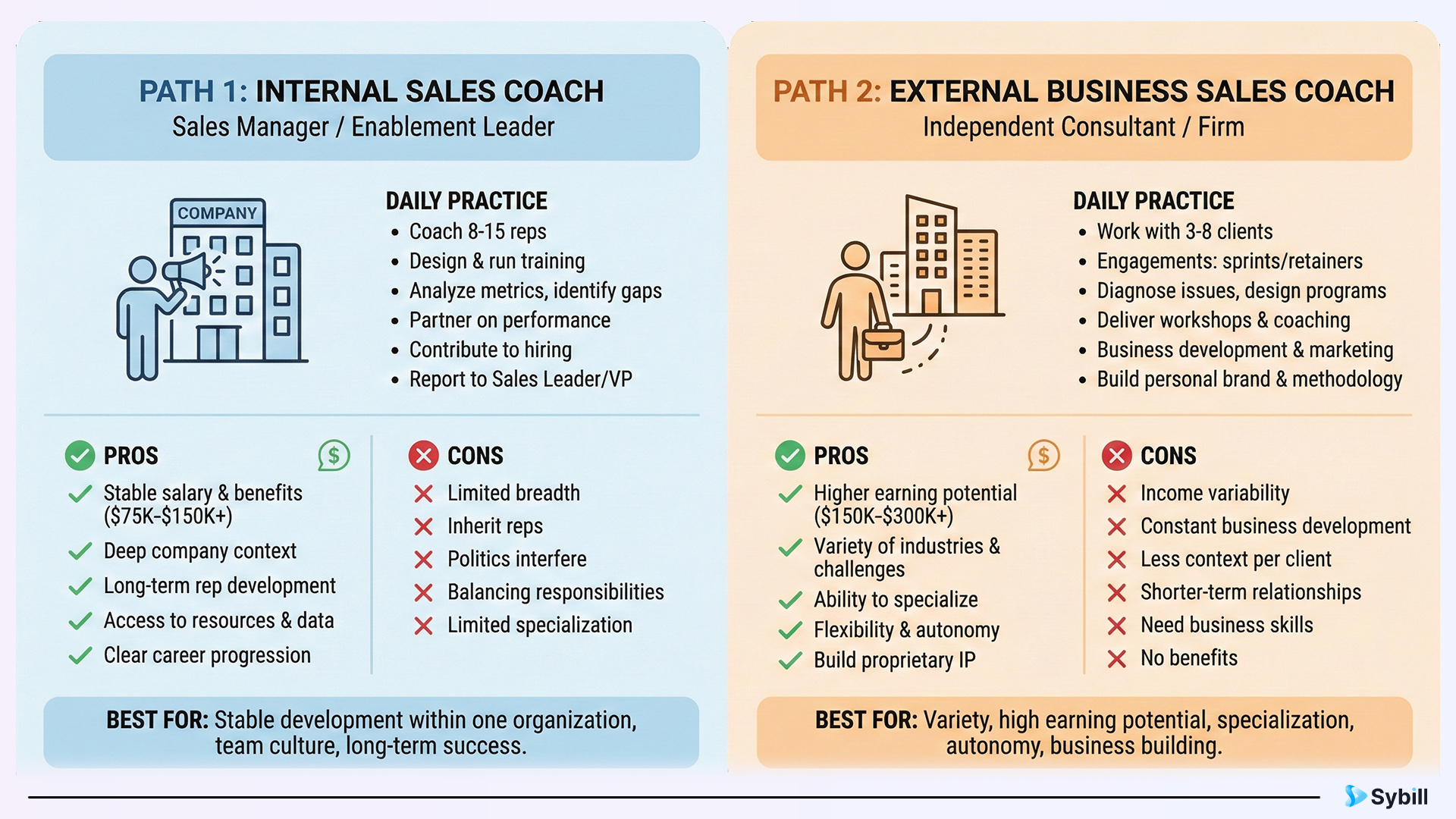
When people say they want to become a sales coach, they’re usually talking about one of two very different career paths. Understanding which one you’re pursuing is critical because the skills, preparation, and business models are distinct.
This is the most common route. You’re employed by a company to coach their sales team. You might be a sales manager who spends 30-40% of your time coaching your direct reports, or you might be a dedicated sales enablement manager or sales performance coach whose entire job is developing reps.
What this looks like in practice:
Pros:
Cons:
Best for: People who love developing talent within one organization, enjoy being part of a team culture, want stability, and are energized by seeing their reps succeed over years, not months.
This route means working with multiple companies as an independent consultant, joining a sales coaching firm, or building your own coaching practice. You’re hired to solve specific problems: ramping a team on a new methodology, improving discovery skills across the org, coaching high-potential reps, or developing managers into better coaches.
What this looks like in practice:
Pros:
Cons:
Best for: Experienced sellers or managers who want independence, have an entrepreneurial streak, love variety, can sell their own services, and want to build a personal brand in sales coaching and training.
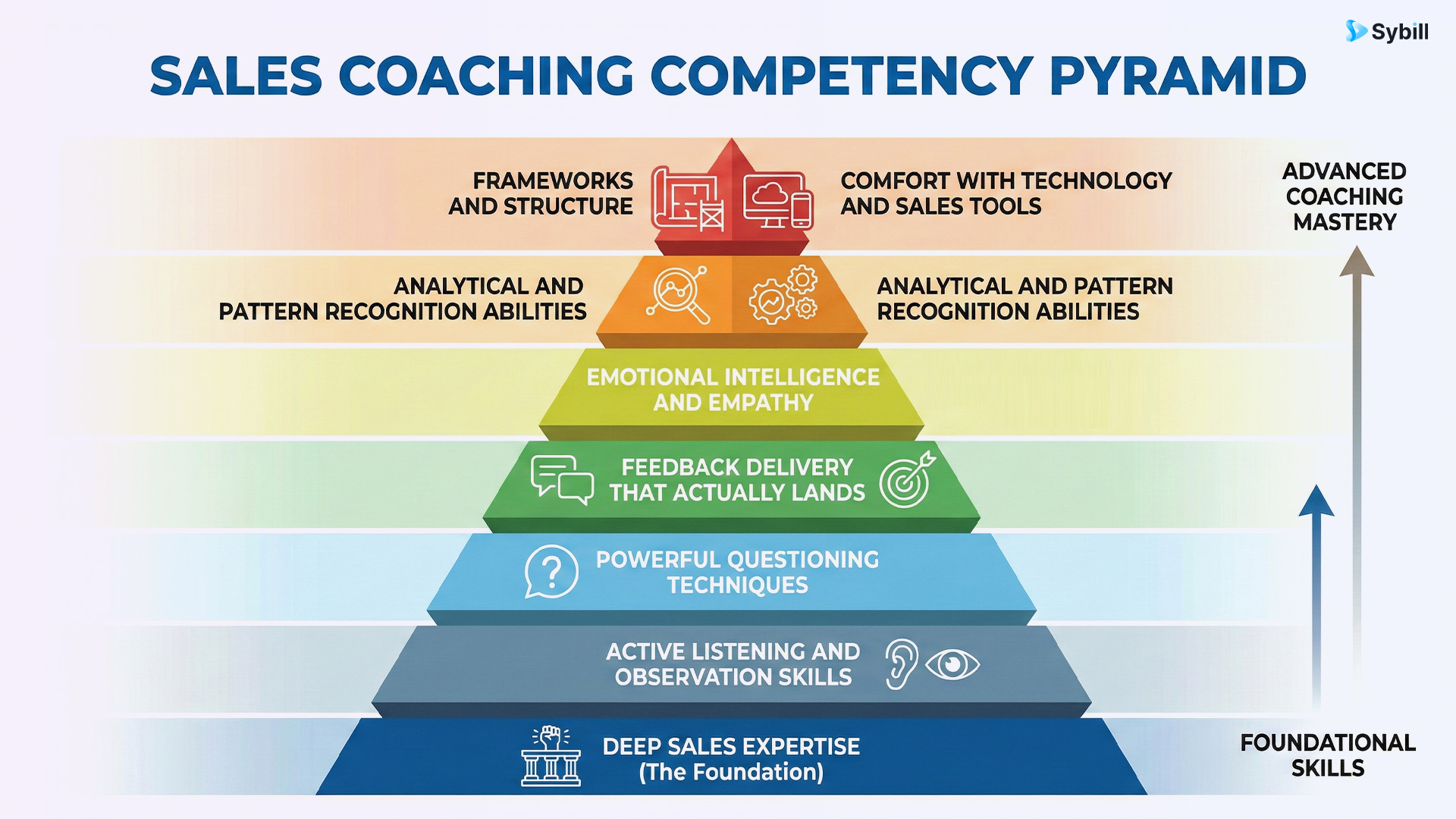
Here’s the hard truth: being a top performer doesn’t automatically make you a great coach. Some of the worst coaches are former superstars who can’t understand why everyone can’t just “do what I did.” The skills that make you a successful sales coach are different from the skills that make you a successful seller.
You can’t coach what you don’t understand. Great coaches have 5-7+ years of selling experience, ideally with a track record of exceeding quota. But it’s not just time in the seat, it’s depth of understanding.
The best coaches can deconstruct why something works. They understand the psychology of buying decisions, the mechanics of different sales methodologies, the nuances of qualification frameworks, and the patterns that separate wins from losses. They’ve seen enough deals to pattern-match: “This feels like that enterprise deal that stalled in legal for three months. Here’s how we got unstuck.”
But here’s the key: they’ve also failed enough to be humble. They know what doesn’t work because they’ve tried it. That humility makes them better coaches because they meet reps where they are instead of judging them.
Most people listen to respond. Coaches listen to understand. They notice the micro-signals: the rep who gets defensive when asked about qualification, the subtle shift in energy when discussing a particular deal, the pattern of blaming external factors instead of examining their own approach.
Great coaches are anthropologists of sales behavior. They watch calls not just for what the rep said, but for what they didn’t ask, where they hesitated, when they talked over the buyer, how they reacted to objections. This observational skill is learnable but takes practice.
The best coaching happens when reps reach insights themselves rather than being told. That requires asking questions that create awareness and self-diagnosis.
Instead of: “You talked too much in that call.” Try: “What did you notice about your talk time versus the buyer’s in that conversation? How do you think that impacted what you learned?”
Instead of: “You need to multi-thread more.” Try: “Who else in that organization needs to be involved for this deal to close? What’s your plan for engaging them?”
Powerful questions guide reps to the answer without spoon-feeding it. This builds judgment and creates behavior change that sticks.
Most managers are terrible at giving feedback. They’re either too vague (“be more confident”) or too harsh (public criticism that kills trust). Great coaches master the art of specific, timely, actionable feedback delivered with care.
The best feedback follows a pattern:
Notice how specific that is? No judgment, just observation and alternative approach. That’s the difference between coaching and criticizing.
Sales is emotionally brutal. Reps deal with rejection daily, miss quotas despite working hard, lose deals they thought were locked, and constantly feel the pressure of targets. Great coaches understand the emotional landscape.
They know when someone needs encouragement versus tough love. They recognize when a rep’s objection-handling problem is actually a confidence problem. They create psychological safety where reps feel comfortable admitting what they don’t know.
Empathy doesn’t mean coddling. It means understanding the emotional context and adjusting your approach accordingly. A rep who just lost their biggest deal needs different coaching than a rep who’s on a winning streak and ready to level up.
Sales coaching isn’t gut-feel-based. The best coaches are data nerds who spot patterns others miss. They analyze metrics across their team and notice: “My reps who ask 8+ discovery questions have 30% higher win rates than those who ask fewer.” That pattern becomes a coaching focus.
They look at successful calls and unsuccessful calls and identify the differentiating moments. They track individual rep development over time: “Sarah’s talk-to-listen ratio has improved 15 points in two months, and her win rate is climbing with it. Let’s keep that momentum.”
This analytical mindset separates professional coaches from casual mentors. One uses data to drive decisions, the other relies on anecdotes.
Great coaches don’t reinvent the wheel every session. They use proven coaching frameworks like GROW (Goal, Reality, Options, Will), coaching conversation templates, and structured feedback models. This creates consistency and helps reps know what to expect.
But they also know when to break from structure. A rep having an emotional breakdown about missing quota doesn’t need the GROW framework, they need human connection. The framework is scaffolding, not scripture.
Modern sales coaching requires tech fluency. You need to understand how CRM systems work, how to use conversation intelligence platforms to analyze calls, how to extract and interpret data, and how to leverage AI sales coaching tools to scale your impact.
Coaches who resist technology get left behind. The coaches who embrace it multiply their effectiveness. When you can use tools like Sybill to automatically surface coaching moments from every call, you’re coaching from real data instead of memory and bias.
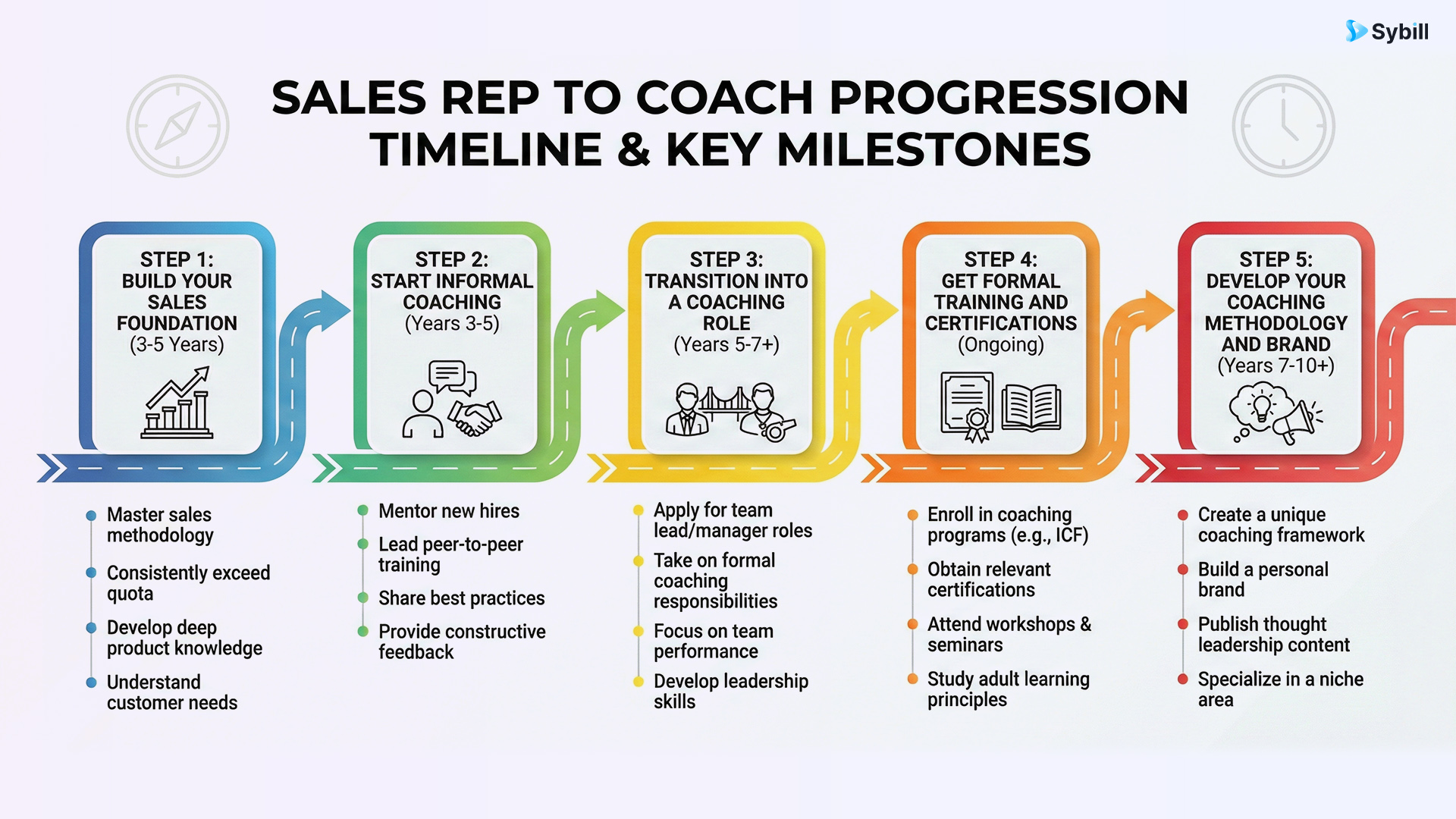
Becoming a sales coach isn’t something you wake up and decide to do tomorrow. It’s a career progression that requires intentional development. Here’s the realistic path:
You can’t skip this step. Before you coach anyone, you need to prove you can sell. This means:
Get quota-carrying experience. Work as an SDR, BDR, or AE. Carry a bag. Feel the pressure of targets. Learn what it’s actually like to cold call, run discovery, deliver demos, handle objections, and close deals.
Exceed expectations consistently. You don’t need to be the #1 rep (though it helps), but you need to demonstrate consistent performance. Hit quota regularly. Understand what makes you successful so you can teach it to others.
Study the craft deliberately. Don’t just do the job, study how you do it. Read sales books. Learn methodologies. Analyze your won and lost deals. Figure out your patterns. What questions consistently uncover pain? How do you create urgency? When do you advance deals versus when do you qualify out?
Develop curiosity about why things work. The best future coaches are the reps who ask questions: “Why did that objection-handling approach work?” “What made that discovery call so effective?” “Why do some messaging angles land and others fall flat?”
This foundation is non-negotiable. Coaches without field experience lack credibility and context. Reps can smell it immediately.
While you’re still selling, start developing coaching skills:
Mentor newer reps. Volunteer to onboard new hires. Shadow them on calls and provide feedback. Help them with deal strategy. See if you enjoy the process of developing others.
Run peer learning sessions. Lead team call reviews. Facilitate role-plays. Share what’s working for you. This teaches you to articulate your approach, which is critical for coaching.
Ask for feedback on your coaching. “Was that feedback helpful? What would make it more actionable?” Develop your coaching style through iteration.
Study great coaches. Watch how the best sales managers run one-on-ones. Notice what makes their feedback effective. Model their question techniques.
This informal coaching is your practice ground. You’re building the muscle memory of observation, feedback, and development before it’s your full-time job.
Now you’re ready to make coaching your primary responsibility. This happens through one of several routes:
Promotion to sales manager. The most common path. You move from individual contributor to managing a team of 5-10 reps. Suddenly, coaching is 30-50% of your job. Your success is measured by your team’s performance, not just your own.
Move into sales enablement. Some companies have dedicated enablement teams. You might become a sales enablement manager or sales performance coaching specialist whose entire job is developing the team’s skills.
Join a coaching firm. Companies like Corporate Visions, Richardson, or Force Management hire experienced sellers to become consultants who deliver their methodologies to client companies.
Start independent consulting. The entrepreneurial route. Hang your shingle as an independent business sales coach. This requires both coaching skills and business development skills (ironically, you need to sell coaching).
Whichever route you choose, this transition is where you shift from “I succeed by selling” to “I succeed by making others successful at selling.”
While real-world experience is critical, formal sales coaching training accelerates your development and provides credibility:
Sales methodology certifications:
Executive coaching certifications:
Sales-specific coaching programs:
These certifications provide frameworks, credibility, and access to communities of practice. They’re not mandatory (plenty of great coaches have zero certifications), but they accelerate your learning curve and give clients/employers confidence in your expertise.
Once you have experience, start developing your unique approach:
Document your frameworks. What’s your coaching philosophy? What models do you use? How do you diagnose performance gaps? Create playbooks that capture your approach.
Build a track record. Track metrics that prove your coaching works. “Reduced ramp time from 6 months to 3.5 months.” “Improved team win rate from 24% to 31%.” “Coached 15 reps to President’s Club.” Quantify your impact.
Create thought leadership. Write about sales coaching. Share insights on LinkedIn. Maybe start a newsletter or blog. Speaking at conferences. Build a reputation as someone who knows their stuff.
Specialize. As you mature, consider specializing in a niche: enterprise sales coaching, SaaS sales coaching, challenger methodology, sales leadership development, coaching managers to coach. Specialists command higher fees and attract better opportunities.
Continuously learn. The best coaches are eternal students. Stay current on sales trends, new methodologies, buyer behavior research, and coaching techniques. Read voraciously. Attend workshops. Learn from other coaches.
This step is about moving from competent coach to recognized expert. It’s where you build a sustainable coaching practice that can last decades.
Want to become a more data-driven coach? Sybill analyzes every sales call to surface coaching insights automatically, from talk-to-listen ratios to objection patterns to buyer engagement signals. Stop guessing what to coach on and start coaching from real conversation data. Get started for free and see how AI amplifies your coaching impact.
If you’re going the independent business sales coach route, understanding the business model is critical. Here’s how professional coaches structure their practices:
Hourly coaching: $150-$500/hour depending on experience and specialization. This works for one-on-one executive coaching or specific deal coaching sessions but doesn’t scale well.
Retainer arrangements: $5K-$25K/month for ongoing access. Might include weekly team coaching sessions, monthly workshops, manager development, and ad-hoc support. This provides stable recurring revenue.
Workshop/training delivery: $3K-$15K per day for in-person workshops. You design and deliver training on specific topics (discovery, objection handling, etc.). Scalable but requires constant booking.
Program-based coaching: $15K-$50K for 90-day or 6-month coaching programs with defined outcomes. Might include assessment, custom playbooks, weekly sessions, and progress tracking.
Certification programs: $50K-$200K+ for licensing your methodology to other coaches or companies. This is advanced, requiring proven frameworks and brand recognition.
Speaking and thought leadership: $5K-$25K+ per keynote. Not coaching per se, but adjacent revenue stream that builds your brand.
Most independent coaches blend multiple revenue streams. Here’s a realistic build:
Year 1: Hustle mode. Take whatever coaching work you can get. Maybe earn $75K-$100K while building your client base and reputation. Reinvest heavily in your business (website, marketing, certifications).
Year 2-3: Establish patterns. You have 3-5 consistent clients on retainer, deliver monthly workshops, and do some hourly coaching. Earning $125K-$175K. Starting to specialize and develop your methodology.
Year 4-5: Scale phase. Known in your niche. Clients refer you. Maybe earn $200K-$250K. You’re selective about engagements and charge premium rates. You’ve published content, maybe written a book, speaking at conferences.
Year 6+: Mature practice. Either you’re commanding top rates ($300K+ individually) or you’ve built a small coaching firm with other coaches delivering under your brand. You might create certification programs or group coaching products that scale beyond your personal time.
This isn’t get-rich-quick. It’s a professional services business that requires sales, marketing, delivery excellence, and continuous reputation building.
Running a coaching practice costs money:
Budget 20-30% of revenue for business expenses. Many new coaches underestimate this and struggle financially because they price based on time delivery, not total business economics.
The coaching landscape has changed dramatically in the last five years. Technology has made it possible to coach at scale, with precision, in ways that were impossible before.
Tools like Sybill, record every sales call, transcribe conversations, and surface insights automatically. For coaches, this is transformative:
Scalability. You can’t manually listen to 100 hours of calls per week. AI can. It analyzes every conversation and flags coaching moments: poor qualification, weak objection handling, dominance of talk time, lack of next-step clarity.
Objectivity. Human memory is selective and biased. Conversation intelligence gives you the actual transcript, the actual talk-to-listen ratio, the actual moments where the deal shifted. You’re coaching from reality, not perception.
Pattern recognition at scale. AI can identify that reps who ask 8+ discovery questions have 32% higher win rates. It can show you that deals mentioning ROI in the first call close 18% faster. These patterns inform your coaching priorities.
Self-coaching capabilities. Reps can review their own calls, see their metrics, and identify improvement areas before you even coach them. This creates awareness and makes your coaching more productive.
Sybill specifically excels at making coaching conversational. Instead of digging through dashboards, managers can ask: “Which reps need help with pricing objections?” or “Show me discovery calls where we identified budget early” and get instant answers. This makes coaching data accessible to every manager, not just data analysts.
Beyond call recording, AI is changing coaching in several ways:
Real-time feedback. Some tools now give reps in-the-moment nudges during calls. “You’ve been talking for 3 minutes straight. Try asking a question.” This creates micro-learning loops.
Personalized development plans. AI can analyze a rep’s entire call history and identify their specific skill gaps. Rep A needs discovery help. Rep B needs objection handling. Rep C needs executive presence. Coaching becomes hyper-personalized.
Automated coaching moments. Instead of manually searching for examples of great discovery calls, AI can surface them automatically. “Here are the three best qualification calls from last month.” Instant coaching library.
Predictive analytics. Some platforms predict which deals are likely to slip based on conversation patterns, so coaches can intervene proactively rather than reactively.
The coaches who embrace these tools multiply their effectiveness. The coaches who resist technology get outworked by coaches using AI to coach smarter.
Technology is a force multiplier, not a replacement. AI can surface insights, but it can’t:
The best coaches use AI for what it’s great at (data analysis, pattern recognition, insight surfacing) and focus their human energy on what only humans can do (relationship building, strategic thinking, emotional support, personalized development).
Learning to coach well takes time and you’ll make mistakes. Here are the most common ones so you can sidestep them:
Many new managers default to replicating their own experience: “My manager barely coached me and I figured it out, so I’ll do the same.” Or they copy bad habits from terrible managers they had.
The fix: Study great coaching deliberately. Read sales management books, take courses, find mentors who are exceptional coaches. Build your own evidence-based approach, not inherited dysfunction.
New coaches love to show off their knowledge. They watch a call and immediately jump into: “Here’s what you should have done...” This creates dependency and robs reps of learning.
The fix: Master the art of powerful questions. “What did you notice about that interaction?” “What might you try differently next time?” “What do you think caused the buyer to disengage there?” Let reps reach insights themselves.
Treating all reps identically ignores that people have different learning styles, career goals, skill levels, and motivation triggers. What works for your star performer will fail with your struggling newbie.
The fix: Personalize your approach. Some reps need direct feedback. Others need space to self-discover. Some respond to data and logic. Others need emotional connection. Adapt your coaching to the individual.
When you only coach problems, coaching becomes associated with failure. Reps dread your feedback sessions because they know it’s criticism time.
The fix: Coach strengths too. “That was brilliant how you handled that procurement objection. Let’s deconstruct what you did so you can replicate it.” Positive coaching builds confidence and creates psychological safety for addressing gaps.
If you can’t measure whether your coaching is working, you’re just hoping. Many new coaches rely on gut feel: “I think the team is improving.”
The fix: Track both behavioral metrics (talk-to-listen ratio, discovery questions asked, multi-threading) and outcome metrics (win rate, deal size, sales cycle length). Connect behavior change to business results. Use data to validate your coaching priorities.
New coaches see a struggling rep and try to coach on qualification, discovery, demo delivery, objection handling, and follow-up all in one session. The rep leaves overwhelmed and changes nothing.
The fix: Focus on one or two high-impact behaviors at a time. “For the next two weeks, we’re working on asking better discovery questions. That’s it.” Depth over breadth. Master one thing before moving to the next.
You have a great coaching session, the rep commits to changing a behavior, and then you never check whether they actually did it. Without accountability, coaching is just conversation.
The fix: Build follow-up into your process. “We talked about improving your talk-to-listen ratio. Let’s review your last three calls and see how you’ve progressed.” Consistent accountability drives behavior change.
Some coaches pride themselves on “old-school” coaching: just gut instinct and experience. They refuse to use conversation intelligence or analytics. Meanwhile, data-driven coaches are running circles around them.
The fix: Embrace technology. Use conversation intelligence to analyze calls at scale. Leverage AI to surface coaching moments. Let data guide your priorities instead of anecdotes and recency bias.
Becoming a sales coach is one of the most rewarding career paths in sales, but it’s not for everyone. Before you make the leap, ask yourself these questions:
Do you genuinely enjoy developing others more than personal achievement?
Are you patient with people’s learning curves?
Are you obsessively curious about what makes selling work?
If you answered yes to these, sales coaching might be your calling. It’s a career where you compound impact: instead of closing 50 deals yourself, you help 10 reps close 500 deals. Instead of hitting quota once, you build a team that hits quota consistently for years.
The industry needs more great coaches. Companies are desperate for people who can actually develop talent, not just manage scorecards. The coaches who combine real sales experience with structured coaching methodologies and modern technology are in massive demand.
Ready to elevate your coaching with AI-powered insights? Sybill gives you instant visibility into every rep’s conversation patterns, skill gaps, and coaching opportunities. Stop coaching from memory and start coaching from data. Try Sybill free and see how conversation intelligence transforms your coaching effectiveness.
No, certification isn't strictly required, but it helps significantly. For internal coaching roles (sales manager), companies rarely require formal coaching certification, they care more about your sales track record and leadership ability. For external business sales coach roles, certifications provide credibility, especially when starting out. ICF coaching credentials, sales methodology certifications (Sandler, Challenger, MEDDPICC), or executive coaching programs signal to clients that you've invested in developing coaching expertise. That said, the most successful coaches often have minimal formal certification but decades of field experience and proven results. Certification accelerates your learning curve but doesn't replace real-world selling experience and coaching practice.
Realistically, 7-10 years from when you start selling. Here's a typical timeline: 3-5 years building sales expertise and track record, 2-3 years in informal coaching roles (mentoring, leading training, managing small teams), then transitioning into a formal coaching position. You can accelerate this with intensive certification programs and deliberate practice, but shortcuts rarely produce excellent coaches. The best coaches combine extensive field experience with structured coaching training. If you're already a successful seller with 5+ years experience, you could transition to a manager role (which includes coaching) within 1-2 years. Building an independent coaching practice typically takes 2-3 years to gain traction and achieve stable income.
It varies widely based on role type and experience. Internal sales coaches (managers/enablement): $75K-$150K base salary for frontline managers, $120K-$200K+ for senior enablement leaders or directors of sales coaching. Independent business sales coaches: $50K-$100K in early years while building your practice, $150K-$250K with established client base, $300K-$500K+ for recognized experts with proprietary methodologies and strong brands. Top-tier executive sales coaches can earn $500K+ annually. Corporate coaching firm employees typically earn $100K-$175K as consultants. Remember that independent coaches face revenue variability and must cover their own benefits and business expenses, so comparing salaries to W-2 roles requires accounting for total compensation and stability.