
Find us at booth #83, join us for a harbor side happy hour, or catch Gorish’s talk.

Sept, 16-18 > Learn more


Tamanna Mishra

August 29, 2026
%20(77).png)
Conceptual Selling is a Miller Heiman methodology for planning customer interactions around the buyer’s concept of success rather than the seller’s feature list. Sellers use the Green Sheet to prepare meeting objectives, ask five types of questions, align their selling process with the customer’s buying process, provide relevant perspective and agree on clear actions for both sides. It works best in complex B2B sales where different stakeholders may define value differently and one generic pitch cannot represent what everyone needs.
Conceptual Selling is frequently summarized as “sell the outcome, not the product.”
That is directionally right, but incomplete.
A seller can replace a list of features with a list of benefits and still spend the entire meeting talking about their own product. The pitch sounds more polished, but the buyer’s actual concept of value remains unknown.
Conceptual Selling puts the customer interaction itself under discipline.
Before an important meeting, the seller should know:
The objective is not to make the pitch sound customer-centric. It is to understand what the customer is buying before trying to sell it.
Conceptual Selling is a buyer-focused sales methodology developed by Robert Miller and Stephen Heiman. Its central premise is that buyers do not purchase products solely for their features. They purchase their own concept of what those products will help them accomplish.
That concept may include:
The seller’s job is to uncover that concept, validate it and determine whether the proposed solution can genuinely support it.
Miller and Heiman developed Conceptual Selling alongside Strategic Selling. The methodologies now sit within Korn Ferry’s sales training portfolio. The current Conceptual Selling with Perspective program focuses on meeting preparation, customer-focused conversations, alignment with the buying process and clear actions for both sides.
The methodology is also detailed in Miller and Heiman’s book, The New Conceptual Selling.
The buyer’s concept is their mental picture of the result they want and how they believe a successful solution should help create it.
It is not necessarily the same as:
Suppose a revenue operations leader asks for automatic call summaries.
The requirement is call summaries.
But the buyer’s concept may be:
A trustworthy deal record that stays current without requiring sales managers to chase representatives for notes.
Another stakeholder may have a different concept:
A complete customer history that helps account executives prepare for calls without searching across five systems.
The same feature supports both concepts, but the value, evidence and buying motivations are different.
The concept sale establishes whether the seller and buyer agree on the outcome, the problem and the intended path forward.
The product sale establishes whether a particular solution can deliver that outcome.
Presenting the product first encourages the buyer to react to capabilities before the team has agreed on what matters. Conceptual Selling reverses that order:
The approach does not ask sellers to hide the product indefinitely. It asks them to earn the right to discuss it in the right context.
Conceptual Selling is broader than asking open-ended questions. Its operating principles shape how the entire interaction is planned.
A seller may believe the strongest value is cost reduction. The buyer may care more about predictability, professional credibility, employee experience or reduced implementation risk.
A sales conversation becomes relevant only when it reflects the buyer’s reasons.
The seller may be moving from discovery to demonstration. The buyer may still be deciding whether the problem deserves attention.
Korn Ferry explains that Conceptual Selling helps sellers recognize and align these two processes.
A scheduled demo does not prove that the buyer is ready to evaluate products. A proposal request does not prove that every stakeholder agrees on the need.
A product can create different value for different people.
The CFO may care about financial control. The operations leader may care about process reliability. An end user may care about removing repetitive work. IT may care about integration, security and governance.
The product remains the same. The concept does not.
Discovery should not become a one-sided extraction exercise in which the seller asks for information and gives nothing useful in return.
The current Conceptual Selling with Perspective approach explicitly asks sellers to find appropriate ways to provide perspective to each person involved in a sale.
That perspective might include:
The seller should not manufacture a provocative insight merely to sound clever. The perspective must help the buyer make a better decision.
Conceptual Selling does not define a seller win as any signed contract.
If the buyer’s concept cannot realistically be delivered by the product, closing the deal creates expectation debt. That debt appears later as poor adoption, implementation conflict, churn or damaged trust.
Win-win means the buyer receives credible value and the seller enters a commercially sound relationship.
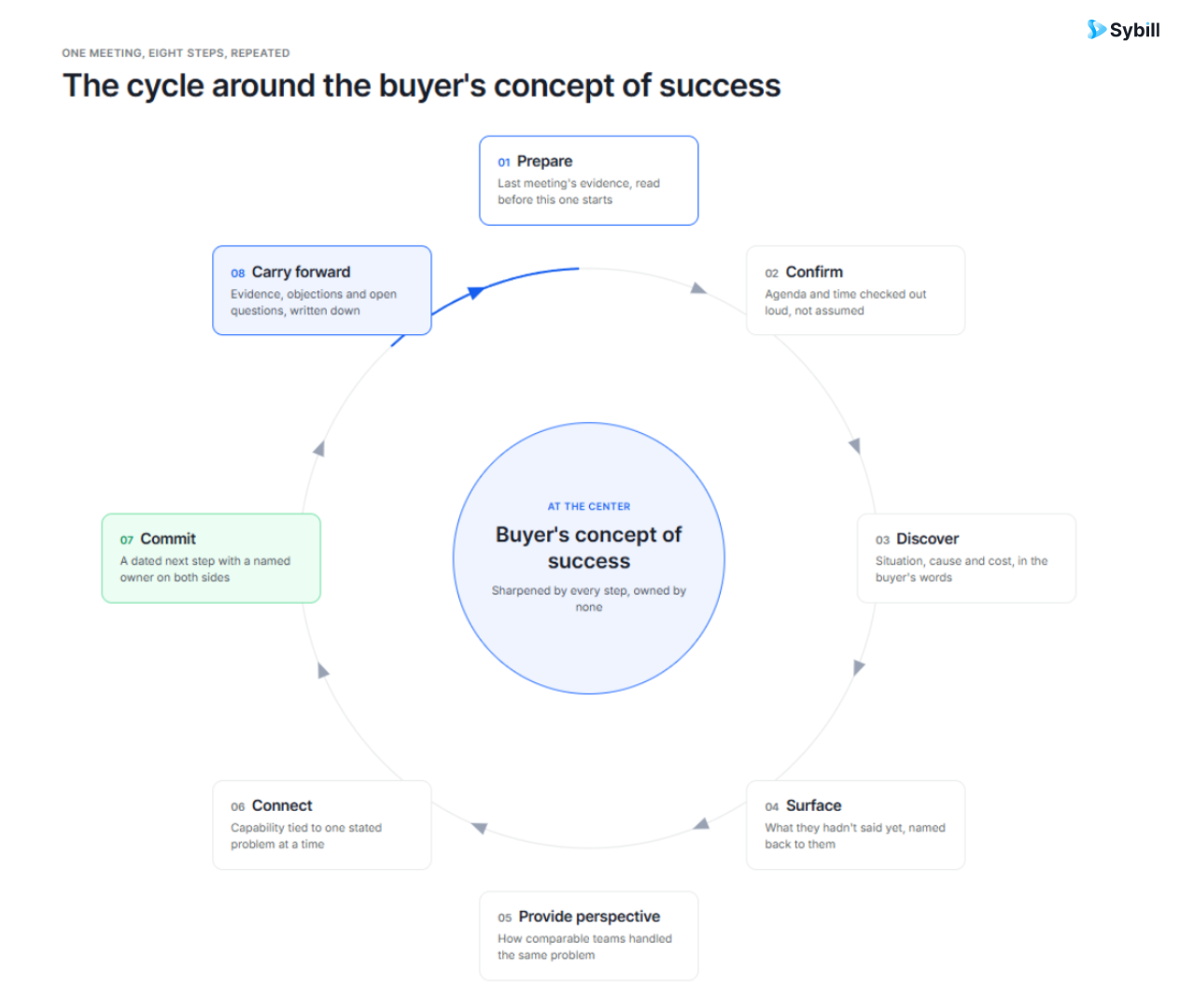
A Conceptual Selling conversation can be understood through three broad stages:
These stages are not rigid agenda blocks. A real conversation moves between questions, clarification and useful information.
What matters is the balance. If the seller gives information before understanding the buyer’s concept, the meeting becomes a pitch. If the seller only gathers information, the buyer may leave without receiving value. If neither side commits to action, the conversation may have been pleasant but commercially inconclusive.
The following is a practical explanatory model, not an official Miller Heiman worksheet.
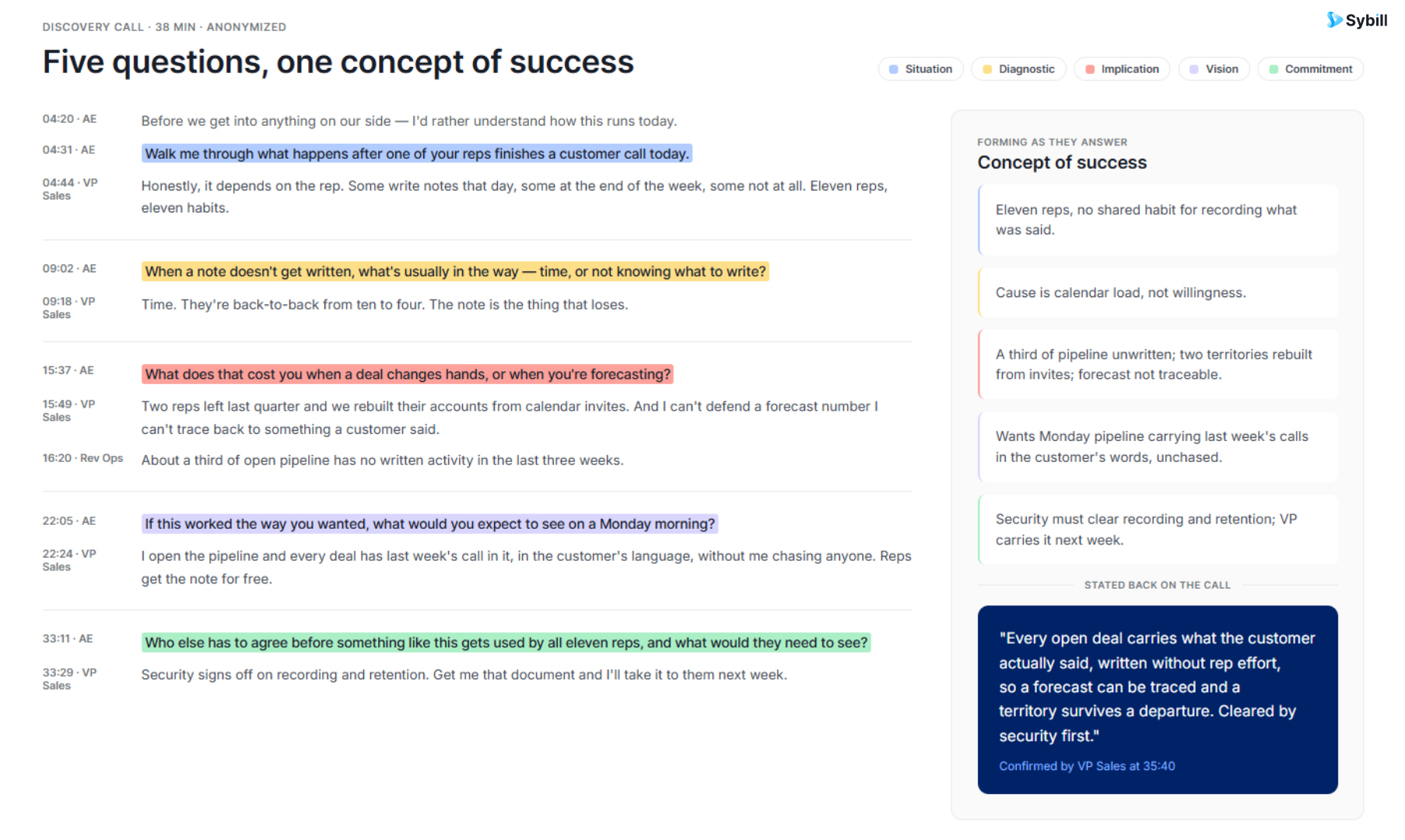
The classic Conceptual Selling framework uses five categories of questions. Each category helps the seller understand a different part of the buyer’s concept.
They are not a script to be recited in order. Using all five categories in quick succession can make the buyer feel processed rather than understood.
Confirmation questions show the buyer that the seller has listened, researched and retained important context.
They can verify:
Useful confirmation questions include:
A confirmation question should remain a genuine question. “You agree that automation is the answer, correct?” is pressure disguised as validation.
New Information questions fill meaningful gaps.
Examples include:
The goal is not to collect every available fact. It is to discover what materially affects the buyer’s concept and decision.
Attitude questions reveal how the buyer interprets the situation.
That matters because two people can agree on the facts and disagree completely about what should happen next.
Examples include:
Attitude questions require trust. They should sound curious, not intrusive or manipulative.
Commitment is broader than signing a contract.
A buyer can demonstrate commitment by:
A useful commitment question asks for an action proportionate to the value and confidence established so far.
Basic Issue questions deliberately surface reasons not to proceed.
Examples include:
These questions can feel uncomfortable. That is precisely why they matter. An unspoken issue does not disappear. It waits until procurement, implementation or a late-stage executive review.
The Green Sheet is the meeting-planning tool associated with Conceptual Selling.
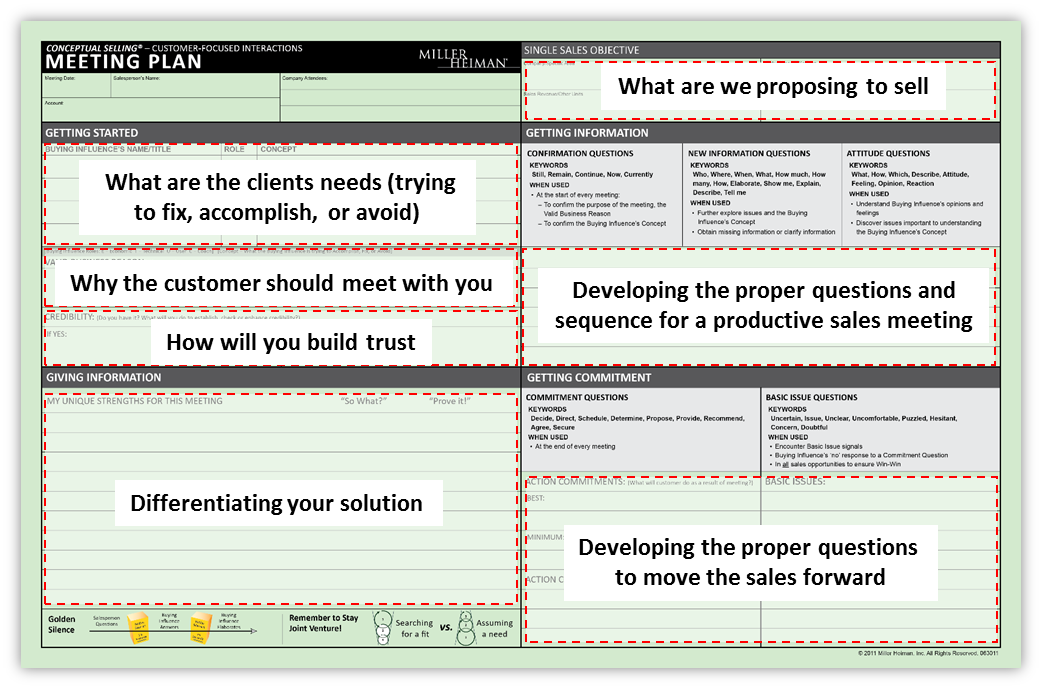
It helps sellers prepare for productive customer interactions rather than relying on a generic agenda, a familiar deck or intuition.
Public Korn Ferry materials describe the Green Sheet as a tool for planning customer interactions. Korn Ferry Sell embeds the Green Sheet alongside the Blue Sheet and Gold Sheet within its methodology platform.
A Green Sheet can help a seller think through:
The Single Sales Objective describes the commercial opportunity that the customer interaction is intended to advance.
It should be specific enough to prevent the meeting from becoming detached from the larger deal, but it should not turn every interaction into an aggressive closing attempt.
For example:
Secure agreement to run a four-week pilot with the North American enterprise team by October 15, subject to validated security and workflow requirements.
That is clearer than:
Discuss next steps and demonstrate the platform.
The Green Sheet plans an individual customer interaction.
The Blue Sheet, used in Strategic Selling, supports the wider opportunity strategy across buying influences, competitive position, risks and actions.
A Blue Sheet may show that the seller needs stronger access to a technical buyer. A Green Sheet helps the seller plan the meeting that could build that relationship.
For a broader explanation of the opportunity-level methodology, read Sybill’s Miller Heiman sales process and Blue Sheet guide.
The following example is fictional.
A seller from a revenue workflow platform is meeting Maya, a Vice President of Revenue Operations at Northstar Systems.
Maya initially asked for better automated call summaries.
A feature-led seller might immediately demonstrate transcription, summaries and CRM fields.
A Conceptual Selling approach starts with a hypothesis:
Northstar may need more consistent customer information across calls, CRM records and forecast reviews.
That hypothesis is useful preparation. It is not yet the buyer’s concept.
Seller: “You mentioned that managers spend part of every forecast call reconstructing what happened in customer meetings. Is that still the main concern?”
Maya: “Yes, although the larger problem is that nobody trusts the opportunity record unless they have spoken directly to the account executive.”
The seller now knows that summaries are not the end goal. Trust in the deal record matters more.
Seller: “Where does that lack of trust create the most serious problem?”
Maya: “Managers can work around it. The problem is when the CRO asks why a commit deal slipped and we cannot show when the risk first appeared.”
The desired outcome is becoming clearer: defensible deal history and earlier risk visibility.
Seller: “How do account executives feel about changing the process?”
Maya: “They are tired of being told to enter more data. If this feels like another inspection system, adoption will be terrible.”
The personal and organizational concern is not simply implementation effort. It is resistance to surveillance and additional administration.
Seller: “What could stop you from moving forward even if the summaries are accurate?”
Maya: “Security will need to approve the meeting data workflow, and our sales leaders will need proof that representatives are not being asked to maintain another system.”
The seller now understands two conditions that could stop the initiative.
Seller: “Teams often frame this as a note-taking project. The more useful implementation question is whether the meeting evidence can update the systems managers already use without creating a second workflow for representatives. It may make sense to test that before evaluating broader analytics.”
The seller has added a relevant implementation perspective without dismissing Maya’s original request.
Seller: “It sounds as though success is not simply better summaries. You need a deal record managers can trust, without adding data entry or making representatives feel monitored. Is that a fair description?”
Maya: “Yes. That is exactly it.”
The buyer has now confirmed the concept in their own language.
Seller: “If we map one enterprise team’s current workflow and confirm the security requirements, would you sponsor a limited pilot with that group?”
Maya: “Yes. I can involve the sales manager and our security partner. Send me the workshop outline first.”
The meeting ends with mutual action:
No one has signed a contract. The opportunity has still advanced.
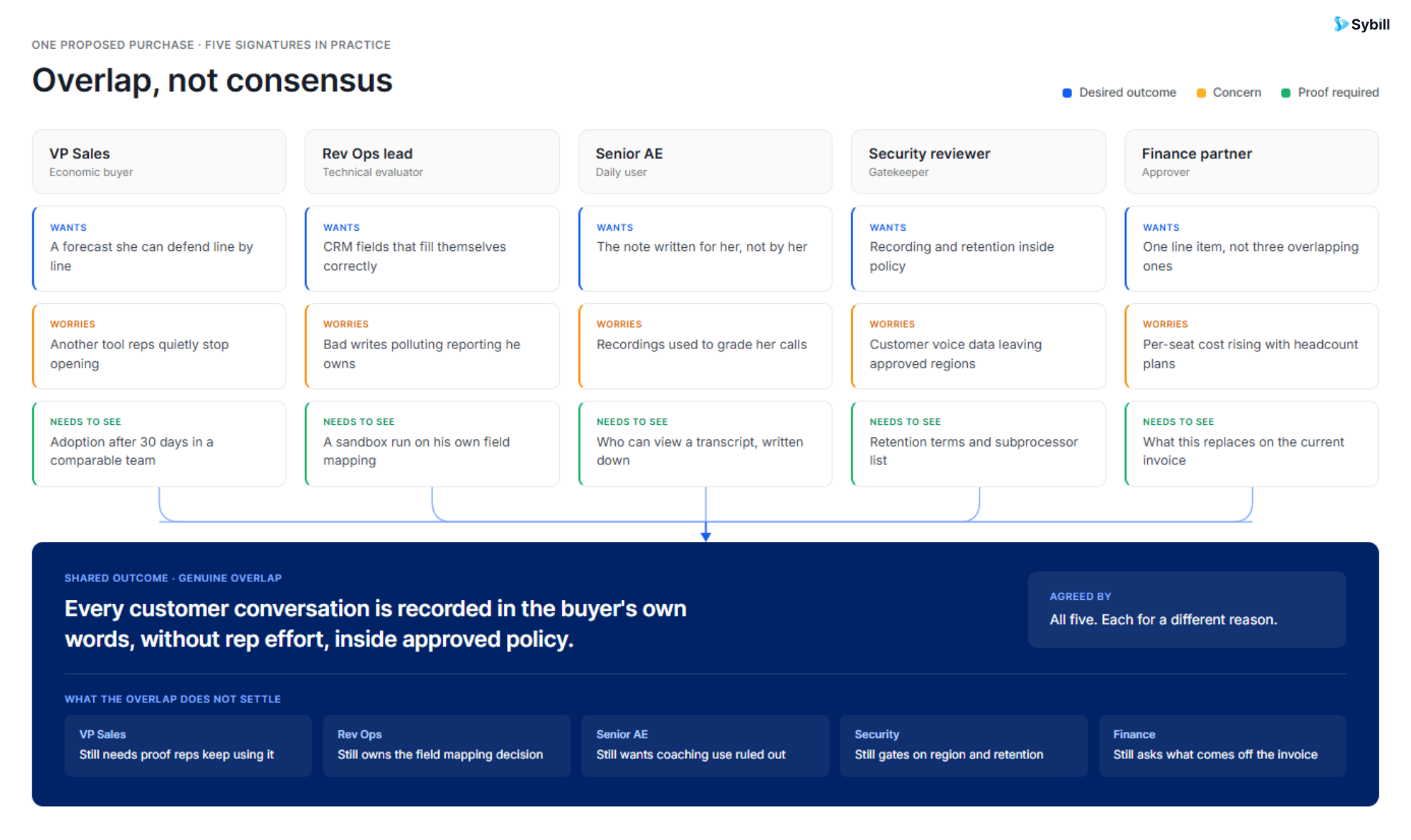
Complex buying groups rarely share one perfectly consistent definition of value.
This creates a challenge we can call concept drift.
As information passes between meetings, stakeholders and internal teams, distinct buyer concepts are often compressed into one generic CRM summary:
Customer wants better sales automation.
That summary is convenient and almost useless.
It hides:
Conceptual Selling helps uncover these differences. Revenue teams also need a reliable way to preserve them across the deal.
Conceptual Selling with Perspective also asks sellers to understand where buyers are in relation to change.
Korn Ferry describes four buyer positions:
This framework prevents a common sales mistake: manufacturing urgency where the buyer sees none.
A buyer in Growth or Trouble may already be receptive to change. A buyer at Even Keel needs a credible reason to reconsider the status quo. An Overconfident buyer may require new evidence, but challenging them without insight will only create resistance.
Conceptual Selling does not promise that every buyer can be persuaded. Sometimes the right conclusion is that the opportunity should not move forward.
Conceptual Selling overlaps with several buyer-focused approaches, but each framework has a different job.
For deeper comparisons, see Sybill’s guides to:
These frameworks can complement one another. A team might use MEDDPICC for qualification, Strategic Selling for opportunity planning and Conceptual Selling for important buyer interactions.
The danger is not using more than one methodology. It is mixing their terminology until representatives no longer know what problem each framework solves.
AI is most useful when it helps sellers prepare, listen and retain context.
It should not decide what the buyer wants based on an isolated phrase or automatically label someone supportive, resistant or ready to buy.
AI can help preserve the buyer’s concept. It cannot decide what that concept is without the buyer.
Useful questions a seller could ask Sybill before a meeting include:
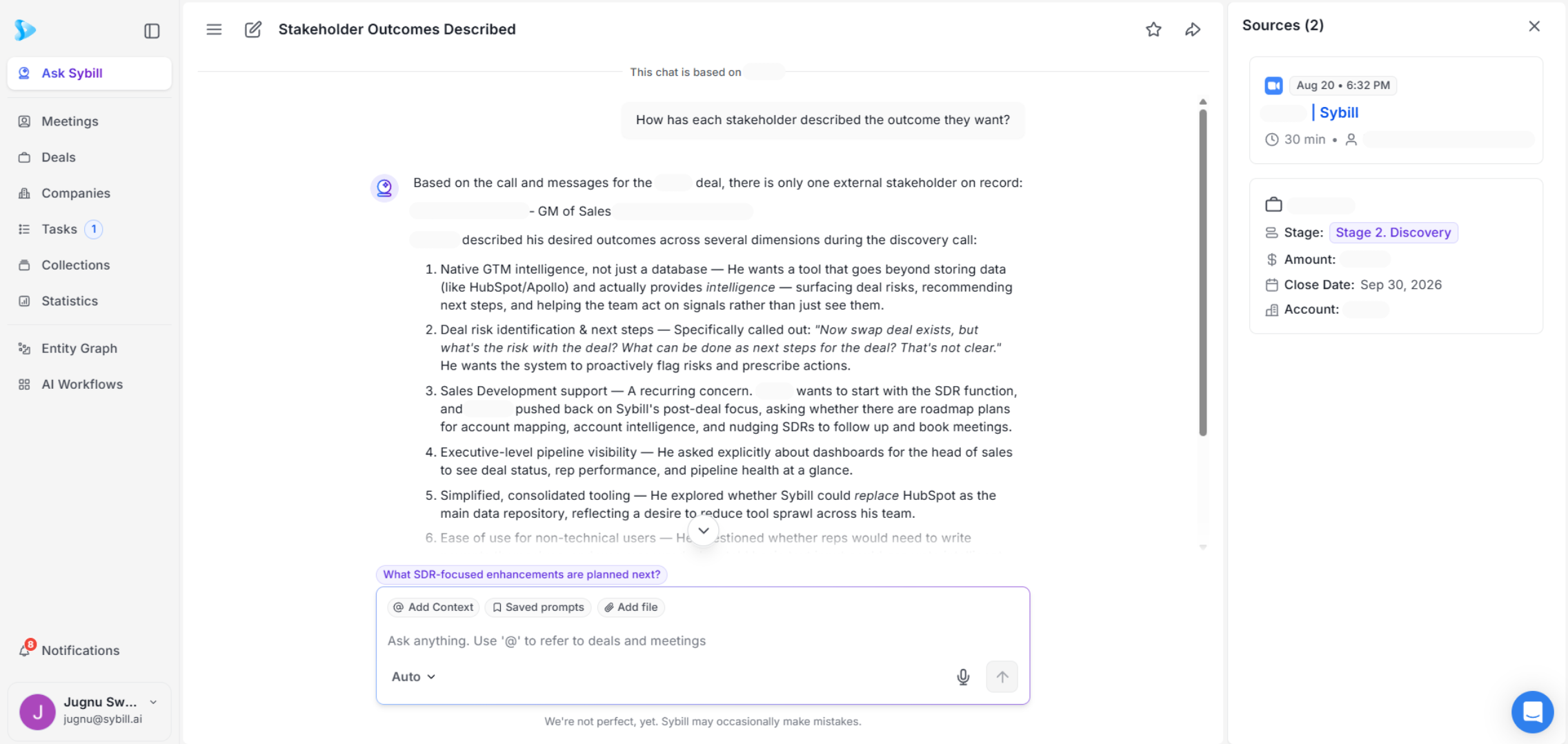
These questions turn accumulated deal context into better preparation. They do not replace direct confirmation with the customer.
Conceptual Selling begins with better meeting preparation. See how Sybill’s Pre-Meeting Briefs bring previous conversations, CRM context, attendee information and open tasks together before the call.
Conceptual Selling is especially useful when:
It is less useful when:
Conceptual Selling should make a complex interaction clearer. Applying it indiscriminately can make a simple purchase harder than necessary.
The most important question in Conceptual Selling is not:
How can we make this product sound more valuable?
It is:
What is this buyer actually trying to accomplish, and can we credibly help?
Answering that question requires preparation, listening, useful perspective and commercial honesty. It also requires continuity.
The buyer’s concept develops across stakeholders and meetings. Priorities change. New concerns emerge. Commitments are made. Assumptions are corrected. If that context is reduced to a short CRM note, the next seller may return to a generic pitch and force the buyer to explain the situation again.
Conceptual Selling gives teams the meeting discipline. Sybill helps preserve the evidence and actions that allow that discipline to continue from one interaction to the next.
Book a Sybill demo to see how your team can prepare with complete deal context, capture buyer priorities and keep mutually agreed actions from disappearing between calls.
Conceptual Selling is a Miller Heiman sales methodology that helps sellers plan customer interactions around the buyer’s concept of success. Instead of beginning with product features, the seller uncovers what the buyer wants to achieve, provides relevant perspective and agrees on meaningful actions for both sides.
Robert Miller and Stephen Heiman created Conceptual Selling. The methodology is described in their book The New Conceptual Selling and is now part of Korn Ferry’s sales training portfolio.
The five types are Confirmation, New Information, Attitude, Commitment and Basic Issue questions. They help sellers verify what they know, discover missing context, understand buyer opinions, test willingness to act and surface issues that could stop the opportunity.
The Green Sheet is the proprietary meeting-planning tool associated with Conceptual Selling. It helps sellers define the Single Sales Objective, prepare important questions, consider the buyer’s concept, plan useful information and identify an appropriate action commitment.
Solution Selling focuses on diagnosing a business problem and positioning a tailored solution. Conceptual Selling focuses more specifically on understanding the buyer’s concept of the desired outcome and planning customer interactions that align the seller’s process with the buyer’s process.
Conceptual Selling helps sellers plan and conduct individual customer interactions. Strategic Selling operates at the wider opportunity level, helping teams understand buying influences, competitive position, risks and the actions needed to win a complex deal.
Yes. Conceptual Selling remains relevant for complex B2B sales because buyers still interpret value differently, involve multiple stakeholders and expect purposeful interactions. The current Korn Ferry version, Conceptual Selling with Perspective, also emphasizes providing useful perspective and ending meetings with clear actions.
AI can help sellers prepare for meetings, retrieve previous buyer context, capture conversations and preserve next steps. It cannot independently determine the buyer’s concept, validate stakeholder attitudes or replace human judgment and direct customer confirmation.
Conceptual Selling is a Miller Heiman sales methodology that helps sellers plan customer interactions around the buyer’s concept of success. Instead of beginning with product features, the seller uncovers what the buyer wants to achieve, provides relevant perspective and agrees on meaningful actions for both sides.
Robert Miller and Stephen Heiman created Conceptual Selling. The methodology is described in their book The New Conceptual Selling and is now part of Korn Ferry’s sales training portfolio.
The five types are Confirmation, New Information, Attitude, Commitment and Basic Issue questions. They help sellers verify what they know, discover missing context, understand buyer opinions, test willingness to act and surface issues that could stop the opportunity.








