Find us at booth #83, join us for a harbor side happy hour, or catch Gorish’s talk.

Sept, 16-18 > Learn more


Tamanna Mishra

February 19, 2026

You join a sales call, say hello, and before you finish your second sentence, the buyer already knows your pricing, your top three competitors, and the exact G2 review where someone complained about your onboarding. They have screenshots. They have opinions. Worse, they have options.
This is not an edge case anymore. This is the default buying experience. 9 out of 10 B2B buyers today read up on social media, review sites, and your own content before even the first sales call.
Buyers do not come to sales calls waiting to be educated from scratch.
They come to pressure-test their thinking.
They come to validate assumptions.
They come to see whether the person on the other side actually understands their context or is about to run a well-rehearsed pitch they have already heard five times this week.
In a world shaped by Google reviews, dating app bios, and comparison tables, persuasion alone is useless. Relevance is everything.
Because transactional selling has felt outdated for a very long time. And that’s not because it is evil or incompetent, but because it is optimized for a buyer who no longer exists. The buyer who needed a rep to explain features. The buyer who had limited access to alternatives. The buyer who could be “convinced” with the right closing technique.
Consultative selling is all about being useful at the exact moment buyers are overwhelmed with information and starving for clarity. It demands that reps ask better questions than Google can answer and offer insights the buyer cannot easily arrive at alone.
This guide breaks down consultative selling without the fluff. You will learn what consultative selling actually means today, the skills that separate real consultants from friendly talkers, real-world consultative selling examples, where and why this approach fails, and how modern AI sales tools make consultative selling scalable instead of exhausting.
Consultative selling is often explained as “asking good questions” or “listening more than talking.” That description is incomplete and, frankly, misleading. Plenty of reps ask questions. Very few actually change how they sell based on what they hear.
Consultative selling is a buyer-first, insight-driven sales approach where the seller focuses on understanding the buyer’s context before recommending any solution. The goal is not to push a product, but to help the buyer make a better decision by reframing problems, surfacing tradeoffs, and connecting symptoms to real business impact.
It shifts the seller’s role from presenter to interpreter.
Consultative selling is a sales approach where reps act as trusted advisors by deeply understanding a buyer’s business context, challenges, and goals, then recommending solutions based on insight rather than persuasion or product features.
This is where many teams get it wrong.
Asking questions is a tactic. Consultative selling is a posture.
A rep can ask twenty discovery questions and still sell transactionally if those questions only exist to steer the buyer toward a pre-decided pitch. True consultative sales uses questions to change how the buyer sees the problem, not just to qualify budget or urgency.
The difference shows up in what happens after the buyer answers:
That interpretive layer is what makes the approach valuable.
Consultative selling is no longer a differentiator because buyers already expect it. Modern buyers have access to pricing pages, demos, reviews, analyst reports, and peer communities before they ever speak to sales. Showing up with a polished pitch does not impress anyone.
What does stand out is a seller who:
In other words, consultative selling is not how you stand out anymore. It is how you avoid being tuned out.
Early consultative selling frameworks from the 1970s and 1980s focused heavily on rapport, relationship-building, and needs discovery. That made sense when buyers relied on sales reps for information and guidance.
Today, the context has changed. Buyers arrive informed but fragmented. They know the surface-level problems but struggle to prioritize, quantify, and align internally. Modern consultative selling must evolve from relationship-led discovery to insight-led decision support.
The rep’s value is no longer access. It is sense-making.
Consultative selling works best in complex, high-consideration deals where decisions involve multiple stakeholders, long-term risk, and tradeoffs that are not obvious from a pricing page or product comparison chart.
Buyers did not suddenly become difficult. They became informed, cautious, and accountable. And that shift explains why consultative sales is no longer optional in 2026.
Most buyers today enter a sales conversation after weeks of independent research. They have read reviews, compared alternatives, watched demos, and already formed opinions. What they have not done is reached alignment internally.
Decisions now involve finance, security, operations, leadership, and end users. Each stakeholder brings a different risk lens. That makes the buying process slower, more political, and far less forgiving of shallow conversations.
This is one of the biggest consultative selling advantages. A consultative approach helps buyers navigate complexity instead of adding to it.
Information is abundant. Meaning is not.
Modern buyers do not need sales reps to explain features. They need help interpreting tradeoffs, connecting symptoms to root causes, and understanding second-order impact. Consultative sales shifts the value of the salesperson from gatekeeper to guide.
The rep who can say “here is what this means for your business” will always outperform the rep who says “here is what our product does.”
Buyers want to feel confident, not pressured. They want to feel supported, not managed. Consultative selling mirrors this reality by letting buyers stay in control while benefiting from expert guidance.
That alignment builds trust quickly and lowers perceived risk. Buyers trust sellers who challenge their thinking respectfully, explain consequences clearly, and are willing to slow the deal down if it leads to a better decision.
Research consistently shows that buyers reward consultative behavior:
In 2026, consultative selling is how buyers protect themselves from making the wrong decision.
Consultative selling and solution selling are often used interchangeably. That is understandable. Both move beyond feature dumping. Both claim to focus on customer needs. And both sound far more evolved than transactional selling.
But they are not the same.
.png)
Both approaches ask discovery questions. Both position the seller as helpful rather than pushy. And both aim to solve a problem instead of forcing a product.
The confusion starts because solution selling looks consultative on the surface. The rep asks about pain points, listens carefully, then maps those needs to a solution they already sell.
Consultative selling goes one level deeper.
Solution selling still starts with your product. The discovery process exists to figure out which version of your solution fits best.
Consultative selling starts with the buyer’s reality. The seller is willing to explore whether the problem is real, urgent, solvable, or even worth solving right now. Sometimes that path leads to your product. Sometimes it does not.
That willingness to decouple advice from outcome is what builds trust and long-term influence.
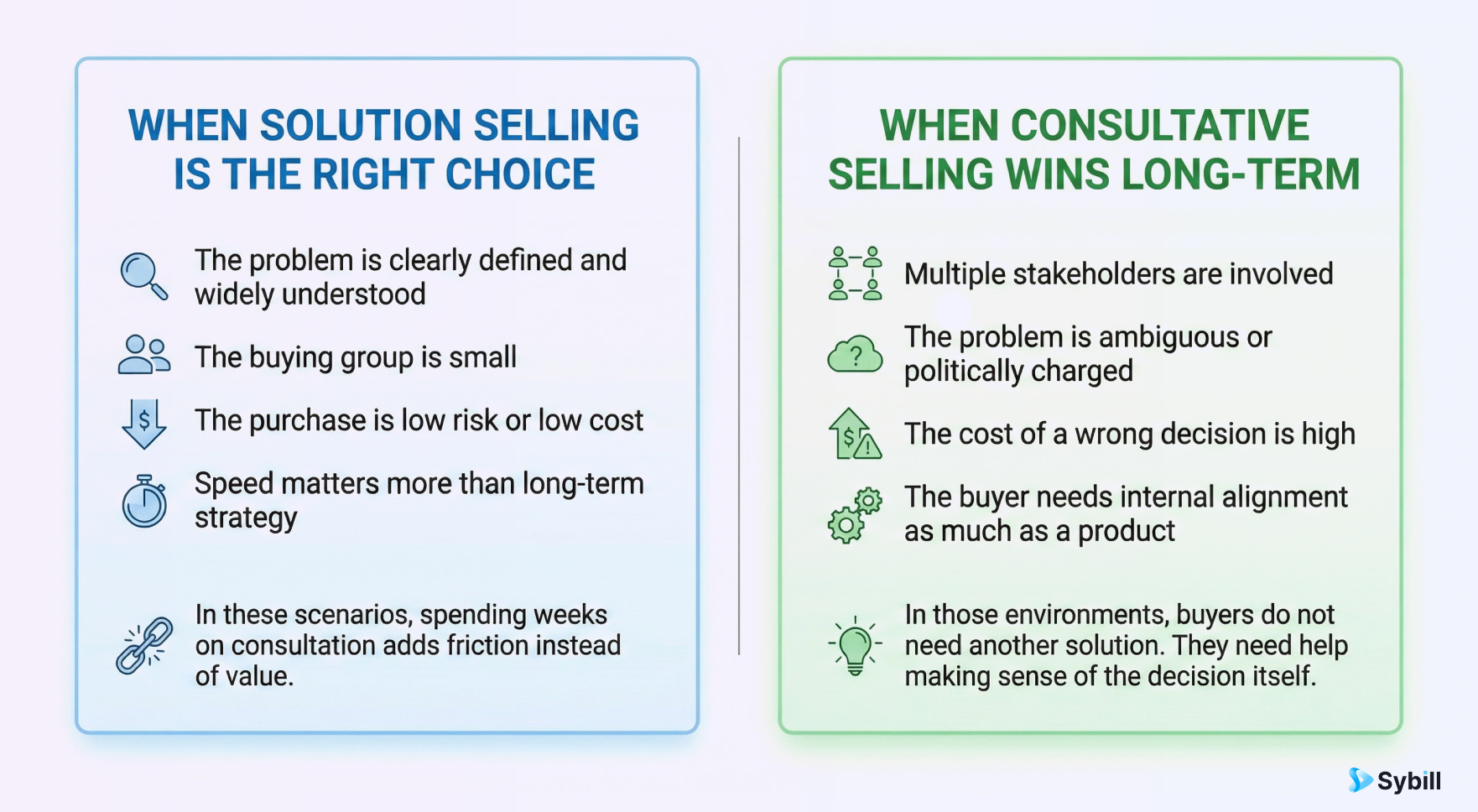
Solution selling works well when:
In these scenarios, spending weeks on consultation adds friction instead of value.
Consultative selling consistently outperforms when:
In those environments, buyers do not need another solution. They need help making sense of the decision itself.
Consultative selling is not a soft skill. It is a discipline. And the reps who do it well share a very specific set of behaviors that go far beyond “asking good questions.”
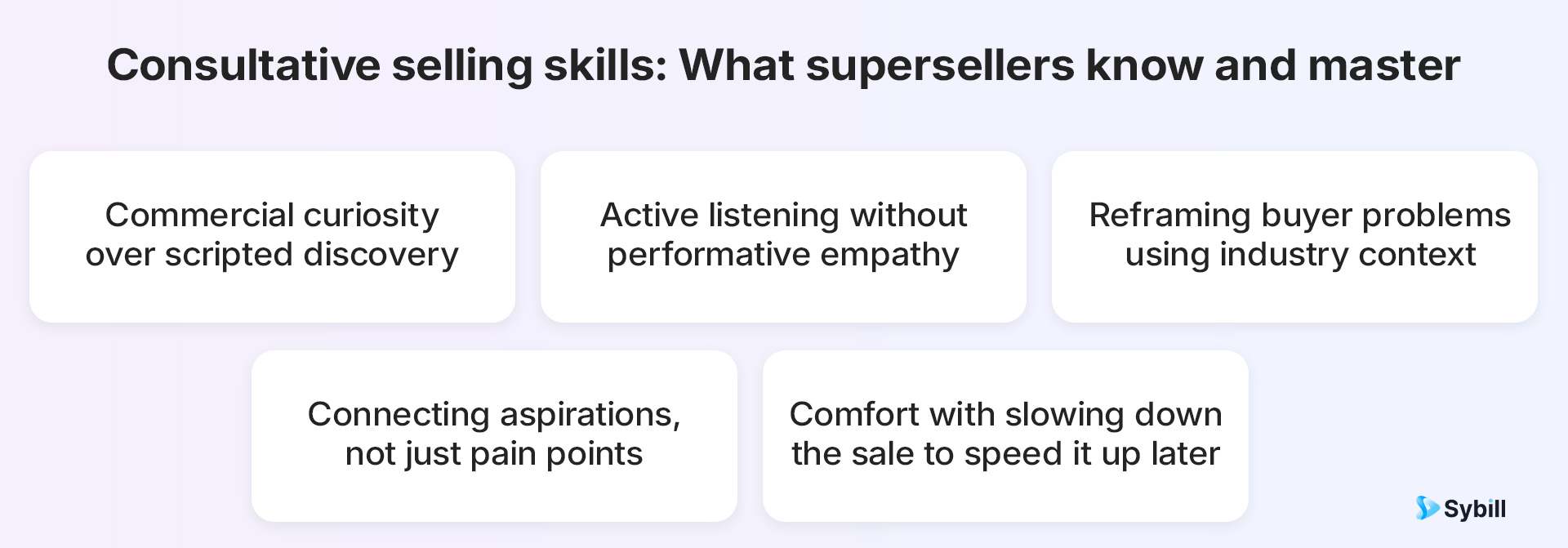
Below are the consultative selling skills that separate true advisors from polite pitchers.
Top consultative sellers are genuinely curious about how a business works, not just whether it fits their ICP. They dig into why something matters, how decisions get made, and what breaks if nothing changes. This curiosity cannot be faked with a discovery checklist.
Nodding, paraphrasing, and saying “that makes sense” is not listening. Strong consultative sellers listen for contradictions, uncertainty, and unspoken risk. They respond with insight, not sympathy, and prove they heard by advancing the buyer’s thinking.
Great reps do not just validate problems. They reframe them. They connect what the buyer is experiencing to patterns seen across similar companies, markets, or growth stages. This is where credibility is built and trust accelerates.
Pain opens the door. Aspirations close the deal. Consultative sellers understand what the buyer is trying to become, not just what they want to fix. They anchor recommendations to future outcomes, not present discomfort.
Top reps are willing to pause momentum when clarity is missing. They know that rushed alignment leads to stalled deals, internal pushback, or regret. Slowing down early often removes friction later in the cycle.
Quota pressure rewards speed, not depth. Many reps revert to pitching the moment urgency appears because it feels safer than thinking. Consultative selling demands patience, confidence, and the ability to sit with ambiguity, which most sales environments do not actively encourage.
Most consultative selling frameworks fail for one simple reason. They assume buyers move in neat, linear stages. Real deals do not. Stakeholders change. Priorities shift. New risks surface mid-cycle. Rigid frameworks collapse the moment reality shows up.
Modern consultative selling needs structure without rigidity. Direction without scripts.
Instead of memorizing stages, top reps anchor themselves to intent at each moment of the deal.
Great consultative selling starts before the meeting, not on the call. Pre-call preparation is where context is built, not notes.
This is where modern teams rely on tools that surface account history, past objections, stakeholder signals, and deal context automatically. A strong pre-meeting brief ensures the rep walks in informed without spending hours piecing things together manually. When preparation is automated, thinking improves.
Discovery is not about asking as many questions as possible. It is about helping the buyer make sense of scattered information.
Consultative sellers listen for patterns, contradictions, and uncertainty. They reflect insight back in real time, helping buyers clarify what actually matters. The best discovery conversations feel like progress, not extraction.
In consultative selling, recommendations are built with the buyer, not delivered to them.
The seller lays out options, tradeoffs, and implications, then collaborates with the buyer to shape a path forward. This shared ownership reduces resistance and increases internal buy-in long before procurement enters the conversation.
Follow-up is where most consultative efforts fall apart. Too many reps revert to generic recap emails and next-step nudges.
High-performing consultative sellers use follow-up to extend insight. They connect the dots from the conversation, clarify decisions made, surface risks discussed, and outline why the next step matters. Modern CRM and AI tools like Sybill make this possible without relying on memory or handwritten notes.
Because it no longer depends entirely on individual skill and discipline. Today, intelligent CRM systems, AI-generated summaries, and contextual follow-ups allow reps to stay consultative without burning out.
When tools handle recall, structure, and continuity, reps can focus on what actually moves deals forward: thinking, not transcribing.
Consultative selling becomes clear when you see what it looks like in practice. Not polished case studies. Real moments where the seller chooses clarity over control.
Below are three consultative selling examples designed for easy scanning and visual treatment. Each shows a different buying context and why the approach works.
Scenario
Consultative move
Outcome
Why it works psychologically
Scenario
Consultative move
Outcome
Why it works psychologically
Scenario
Consultative move
Outcome
Why it works psychologically
Enterprise sales research consistently shows that buyers trust and reward sellers who reduce risk, increase clarity, and challenge assumptions respectfully. These consultative selling examples work because they remove pressure and replace it with confidence.
Consultative selling is not about saying yes. It is about saying the right thing at the right moment, even when it costs you the deal today.
Consultative selling is often presented as the enlightened alternative to “old-school” sales. That framing is incomplete. This approach has real tradeoffs, and ignoring them leads to poor execution and frustrated teams.
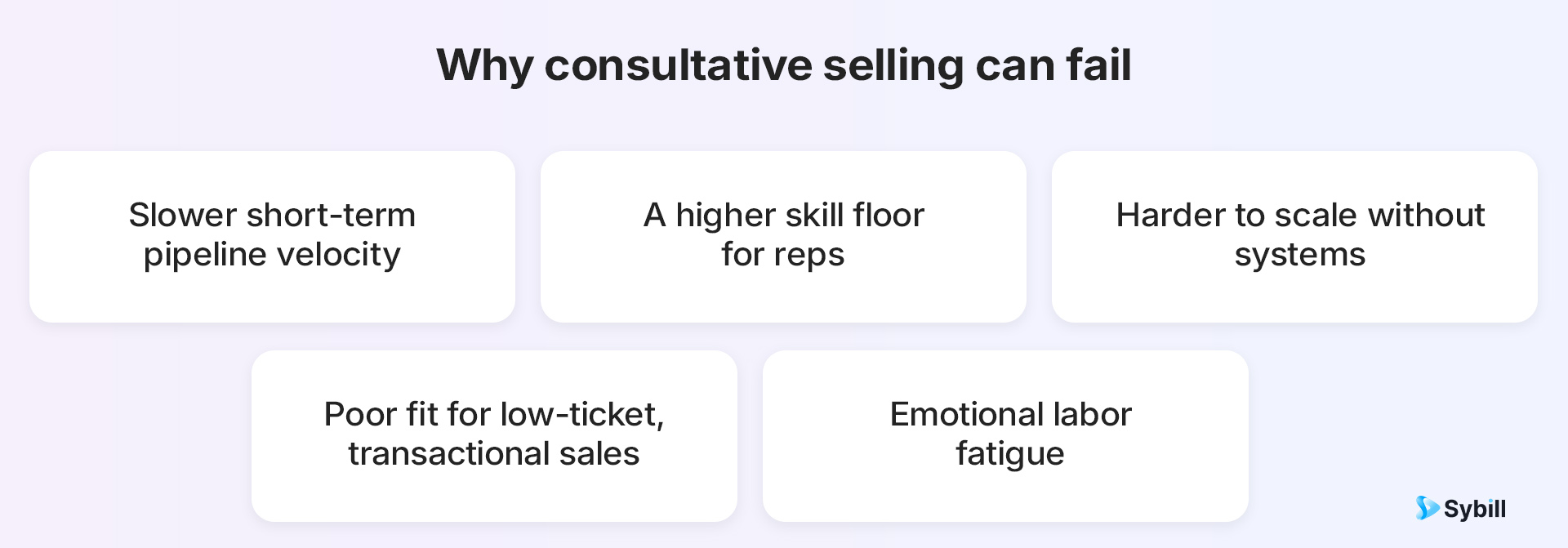
Here is the uncomfortable truth leaders need to hear.
Consultative selling takes time. Deals move more deliberately in the early stages because clarity is built before urgency is manufactured. Teams chasing fast quarter-end wins may see slower early pipeline movement.
Not every rep can sell consultatively on day one. This approach demands business acumen, confidence, and the ability to think on the fly. Without strong coaching, many reps default back to pitching under pressure.
Consultative selling does not scale on memory and good intentions. Without CRM structure, call intelligence, and follow-up automation, reps burn out trying to remember context across deals.
When buying decisions are simple and low risk, consultative selling adds friction. In these environments, speed beats depth, and over-consulting hurts conversion.
Constant deep listening, stakeholder management, and decision support takes energy. Reps practicing consultative selling without support often experience faster burnout.
Consultative selling sounds great in theory. In practice, it collapses the moment reps are forced to rely on memory, handwritten notes, and post-call guesswork.
Consultative selling does not fail because reps lack empathy. It fails because humans are terrible storage systems.
A consultative approach requires reps to remember context across long sales cycles, multiple stakeholders, and dozens of conversations. Without systems, this becomes cognitively expensive and error-prone.
When reps forget what was said, who said it, or why it mattered, the conversation resets. Trust erodes. Momentum stalls.
Modern sales automation tools exist to protect consultative selling from breakdown.
Together, these systems ensure consultative selling is consistent, not personality-dependent.
Admin work is the silent killer of consultative selling. Manual note-taking, CRM updates, and follow-up drafting drain energy that should be spent interpreting buyer signals.
Automation handles recall, summaries, and task capture so reps can focus on:
Thinking scales when memory does not have to.
AI-powered tools now capture consultative signals automatically:
These insights allow reps to stay consultative without being overwhelmed.
Consultative selling does not scale through better note-takers or stronger memories.
It scales through intelligence, structure, and automation.
When systems handle context, reps can do what consultative selling actually requires: think clearly and advise confidently.
For years, consultative selling depended on exceptional memory, intuition, and discipline. That made it powerful but fragile. AI changes the equation by turning consultative selling from an individual skill into a repeatable system.
Buyers rarely state their real concerns cleanly or once. They hint, circle back, contradict themselves, and test reactions across multiple conversations.
AI-powered systems analyze language patterns across calls, emails, and meetings to surface:
This allows consultative selling to operate on real world signals.
Great consultative sellers are defined by the second question, not the first.
AI highlights what changed, what stalled, and what matters next so reps can follow up with precision instead of vague check-ins. The result is conversations that feel thoughtful, not reactive.
This is where consultative selling moves from curiosity to confidence.
Manual note-taking forces reps to choose between listening and documenting. AI removes that tradeoff.
Automatic call summaries, objection tracking, and next-step suggestions ensure nothing critical gets lost. Reps stay present in the conversation while AI handles recall and structure.
Consultative selling becomes sustainable instead of exhausting.
Traditional consultative selling relies heavily on intuition. AI adds evidence.
Instead of relying on instinct, reps can see:
This shift turns consultative selling into a data-backed discipline.
Teams using AI-powered sales workflows with Sybill, for example, consistently report:
Less busywork. Better conversations. Stronger outcomes.
Sybill is built for consultative selling in the real world.
It captures buyer signals automatically from calls and meetings, generates accurate summaries, highlights objections and intent, and prepares reps with pre-meeting briefs so they walk in informed. Post-call, it helps reps follow up with context-rich emails instead of generic recaps.
The result is consultative selling that scales without relying on memory or manual effort.
Small sales teams do not fail at consultative selling because they lack intent. They fail because they buy tools designed for large teams with complex ops layers.
When choosing a consultative selling tool, simplicity is a competitive advantage.
If a tool requires a RevOps playbook to operate, it is already too heavy.
More features do not mean more value. They mean more decisions, more dashboards, and more places for context to hide.
Small teams need tools that work quietly in the background. When reps have to actively manage the tool, consultative selling suffers because attention shifts from buyers to software.
Must-have
Nice-to-have
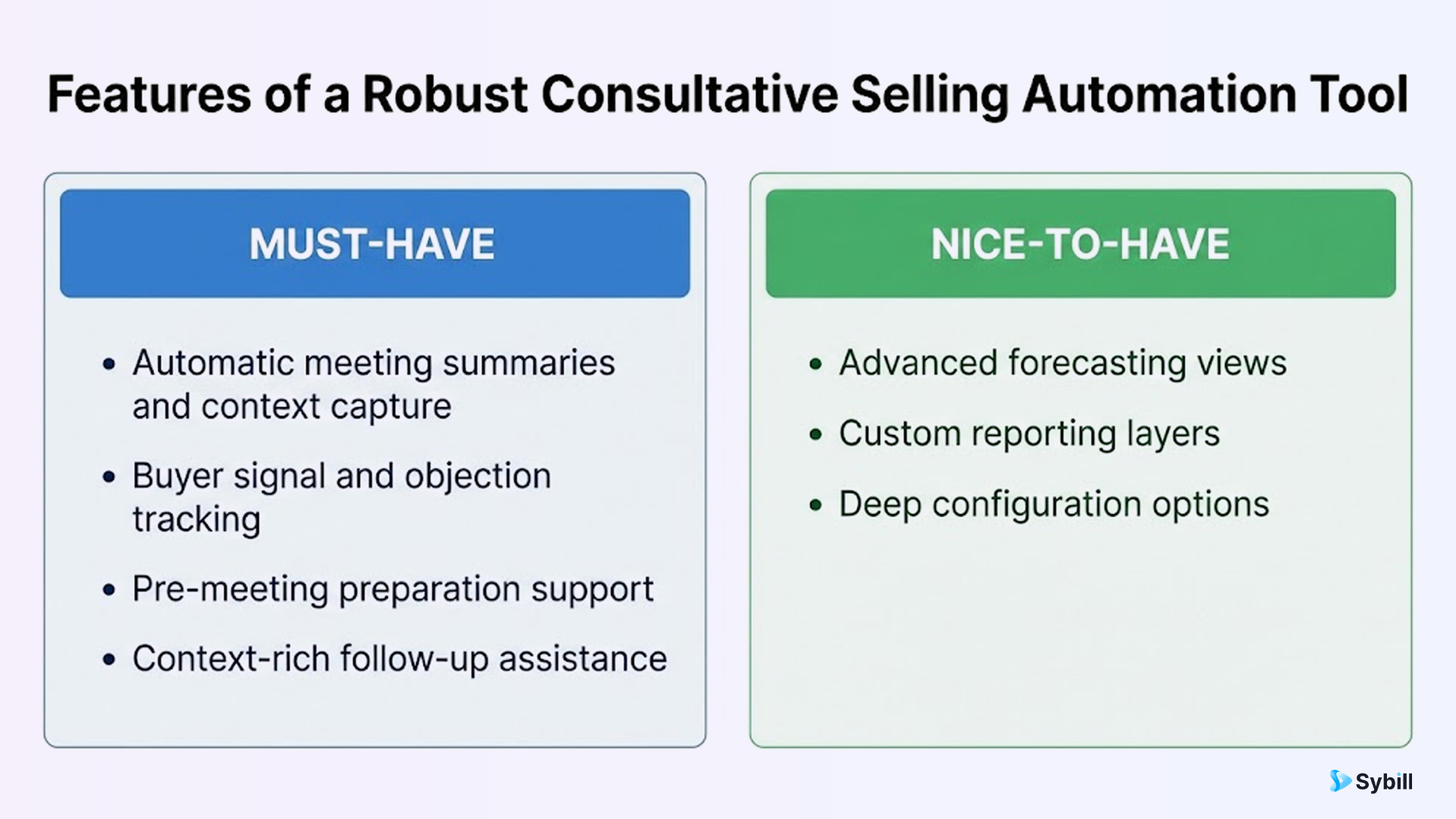
Start with thinking support. Add complexity later if needed.
If the tool demands attention, it is working against consultative selling,
Consultative selling tools should amplify thinking, not create more dashboards. The best tools make reps smarter without making them busier.
Consultative selling is not a script you memorize or a tone you adopt. It is a mindset. One that prioritizes clarity over charm and usefulness over performance. Buyers do not need another charismatic pitch. They need help making sense of risk, tradeoffs, and consequences.
In a world shaped by comparison videos, review threads, and instant expert opinions, smooth talkers fade fast. The reps who win are the ones who can interpret complexity, challenge assumptions, and say the uncomfortable but helpful thing at the right moment. Think less reality TV sales drama, more trusted advisor energy.
The future of consultative selling belongs to teams that pair human judgment with intelligent systems. Modern sales teams are using Sybill to capture buyer signals automatically, surface real objections, prepare smarter, and follow up with insight instead of guesswork.
To implement consultative selling using a CRM, treat the CRM as a memory system, not a reporting obligation. Use it to capture buyer context, stakeholder history, objections, and decision drivers across calls and emails. Conversation insights, timelines, and deal notes should help reps understand why a deal is moving or stalling. Pre-call intelligence ensures reps enter conversations informed. Post-call intelligence ensures insights compound instead of disappearing. When CRM supports thinking, consultative selling becomes consistent.
Several providers offer consultative selling training programs, including RAIN Group, Richardson, Sandler, and Challenger-based consultative hybrids. Most programs teach questioning, listening, and deal strategy. The gap is reinforcement. Skills training alone fades quickly under quota pressure. Real behavior change happens only when training is reinforced by tools that guide reps during live deals. Without systems to support consultative behavior, training becomes theory instead of habit.
Sales professionals often recommend books like The Challenger Sale for reframing conversations, SPIN Selling for structured questioning, and Let’s Get Real or Let’s Not Play for trust-based selling. Each offers strong conceptual grounding. Where books fall short is execution at scale. They explain what good looks like but cannot support reps in real-time. Without practical reinforcement, even the best ideas stay on the bookshelf instead of showing up on calls.