Find us at booth #83, join us for a harbor side happy hour, or catch Gorish’s talk.

Sept, 16-18 > Learn more

%20(1).avif)
Mamta Tainwala

March 3, 2026
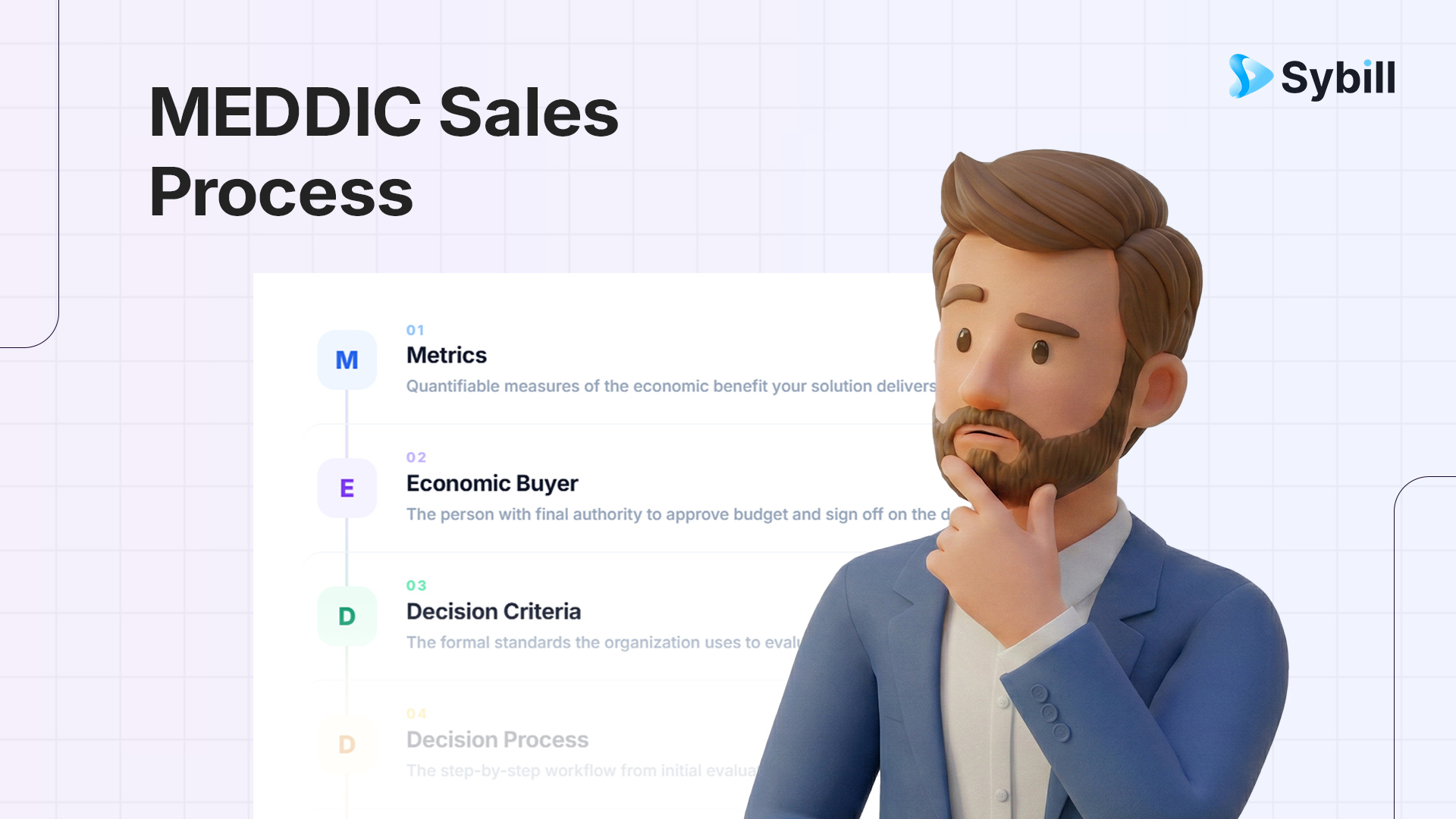
MEDDIC is a B2B sales qualification framework that stands for Metrics, Economic Buyer, Decision Criteria, Decision Process, Identify Pain, and Champion. Created at PTC in the 1990s, it helped the company grow from $300 million to $1 billion in four years. Today, it's the go-to methodology for enterprise sales teams navigating complex, multi-stakeholder deals. This guide covers what MEDDIC means, how each component works, the right discovery questions to ask, when to use it versus its variants (MEDDICC, MEDDPICC), common mistakes teams make, and how AI tools like Sybill help you execute it consistently without adding admin work.
In this guide, we'll cover:
You know that feeling when a deal you were convinced would close just... doesn't? The champion goes quiet. The timeline slips. Suddenly the economic buyer you've never actually spoken to has "concerns." You realize you were playing checkers while the deal was playing chess.
MEDDIC exists to stop that from happening.
MEDDIC is a sales qualification framework designed for complex B2B deals. It gives sales reps and revenue teams a structured checklist for understanding exactly where a deal stands, who controls it, and whether it will actually close. Not based on gut feel. Based on evidence gathered from the buyer's own organization.
The core idea is simple: the more you know about how your buyer thinks, decides, and defines success, the less likely you are to be surprised when you're three months into a deal and suddenly nothing is moving.
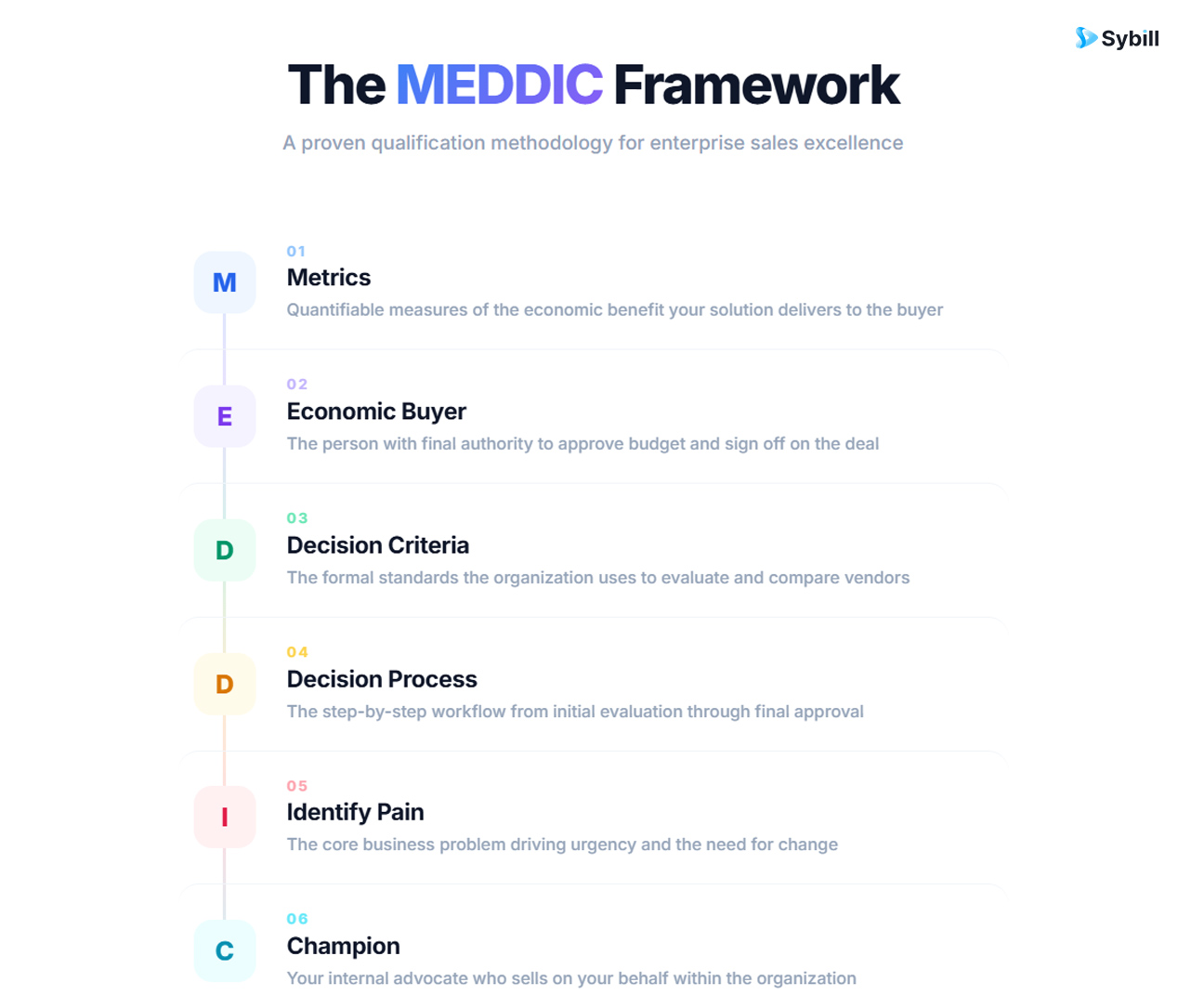
MEDDIC is an acronym. Each letter represents a category of information a sales rep must understand and validate before a deal can be accurately qualified:
These six elements form the MEDDIC sales process. Together, they tell you whether the deal is real, whether you're talking to the right people, whether you can win, and what it will actually take to get a signature.
MEDDIC was developed in 1996 by Jack Napoli and Dick Dunkel at Parametric Technology Corporation (PTC), a software company operating in the highly complex enterprise technology space. PTC's sales cycles were long, expensive, and involved multiple stakeholders across large organizations. Reps needed a way to qualify deals systematically, not just optimistically.
The framework delivered. PTC grew its annual revenue from $300 million to over $1 billion in four years using MEDDIC as its core sales qualification methodology. Word spread fast. By the early 2000s, MEDDIC had become the standard approach for enterprise software sales across Silicon Valley and beyond.
It is worth noting that the acronym itself has a somewhat ironic origin. Jack Napoli has been quoted saying the acronym "sucks" as a mnemonic device. And yet, here we are, nearly 30 years later, with the methodology still intact and still outperforming just about everything else in complex B2B sales. Sometimes clunky acronyms carry great ideas.
Metrics are the quantifiable outcomes your prospect is trying to achieve. Not vague goals like "improve efficiency," but actual numbers: reduce onboarding time by 3 weeks, cut support ticket volume by 40%, increase pipeline velocity by 20%.
Without metrics, you're selling into a fog. With them, you can tie your solution directly to the business case the economic buyer will use to justify the purchase internally. Metrics also create urgency, because when a prospect can see the dollar cost of inaction, they feel it.
Discovery questions to ask:
The Economic Buyer is the person with actual budget authority. Not the champion, not the committee, not the manager you have a great relationship with. The one who can say yes and write the check.
This is one of the most commonly missed elements in complex deals. Reps spend months building relationships with stakeholders who can influence but not decide. They assume warmth in the room equals authority to buy. It usually doesn't. Understanding who controls the funds, and getting access to that person, is non-negotiable.
Discovery questions to ask:
Visual cue: [IMAGE: Illustration of a multi-stakeholder buying committee with arrows showing influence vs. decision authority | Alt text: "Diagram showing the difference between influencers and the economic buyer in a B2B buying committee"]
Decision Criteria are the specific factors your prospect will use to evaluate and choose between solutions. Features? Price? Integration requirements? Security certifications? Vendor reputation? Support SLAs?
Every buying team has a rubric, even if they haven't written it down yet. Your job is to surface it, understand it, and ideally help shape it in your favor during early conversations. If you discover the criteria late in the deal, you're reacting to a game you weren't part of designing.
Discovery questions to ask:
Decision Process maps the internal workflow your prospect has to complete before they can buy. Who needs to sign off? What happens after the demo? Does legal review every contract? Does IT need to complete a security review? Does procurement have a 6-week vendor onboarding queue?
The Decision Process is what causes "sure, let's move forward" to turn into three months of silence. If you don't know it, you can't manage it. If you know it, you can help your champion navigate it and keep momentum.
For a deeper dive on this component, check out Sybill's guide to understanding the Decision Process in MEDDPICC.
Discovery questions to ask:
Pain is the engine of every deal. Without genuine, acknowledged pain, there is no urgency to buy, no business case to justify, and no champion motivated to fight for the project internally. Identifying pain means understanding not just what problem exists, but how severe it is, how widely it is felt, and what it costs the organization to leave it unsolved.
Surface-level pain ("our reporting is slow") is not enough. You need to find the organizational consequence ("which is why we missed the board's forecast two quarters in a row, and the CEO has made this a top priority"). That version of the pain creates a compelling event. The first version gets you added to a list of vendors under evaluation.
For a structured approach to surfacing this in discovery, the best discovery questions for sales guide has a full MEDDIC-aligned question set.
Discovery questions to ask:
Your Champion is your internal advocate: someone inside the prospect's organization who genuinely wants your solution to win, has credibility with the decision-makers, and is willing to go to bat for you in meetings you are not invited to.
This is different from a supporter. Supporters like you. Champions fight for you. A good champion will share internal objections with you before they surface publicly, help you access the Economic Buyer, and position your solution in ways that resonate with their leadership team.
If you don't have a champion, you don't have a deal. You have an evaluation.
Discovery questions to ask:
MEDDIC has evolved over time as enterprise buying processes have grown more complex. Here's the short version:
MEDDIC is the original six-element framework. Best for teams new to structured qualification and deals with relatively straightforward procurement.
MEDDICC adds a seventh element: Competition. Useful in crowded markets where you need to actively understand and counter what alternatives your buyer is evaluating.
MEDDPICC adds both Competition and Paper Process, which covers the legal, procurement, and administrative workflow required to finalize a deal. Critical for enterprise sales where contracts can get stuck in procurement limbo for months.
For most teams selling into enterprise accounts with complex buying committees, MEDDPICC is the more complete framework. But for teams just getting started with structured qualification, MEDDIC is the right place to begin. The Sybill blog on MEDDPICC vs. MEDDIC goes deeper on exactly when to level up.
MEDDIC is not for every deal. It's a framework built for complexity. Here's where it earns its keep:
And where MEDDIC may not be the right fit: transactional sales, short cycles, or teams who are new to sales and need something simpler to get started with. In those cases, BANT vs. MEDDIC is worth reading before you commit to either.
Even teams that know the framework well often stumble in execution. Here are the patterns that kill MEDDIC deals:
Treating it as a checklist, not a conversation. MEDDIC is not a form to fill out before a deal moves stages. It's a living picture of deal health, gathered through genuine discovery conversations. Reps who box-check it will get technically complete fields and no real intelligence.
Skipping the Economic Buyer. This is the most common and most costly mistake. If your champion cannot get you access to the economic buyer, that is a signal, not an obstacle. It means either the deal lacks executive priority, or your champion is not as influential as they appear to be.
Accepting vague metrics. "Increase efficiency" and "save time" are not metrics. Push until you get a number. If the prospect cannot quantify the value, you cannot build a business case, and you will lose to the status quo.
Letting the Champion go cold. Your Champion needs to be actively engaged throughout the deal. If weeks pass without contact, the deal is drifting. Regular touchpoints, even informal ones, keep your advocate primed and informed.
Not capturing it in the CRM. MEDDIC qualification information is only useful if it lives somewhere accessible to the whole team. If it only exists in a rep's head, it disappears the moment the rep goes on vacation or leaves the company.
Running MEDDIC well requires two things: asking the right questions during discovery, and actually capturing the answers somewhere actionable. Most teams nail the first part. They fall apart on the second.
Sybill closes that gap automatically. It joins your calls, listens for MEDDIC signals across every conversation (pain language, economic buyer mentions, decision process clues, metrics discussions), and maps what it hears to your CRM fields without manual data entry from your reps. After every call, qualification criteria are updated, deal summaries are written, and follow-up emails are drafted with the context to match.
The result is a pipeline where every opportunity has an honest qualification picture, not the one your rep wished were true.
Get started for free with Sybill and start running MEDDIC the way it was actually meant to be used.
Getting your team to actually use MEDDIC, consistently, across every deal, is a different challenge than understanding the framework. Here's what works:
Start with deal reviews, not training decks. The fastest way to build MEDDIC habits is to run your next pipeline review using MEDDIC as the lens. Ask: "Who is the economic buyer on this deal?" "What's the quantified pain?" "What does the decision process look like?" Reps learn the framework by living it, not by sitting through a slide presentation.
Build it into your ICP guide. MEDDIC qualification and your Ideal Customer Profile should be connected. The better your ICP definition, the easier it is to predict which MEDDIC elements are most relevant for a given deal type.
Use call intelligence to reinforce it. When reps hear their own calls analyzed against MEDDIC dimensions, adoption accelerates. Sybill's sales call transcripts and discovery scoring show exactly where discovery gaps exist, making coaching conversations specific instead of general.
Connect it to sales forecasting. Deals with fully qualified MEDDIC fields should carry higher forecast confidence than those with gaps. When managers use MEDDIC scores to weight their pipeline, reps learn quickly that qualification completeness has a direct impact on how their deals are counted.
Automate the admin with AI. The AE AI agent in Sybill can auto-fill MEDDIC fields from call recordings and email threads, generate deal summaries, and flag gaps in real time. Reps stop dreading the post-call update. Managers stop chasing CRM hygiene. And the MEDDIC data is actually there when you need it.
Once you've gathered solid MEDDIC intelligence, the next job is using it to align your buyer around a shared path to close. That's where mutual action plans (MAPs) come in. A MAP formalizes the Decision Process, assigns owners on both sides, and makes the Champion's job of selling internally much easier.
Think of MEDDIC as the intelligence layer and MAPs as the execution layer. Together, they give enterprise deals the structure they need to survive long buying cycles, multiple stakeholders, and the inevitable slowdowns that come with complex procurement.
MEDDIC stands for Metrics, Economic Buyer, Decision Criteria, Decision Process, Identify Pain, and Champion. It is a B2B sales qualification framework used to evaluate and manage complex deals with multiple stakeholders and long sales cycles.
MEDDIC is a structured approach to qualifying sales opportunities. It guides reps to gather specific information about a prospect's business needs, decision-making authority, internal processes, and key pain points before investing significant time and resources into a deal. It is most commonly used in enterprise B2B sales environments.
The MEDDIC sales methodology is a deal qualification system where every letter of the acronym represents a category of information a rep must understand: how the buyer measures success (Metrics), who controls budget (Economic Buyer), what they're evaluating (Decision Criteria), how they will decide (Decision Process), what pain is driving the purchase (Identify Pain), and who is advocating internally for your solution (Champion).
The MEDDIC sales process is the application of the MEDDIC framework across the full sales cycle. Rather than a fixed sequence of steps, it functions as a continuous checklist that reps revisit and update as they learn more about the deal. Each element should be validated before a deal advances to a late stage in the pipeline.
MEDDIC has six components. MEDDPICC has eight, adding Paper Process (navigating procurement and legal requirements) and Competition (understanding and countering alternatives the buyer is evaluating). MEDDPICC is better suited for mature enterprise sales environments where administrative and competitive complexity regularly stalls deals. See the full comparison in the MEDDPICC vs. MEDDIC guide.
MEDDIC improves forecast accuracy because it replaces rep optimism with verified evidence. When a deal has a confirmed Economic Buyer, a quantified pain, a mapped Decision Process, and an active Champion, it is far more likely to close than one where those elements are assumed. Teams using MEDDIC typically see forecast accuracy improve from the 60-70% range to above 85% because unqualified deals are identified and removed earlier. Pairing MEDDIC with AI-driven forecasting takes it further by surfacing gaps automatically.
Yes, significantly. AI tools like Sybill can analyze call recordings and email threads to extract MEDDIC-relevant signals, auto-update CRM fields, flag missing qualification criteria, and generate discovery scorecards after every conversation. Instead of relying on reps to manually populate qualification fields, AI captures the intelligence in the background and surfaces it in a usable form. The sales manager AI agent in Sybill runs MEDDIC analysis across your entire pipeline, not just individual deals.
MEDDIC is most commonly applied in enterprise B2B environments because that's where its complexity pays off. For shorter, transactional sales cycles, the overhead of gathering all six elements may not be worth it. That said, even in mid-market sales, applying the core principles around economic buyer access and quantified pain will improve close rates. For a comparison with simpler frameworks, check out BANT vs. MEDDIC.
MEDDIC has been around for nearly 30 years because it works. It works because it forces sales reps to replace assumptions with facts, and vague pipeline confidence with actual deal intelligence.
But a framework sitting in a wiki page or a training deck is not a sales methodology. It's a document. The teams that win with MEDDIC are the ones who make it a living part of every discovery call, every deal review, and every forecast conversation.
Sybill makes that happen without burying your reps in admin. It captures MEDDIC signals automatically from every call and email, updates your CRM in real time, leverages AI in your sales process to flag qualification gaps before they become forecast surprises, and helps your team run tighter deals, quarter after quarter.
Get started for free with Sybill and make MEDDIC the way your team actually sells, not just something they know about.
MEDDIC stands for Metrics, Economic Buyer, Decision Criteria, Decision Process, Identify Pain, and Champion. It is a B2B sales qualification framework used to evaluate and manage complex deals with multiple stakeholders and long sales cycles.
MEDDIC is a structured approach to qualifying sales opportunities. It guides reps to gather specific information about a prospect's business needs, decision-making authority, internal processes, and key pain points before investing significant time and resources into a deal. It is most commonly used in enterprise B2B sales environments.
The MEDDIC sales methodology is a deal qualification system where every letter of the acronym represents a category of information a rep must understand: how the buyer measures success (Metrics), who controls budget (Economic Buyer), what they're evaluating (Decision Criteria), how they will decide (Decision Process), what pain is driving the purchase (Identify Pain), and who is advocating internally for your solution (Champion).