Find us at booth #83, join us for a harbor side happy hour, or catch Gorish’s talk.

Sept, 16-18 > Learn more


Tamanna Mishra

January 21, 2026
TL;DR
Your CRM says the buyer is a CFO.
LinkedIn says 15 years of experience.
The account fits your ICP perfectly.
And yet, the deal is stuck. No clear objection. No hard no. Just radio silence and a pipeline forecast quietly losing credibility.
This is the modern sales paradox. Teams have more data than ever, yet less clarity on buyer behavior than they would like to admit. We track titles, industries, company size, and tech stacks with surgical precision. But when it comes to understanding why a buyer hesitates, stalls, or suddenly ghosts, most teams are guessing.
You know what it’s like. Spotify knows your age and location but has no idea what you actually want to listen to. The inputs exist. The insight does not.
Most sales teams confuse information with understanding. Demographics explain who the buyer is. They do not explain how that buyer thinks, decides, or manages risk. Two CFOs with identical profiles can behave in completely opposite ways once real pressure enters the deal.
This is where psychographics in sales matter. B2B psychographics uncover motivation, risk tolerance, internal pressure, and decision style. They explain why intent signals look strong but decisions slow down. They bridge the gap between surface-level data and real buying decisions.
In this blog, we break down what psychographics actually mean, how they show up in B2B sales, real psychographics examples, and practical frameworks you can use to spot them before deals stall.
Psychographics explain why buyers make decisions, not just who they are. If demographics tell you the job title and firmographics tell you the company context, psychographics tells you what actually drives action or hesitation.
In plain terms, what is psychographics? It is the mix of attitudes, motivations, fears, priorities, and beliefs that shape how someone evaluates risk and makes choices. These are not abstract traits. They are practical forces that show up in real sales conversations.
Demographics and firmographics are static. They describe the buyer on paper.
Psychographics are dynamic. They explain how that buyer behaves under pressure.
Two CFOs can share the same title, tenure, and company size and still behave in completely different ways once a decision threatens their credibility, workload, or political standing. That difference lives in psychographic traits, not in your CRM fields.
Most B2B buying decisions are made under constraints. Buyers weigh:
Deals rarely stall because value is unclear. They stall because the perceived personal risk feels higher than the professional upside. This is why psychographics examples are often more predictive than personas.
Psychographics are not personality tests. You do not need labels, quizzes, or abstract archetypes.
Psychographics are observable.
They show up in behavior, language, and decisions. In what buyers ask. In what they avoid. In how they justify delay or push for speed.
Psychographics in B2B sales sit at the intersection of emotion and accountability. Buyers are emotional, but they are also accountable to peers, leaders, and outcomes that affect their careers.
In B2B, decisions are filtered through:
This is where B2B psychographics become essential. Longer buying cycles amplify doubt. More stakeholders introduce conflicting motivations. Rational justifications often mask emotional drivers like fear of blame or desire for control.
The strongest sales conversations decode motivation before pitching value. They adapt framing based on how buyers want to evaluate, justify, and defend decisions internally.
In complex deals, winning is less about what you sell and more about aligning with how the buyer needs to buy.
Psychographics becomes tangible when you recognize how psychology shows up mid-deal. Below are common psychographics examples that shape outcomes in B2B sales.
These examples of psychographics in sales show up everywhere. In calls, as repeated clarifications or hesitation. In emails, as urgency or silence. In objections, as logic layered over emotion.
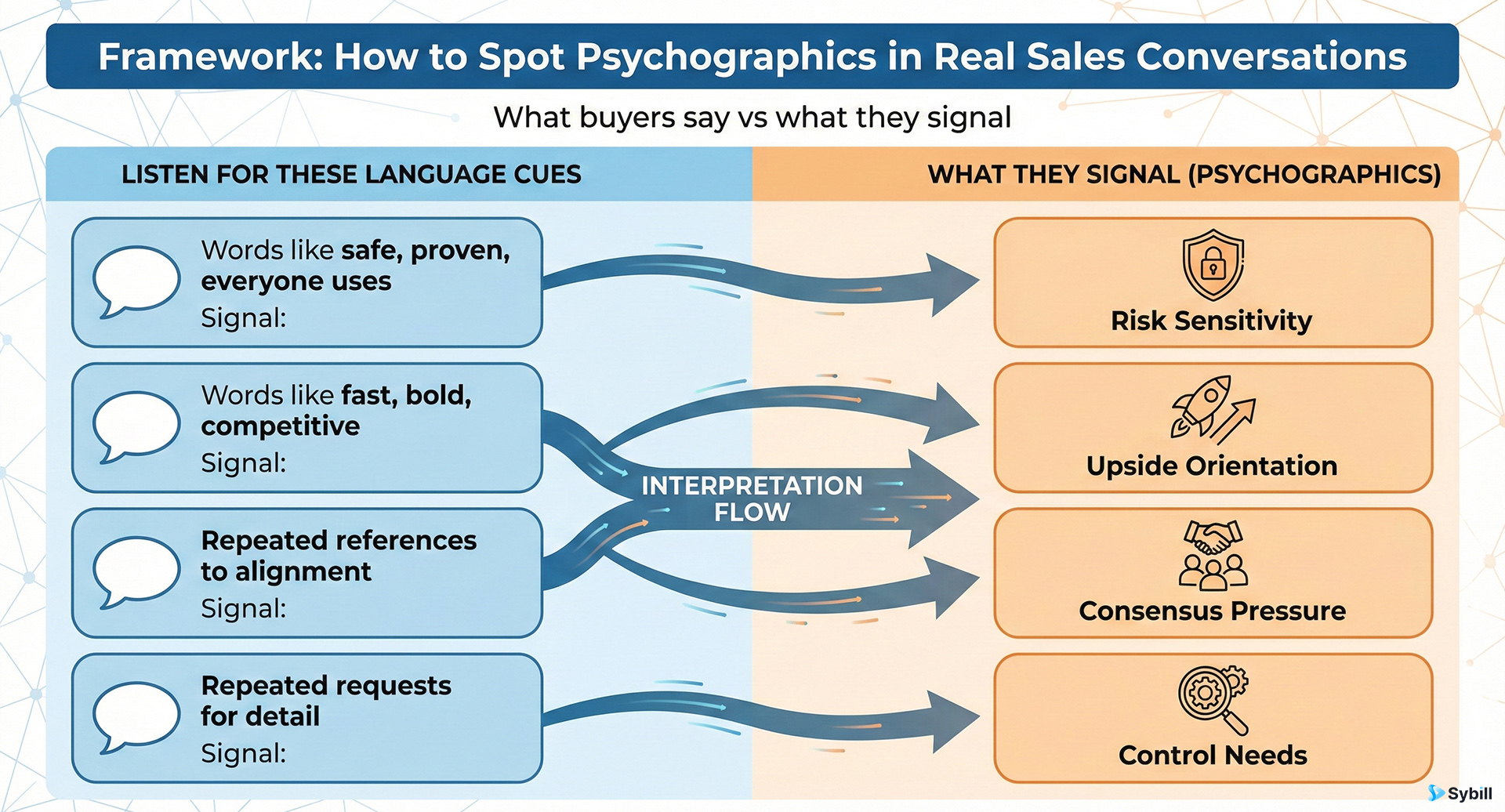
The better you listen, the earlier psychographics becomes visible. And once you see it, deal behavior stops being mysterious.
Buyer personas look great in decks. Clean. Confident. Comforting. They also age terribly.
Personas are built on averages. They assume stability. Same role, same priorities, same behavior. Real buyers do not work that way. Job titles stay constant. Motivation does not. The moment pressure enters a deal, personas stop being useful.
This is why psychographics in sales consistently outperforms persona-led selling.
Personas freeze buyers in time. They describe who someone was when the model was created, not who they are during a live deal. In B2B, context changes fast. New leadership. Budget scrutiny. Internal politics. One bad quarter.
Under pressure, buyers revert to their psychographic defaults. Risk tolerance tightens. Decision speed changes. Control needs increase. None of this shows up in a persona document.
Psychographics explains why some deals move quickly and others quietly die. A risk-averse buyer will slow down even when value is clear. A control-oriented buyer will stall without visibility. A consensus builder will delay until internal alignment feels safe.
These patterns directly impact deal velocity. They also explain late-stage losses that look irrational on paper but make perfect sense psychologically.
Most objections are framed as rational concerns. Budget. Timing. Features. Underneath, they are expressions of fear, uncertainty, or misalignment.
B2B psychographics connects objections to motivation. When you understand what a buyer is optimizing for, objections stop being blockers and start being signals.
The actionable shift is simple but powerful. Stop asking, “Who is this buyer?” Start asking, “What does this buyer optimize for right now?”
That question unlocks better discovery, sharper positioning, and fewer surprises late in the deal.
Psychographics is not a theory you apply once. It shows up differently at every stage of the sales cycle. The strongest teams adjust their approach as buyer motivation shifts under pressure. Below is how psychographics in sales reveals itself from first conversation to final decision.
Discovery is where psychographics first leaks out.
What to listen for
How to frame questions
Buyers rarely say what they are afraid of directly. They show it through what they avoid and what they keep circling back to.
During evaluation, psychographics becomes louder.
Common patterns
These examples of psychographics in sales explain why some buyers want exhaustive proof while others want a fast path to yes. The product did not change. The decision lens did.
Negotiation is where misalignment often kills deals.
Psychographic tension points
Some buyers negotiate to reduce exposure. Others negotiate to increase confidence. When sellers default to price concessions instead of reframing risk or value, they miss the real concern.
The final decision rarely happens on the call.
What matters here
Psychographic traits determine whether a buyer can sell the decision internally. If that story is weak, deals stall or collapse late. When psychographics is understood, decisions move with far less friction.
Psychographics is powerful. Misused, it creates false confidence. Most failures come from treating it as a shortcut instead of a discipline. Common missteps include:
These mistakes flatten nuance. They turn insight into assumptions and lead teams to push when they should adapt.
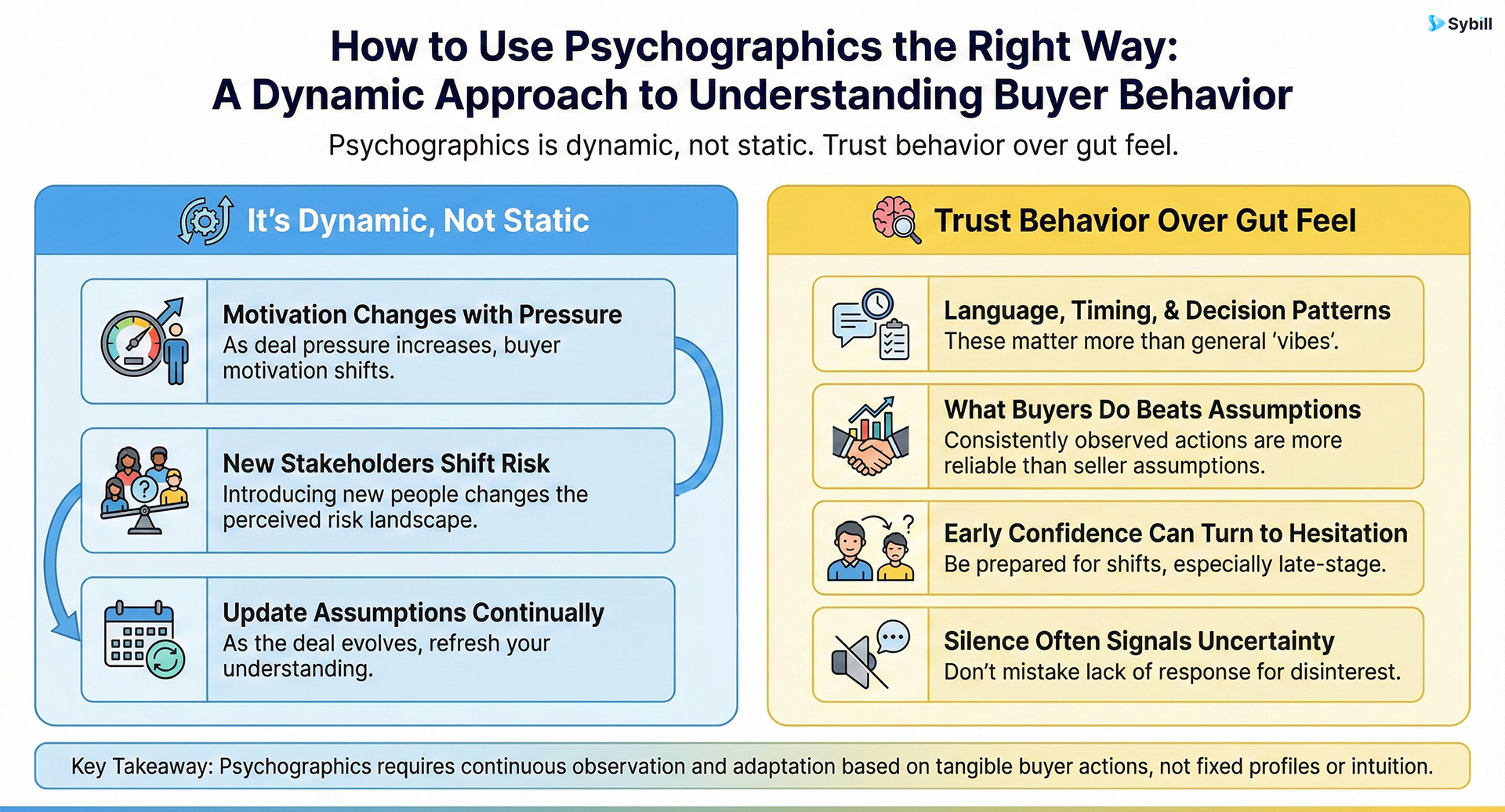
Used correctly, psychographics sharpens judgment about your buyers’ needs and intent.
Psychographics only creates leverage when it changes how teams operate day to day. You do not need a new process. You need sharper attention to how buyers think and decide.
Audit your discovery questions
Most discovery focuses on requirements. Add questions that surface motivation. Why now? What happens if nothing changes? What success needs to look like internally?
Review recent lost deals
Look for psychographic mismatch, not just feature gaps. Where did urgency drop? Where did risk sensitivity increase? These patterns show up clearly in hindsight.
Train reps to listen differently
Encourage reps to listen for motivation, hesitation, and confidence, not just use cases. This is where psychographics in sales becomes actionable.
Motivation
What outcome does the buyer personally care about?
Risk posture
Are they minimizing downside or chasing upside?
Decision style
Do they move through consensus or authority?
Internal pressure
Who else needs to feel safe with this decision?
This framework works across industries and is especially powerful in B2B psychographics, where accountability shapes behavior.
What looked like a pricing issue was actually a risk issue
A mid-market buyer engaged deeply, asked detailed questions, and pushed hard on pricing late in the cycle. On paper, it looked like budget resistance.
Call review showed repeated language around “getting this wrong” and “needing leadership coverage.” Once the conversation shifted to risk mitigation and internal validation, pricing stopped being the blocker.
Deals are rarely lost because the product was wrong. They are lost because something invisible went unaddressed. Fear. Misaligned urgency. Internal risk that never made it into the forecast.
This is the core truth of psychographics in sales. Deals are lost in the mind long before they are lost in the pipeline. Psychographics turns that invisible friction into visible signals. When teams understand why buyers hesitate, they stop reacting late and start guiding decisions earlier.
Sales conversations now happen across dozens of calls, emails, and stakeholders. No rep can reliably track shifting motivation across that volume. Notes are incomplete. Memory is selective. Patterns only become obvious after deals slip or die.
Modern sales teams use AI to surface real buyer intent instead of relying on assumptions. AI connects language, behavior, and timing across conversations to reveal what buyers are optimizing for in real time.
This is where Sybill fits naturally.
Sybill helps teams understand buyer psychology by listening to real conversations and translating them into usable insight.
How Sybill supports psychographic selling
The result is sharper judgment.
If you want to see how psychographics actually shows up when sales teams listen closely, this is where it starts. Click here to try Sybill free.
Audience segmentation helps sales teams understand who they are selling to and how to approach them. There are four primary types.Demographic segmentation focuses on individual attributes like role, seniority, and experience.Firmographic segmentation looks at company-level data such as industry, size, revenue, and geography.Behavioral segmentation tracks observable actions like product usage, engagement, and buying history.Psychographic segmentation captures attitudes, motivations, fears, and decision drivers.Psychographics complements the other three by explaining why buyers behave the way they do. Demographics tell you who the buyer is. Behavior shows what they do. Psychographics explains what they care about when trade-offs appear. In complex B2B deals, that explanation is often the missing piece.
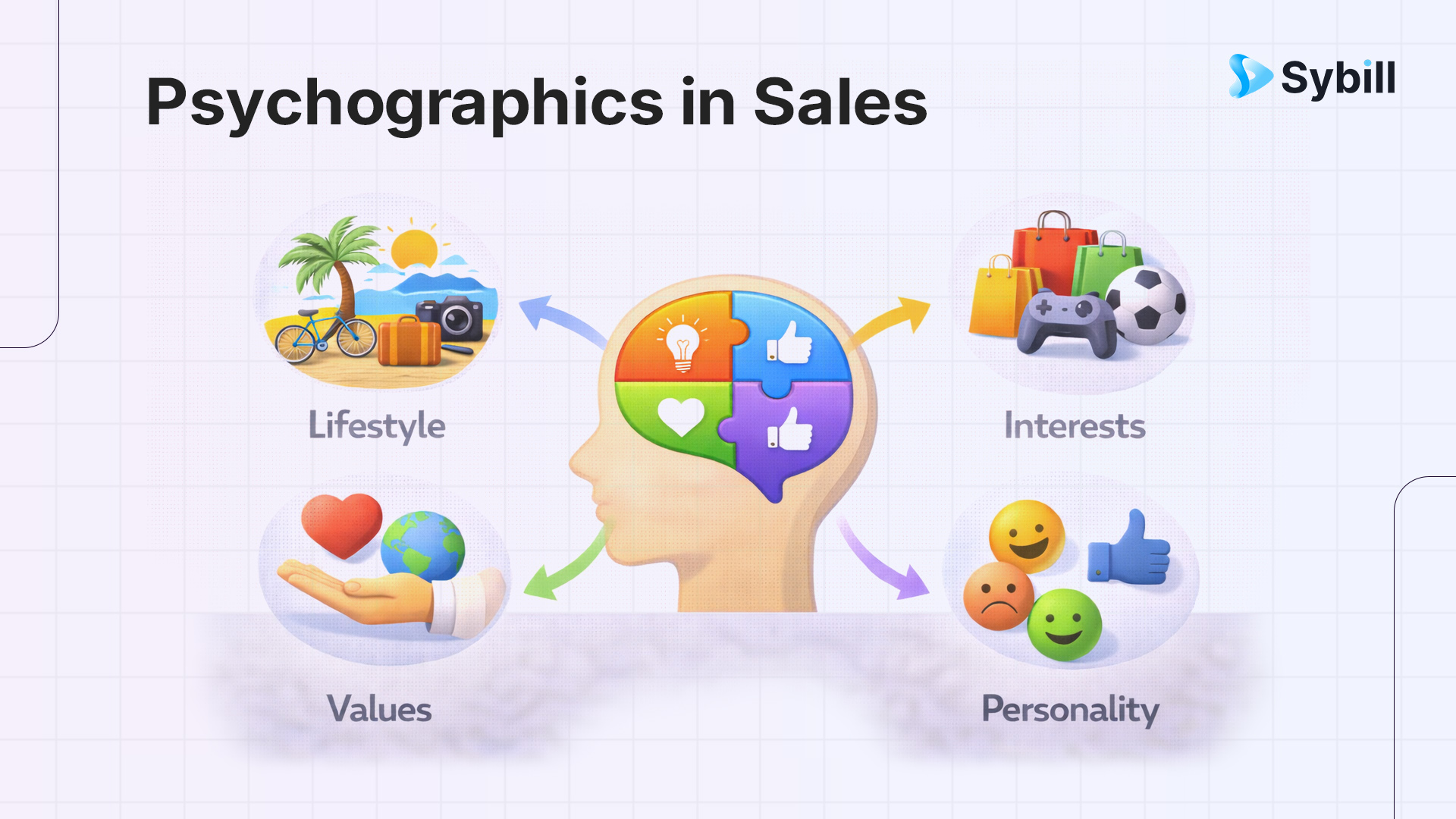
Psychographic segmentation variables describe how buyers think and decide under pressure.Values influence what buyers prioritize, such as stability versus innovation.Attitudes shape how buyers view change, vendors, and internal risk.Interests signal where attention goes during evaluation and discovery.Lifestyle reflects work habits, pace, and openness to disruption.Motivations reveal what success or failure means personally and professionally.In sales scenarios, these variables determine whether buyers seek proof, push speed, demand control, or delay decisions until alignment feels safe.
Psychographic traits are recurring decision patterns that show up in buyer behavior. They include traits like risk sensitivity, need for control, urgency bias, and preference for consensus.In B2B sales, these traits explain why two buyers with identical titles behave differently. One might push for rapid execution while another stalls for validation. Traits predict buying behavior better than seniority because they reveal how buyers react when accountability and pressure increase.