Find us at booth #83, join us for a harbor side happy hour, or catch Gorish’s talk.

Sept, 16-18 > Learn more


Tamanna Mishra

August 8, 2026
%20(65).png)
Sales ghosting usually reflects lost urgency, stakeholder misalignment, an unresolved objection, or a next step that was never truly agreed. Prevention starts during discovery, not with the fifth follow-up email. Capture buyer context, map the buying group, confirm dated actions, and watch for momentum loss. AI sales tools can help reps preserve deal context, follow up quickly, and spot stalled deals before prospects disappear.
If a cold prospect never replied, they did not ghost you. They simply did not engage.
Sales ghosting begins when a buyer shows intent, takes a meeting, asks for information, requests pricing, or agrees to a next step, then disappears. That distinction matters because the fix is rarely “send a more personalized bump.”
The deal usually began losing momentum before the unanswered email. Urgency was soft. The champion could not build internal support. An objection got a courteous but incomplete answer. Everyone left the demo saying “great conversation,” but nobody put the next meeting on the calendar.
Then the rep sends “just checking in” six times and calls it persistence. That is Groundhog Day with a calendar link.
Learning how to avoid getting ghosted in sales requires a wider view of the deal. You need to understand what the buyer is trying to change, who must agree, what could stop the decision, and whether both sides are completing their commitments.
Sales ghosting is when a prospect who previously engaged in a genuine buying conversation stops responding without closing the loop. It is different from an unanswered cold email, and it is often the final symptom of a stalled or poorly qualified deal.
The stage at which the buyer goes quiet offers the first diagnostic clue.
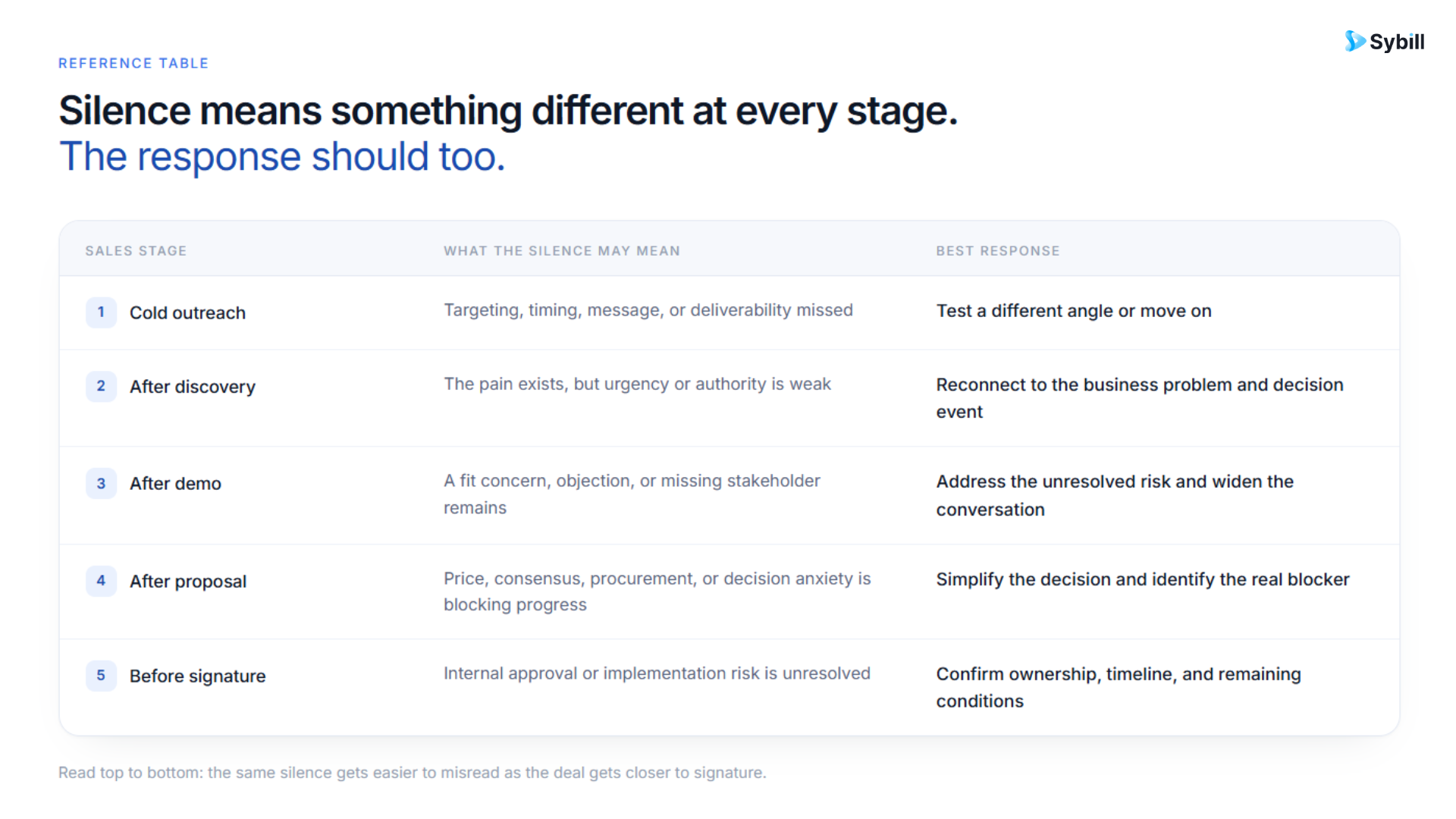
“They got busy” is possible. It is also the least useful diagnosis because you cannot manage it. These causes are more actionable:
Ghosting signals do not live in one inbox. They sit across meetings, email, CRM fields, internal conversations, dialer calls, and tasks nobody updated.
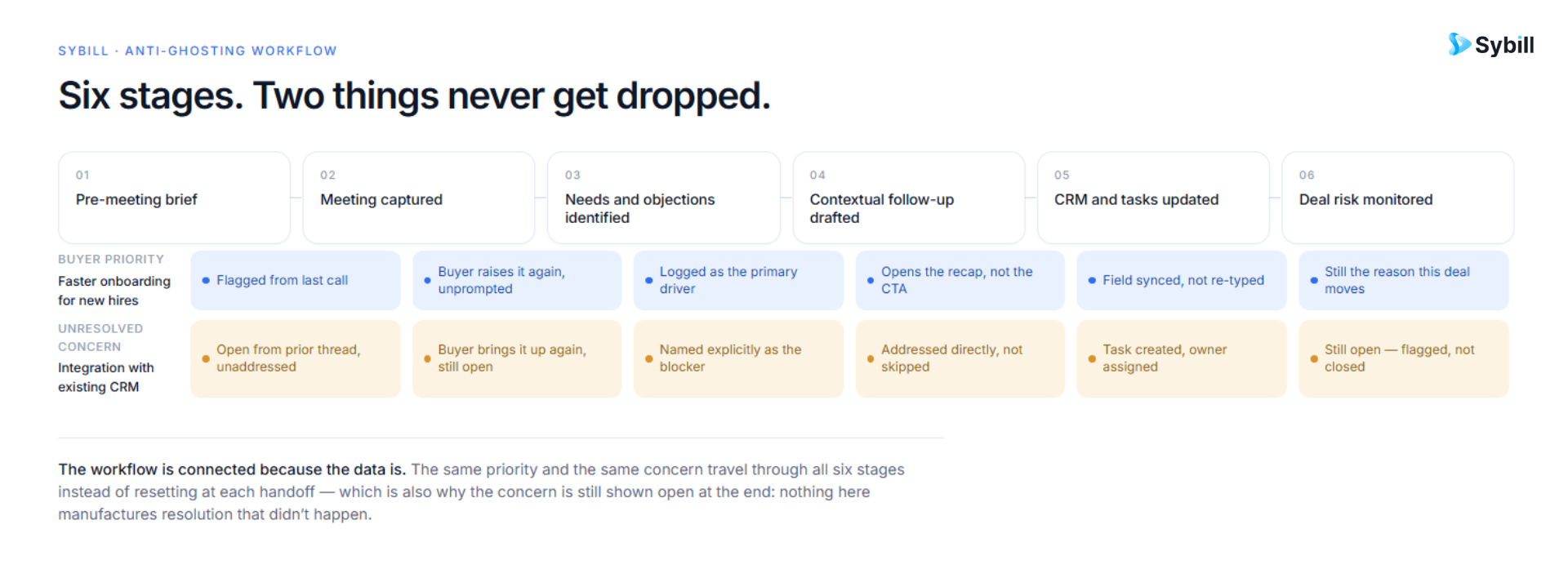
Sybill’s integrations connect deal activity across the tools reps already use, giving its AI the context to support one continuous workflow:
Reps can also use Ask Sybill to ask questions such as, “What could prevent this deal from moving forward?” or “Which stakeholder have we not engaged?”
That is the difference between a reminder tool and an AI sales assistant for follow-ups. One tells you to send something. The other helps you understand what the deal needs next.
Stop guessing why your deal went quiet. See Sybill in action.
“They loved the demo” is not qualification. Ask what happens if the buyer does nothing, which business event creates the deadline, who owns the outcome, and whether budget exists. If the problem has no consequence and the date has no reason, the opportunity may be pipeline cosplay.
Identify the champion, economic buyer, decision-maker, procurement partner, security reviewer, implementation owner, and people affected by the change. Then ask your champion how each stakeholder defines success. Multi-threading is not collecting contacts. It is building enough shared context for the group to decide.
Do not wait for a formal no. Ask:
These sales closing questions create useful discomfort. That is better than comfortable ambiguity followed by three weeks of silence.
Do not settle for “we’ll circle back.” Confirm the action, owner, date, purpose, and attendees. Then put it on the calendar while everyone is present.
Close rates are known to decline when next steps are not discussed on the first call. Treat that as vendor research, not a universal constant. The practical lesson still holds: vague next steps create room for deals to drift.
A strong follow-up should capture:
The email should help your contact move the decision internally. For deeper guidance, use this framework for sales follow-up emails.
Stop sending reminders disguised as emails. Bring a useful answer, implementation detail, relevant proof point, stakeholder-specific resource, new product development, or simpler decision path.
If your fourth message says the same thing as your first, the buyer is not the only person avoiding a decision.
Sales ghosting has leading indicators:
Use these signals to identify at-risk deals before they slip. Intervene while the buyer is still talking, not after the deal has become a missing-person case in the forecast.
Some buyers ghost because a no feels like an invitation to another persuasion campaign. Give them clean choices:
A real no is more useful than a fictional commit. It cleans the forecast, protects rep time, and leaves the relationship intact.
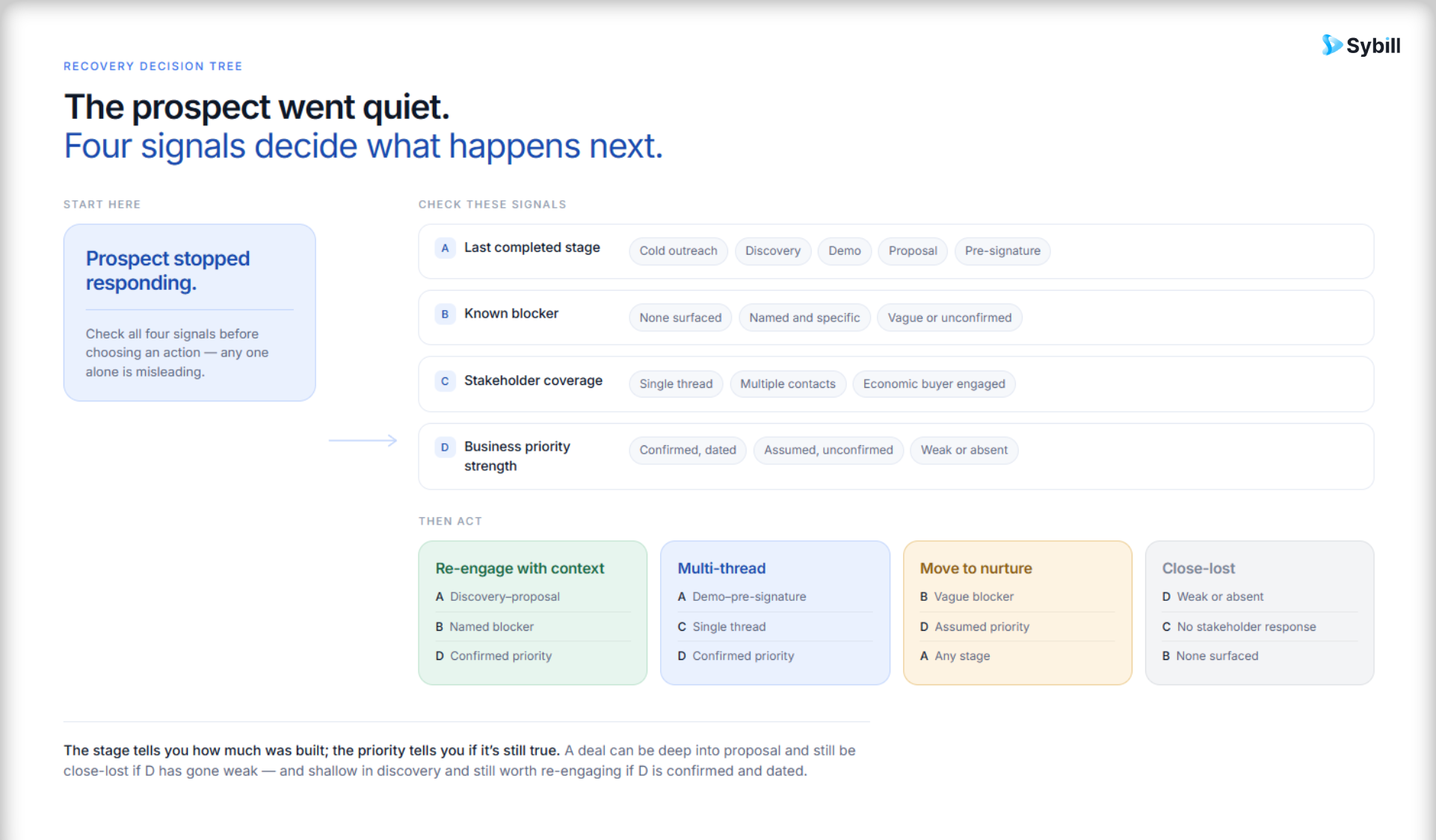
When silence has already started, do not increase volume before improving the diagnosis.
Subject: The rollout question from our call
Hi [Name], you mentioned that adoption across the regional teams is the biggest concern. I pulled together a one-page rollout view you can share internally. Would it help to review it with [implementation owner] for 20 minutes on Thursday?
Subject: One question on the proposal
Hi [Name], the proposal reflects the [priority] and [timeline] we discussed. My sense is that [pricing, security, or implementation] may still need internal alignment. Is that the main blocker, or has the priority changed?
Subject: Close the loop?
Hi [Name], I do not want to keep filling your inbox if [initiative] is no longer active. Should I close this out, revisit it in [period], or connect with someone else who now owns the decision?
There is no universal magic number. Stop active pursuit when the buyer repeatedly misses agreed actions, there is no validated business priority, you cannot reach beyond one disengaged contact, the account no longer fits, or another follow-up would add no value.
Do not leave the deal in active pipeline because nobody wants to call it. Move it into trigger-based nurture and re-engage when something meaningful changes, such as new leadership, budget timing, a product launch, an expansion event, or a relevant capability update.
Avoiding sales ghosting is not about producing an endless supply of clever emails. It is about running a deal in which urgency is real, stakeholders are visible, objections are discussable, and every meeting ends with mutual action.
Sybill helps reps preserve that context and act on it across meetings, follow-ups, CRM updates, tasks, and deal inspection. So when momentum starts to fade, you can investigate and respond before the forecast fills with deals nobody is truly buying.
Turn every sales conversation into a clear next step. Book a Sybill demo.
Prospects often ghost because urgency weakened, the buying group could not reach consensus, an objection remained unresolved, or the next step was vague. Sometimes the account was never properly qualified. Review the last substantive interaction and deal context before assuming the buyer simply forgot to reply.
Reference the buyer’s stated priority, address the most likely blocker, add one useful piece of information, and ask one low-effort question. Avoid “just checking in.” If several relevant attempts receive no response, send a respectful close-the-loop email and move the account to nurture.
There is no reliable number that applies to every deal. Follow up while you have a valid business reason, a credible buying priority, and new value to add. Stop active pursuit when commitments repeatedly go unmet or your messages merely repeat the same ask. Relevance matters more than volume.
AI cannot create buyer urgency or consensus by itself. It can help prevent avoidable ghosting by capturing objections and commitments, drafting timely follow-ups from real deal context, updating CRM records, and surfacing stalled momentum. The rep still needs to apply judgment and lead the buying process.
Prospects often ghost because urgency weakened, the buying group could not reach consensus, an objection remained unresolved, or the next step was vague. Sometimes the account was never properly qualified. Review the last substantive interaction and deal context before assuming the buyer simply forgot to reply.
Reference the buyer’s stated priority, address the most likely blocker, add one useful piece of information, and ask one low-effort question. Avoid “just checking in.” If several relevant attempts receive no response, send a respectful close-the-loop email and move the account to nurture.
There is no reliable number that applies to every deal. Follow up while you have a valid business reason, a credible buying priority, and new value to add. Stop active pursuit when commitments repeatedly go unmet or your messages merely repeat the same ask. Relevance matters more than volume.