Find us at booth #83, join us for a harbor side happy hour, or catch Gorish’s talk.

Sept, 16-18 > Learn more


Tamanna Mishra

March 20, 2026
Every company claims their QBRs are strategic conversations.
In reality, many of them look more like this:
Slide 1: Last quarter’s numbers
Slide 2: A graph nobody quite understands
Slide 3: “Any questions?”
Meanwhile the customer is quietly thinking:
“Could this not have been an email?”
The irony is that the quarterly business review is actually one of the highest-leverage meetings in any B2B relationship.
Done right, it can:
Done wrong, it becomes another meeting everyone politely survives.
And the stakes are higher than most teams realize.
72% of expansion revenue in SaaS comes from existing customers. Bain research has also shown that increasing customer retention by just 5% can boost profits by 25–95%.
That means the conversations you have with customers after the sale often matter more than the sales process itself.
Which is exactly why the quarterly business review is not just a meeting. It is a revenue lever.
In this guide, we will break down:
Also read:
Let us start with the basics.
The QBR meaning in business is simple on paper, but in practice it carries far more strategic weight than many teams realize.
A Quarterly Business Review (QBR) is a structured meeting held every three months between a company and its customer or internal stakeholders. The purpose is to review performance, assess value delivered, align on strategic goals, and define priorities for the upcoming quarter.
In most B2B organizations, quarterly business reviews are led by account managers, customer success leaders, or revenue teams. These sessions bring together stakeholders to evaluate how well the partnership is progressing and whether the product, service, or engagement is delivering measurable business outcomes.
A strong quarterly business review goes beyond presenting performance metrics. It connects data to strategic impact and ensures both sides remain aligned on what success looks like.
Typically, an effective QBR focuses on:
This is where many companies misunderstand the role of a QBR.
A QBR is not a status meeting where someone walks through a slide deck of metrics.
Executives do not attend these sessions to hear numbers they could read in a dashboard.
A good QBR is a strategy conversation that connects product performance to real business goals.
At its best, a quarterly business review helps teams:
But even though the purpose of a QBR is clear, many of them fail long before the meeting even begins.
A quarterly business review is supposed to strengthen relationships and drive growth. Yet many QBRs fall flat. Not because the idea is wrong, but because the execution is.
Here are the most common reasons QBRs fail.
Many QBRs become a recap of last quarter’s metrics.
Revenue numbers. Usage charts. Support tickets.
But strong QBRs focus on what comes next:
The past provides context. The real value of a QBR is shaping the next quarter.
Executives do not want dashboards.
They want insight.
Instead of walking through dozens of charts, a strong quarterly business review answers a simple question:
What does this data mean for the customer’s business?
A QBR should not feel like a product update.
It should answer one critical question:
How are we helping the customer win?
When that narrative is missing, the meeting becomes transactional instead of strategic.
Behind the scenes, most QBRs are assembled from scattered data sources:
Sales and customer success teams often spend hours compiling slides and pulling insights together.
The result is rushed preparation and incomplete narratives.
This is exactly why high-performing teams treat the quarterly business review as a structured framework rather than a last-minute presentation.
Supersellers use Sybill’s Pre-Meeting Briefs to change this. Click here to learn more.
A strong QBR agenda is not just a meeting outline. It is a strategic framework that guides the conversation from past performance to future opportunity.
High-performing revenue teams treat quarterly business reviews like a structured narrative. Each section builds on the previous one to show how the partnership is creating measurable business impact.
Across SaaS and enterprise organizations, the most effective quarterly business review agendas follow a similar structure.
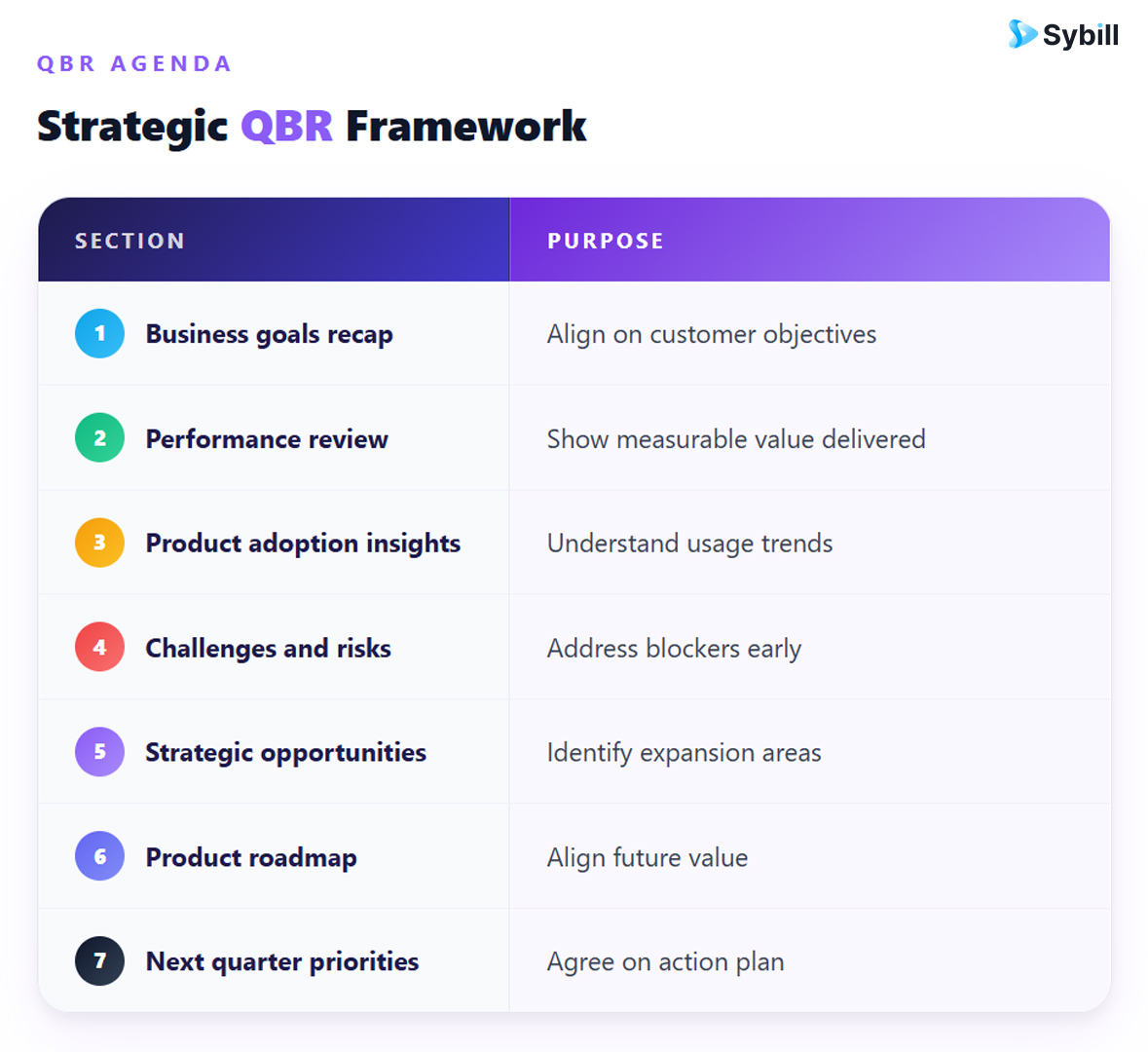
This structure ensures the meeting flows logically instead of feeling like a disconnected slide deck.
The most effective QBRs follow a clear story:
Goal → progress → insights → next steps
When this narrative is present, stakeholders quickly understand:
Without this structure, even well-prepared QBRs can feel like a random collection of updates.
To make this framework more concrete, let us look at a few QBR examples used by successful revenue teams.
Not every quarterly business review looks the same. The structure and emphasis often change depending on the type of customer relationship.
However, strong QBRs always connect performance data to business impact. Below are three practical QBR examples used by revenue teams across SaaS, enterprise sales, and project-driven engagements.
This type of QBR is commonly run by customer success managers to ensure customers are receiving measurable value from the product.
Focus
Key metrics to review
The objective is to demonstrate that the product is driving tangible results and to identify areas where adoption can be improved.
Enterprise accounts typically involve multiple stakeholders and long-term strategic partnerships. These QBRs are designed for executive alignment rather than product walkthroughs.
Focus
Key metrics to review
These reviews often include senior decision-makers and focus heavily on strategic direction rather than operational details.
For organizations delivering projects or services, QBRs are used to track delivery performance and manage risks.
Focus
Key metrics to review
These sessions ensure both teams remain aligned on timelines, resources, and potential delivery risks.
Across all these QBR examples, one pattern stands out.
The most effective reviews focus on business outcomes, not just product metrics.
To make this process repeatable across teams and customers, organizations often rely on structured QBR templates.
Even the best strategy can fall apart without structure. That is why high-performing teams rely on QBR templates to keep their quarterly business reviews consistent, strategic, and focused on outcomes.
A good template ensures every QBR answers the same critical questions:
What value did we deliver?
What challenges exist?
What opportunities should we pursue next?
Below are three practical templates used by revenue teams.
This template is designed for leadership conversations where the focus is strategic value rather than operational details.
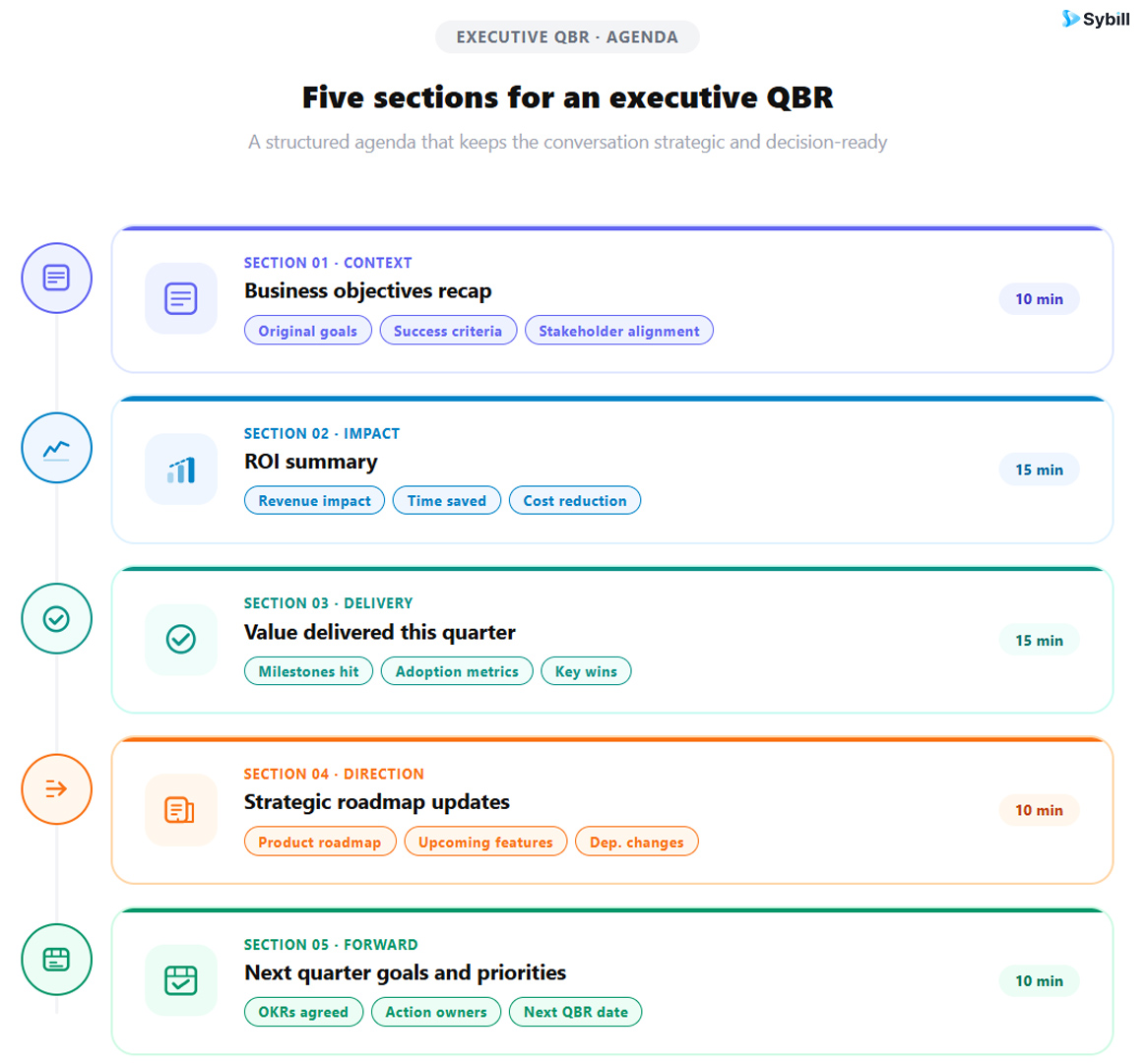
Executive QBRs should remain concise and insight-driven, highlighting outcomes rather than raw data.
Customer success teams use this template to show adoption progress and ensure customers are achieving measurable results.
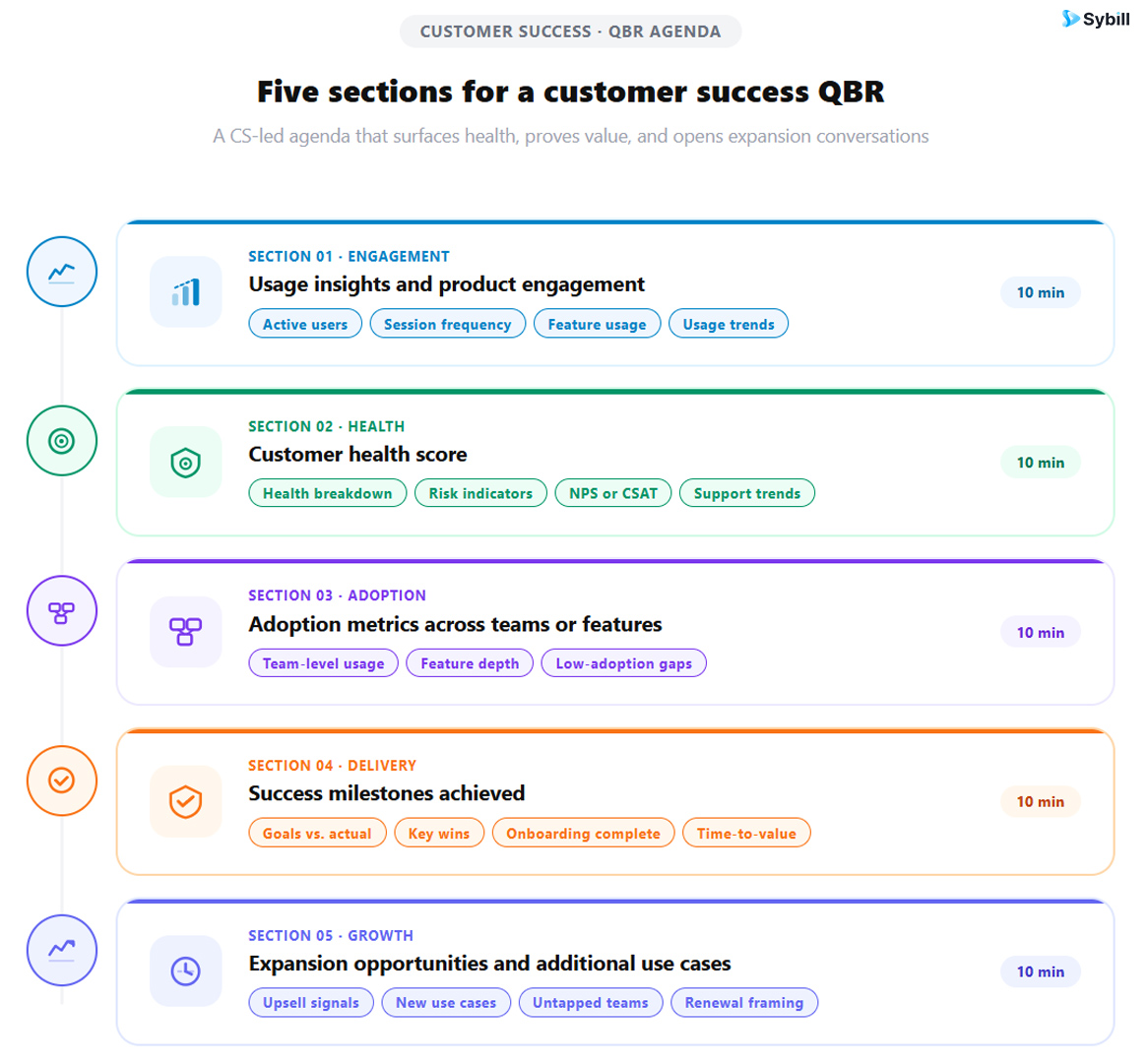
The goal is to demonstrate ongoing value and strengthen the long-term partnership.
For account managers and revenue teams, the focus shifts toward growth opportunities and account strategy.
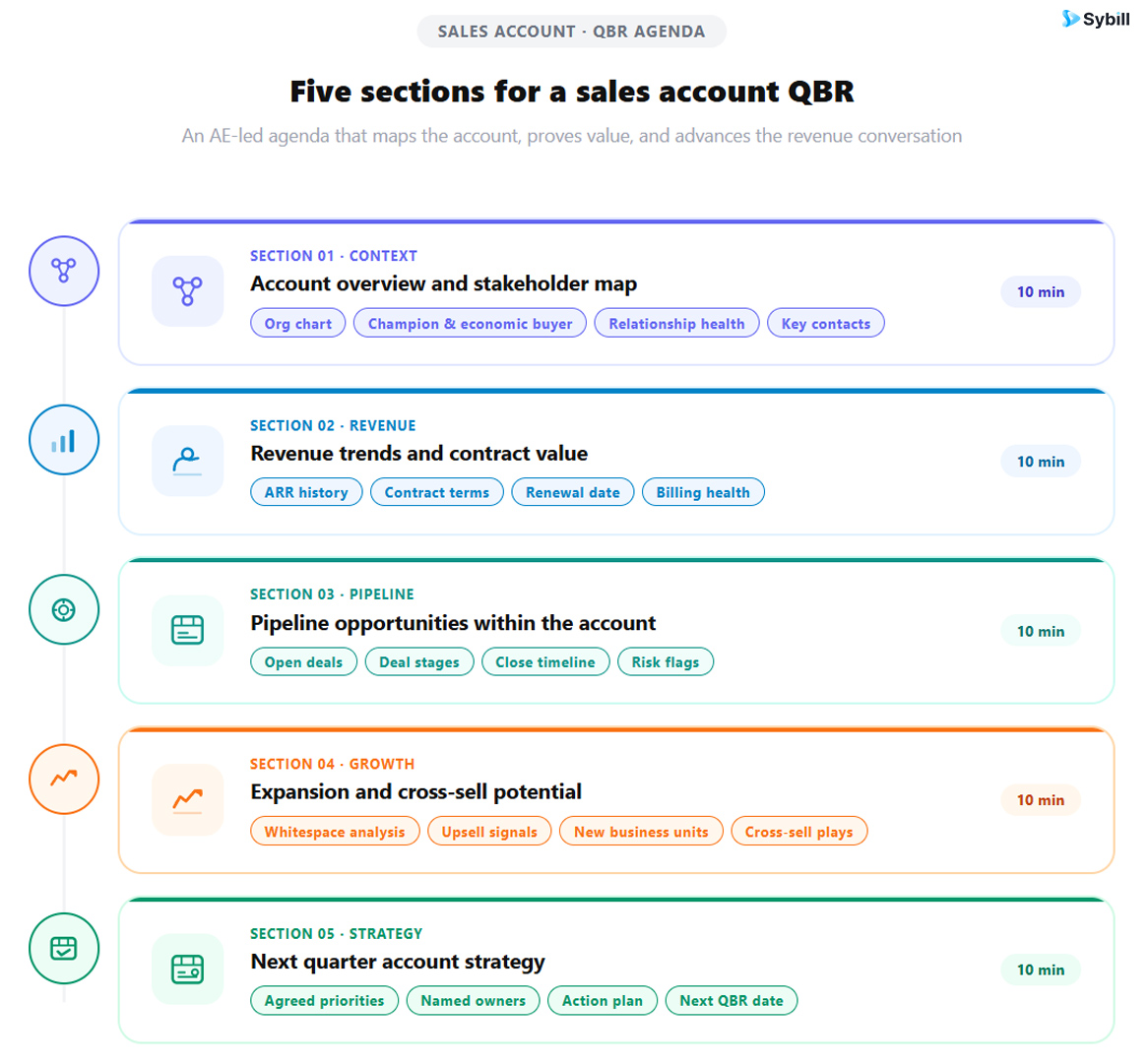
Templates like these ensure every quarterly business review tells the same strategic story.
But even with a strong template, the real challenge often lies in preparation.
Running a strong quarterly business review sounds straightforward. Preparing for one is a different story.
Behind every polished QBR presentation is hours of manual prep work. Sales and customer success teams often pull information from multiple systems just to build the narrative for the meeting.
Typical QBR preparation involves gathering insights from:
It is not unusual for teams to spend four to six hours preparing for a single QBR agenda.
And the problem is not just time. It is fragmentation.
Important insights often live in different tools, making it difficult to build a complete story about the customer relationship.
This friction creates three common problems:
The result is a QBR that feels reactive instead of strategic.
This is where platforms like Sybill change the way revenue teams prepare for QBRs.
Instead of digging through scattered systems, teams can walk into a quarterly business review with clear context already surfaced.
Sybill helps revenue teams:
Instead of spending hours assembling slides, sales and customer success teams can focus on what actually matters during a quarterly business review: strategic conversations that drive the next phase of growth.

Top-performing revenue teams treat a quarterly business review as more than a routine meeting. They approach it as a strategic conversation designed to strengthen relationships, demonstrate value, and unlock growth opportunities.
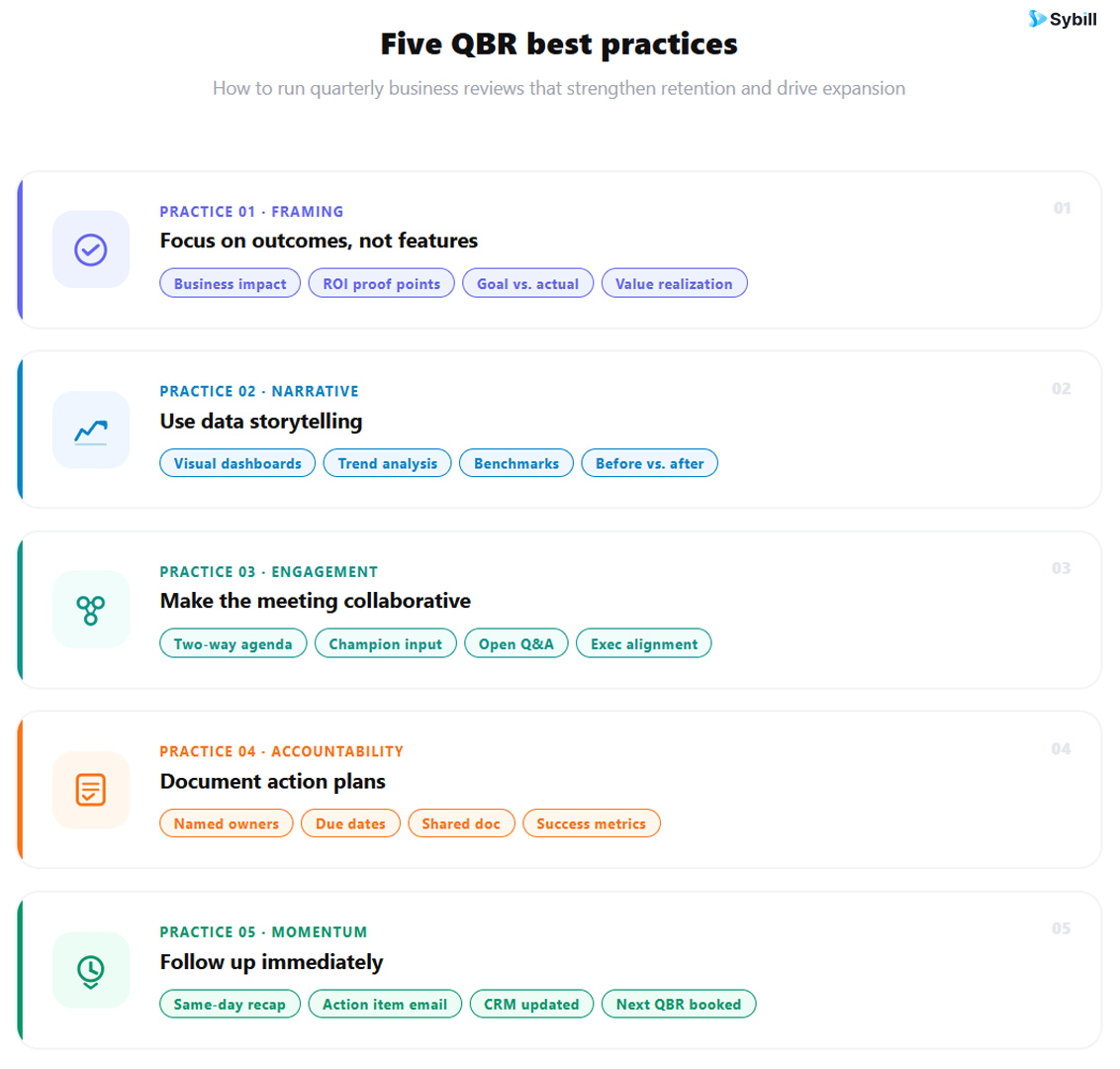
Here are the practices that consistently separate effective QBRs from forgettable ones.
Executives care about business impact, not product walkthroughs.
Instead of highlighting features or technical capabilities, strong QBRs show how the product or service contributed to measurable outcomes such as revenue growth, operational efficiency, or customer acquisition.
Dashboards alone rarely drive meaningful conversations.
High-performing teams turn data into insight by connecting metrics to the bigger narrative. Instead of showing charts, they explain what the numbers mean and why they matter for the customer’s goals.
In short: insights beat dashboards.
The best QBRs are conversations, not presentations.
Leading teams actively invite customer input, ask strategic questions, and encourage stakeholders to share feedback about priorities, challenges, and upcoming initiatives.
A successful quarterly business review always ends with clarity.
Every meeting should conclude with agreed next steps, owners, and timelines so that progress continues beyond the call.
Momentum matters.
Prompt follow-up ensures action items are implemented and reinforces the partnership between both teams.
When these practices are applied consistently, the quarterly business review becomes far more than a reporting exercise. It becomes a powerful driver of retention, expansion, and long-term customer success.
A quarterly business review should never feel like a routine update. It should feel like a strategy session.
The best QBRs:
But delivering that level of insight requires preparation. And preparation requires visibility into customer conversations, deal context, and engagement signals.
That is why modern revenue teams use platforms like Sybill to automate the groundwork. With tools such as Pre-Call Brief, Magic Summary, CRM Autofill, Personalized Emails, and Ask Sybill, teams walk into every QBR already knowing what matters most to the customer.
Because the best QBR is not the one with the most slides.
It is the one that drives the next quarter of growth.
Want to run smarter QBRs? Try Sybill and walk into every review with the insights already prepared.
A strong quarterly business review should focus on strategic outcomes rather than just reporting metrics. A typical QBR agenda includes a recap of business goals, performance and ROI delivered, product adoption insights, challenges or risks, and priorities for the next quarter. The goal is to show measurable value and align both teams on future growth.
Most quarterly business review meetings typically last between 45 and 60 minutes. Executive-level QBRs may run longer depending on the number of stakeholders involved. The key is to keep the discussion focused on insights, business impact, and next steps rather than lengthy slide presentations.
A QBR usually focuses on operational performance, product usage, and account health across the previous quarter. An executive business review (EBR) is more strategic and involves senior stakeholders discussing long-term goals, business impact, and future roadmap alignment. Both formats aim to strengthen the partnership and drive growth.
A strong quarterly business review should focus on strategic outcomes rather than just reporting metrics. A typical QBR agenda includes a recap of business goals, performance and ROI delivered, product adoption insights, challenges or risks, and priorities for the next quarter. The goal is to show measurable value and align both teams on future growth.
Most quarterly business review meetings typically last between 45 and 60 minutes. Executive-level QBRs may run longer depending on the number of stakeholders involved. The key is to keep the discussion focused on insights, business impact, and next steps rather than lengthy slide presentations.
A QBR usually focuses on operational performance, product usage, and account health across the previous quarter. An executive business review (EBR) is more strategic and involves senior stakeholders discussing long-term goals, business impact, and future roadmap alignment. Both formats aim to strengthen the partnership and drive growth.