Find us at booth #83, join us for a harbor side happy hour, or catch Gorish’s talk.

Sept, 16-18 > Learn more

%20(1).avif)
Mamta Tainwala

March 6, 2026
What you'll learn:
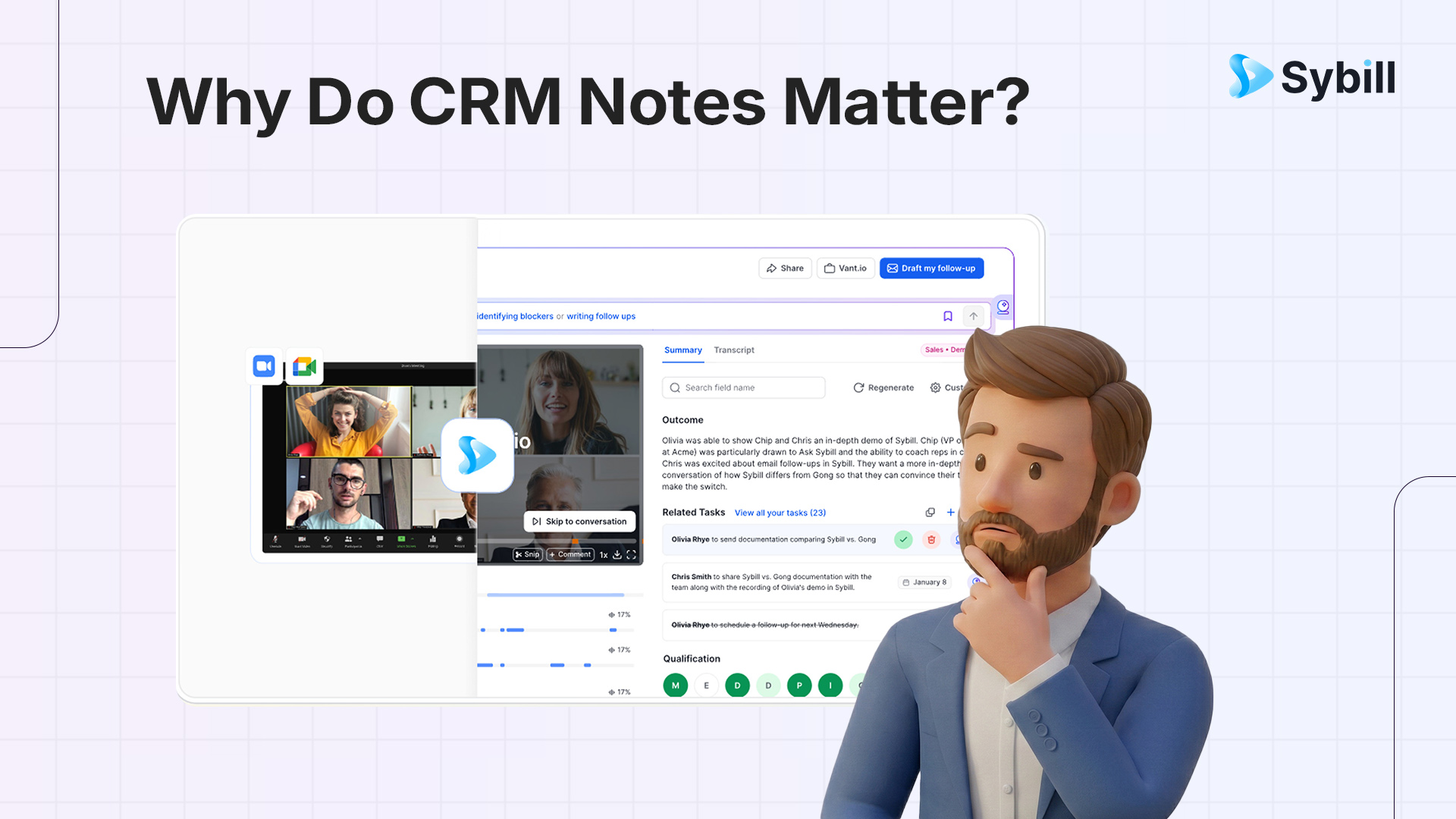
Picture this. A deal has been in the pipeline for six weeks. The rep who owns it just went on vacation. Their manager jumps in to cover a call with the prospect, opens the CRM, and finds: "Good call. Sent proposal. Following up."
That is the entire note. Six weeks of context. Three calls. Multiple stakeholders. Competing priorities, budget pushback, a legal bottleneck. All of it summarized in nine words that tell you absolutely nothing useful.
This is not a rare edge case. It is a Tuesday in most sales orgs.
CRM notes are one of those things that everyone agrees matter in theory and almost nobody does well in practice. The result is a CRM that looks populated but is functionally hollow, full of fields and records and timestamps that gesture at real conversations without actually capturing them.
This guide is about why that gap is so expensive, what good notes actually do for your revenue organization, and why AI has become the most practical way to close it.
Let's clear up a common misconception: a CRM note is not just a memory aid for the rep who took the call. That is the smallest thing it does.
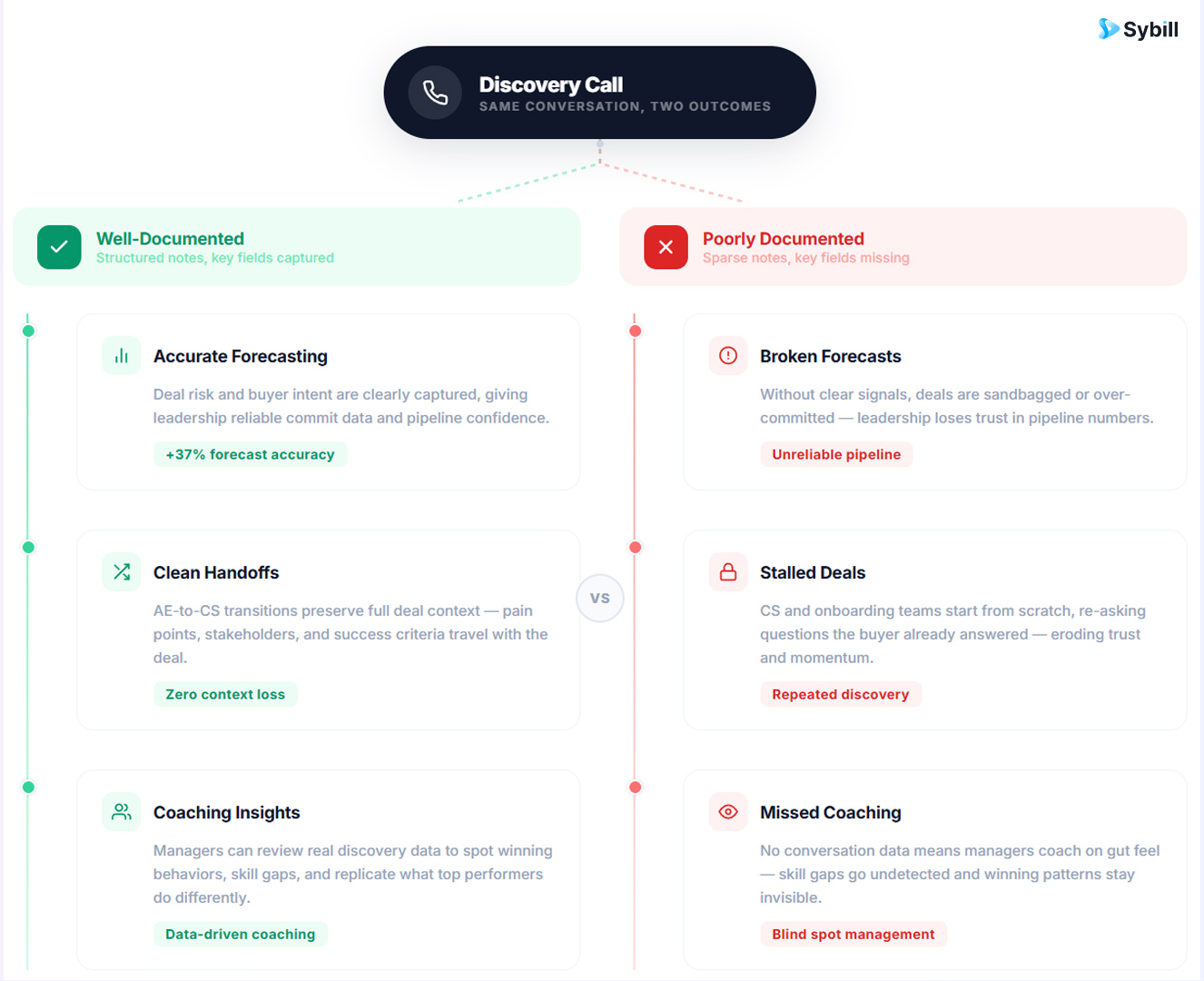
A CRM note is actually a piece of shared infrastructure. It is the mechanism by which context travels from one conversation to the next, from one team member to another, and from the beginning of a deal to the end of a customer relationship. When notes are good, the whole revenue engine runs more smoothly. When they are not, friction shows up everywhere: in forecasting, in handoffs, in coaching, in the deal itself.
Here is what a genuinely useful CRM note enables, broken down by function.
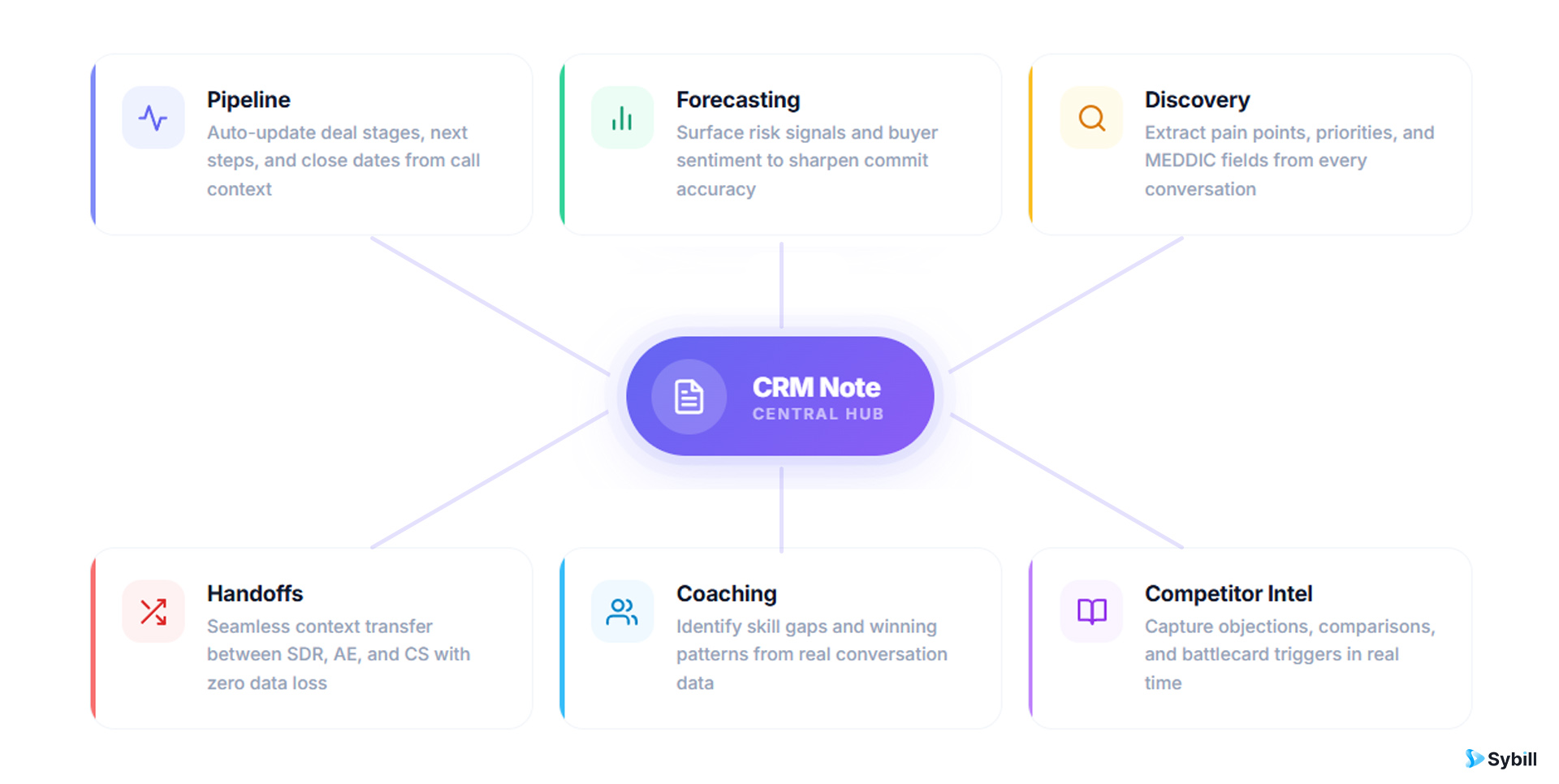
A healthy sales pipeline depends on accurate deal context. Stage names and deal values only tell half the story. The other half is in the notes: what did the prospect actually say about their timeline? Is budget confirmed or assumed? Who else is in the buying committee? Is there a legal review coming that no one has flagged?
When notes are vague, managers cannot tell which pipeline deals are real and which are wishful thinking dressed up as forecasts. They end up making decisions based on what reps tell them in one-on-ones rather than what is verifiable in the system. That is not pipeline management. That is hallway gossip with a CRM logo on it.
Sales forecasting is only as reliable as the data it draws from. When CRM notes lack specifics around decision criteria, competing priorities, or stakeholder engagement, forecast models fill those gaps with assumptions. And assumptions tend to be optimistic, which is exactly why so many end-of-quarter forecasts do not land.
The rep who documented that the economic buyer explicitly said "we need sign-off from legal before any commitment" has given everyone downstream a real signal. The rep who typed "interested, moving forward" has given everyone a false one.
Great discovery questions are only half the work. The other half is making sure what you learned gets recorded clearly enough that your next conversation can build on it. Every discovery call either confirms or updates your understanding of the prospect's situation. If that understanding lives only in the rep's memory, every new conversation risks starting from zero.
When notes capture the full picture from discovery, including stated pain, business impact, critical events, and decision criteria aligned to a framework like SPICED, every subsequent call is a continuation of the same story. The prospect feels heard. The rep shows up prepared. The deal moves forward with momentum instead of repeating the same ground.
Handoffs are some of the most fragile moments in the revenue cycle. An SDR hands off to an AE. An AE closes the deal and hands off to Customer Success. A CSM manages the account through renewal. At each of these transitions, context either transfers or evaporates.
A strong SDR playbook will tell reps exactly what context needs to be captured before a meeting is passed to an AE. But the execution of that handoff lives in the notes. When they are complete, the AE walks in knowing the prospect's situation, the pain that was expressed, and the commitments that were made. When they are not, the AE starts over, the prospect notices, and confidence in your organization takes a hit before the sales process has even properly begun.
The same is true at the AE-to-CS handoff. The sales-to-customer success transition is one of the most common drivers of early churn precisely because what was promised during the sales process does not make it into the onboarding plan.
Sales managers cannot coach on conversations they did not hear. When reps take cursory notes, managers have no visibility into what actually happened on a call: what objections came up, how the rep responded, what the prospect's emotional temperature was, or whether the right questions were asked at the right moment.
Good CRM notes give managers something to coach from. When a note captures not just what was decided but what was said, what hesitations emerged, and what was left unresolved, a manager can have a specific, useful coaching conversation instead of a generic one. Over time, this is how AI-powered sales managers and coaching tools become genuinely useful: they have real data to work from.
This is the most underappreciated function of CRM notes in most organizations. Every time a prospect mentions a competitor, raises a common objection, or describes a buying process pattern, that data has value beyond the individual deal. Across dozens or hundreds of notes, patterns emerge: which objections come up most in certain industries, which competitors show up in which segments, which success criteria matter most to specific buyer roles.
But that pattern intelligence only exists if the notes actually captured those details in the first place. Vague notes produce no intelligence. Competitor intelligence only works when the raw material is there. A CRM full of "good call, following up" entries is not a database. It is a void.
This sounds counterintuitive, but it is worth sitting with: a CRM full of incomplete, inaccurate, or vague notes is more dangerous than an empty one.
An empty note tells you the context is missing. You know to ask. A note that says "good meeting, moving to proposal stage" tells you nothing actionable, but it looks like something. It creates false confidence. A manager reviewing the pipeline sees a note and assumes the deal is real. A rep picking up a handoff assumes they have enough context to proceed. They do not. And by the time that becomes apparent, it is usually at a moment of friction: a prospect who feels they have to re-explain themselves, a manager who gets blindsided in a forecast call, a customer who churns in month three because the success team did not know what was actually promised.
The cost of bad notes is not in the hours spent taking them. It is in the downstream decisions that get made on false information.
Understanding why notes fail is the first step toward fixing the problem.
The time gap. Notes taken an hour after a call capture maybe half the detail of notes taken immediately after. Notes taken the following morning capture less. Notes that "will definitely get done today" and disappear into the close-of-business rush capture almost nothing. The decay of recall is not a discipline problem. It is biology. Systems that require notes to be entered later will always produce worse notes than systems that capture them in real time or immediately after the call.
The effort ceiling. Manual note entry is work. The more work it is, the less thoroughly it gets done, especially when a rep has three back-to-back calls and a follow-up sequence to manage. Humans have a natural tendency to do the minimum viable version of tasks that feel administrative and unrewarded. Asking reps to write detailed notes after every call without removing friction elsewhere is asking them to choose between selling and documenting. Most will choose selling. That is the right instinct. The system needs to adapt.
The inconsistency trap. When every rep has their own note-taking style, the CRM stops being a shared resource and starts being a collection of individual filing systems. No two notes look the same. No one outside the rep who wrote them can quickly extract what they need. The signal-to-noise ratio drops. Sharing and collaboration across your team becomes harder when context is locked in a personal shorthand nobody else can parse.
The subjectivity problem. Notes written by reps often reflect what the rep wishes was true rather than what the prospect actually said. "They seemed interested" is very different from "they asked for a second call with their VP of Finance." One is an interpretation. The other is a fact. When the line between those blurs in CRM notes, everything downstream becomes less reliable.
Stop letting note-taking slow your team down. Get started for free with Sybill and let AI handle the documentation while your reps handle the deal.
The four failure patterns above share a common cause: they are all consequences of treating note-taking as a manual task that happens after the conversation rather than a process that runs alongside it.
AI reverses that assumption.
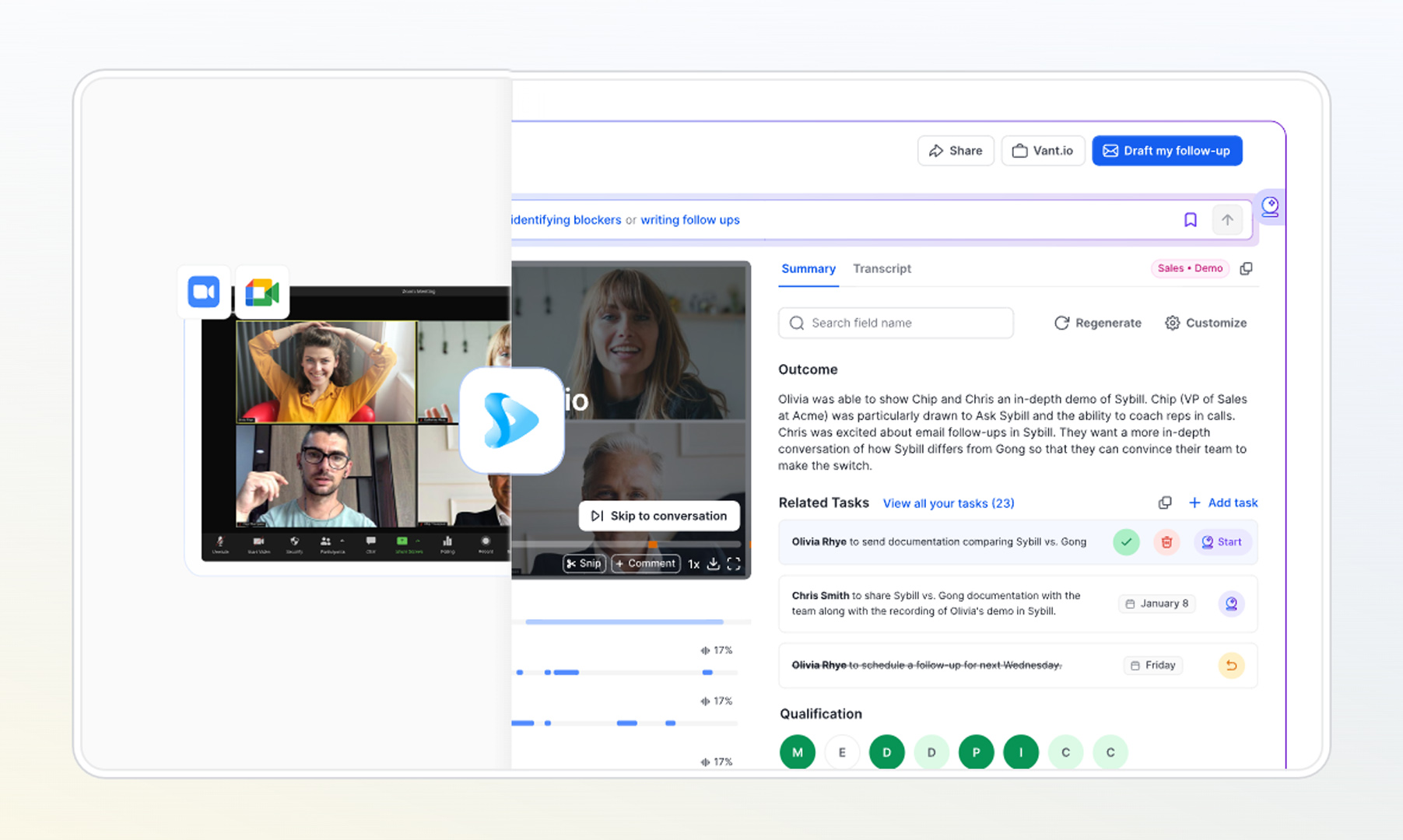
Instead of asking reps to reconstruct what happened on a call from memory, AI captures it as it happens. Instead of asking managers to infer deal health from vague notes, AI extracts and structures the signals that actually indicate deal health. Instead of hoping reps follow a consistent format, AI applies the same framework to every call automatically.
Here is what that looks like in practice with Sybill's CRM Autofill: after every call, Sybill pushes structured data directly into your CRM fields, including custom ones mapped to MEDDPICC, BANT, SPICED, or whatever qualification framework your team uses. The rep does not type a single field. The information goes in clean, consistent, and immediately useful.
Sybill's Magic Summaries go a level further. They do not just log what was said. They capture what it meant: buyer intent signals, emotional engagement cues, unresolved objections, stated next steps, and competitive mentions. What you get is not a transcript. It is a sales-grade interpretation of the call, written in plain language, available in your inbox and your CRM before you have had a chance to switch tabs.
For managers, Sybill's deal inspection means the pipeline review is based on actual deal data, not rep self-reporting. You can see which deals have genuine momentum and which are stalled, based on the content of conversations, not the optimism of forecast updates.
For reps working on their own game, the personal coach feature uses the same note and call data to deliver specific, personalized feedback. Not "be more confident on calls." But "in your last four discovery calls, you moved to demo before confirming the decision process. Here is how that is affecting deal velocity."
For sales plays, the notes power everything. Sybill's AI draws on your real conversation history to surface what has worked in similar deals, what objections tend to appear at this stage, and what the next best action is, because it actually knows what was said.
And when you want to query across all of it, Ask Sybill lets you ask plain-language questions across your entire deal portfolio: "Which open deals have an economic buyer identified?" or "Which accounts mentioned budget freeze in the last 30 days?" The answers are in there. They just need a note infrastructure solid enough to support them.
Why do CRM notes matter so much for sales teams?
CRM notes are the primary mechanism for transferring context between conversations, team members, and deal stages. When they are accurate and consistent, they enable better forecasting, cleaner handoffs, sharper coaching, and more personalized follow-up. When they are vague or incomplete, every downstream function suffers, often without the team realizing that note quality is the root cause.
What should a good CRM note include?
A good CRM note captures: the prospect's stated pain and business context, who participated and their roles, key objections or concerns raised, agreed-upon next steps with owners and dates, and any signals around budget, timeline, or competing priorities. Notes tied to a qualification framework like MEDDPICC or SPICED are especially useful because they apply consistent structure across every deal.
How do bad CRM notes affect sales forecasting?
Forecasting models rely on deal stage data, deal values, and qualitative signals from notes and activity. When notes are vague, the qualitative layer disappears, and forecast models lean entirely on stage labels and rep estimates, both of which are prone to optimism bias. The result is forecasts that look confident but miss regularly. Accurate notes reduce forecast variance because they surface the real signals that determine whether a deal is healthy.
Can AI really replace manual CRM note-taking?
AI does not eliminate the human judgment involved in a sale, but it does eliminate the administrative work of documenting it. Tools like Sybill capture, structure, and push notes into your CRM automatically after every call. What remains for the rep is a quick review, not a writing exercise. The net result is notes that are more consistent, more complete, and available faster than anything done manually at scale.
How does poor note-taking contribute to customer churn?
Churn often originates in mismatches between what was promised during the sales process and what gets delivered after the deal closes. When notes do not capture the specific outcomes the customer was promised, the success criteria they cared about, or the hesitations they expressed, customer success teams inherit an incomplete picture. They onboard to a generic plan instead of the customer's actual goals, which is one of the most preventable causes of early churn.
What is the best way to improve CRM note-taking across a team?
The most effective approach combines a consistent framework (applied to every deal), a clear standard for what each note must contain, and technology that reduces the manual effort required. If you want a deeper dive into exactly how to structure your notes and what formats work best, the guide on the best way to take notes in your CRM covers this in detail.
There is a version of a CRM that is the most valuable asset on your go-to-market team: a live, accurate record of every customer relationship, every deal dynamic, and every signal your buyers have sent. A system your managers trust, your reps rely on, and your CS team can actually use.
And then there is the version most teams actually have.
The gap between those two versions is not a technology problem. Most teams already have a CRM that can hold great notes. It is an execution problem, and specifically, it is the problem of asking humans to do consistently, accurately, and thoroughly what AI is now significantly better at.
The teams closing that gap are not doing it by writing better notes. They are doing it by letting AI write the notes for them, reliably, at scale, on every call, every day. That is the operational shift Sybill makes possible.
Get started for free with Sybill and find out how much better your pipeline, your forecasts, and your coaching conversations get when your CRM actually reflects reality.
CRM notes are the primary mechanism for transferring context between conversations, team members, and deal stages. When they are accurate and consistent, they enable better forecasting, cleaner handoffs, sharper coaching, and more personalized follow-up. When they are vague or incomplete, every downstream function suffers, often without the team realizing that note quality is the root cause.
A good CRM note captures: the prospect's stated pain and business context, who participated and their roles, key objections or concerns raised, agreed-upon next steps with owners and dates, and any signals around budget, timeline, or competing priorities. Notes tied to a qualification framework like MEDDPICC or SPICED are especially useful because they apply consistent structure across every deal.
Forecasting models rely on deal stage data, deal values, and qualitative signals from notes and activity. When notes are vague, the qualitative layer disappears, and forecast models lean entirely on stage labels and rep estimates, both of which are prone to optimism bias. The result is forecasts that look confident but miss regularly. Accurate notes reduce forecast variance because they surface the real signals that determine whether a deal is healthy.