Find us at booth #83, join us for a harbor side happy hour, or catch Gorish’s talk.

Sept, 16-18 > Learn more

%20(1).avif)
Mamta Tainwala

May 15, 2026
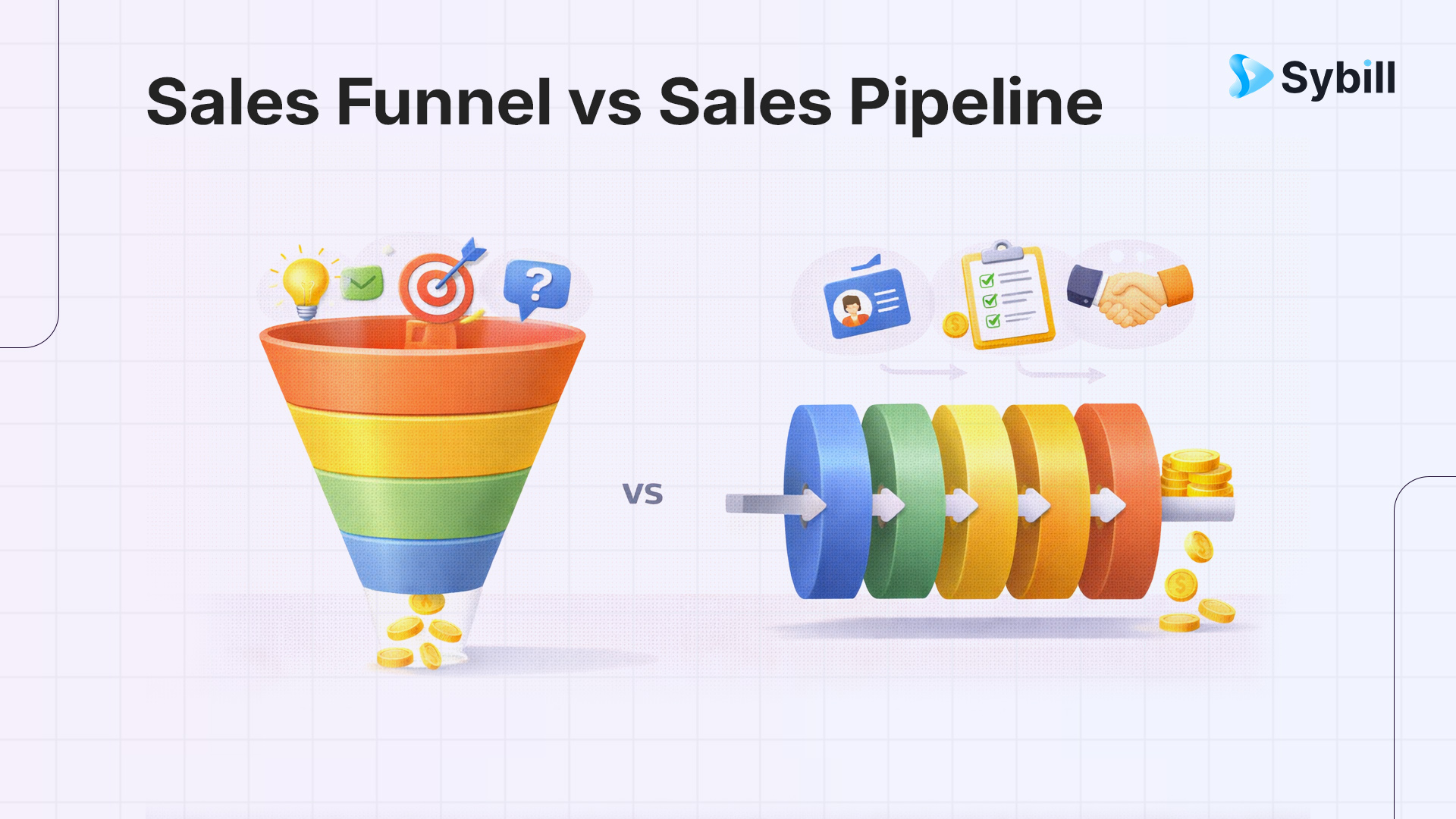
Sales funnels track the buyer's journey from awareness to purchase, measuring conversion rates at each stage. Sales pipelines visualize your team's internal sales process, showing which deals are where and what actions to take next. The funnel answers "Are we attracting the right people?"; the pipeline answers "What should we do today to move deals forward?" You need both, but they're not interchangeable, and mixing them up is costing you deals.
Marketing swears they delivered enough leads. Sales insists the leads were garbage. Finance is recalculating projections. And you're stuck in the middle, staring at a CRM full of opportunities that somehow never materialize into revenue.
A sales funnel tracks the buyer's journey from awareness to purchase and measures conversion rates at each stage (top-of-funnel awareness, mid-funnel consideration, bottom-of-funnel decision), while a sales pipeline visualizes your team's internal sales process showing which deals are at which stage (prospecting, qualification, demo, proposal, negotiation, closed) and their expected revenue value. Use the funnel view for marketing and demand generation strategy — understanding where prospects drop off — and the pipeline view for sales execution and forecasting — knowing which deals need attention and predicting revenue. AI tools like Sybill bridge both views by capturing conversation intelligence from pipeline deals that reveals where buyers actually are in their funnel journey, preventing the common disconnect between where reps place deals in the pipeline and where buyers actually are in their decision process.
This confusion is why your forecast is perpetually optimistic but your actuals keep disappointing. It's why your pipeline looks healthy on paper but conversion rates are abysmal. It's why marketing and sales can't agree on what "qualified" means, why deals stall in limbo for months, and why your best reps are burning out chasing opportunities that were never real to begin with.
The sales funnel and the sales pipeline are not the same thing. They measure different activities, serve different purposes, and require different strategies. Treating them as interchangeable doesn't just create confusion, it creates systematic blind spots that quietly drain revenue, quarter after quarter.
According to research from CSO Insights, only 54% of forecasted deals actually close. Salesforce reports that sales teams spend less than 28% of their week actually selling. And studies consistently show that the gap between pipeline coverage and actual closed revenue is widening, not shrinking.
In the sections that follow, we'll break down exactly what the sales funnel is, what the sales pipeline is, how they differ, how they interact, and most importantly, how to use both to build a predictable, scalable revenue engine.
A sales funnel is the bird's-eye view of how potential customers move from "I have no idea you exist" to "Here's my credit card." It's buyer-centric, conversion-focused, and shaped like, well, a funnel—wide at the top where awareness lives, narrow at the bottom where purchases happen.
Modern B2B buyers don't follow a neat, linear path anymore. They zigzag, backtrack, and disappear for weeks before resurfacing. Research shows buyers are already 57% to 70% through their buying journey before they even contact sales. By the time they raise their hand, they've consumed content, compared competitors, built internal business cases, and probably stalked your LinkedIn profile.
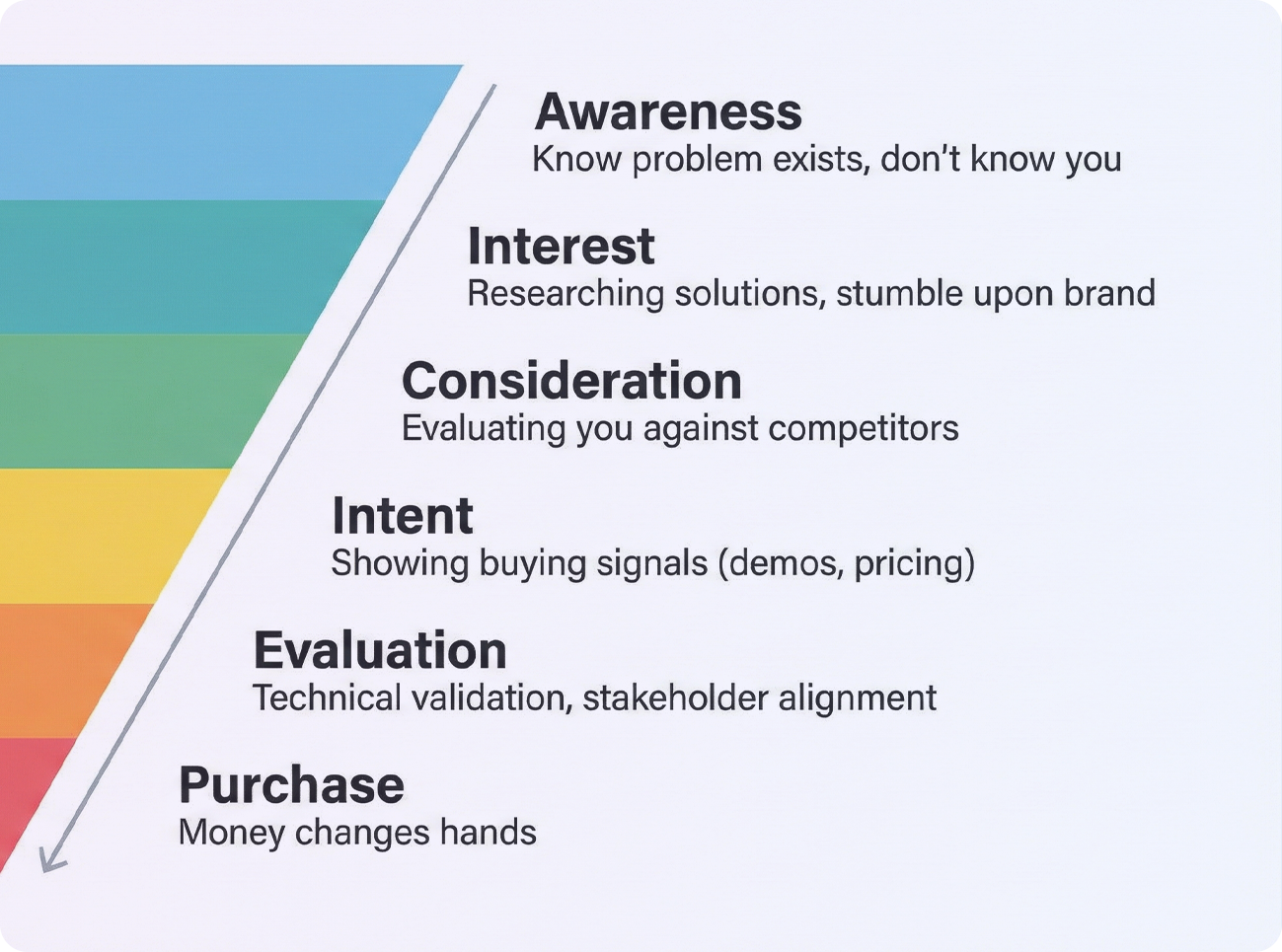
The classic sales funnel stages look something like this:
Awareness → They know a problem exists but don't know you exist yet
Interest → They're researching solutions and stumble upon your brand
Consideration → They're actively evaluating you against competitors
Intent → They're showing buying signals (demo requests, pricing inquiries)
Evaluation → They're deep into technical validation, stakeholder alignment
Purchase → Money changes hands
Learn more about optimizing each stage in our guide to the 6 stages of a B2B sales funnel.
Your funnel tells you how healthy your entire customer acquisition engine is. It answers questions like:
The sales funnel is marketing and sales territory together. It's the strategic blueprint for understanding buyer behavior and optimizing the journey from stranger to customer.
If the funnel is the buyer's journey, the sales pipeline is your team's workflow. It's the internal, seller-focused view of every active deal and where it sits in your process.
A sales pipeline is highly actionable. It's built for the daily grind of selling. It answers:
A typical B2B sales pipeline looks like:
Prospecting → Identifying potential customers
Qualification → Determining if they're a fit (budget, authority, need, timeline)
Discovery → Understanding their pain points and requirements
Proposal/Demo → Presenting your solution
Negotiation → Handling objections, discussing terms
Close → Deal won (or lost)
Notice the difference? The funnel measures buyer behavior and conversion rates. The pipeline tracks seller activities and deal progression.
Your pipeline is what reps live in every day. It's where deals get moved from "initial contact" to "negotiation" to "closed-won." It's also where deals go to die if you're not managing it properly—hello, zombie opportunities sitting in "proposal sent" for 90 days.
Let's make this crystal clear with a side-by-side comparison:
.png)
Here's the most important distinction: your funnel reflects what buyers do; your pipeline reflects what your team does.
The funnel is about conversion efficiency. If 1,000 people enter awareness but only 10 make it to purchase, you've got a funnel problem (probably in qualification or value communication).
The pipeline is about execution and forecasting. If you've got 50 deals in "demo scheduled" but only 5 in "negotiation," you've got a pipeline problem (probably in moving deals forward or qualification rigor).
As Sybill's breakdown of sales pipeline vs sales funnel puts it: pipelines reflect what your team does, funnels measure how well that effort converts. You need both.
The confusion stems from the fact that funnel and pipeline stages often align. For example:
But here's where it gets messy. When sales teams use "funnel" and "pipeline" interchangeably, they start making bad decisions:
Problem 1: Pipeline Bloat
You celebrate adding more deals to the pipeline without checking if they're actually qualified. Result? A fat, impressive-looking pipeline that converts at dismal rates because it's stuffed with tire-kickers.
Problem 2: Funnel Neglect
You obsess over moving individual deals through your pipeline stages but ignore the fact that your top-of-funnel conversion sucks. Result? Your pipeline runs dry in three months because you're not feeding it properly.
Problem 3: Misaligned Metrics
You track "funnel metrics" like lead volume but ignore pipeline health indicators like average deal size or time-in-stage. Result? You hit activity targets but miss revenue goals.
The smartest sales teams? They use both lenses. They analyze the funnel to understand buyer behavior and optimize marketing. They manage the pipeline to prioritize deals and coach reps on execution.
Get started for free with Sybill to automatically track both your funnel health and pipeline progression from every sales conversation.
The magic happens when you integrate both frameworks. Here's how top-performing teams do it:
Your funnel generates the opportunities that fill your pipeline. If your funnel is leaking at the "consideration" stage, your pipeline will eventually run dry because you're not producing enough qualified opportunities.
Action: Regularly audit your funnel conversion rates. If you're losing too many prospects between Interest and Intent, that's a content or nurturing problem—not a sales problem.
Your pipeline tells you which deals are actually closing and which ones stall. That feedback should inform your funnel strategy.
Action: If deals consistently stall at the "Proposal" stage in your pipeline, that's a signal that prospects aren't properly qualified in the funnel. Tighten your qualification criteria at the Interest/Consideration stages.
Marketing typically owns the funnel (awareness through early interest). Sales owns the pipeline (qualification through close). But the handoff between them needs to be seamless.
Action: Define clear criteria for when a lead moves from "Marketing Qualified Lead (MQL)" to "Sales Qualified Lead (SQL)." This is where funnel meets pipeline. Use frameworks like BANT or MEDDPICC to standardize this transition.
Don't just track pipeline metrics like deal count and average deal size. Also monitor funnel metrics like stage-to-stage conversion rates and time-in-stage.
Action: Build dashboards that show both views. Your weekly sales meeting should discuss pipeline movement ("Which deals are closing this week?") AND funnel health ("Are we generating enough qualified pipeline for next quarter?").
The best teams use tools that track both funnel and pipeline activity without creating admin hell for reps.
Sybill integrates with your CRM to automatically capture deal progression, update pipeline stages, and provide insights into both buyer journey patterns and rep activity—all from your sales conversations. No manual data entry, no guesswork.
More deals in your pipeline sounds impressive. But if they're poorly qualified, you're just creating work for your team without creating revenue.
The fix: Focus on pipeline quality metrics like conversion rate and win rate, not just total pipeline value. A smaller, healthier pipeline converts better than a bloated one.
Sales and marketing misalignment is one of the biggest pipeline killers. If marketing is generating garbage leads, your pipeline suffers. If sales isn't providing feedback on lead quality, your funnel stays broken.
The fix: Establish shared definitions of what makes a qualified lead and create regular sync meetings where marketing and sales review funnel performance together.
Moving a deal from "Discovery" to "Proposal" doesn't mean progress if nothing substantive happened. Too many teams advance deals through stages just to show activity.
The fix: Define clear exit criteria for each pipeline stage. What needs to happen before a deal can legitimately move to the next stage? Document it and hold reps accountable.
Deals that sit untouched for 60, 90, or 120 days create a false sense of security. They inflate your forecast and waste rep attention.
The fix: Institute regular pipeline hygiene reviews. If a deal hasn't progressed in 30+ days, it needs a defined next step or it gets closed-lost.
The answer isn't either-or. You need both, but the emphasis depends on your role:
Sales Reps: Pipeline First
Your daily focus should be on moving deals through your pipeline. Which deals need a follow-up? Which are at risk of stalling? What's my next action for each opportunity?
Sales Managers: Pipeline Health + Funnel Flow
You need visibility into both. Are your reps advancing deals effectively (pipeline)? Are you generating enough new opportunities to hit targets next quarter (funnel)?
Marketing Teams: Funnel First
Your job is to keep the top of the funnel healthy and ensure qualified leads are flowing into the sales pipeline. Track awareness metrics, conversion rates, and lead quality.
Revenue Leaders: Both, Always
You're responsible for the entire revenue engine. You need to see how the funnel feeds the pipeline, where conversion drops, and how rep activity impacts outcomes.
The best sales organizations create systems where funnel insights inform pipeline actions and pipeline feedback shapes funnel optimization. It's a flywheel, not a one-way street.
Sales funnel vs sales pipeline isn't a battle. It's a partnership.
Your funnel shows you if you're attracting the right people and if they're moving toward a purchase decision. Your pipeline shows you which specific deals your team is working and what actions will move them to close.
Confuse them, and you'll optimize for the wrong things—more pipeline that doesn't convert, or better funnels that don't get worked properly.
Master both, and you'll have the strategic visibility to plan for the future (funnel) and the tactical clarity to execute today (pipeline).
Want a system that tracks both without drowning your reps in admin work? Get started for free with Sybill. It captures every sales conversation, auto-updates your CRM with deal progression, and gives you clear visibility into both what buyers are doing (funnel) and what your team needs to do next (pipeline).
Because the best sales teams don't debate red pills vs blue pills. They take both and build the Matrix.
While some stages align conceptually (e.g., funnel "Interest" and pipeline "Qualification"), they're measuring different things. The funnel tracks buyer behavior and conversion rates; the pipeline tracks seller actions and deal progression. It's better to define distinct stages for each that reflect their different purposes, even if there's overlap.
If you're generating lots of leads but they're not converting into qualified opportunities, that's a funnel problem, likely in targeting or lead quality. If you have qualified opportunities entering the pipeline but they're stalling or not closing, that's a pipeline problem, likely in sales execution, qualification rigor, or deal management. Look at where prospects are dropping off to diagnose the issue.
Your CRM (like HubSpot, Salesforce, Zoho or Dynamics365) is the foundation for tracking both. For funnel optimization, add marketing automation and analytics tools. For pipeline management, use conversation intelligence platforms like Sybill that automatically capture deal insights, update stages, and provide visibility into both buyer journey patterns and rep execution, without manual data entry.