Find us at booth #83, join us for a harbor side happy hour, or catch Gorish’s talk.

Sept, 16-18 > Learn more


Tamanna Mishra

May 1, 2026
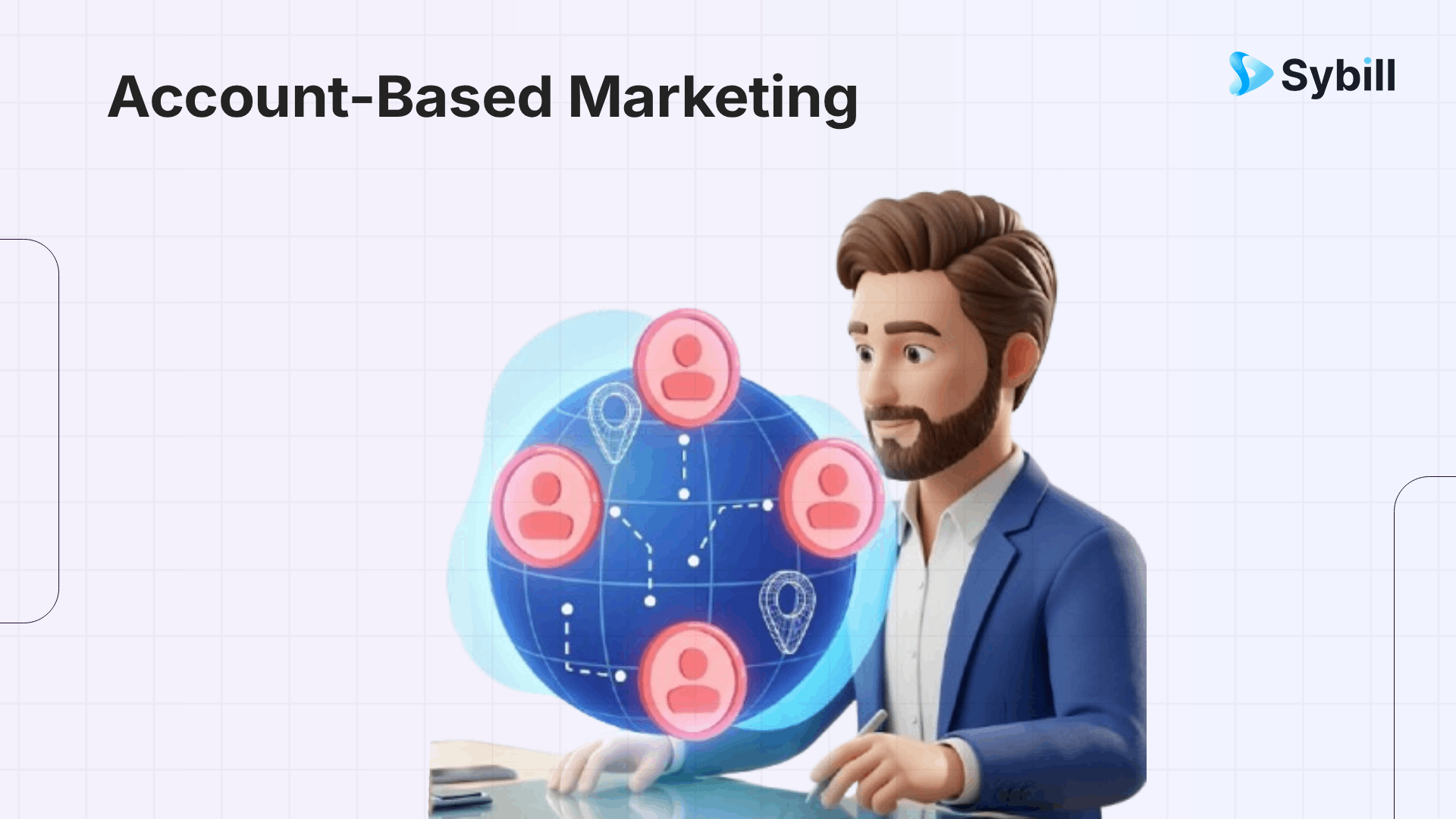
Account-based marketing (ABM) is a B2B strategy where sales and marketing focus on a defined set of high-value accounts instead of chasing individual leads. It prioritizes personalization, alignment, and deal quality over volume. The result? Larger deal sizes, faster cycles, and better win rates. But here’s the catch: most ABM programs fail at execution. This guide breaks down what ABM is, how it works, real examples, and how tools like Sybill help teams actually make it work.
“Let’s do ABM.” Sounds strategic. Feels premium. Looks great in a boardroom.
But what usually happens?
You build a target account list.
Run a few ads.
Send “personalized” emails that aren’t really personalized.
Hope something sticks.
That’s not account-based marketing. That’s lead gen wearing a better outfit.
True ABM is precise. Coordinated. Deeply personalized. And brutally execution-heavy.
Now let’s get into the real thing.
The simple definition
Account-based marketing (ABM) is a B2B strategy where marketing and sales teams work together to identify, target, and engage a set of high-value accounts with personalized campaigns.
Instead of marketing to thousands of leads, you focus on:
ABM is not a campaign. It’s a go-to-market strategy built around accounts, not leads.
That means:
If traditional marketing is fishing with a net, ABM is spear fishing.
Start with your ideal customer profile (ICP):
Then build a target account list (TAL).
ABM is not about one lead.
It’s about:
Most B2B deals involve 6–10 stakeholders. Ignore this, and ABM collapses.
This is where most teams fake it.
Real ABM personalization includes:
Not just “Hi {First Name}”.
ABM works when every touchpoint reinforces the same story:
No silos. No mixed messaging.
Forget MQLs.
Track:
.png)
You’re targeting accounts that already fit your ICP.
Sales and marketing stop fighting over lead quality.
You invest in fewer, better opportunities.
You engage entire buying committees, not just one contact.
This is where it gets interesting. ABM doesn’t fail because of strategy. It fails because of execution gaps.
You know an account is “active.”
You don’t know why.
You’re guessing what matters to the buyer.
Marketing runs campaigns.
Sales runs conversations.
They don’t connect.
Your tools track:
But not:
And that’s where deals are actually won or lost.
Let’s make this real.
Instead of running broad campaigns, they:
Result:
That’s ABM. Not volume. Precision.
.png)
Performance marketing:
ABM:
Both matter. But they solve different problems.
Execution inside real conversations is the hardest part in ABM. And this is where Sybill comes in.
Your stack likely includes:
They tell you:
But not:
Sybill sits on top of your ABM stack and connects:
Signals → Conversations → Actions
Surface patterns across accounts:
Every call summarized with context:
No lost information. No guesswork.
Account intelligence captured automatically:
Follow-ups that reflect real conversations, not templates.
Turns insights into execution:
ABM success depends on:
Sybill strengthens all three by grounding your strategy in real buyer conversations.
Most ABM tools tell you who to target. Sybill makes sure you actually win them.

Account-based marketing is not complicated.
That’s it. But execution? That’s where most teams fail.
Because:
The best ABM strategies don’t just identify opportunities. They act on them consistently.
That’s the difference between pipeline… and closed deals.
ABM (account-based marketing) is a B2B strategy where sales and marketing teams focus on a defined set of high-value accounts instead of individual leads, using personalized campaigns to engage multiple stakeholders.
Account-based marketing means treating each target company as a market of one, aligning sales and marketing efforts to engage decision-makers with tailored messaging and coordinated outreach.
An example of ABM is targeting a shortlist of enterprise companies with personalized ads, emails, and sales outreach tailored to each account’s industry, challenges, and stakeholders.
The 3-3-3 rule involves focusing on 3 accounts, 3 stakeholders per account, and 3 personalized touchpoints to drive deeper engagement and better outcomes.
ABM focuses on high-value accounts with personalized campaigns and long sales cycles, while performance marketing focuses on generating high volumes of leads through broad targeting and short-term conversions.
ABM (account-based marketing) is a B2B strategy where sales and marketing teams focus on a defined set of high-value accounts instead of individual leads, using personalized campaigns to engage multiple stakeholders.
Account-based marketing means treating each target company as a market of one, aligning sales and marketing efforts to engage decision-makers with tailored messaging and coordinated outreach.
An example of ABM is targeting a shortlist of enterprise companies with personalized ads, emails, and sales outreach tailored to each account’s industry, challenges, and stakeholders.





.avif)