
Find us at booth #83, join us for a harbor side happy hour, or catch Gorish’s talk.

Sept, 16-18 > Learn more

%20(1).avif)
Mamta Tainwala

April 11, 2026
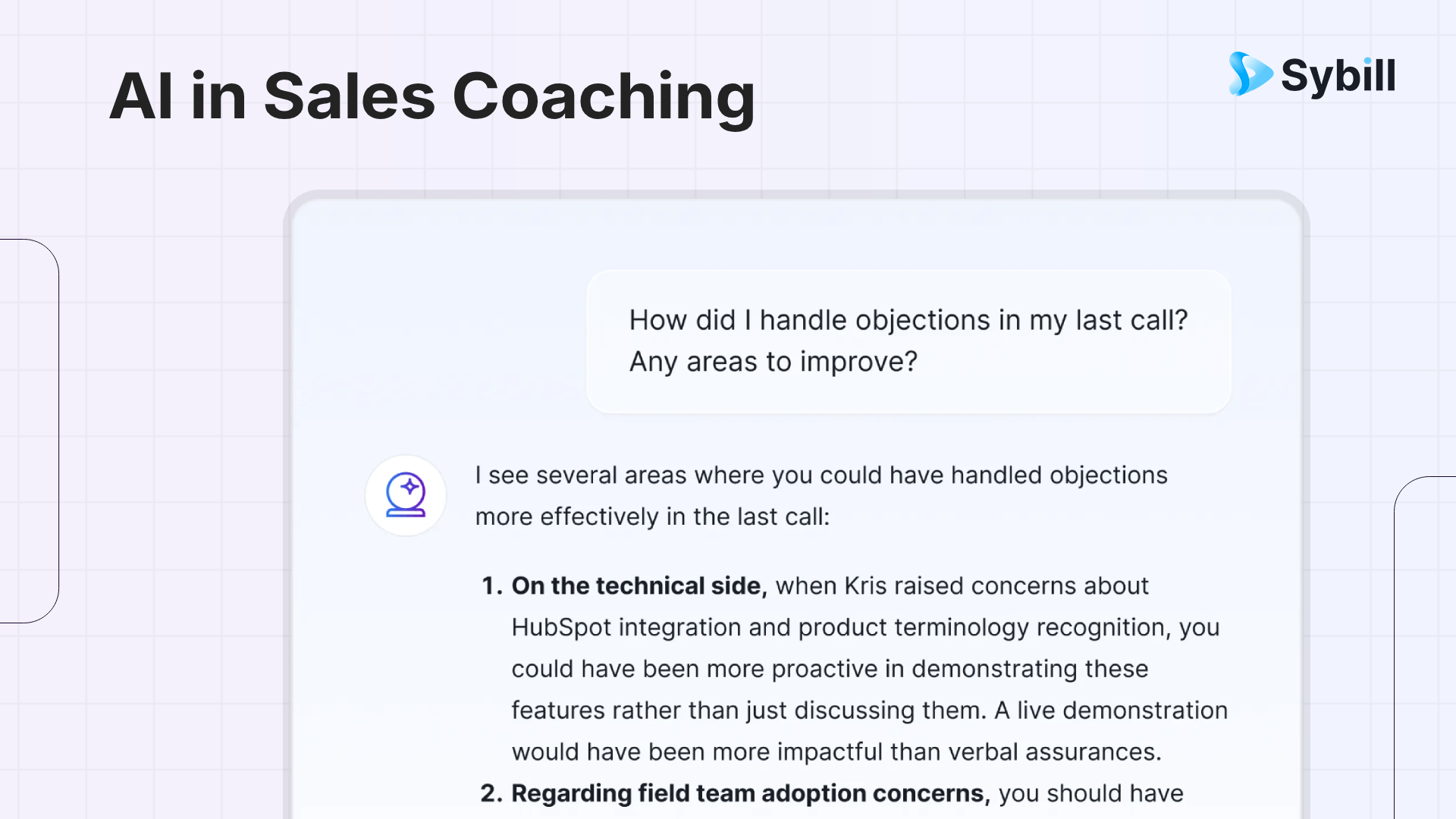
Uncoached reps lose up to 70% more deals than their trained counterparts, according to Sales Focus Advisory. But the problem has never been whether coaching matters. The problem has always been how to deliver it consistently, at scale, without burning out every frontline manager on the team.
Traditional sales coaching is built on a model that cannot keep up. Managers review a handful of calls per week. Feedback arrives days or weeks after the conversation happened. Coaching quality depends on which manager a rep reports to, how much bandwidth that manager has, and whether they happened to catch the right call. The result is inconsistent development, uneven performance, and a coaching program that looks great on paper but produces mediocre outcomes in the pipeline.
AI in sales coaching changes the fundamental mechanics. Instead of relying on selective observation and delayed feedback, AI analyzes every conversation, surfaces patterns across deals, and delivers personalized insights to reps and managers when they can actually act on them. According to Highspot's 2025 State of Sales Enablement Report, B2B companies that incorporate AI coaching programs are 20% more likely to see higher revenue outcomes than those that do not.
This guide breaks down how AI sales coaching actually works in 2026, what separates real coaching intelligence from analytics dashboards, and how to evaluate whether your current stack is helping reps improve or just documenting what went wrong.
AI sales coaching is a data-driven approach that uses artificial intelligence to analyze sales conversations, buyer interactions, and CRM activity to deliver objective, personalized feedback and guidance to sales reps. It replaces the subjective, bandwidth-limited coaching model where managers review a small sample of calls and provide feedback based on memory and opinion.
Modern AI sales coaching platforms analyze every customer interaction, from calls and meetings to emails and CRM entries, and surface patterns that humans would struggle to identify manually. These patterns include which objection-handling approaches correlate with closed deals, where specific reps consistently lose momentum in the sales cycle, which discovery questions lead to deeper engagement, and which deals show early warning signals of stalling.
The shift is from coaching as an event (the quarterly review, the monthly 1:1) to coaching as a continuous, integrated part of the selling workflow. Reps get feedback after every call. Managers get prioritized coaching recommendations based on data, not guesswork. And the entire organization benefits from a coaching system that scales without requiring more manager hours.
AI sales coaching is not a single feature. It is a set of capabilities that work together to turn raw conversation data into coaching actions. Here is how the core components function in practice.
Every AI coaching system starts with conversation intelligence: the ability to record, transcribe, and analyze sales conversations at scale. But in 2026, transcription alone is table stakes. What matters is what the AI does with the conversation data after capture.
Strong conversation intelligence platforms go beyond keywords and talk-to-listen ratios to analyze objection patterns across deals, identify which talk tracks correlate with wins versus losses, detect buyer sentiment shifts during pricing discussions, flag when reps skip critical discovery questions, and surface competitive mentions and how reps respond to them. This analysis creates the raw material for coaching. Without it, coaching remains anecdotal. With it, coaching becomes evidence-based.
The most valuable AI coaching insights do not come from analyzing a single call in isolation. They come from analyzing patterns across hundreds or thousands of calls to identify systemic coaching opportunities.
For example, AI might surface that a specific rep consistently loses deals at the proposal stage, that discovery calls where the economic buyer is absent have a 40% lower close rate, that competitive mentions of a particular vendor increased 3x in the last quarter, or that top performers spend 60% more time on multi-threading than average performers.
These cross-deal patterns are invisible to managers who can only review a handful of calls per week. But they are exactly the insights that drive strategic coaching interventions with measurable impact.
Coaching is only as good as the data it is built on. If CRM data is incomplete, outdated, or inaccurate, every coaching conversation starts from a place of uncertainty. Managers ask reps to "walk me through your pipeline" because they cannot trust what the CRM shows.
AI solves this by automating CRM updates after every interaction. When a tool like Sybill's CRM Autofill populates qualification framework fields, deal stages, next steps, and stakeholder data from actual conversations, the CRM becomes a reliable coaching surface. Pipeline reviews shift from data audits to strategic discussions about deal health, skill gaps, and intervention priorities.
The most significant evolution in AI sales coaching for 2026 is the shift from dashboards to conversations. Instead of requiring managers to navigate analytics interfaces, interpret charts, and manually correlate data points, modern AI coaching tools let managers and reps ask questions in natural language.
A manager can ask: "Which reps are struggling with pricing objections this quarter?" or "Show me deals where discovery depth was below average." The AI returns evidence-backed answers sourced from actual conversations, not CRM stage labels or rep self-reports.
This is how Sybill's Ask Sybill works. It functions as a conversational interface trained on all calls, emails, and CRM data, delivering cross-deal intelligence that would take hours of manual call review to assemble. Managers walk into 1:1s with specific, data-backed talking points instead of generic questions about pipeline.
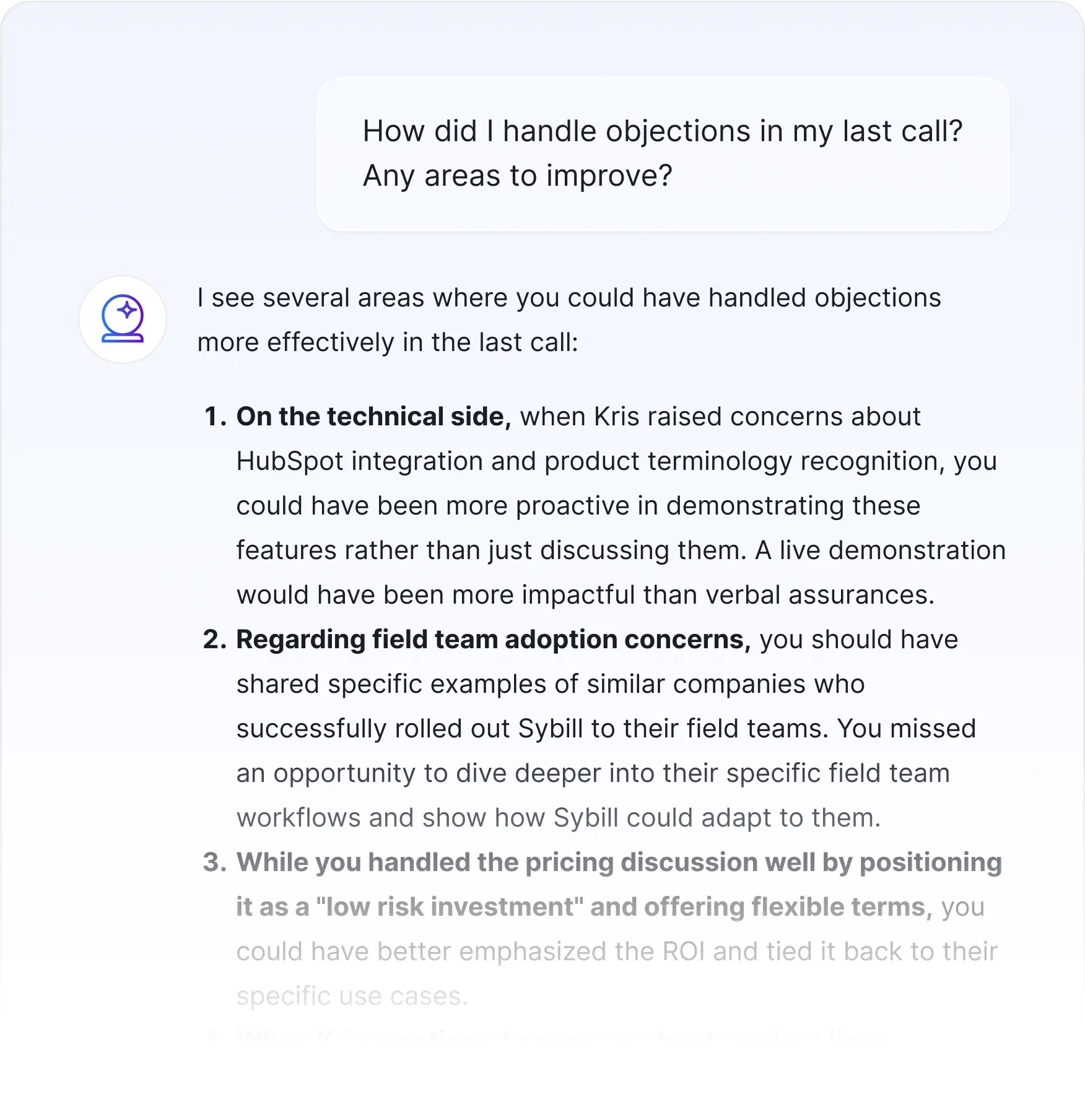
AI in sales coaching operates on two distinct dimensions, and the best coaching programs address both.
Deal coaching is tactical and immediate. It focuses on specific opportunities in the pipeline and answers questions like: What risks exist in this deal? Which stakeholders are missing from the conversation? What objections surfaced in the last meeting? What should the rep do next to advance this opportunity?
AI powers deal coaching by analyzing conversation history across an opportunity and surfacing signals that a manager reviewing one call might miss. A silent decision-maker, a budget concern mentioned casually in a discovery call, a competitive mention that the rep did not address, or a next step that was never confirmed.
Sybill's Deal Workspace centralizes these signals for every opportunity: risks, blockers, stakeholder mapping, and multithreading status. Managers can inspect deal health without assembling information from five different tools.
Skill coaching is strategic and longitudinal. It focuses on developing repeatable capabilities that improve a rep's performance across all deals, not just one. Skill coaching addresses patterns like weak discovery questioning, poor objection handling, inconsistent methodology adherence, or an inability to multi-thread effectively.
AI enables skill coaching at scale by analyzing a rep's performance across dozens or hundreds of conversations and identifying the behavioral patterns that separate their results from top performers. Instead of a manager guessing that a rep "needs to work on discovery," AI can pinpoint that the rep consistently skips the timeline question in 73% of discovery calls, or that their talk-to-listen ratio during pricing conversations is twice the team average.
This level of specificity transforms coaching from generic advice into personalized development with measurable outcomes.
Not every tool that claims "AI coaching" actually delivers coaching. Many provide analytics, dashboards, and call recordings but leave the interpretation and action to the manager. Here is what separates real coaching intelligence from reporting.
The critical question when evaluating AI coaching tools is whether insights translate into execution. A dashboard that shows talk-to-listen ratios is analytics. A system that identifies a rep's specific skill gap, surfaces the relevant call clips, and suggests a coaching intervention is coaching.
Look for tools that close the loop between insight and action. After identifying a coaching opportunity, does the platform help the manager deliver targeted feedback? Does it help the rep practice or improve? Or does it simply present data and hope someone acts on it?
Single-call analysis is useful for post-call review. Cross-deal analysis is what powers real coaching. If the tool can only tell you what happened on one call, it is a call recording platform. If it can tell you what patterns exist across a rep's last 50 calls, or how a specific objection is handled differently by top performers versus struggling reps, it is a coaching platform.
Coaching tools that require reps or managers to visit a separate dashboard, navigate away from their CRM, or spend additional time reviewing interfaces will see low adoption. The best AI coaching tools embed insights into the existing workflow: CRM, Slack, email, and the meeting platform reps already use every day.
Whether your team follows MEDDPICC, BANT, SPICED, or a custom framework, AI coaching should reinforce methodology adherence automatically. This means detecting when qualification criteria are missing from a call, flagging when reps skip stages, and surfacing gaps in methodology execution before they become deal risks.
The best AI coaching tools are bidirectional. Reps use them to self-coach: reviewing their own patterns, understanding where they lose deals, and getting personalized improvement recommendations without waiting for a manager's calendar. Managers use them to prioritize coaching interventions, prepare for 1:1s with data-backed talking points, and track skill development over time.
AI removes the bottleneck of manager bandwidth. Instead of one manager reviewing a handful of calls and coaching a small percentage of interactions, AI analyzes every conversation and delivers personalized feedback to every rep. Managers shift from doing the research to acting on the insights. The result is coaching that reaches every rep, on every deal, without requiring more manager hours.
Onboarding traditionally takes six to nine months before a new rep reaches full productivity. AI shortens that timeline by giving new hires immediate feedback on every call, surfacing examples of top-performer behavior they can model, and identifying specific skill gaps before they become entrenched habits. Instead of learning through months of trial and error, reps learn from their own real conversations with AI-powered analysis from day one.
In traditional coaching, the rep's development depends heavily on which manager they report to. Some managers are excellent coaches. Others are stretched too thin to coach at all. AI normalizes coaching quality by ensuring every rep receives the same depth of analysis, the same quality of insights, and the same accountability for improvement, regardless of who manages them.
When coaching is based on AI analysis of actual conversations, the dynamic changes. Reps cannot dismiss feedback as subjective. Managers do not have to rely on memory or gut feel. Both parties work from the same evidence base: what the buyer actually said, how the rep actually responded, and what the data shows about which approaches produce results.
When AI coaching improves CRM data quality (through automated updates), surfaces deal risks earlier (through cross-deal analysis), and helps reps advance opportunities more effectively (through skill development), forecast accuracy improves as a natural byproduct. Coaching and forecasting are not separate activities. Better coaching produces better data, and better data produces better forecasts.
AI coaching is only as good as the data it analyzes. If your CRM is full of incomplete records, if calls are not being captured consistently, or if email data is siloed, the insights will be shallow or misleading. The first step in implementing AI coaching is ensuring the data infrastructure is sound. Tools like Sybill's CRM Autofill address this directly by ensuring every interaction produces complete, structured CRM data without relying on reps to manually log it.
The most effective coaching programs in 2026 are hybrid. AI handles the heavy lifting: identifying patterns, flagging coaching moments, preparing data for 1:1s, and delivering personalized feedback at scale. Human managers bring context, empathy, encouragement, and the strategic judgment that AI cannot replicate. The pattern is clear: AI finds the insight, the manager delivers the coaching, and the rep executes the improvement.
Reps and managers who feel monitored rather than supported will resist AI coaching tools. The key to adoption is demonstrating that AI coaching saves time (fewer manual CRM updates, faster 1:1 prep, less time searching for call recordings) and improves outcomes (better deal visibility, more personalized feedback, faster ramp). Start with use cases that benefit the rep directly, like automated follow-ups and self-coaching insights, before expanding to manager-facing analytics.
Do not try to implement AI coaching across every workflow simultaneously. Start where the pain is most acute. For most teams, that means post-call automation (summaries, CRM updates, follow-ups) and pipeline review preparation. Once those workflows are running, expand into skill gap analysis, methodology enforcement, and cross-team performance benchmarking.
Sybill is built for the specific coaching workflows that matter most: post-call execution, deal inspection, cross-deal intelligence, and continuous improvement. Here is how each capability maps to coaching outcomes.
Magic Summaries capture what happened in every conversation, including verbal content and non-verbal engagement signals like nods, smiles, and hesitation. Managers get coaching-ready context without reviewing full recordings. Reps get a clear record of what was discussed, what was committed, and what the buyer's real reactions were.
CRM Autofill populates 30+ fields after every interaction, including qualification framework data (MEDDPICC, BANT, SPICED), deal stage progression, next steps, and stakeholder involvement. When CRM data is reliable, coaching conversations start from truth instead of guesswork.
Ask Sybill is the conversational coaching interface. Managers can ask questions like "Which reps are struggling with pricing conversations?" or "Show me calls where discovery depth was below average" and get instant, evidence-backed answers with specific call references. This transforms 1:1 preparation from a manual research task into a 30-second query.
Deal Workspace centralizes risks, blockers, stakeholder mapping, and deal momentum for every opportunity. Managers can inspect deal health visually and identify coaching intervention points without assembling data from multiple sources.
Pre-Call Briefs aggregate buyer history, previous objections, and relevant context from earlier conversations into a concise preparation document. Reps show up to every call prepared, and managers can evaluate preparation quality as part of the coaching process.
Follow-Up Emails draft themselves in the rep's own voice using actual conversation context. Managers can evaluate follow-up quality without waiting for reps to send them, and reps benefit from AI assistance that improves their written communication over time.
Together, these capabilities create a coaching system that is always on, evidence-based, and embedded in the selling workflow. Coaching does not require a separate tool, a separate meeting, or separate manager bandwidth. It happens as a natural byproduct of every conversation.
The teams that outperform in 2026 are not coaching more. They are coaching smarter. They are replacing anecdotal feedback with evidence-based insights, swapping delayed reviews for always-on analysis, and building coaching into the selling workflow instead of treating it as a separate activity.
Get started for free with Sybill and see what coaching looks like when every conversation becomes a learning opportunity.
What is AI sales coaching?
AI sales coaching is a technology-driven approach that uses artificial intelligence to analyze sales conversations, CRM data, and buyer interactions to deliver personalized, objective coaching feedback to sales reps. Unlike traditional coaching that depends on manager bandwidth and selective call review, AI coaching analyzes every interaction at scale and surfaces patterns, skill gaps, and deal risks that inform targeted development. The goal is to make coaching continuous, evidence-based, and available to every rep, not just those with the most attentive managers.
Does AI replace human sales managers in coaching?
No. AI augments human coaching by handling the analysis and pattern recognition that managers do not have time to do manually. The most effective programs in 2026 use a hybrid model: AI identifies the coaching opportunity, prepares the data, and surfaces the insight. The human manager delivers the feedback with context, empathy, and strategic judgment. AI makes managers more effective coaches; it does not replace the human relationship that drives behavior change.
How does AI sales coaching improve forecast accuracy?
AI coaching improves forecast accuracy by improving the upstream inputs that forecasts depend on. When CRM data is complete and accurate (through automated updates), when deal risks are identified early (through cross-deal analysis), and when reps advance opportunities more effectively (through skill development), the data flowing into forecast models is higher quality. Forecasting becomes proactive rather than reactive, and pipeline reviews become coaching conversations rather than data audits.
What data does AI need to deliver effective coaching?
AI coaching requires access to conversation data (call recordings and transcripts), CRM records (deal stages, activities, field data), email interactions, and calendar data. The richer the data set, the more accurate and actionable the coaching insights. Platforms like Sybill integrate across all of these sources to create a unified view of rep performance and deal health.
How long does it take to see results from AI sales coaching?
Most teams see immediate productivity gains from post-call automation (CRM updates, follow-up emails, meeting summaries) within the first week. Coaching-specific outcomes like improved objection handling, better discovery depth, and shorter ramp times typically emerge within 30 to 90 days as the AI accumulates enough conversation data to identify meaningful patterns and deliver personalized recommendations.
Can AI coaching work with my existing sales methodology?
Yes. Strong AI coaching platforms support MEDDPICC, BANT, SPICED, and custom frameworks. Sybill auto-populates methodology-specific CRM fields from conversations and flags when qualification criteria are missing or incomplete. This turns methodology from a theoretical framework into an enforced, measurable practice.
AI sales coaching is a technology-driven approach that uses artificial intelligence to analyze sales conversations, CRM data, and buyer interactions to deliver personalized, objective coaching feedback to sales reps. Unlike traditional coaching that depends on manager bandwidth and selective call review, AI coaching analyzes every interaction at scale and surfaces patterns, skill gaps, and deal risks that inform targeted development. The goal is to make coaching continuous, evidence-based, and available to every rep, not just those with the most attentive managers.
No. AI augments human coaching by handling the analysis and pattern recognition that managers do not have time to do manually. The most effective programs in 2026 use a hybrid model: AI identifies the coaching opportunity, prepares the data, and surfaces the insight. The human manager delivers the feedback with context, empathy, and strategic judgment. AI makes managers more effective coaches; it does not replace the human relationship that drives behavior change.
AI coaching improves forecast accuracy by improving the upstream inputs that forecasts depend on. When CRM data is complete and accurate (through automated updates), when deal risks are identified early (through cross-deal analysis), and when reps advance opportunities more effectively (through skill development), the data flowing into forecast models is higher quality. Forecasting becomes proactive rather than reactive, and pipeline reviews become coaching conversations rather than data audits.








