Find us at booth #83, join us for a harbor side happy hour, or catch Gorish’s talk.

Sept, 16-18 > Learn more

%20(1).avif)
Mamta Tainwala

February 12, 2026
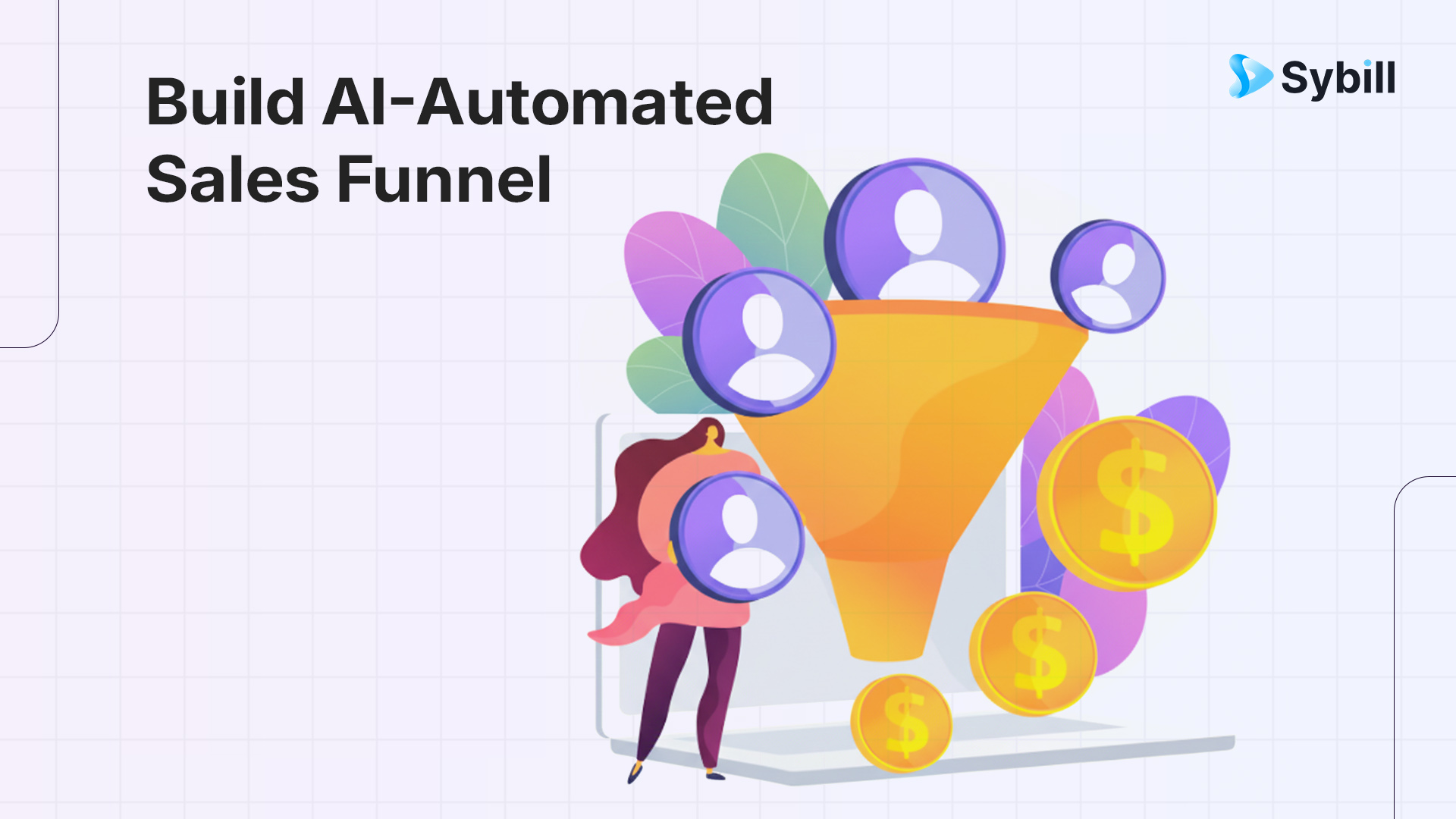
TL;DR: Building an AI-automated sales funnel comes down to six moves:
1. Use AI to research and score leads so reps only chase prospects worth chasing
2. Auto-capture qualification signals from live conversations instead of relying on reps to log them manually
3. Trigger personalized follow-ups within minutes of every call using actual deal context, not templates
4. Surface deal intelligence and objection patterns at the conversion stage so reps close with data, not hope
5. Let AI fill your CRM after every interaction so pipeline data reflects reality, and
6. Monitor retention signals to catch churn risks before renewal conversations.
Start with CRM automation and follow-ups (the biggest time sinks), then layer in intelligence. The whole system compounds: better data feeds better scoring, which feeds better conversations, which feeds better data.
You pour leads into the top, commit your reps to working them, and then watch in slow-motion horror as prospects leak out of every stage because nobody can follow up fast enough, CRM data goes stale, and the "hot leads" turn cold before anyone gets to them. Well, life without automation sucks and even in the age of AI, is the reality of some reps.
The trap is not the funnel itself. Funnels work. The trap is trying to run one manually in 2026 when your buyers expect instant personalization, your competitors are using AI to respond in minutes, and your reps are drowning in admin instead of selling.
AI does not just patch the leaks. It redesigns the plumbing. And the best part? You do not need to rip out your existing stack to make it work. You need to be strategic about where AI plugs in and what it automates at each stage.
Let's build this thing, step by step.
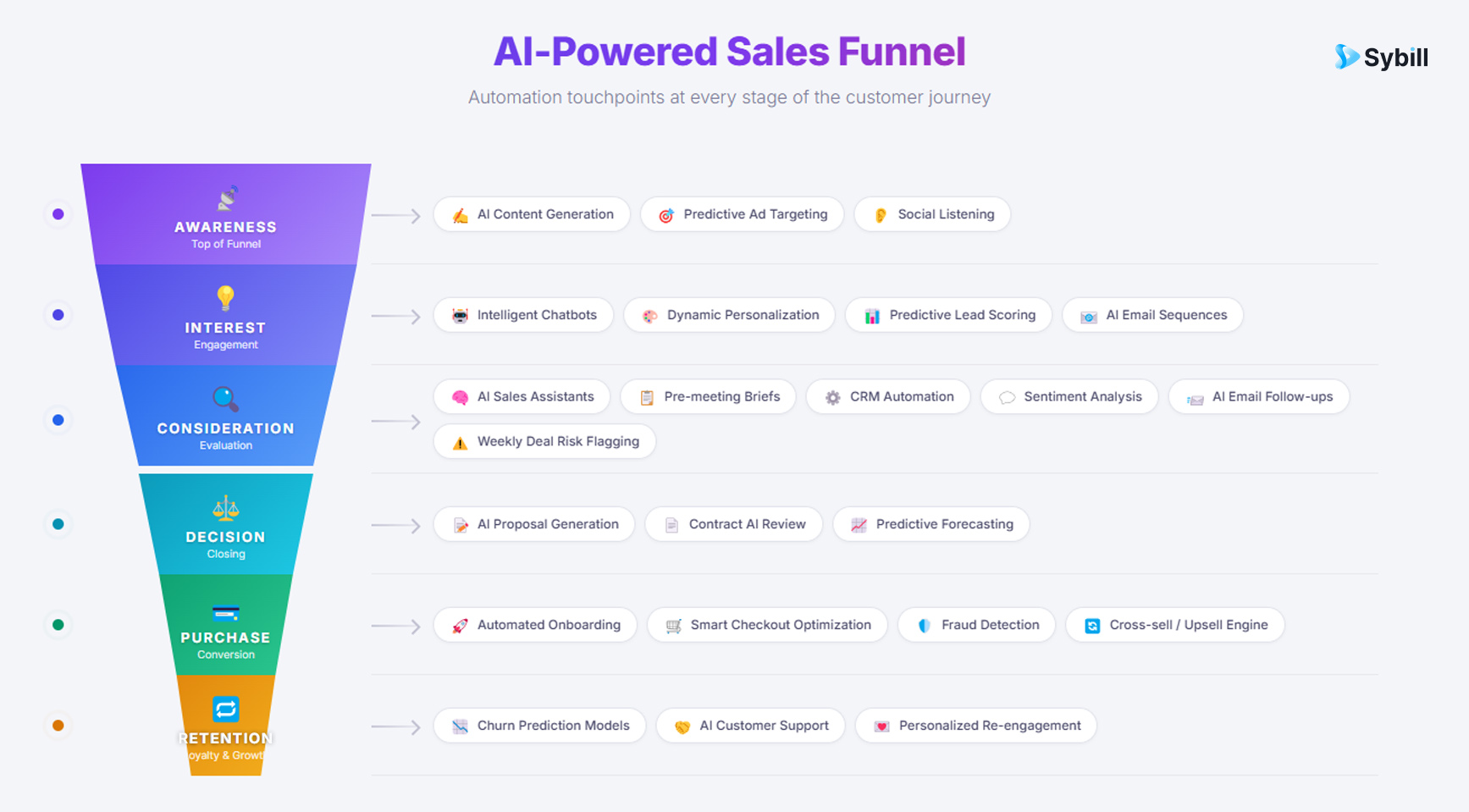
An AI-automated sales funnel is the same fundamental buyer journey you already know, with intelligence layered into each stage so the right things happen at the right time without a human manually triggering every action.
The classic funnel stages still apply. Awareness is where prospects discover you. Interest is where they engage. Evaluation is where they compare options. Decision is where they commit. Retention is where you keep them. If you want a deeper dive into the stages of a B2B sales funnel, that is worth a read on its own.
What changes with AI is not the structure but the execution. Instead of a rep manually scoring leads based on gut instinct, AI analyzes behavioral signals and scores them in real time. Instead of a rep spending 20 minutes drafting a follow-up email after every call, AI drafts it in seconds using the actual conversation as context. Instead of CRM fields sitting empty for weeks until someone gets around to auto-updating them, AI fills them after every interaction.
The result is a funnel that moves faster, leaks less, and lets your reps spend their limited hours on the work that actually requires a human: building relationships, handling complex objections, and closing deals.
Every funnel starts with a question: who should we be talking to?
Traditionally, this meant hours of manual research. Reps scrolled through LinkedIn, cross-referenced firmographic data in spreadsheets, and tried to piece together whether a company fit the ideal customer profile. It was tedious, inconsistent, and ate into the time reps should have been spending on actual conversations.
AI collapses that research cycle dramatically.
Automated audience intelligence. AI tools can analyze your existing customer base and identify the patterns that define your best accounts, including industry, company size, technology stack, buying behavior, and engagement history. That pattern becomes your ideal customer profile, and AI uses it to surface lookalike prospects you would have missed.
Lead enrichment on autopilot. Once you have a prospect's name and company, AI can pull in job title, recent company news, tech stack details, LinkedIn activity, and more. What used to take a rep fifteen minutes per lead now happens in seconds across hundreds of leads simultaneously.
Prioritization that is data-driven, not gut-driven. Not all leads are created equal, and AI helps your team stop treating them like they are. By analyzing intent signals, engagement patterns, and firmographic fit, AI sorts your leads by likelihood to convert. Your reps contact the hottest leads first and stop wasting cycles on people who were never going to buy.
The key here is not just generating more leads. It is generating better ones and giving your reps the context they need before the first conversation even starts. Sybill's pre-meeting briefs do exactly this by automatically pulling deal history, attendee backgrounds, and company insights, so reps walk into every call prepared.
Lead qualification is where most funnels start bleeding. A lead comes in, gets a surface-level assessment, and either gets chased prematurely or ignored until it is too late. The problem is rarely a lack of framework. Most sales orgs have heard of BANT or MEDDPICC. The problem is consistent execution.
AI solves the consistency problem by embedding qualification into the conversation itself.
Real-time signal capture. During a discovery call, AI listens for the signals that matter: budget mentions, authority indicators, pain point specificity, timeline urgency. Instead of relying on a rep to remember and log these details after the call (spoiler: they often don't), AI captures them automatically. Sybill's conversation intelligence does this by analyzing every call and extracting qualification criteria like budget signals, decision-maker involvement, and competitive mentions, then writing them directly into your CRM.
Scoring that refreshes with every interaction. Static lead scores are almost useless because a lead that was cold two weeks ago might be warm today after engaging with three pieces of content and attending a webinar. AI-powered lead qualification re-scores continuously based on new data, so your pipeline always reflects reality.
Framework compliance without the friction. The reason qualification frameworks fail is not that they are wrong. It is that filling them out is boring. When AI auto-populates BANT or MEDDPICC fields from conversation data, reps actually have complete qualification records without adding a single minute to their workflow.
The middle of the funnel is where patience meets persistence. Leads know who you are. They have shown some interest. But they are not ready to buy yet. This is where most deals die quietly, not because the lead was bad, but because the follow-up was late, generic, or just stopped altogether.
AI keeps the middle of your funnel alive in three critical ways.
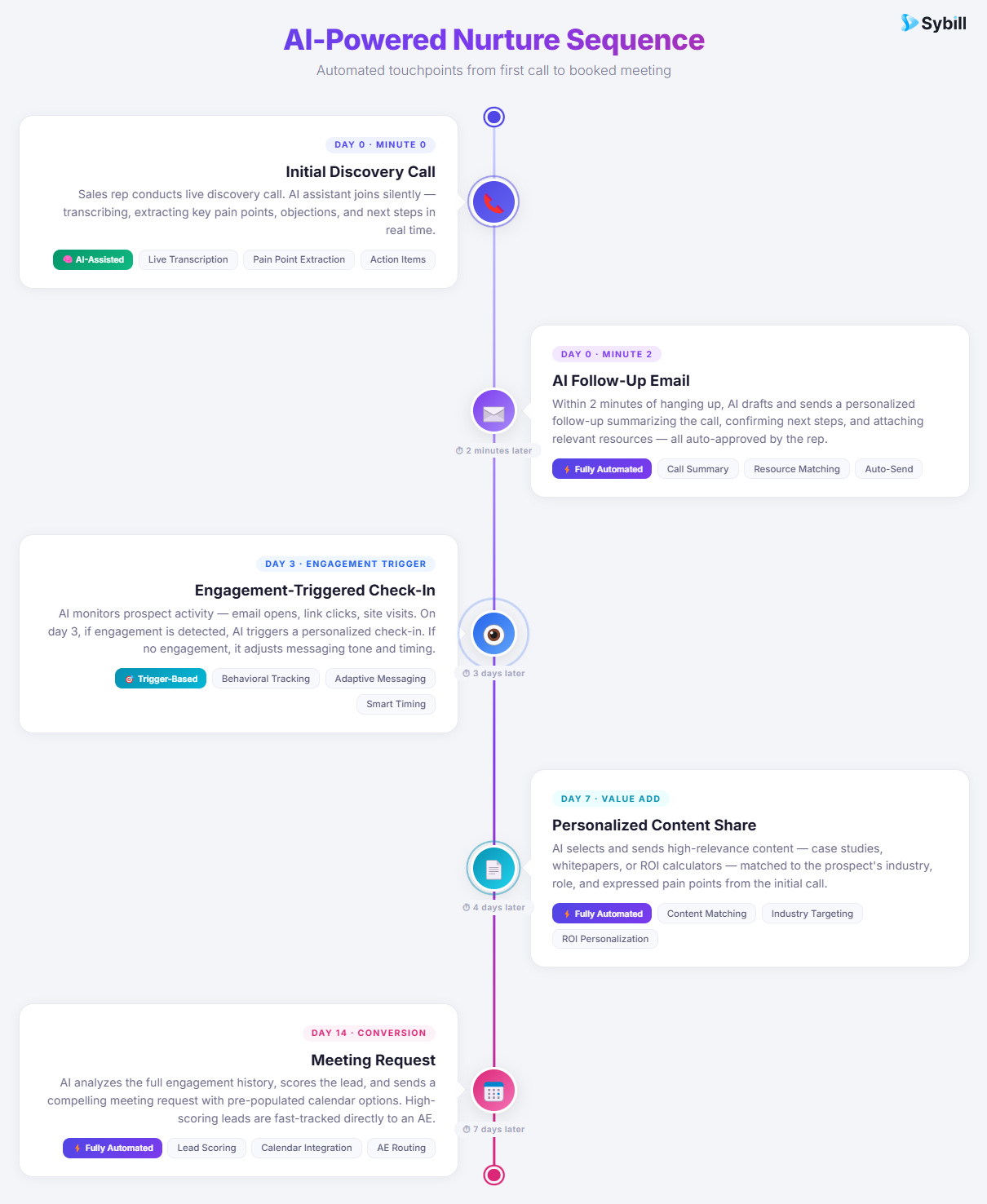
Personalized follow-ups that write themselves. After every call, demo, or email exchange, AI can draft a follow-up that references specific pain points discussed, next steps agreed upon, and the right tone for the relationship. Sybill generates AI follow-up emails that sound like the rep wrote them, because they are trained on the rep's actual writing style and the context of the conversation.
Timing that adapts to buyer behavior. AI does not just send follow-ups on a fixed schedule. It watches for engagement signals, like a prospect reopening a proposal email or revisiting your pricing page, and triggers outreach at the moment of highest intent. That is the difference between "just checking in" and "reaching out because I noticed you were looking at X."
Segmented nurturing at scale. Not every lead in the middle of your funnel needs the same treatment. A technical evaluator needs different content than a VP of Sales. AI segments your leads based on their role, stage, engagement level, and expressed interests, then routes the right content to the right person. Your reps handle the high-touch conversations. AI handles everything else.
The follow-up email templates that Sybill offers are a good example of how this works in practice. They pull in deal-specific context, objections, and next steps automatically, so every touchpoint advances the conversation rather than just occupying inbox space.
Get started for free with Sybill and let AI handle your follow-ups, CRM updates, and deal prep while you focus on closing.
Conversion is where everything upstream either pays off or falls apart. The prospect has been nurtured. They are evaluating your solution against alternatives. The final stretch demands precision: the right information, the right timing, and zero dropped balls.
AI sharpens the conversion stage in ways that are hard to replicate manually.
Deal intelligence that surfaces what matters. By the time a deal reaches the conversion stage, there is a trail of calls, emails, and interactions behind it. AI synthesizes all of that context into a clear picture of where the deal stands, what risks exist, and what needs to happen next. Sybill's Deal Summaries do this by aggregating insights from every touchpoint and updating your CRM in real time, so reps and managers never have to dig through transcripts to understand a deal.
Objection handling backed by data. Every sales team faces a handful of recurring objections. AI identifies which objections come up most frequently across your team's calls, which responses work best, and where reps tend to stumble. That cross-deal intelligence turns individual call experience into team-wide knowledge. Sybill's Ask Sybill feature lets reps query their deal data conversationally, pulling up past objections, competitor mentions, and successful responses in seconds.
Proposals and collateral generated on the fly. When a deal is moving, speed matters. AI can generate custom proposals, business cases, and one-pagers using deal-specific data, saving reps the hours they would normally spend building these from scratch.
Pipeline visibility for managers. Conversion is not just a rep-level concern. Sales managers need to see which deals are healthy, which are stalled, and which need intervention. AI-powered pipeline views flag risks automatically, like deals with no next steps, single-threaded relationships, or engagement that has dropped off. Sybill's pipeline management capabilities give managers this visibility without requiring reps to spend their evenings updating CRM fields.
Nobody likes to say this out loud but your funnel is only as good as your CRM data. And for most teams, CRM data is somewhere between “as far as my memory goes” and "creative fiction."
Reps hate updating CRM. That is not a character flaw. It is a rational response to a task that feels low-value, takes forever, and usually happens at the end of an already long day. The result is empty fields, stale deal stages, and pipeline views that are essentially fantasy.
AI fixes this at the root by making CRM updates a byproduct of selling, not a separate chore.
Auto-filling fields from conversation data. After every call and email, AI extracts the signals that matter: pain points, objections, next steps, competitors mentioned, stakeholders identified, and qualification criteria. Then it writes them into your CRM in a format that sounds human and reads useful. Sybill's CRM Autofill does this across unlimited fields with a 99% fill rate, adapting to your team's sales methodology whether that is BANT, MEDDPICC, SPICED, or something custom.
Updates that evolve with the deal. Most CRM automation overwrites old data with new data after each call. AI-powered systems are smarter. They understand how a deal is progressing and update fields in context, so your CRM reflects the full arc of the relationship, not just the last conversation.
Cleaner pipeline, better forecasting. When CRM data is actually reliable, everything downstream improves. Pipeline reviews become coaching sessions instead of data-entry audits. Forecasts get more accurate because they are based on real deal signals, not optimistic guesses. Managers can spot at-risk deals early and intervene before revenue slips.
The funnel does not end at "closed won." The most profitable deals come from expanding existing relationships, and AI helps here too.
Churn risk detection. AI monitors engagement patterns, support interactions, and usage data to flag accounts that might be at risk before the renewal conversation even starts. Early warning means proactive outreach, not reactive damage control.
Upsell and cross-sell intelligence. By analyzing what your customer has purchased, how they use your product, and what adjacent problems they have mentioned in calls, AI identifies natural expansion opportunities. A rep who walks into a QBR knowing that the customer mentioned "scaling their SDR team" three months ago has a very different conversation than one who walks in blind.
Automated health checks. AI can trigger check-in sequences, satisfaction surveys, and success milestone emails based on account activity, ensuring that your customers feel supported without requiring a CSM to manually track every account.
Even with AI, funnels can go sideways. Here are the pitfalls worth avoiding:
An AI-automated sales funnel is not about replacing your sales team with robots. It is about removing the friction that keeps good reps from doing great work. It is about follow-ups that land in minutes, not days. CRM data that reflects reality, not wishful thinking. Pipeline visibility that lets managers coach instead of audit.
The teams that build this infrastructure now are creating a compounding advantage. Every automated follow-up, every auto-filled CRM field, every AI-surfaced deal insight makes the system a little smarter and the team a little faster. Over time, that gap becomes very hard to close.
Admiral Ackbar did not have AI to help him spot the trap. You do.
Get started for free with Sybill and build a sales funnel that runs, learns, and converts while your team focuses on what they do best.
What is an AI-automated sales funnel?
An AI-automated sales funnel is a structured buyer journey where artificial intelligence handles repetitive tasks at each stage, including lead scoring, personalized outreach, follow-up emails, CRM updates, and deal analytics. It keeps leads moving through the funnel without requiring reps to manually manage every interaction.
How does AI improve lead qualification in a sales funnel?
AI captures qualification signals directly from conversations, such as budget mentions, authority indicators, and timeline urgency, and updates CRM fields automatically. This ensures qualification frameworks like BANT or MEDDPICC stay accurate and current without adding to rep workload.
Can I automate my sales funnel without replacing my existing CRM?
Yes. The best AI sales tools layer on top of your current stack rather than replacing it. Sybill integrates with Salesforce, HubSpot, and other major CRMs, automating data entry and surfacing deal intelligence without requiring you to switch platforms.
How much time does AI funnel automation save sales reps?
Most teams report saving 5-10 hours per rep per week by automating CRM updates, follow-up email drafting, meeting prep, and deal reporting. That time goes directly back into selling and relationship-building.
What is the difference between a sales funnel and a sales pipeline?
A sales funnel represents the buyer's journey from awareness to purchase, focusing on the customer's perspective. A sales pipeline represents your internal sales process, tracking where deals stand and what actions need to happen next. Both are essential, and AI can automate elements of each.
Is an AI-automated sales funnel only for large sales teams?
No. Solo reps and small teams often benefit the most because they have the least bandwidth for manual admin. AI gives a two-person team the operational capacity of a much larger org by handling the busywork automatically.
An AI-automated sales funnel is a structured buyer journey where artificial intelligence handles repetitive tasks at each stage, including lead scoring, personalized outreach, follow-up emails, CRM updates, and deal analytics. It keeps leads moving through the funnel without requiring reps to manually manage every interaction.
AI captures qualification signals directly from conversations, such as budget mentions, authority indicators, and timeline urgency, and updates CRM fields automatically. This ensures qualification frameworks like BANT or MEDDPICC stay accurate and current without adding to rep workload.
Yes. The best AI sales tools layer on top of your current stack rather than replacing it. Sybill integrates with Salesforce, HubSpot, and other major CRMs, automating data entry and surfacing deal intelligence without requiring you to switch platforms.