Find us at booth #83, join us for a harbor side happy hour, or catch Gorish’s talk.

Sept, 16-18 > Learn more

%20(1).avif)
Mamta Tainwala

March 31, 2026
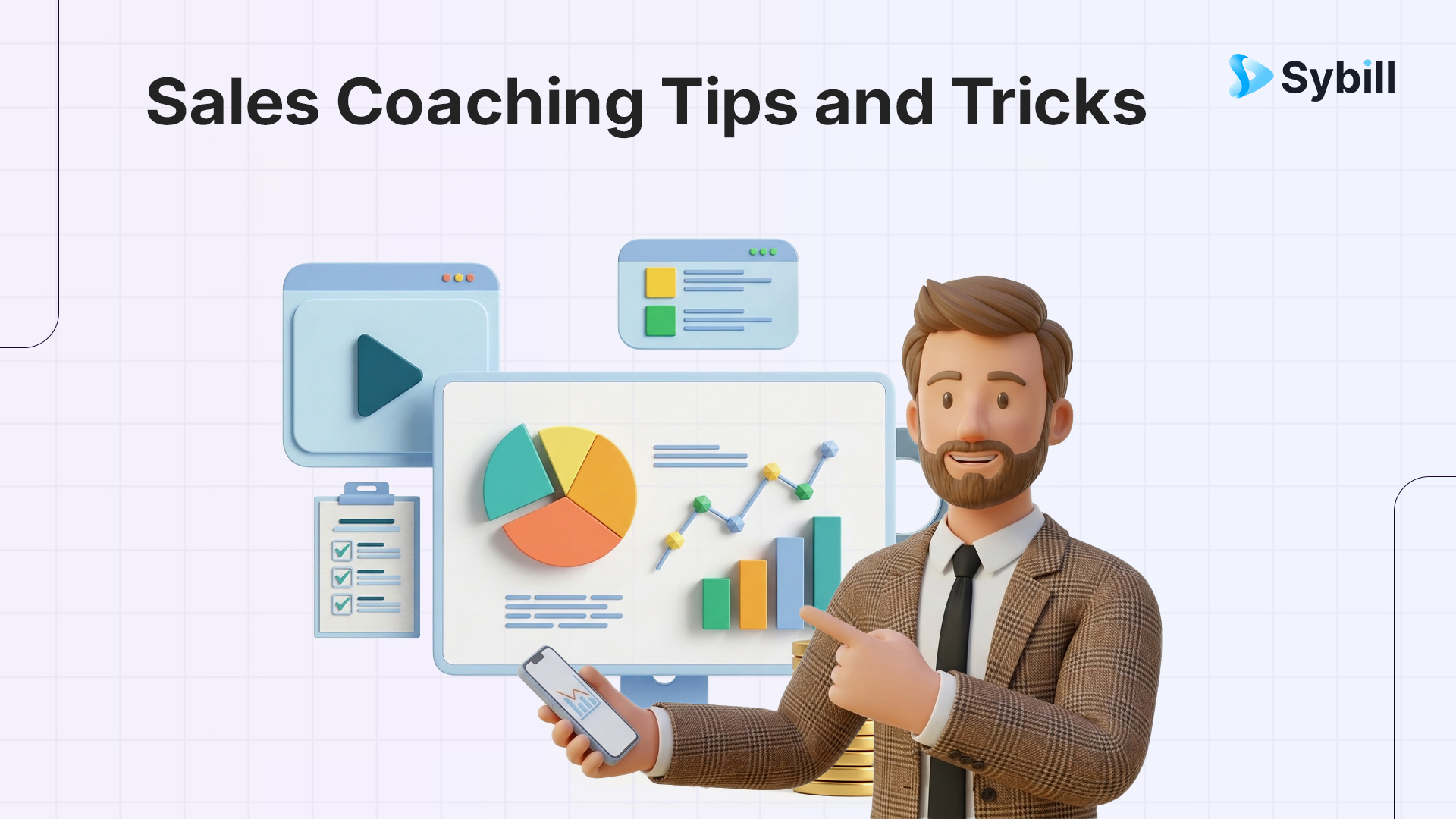
Sales coaching is the single highest-leverage activity a sales manager can invest time in. Not pipeline reviews. Not forecast calls. Not the fifth follow-up Slack about updating CRM fields. Coaching.
According to Gartner, effective coaching can boost sales performance by 8%. That might sound modest until you multiply it across a 20-person team closing six- and seven-figure deals. The problem is not that managers don't want to coach. It is that coaching gets squeezed between deal fires, internal meetings, and the relentless grind of administrative overhead.
This guide is built for sales leaders who want practical, actionable sales coaching techniques that work in the real world of too-many-deals and not-enough-hours. We will walk through 15 tips and tricks that span both strategic and tactical coaching, show you how to measure what is working, and explain how AI-powered coaching tools are making it possible to coach every rep on every deal without burning out.
Let's get into it.
Sales coaching is the structured, ongoing process of helping individual reps develop the skills, habits, and deal awareness they need to perform at their best. It is not a quarterly performance review dressed up with a friendlier name. It is not micromanagement. And it is definitely not a forecast call where the manager interrogates reps about close dates.
Good coaching, as we break down in our guide to deal coaching that wins, shifts from telling to asking. It nudges reps to analyze, self-correct, and grow rather than waiting for a manager to point out what went wrong. The best coaches help reps think like strategists, not script readers.
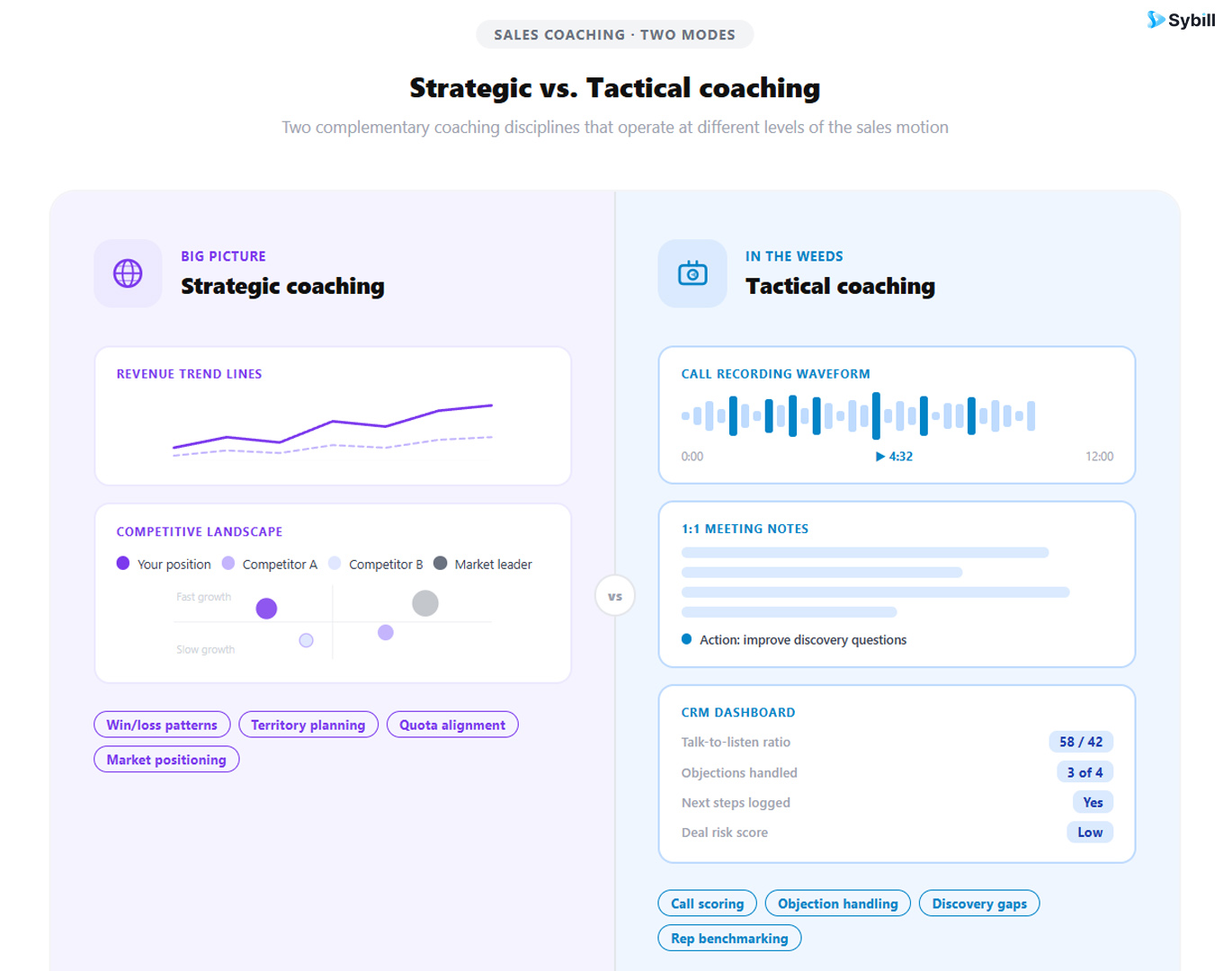
Coaching broadly falls into two categories:
Strategic coaching addresses higher-level concepts. Think market intelligence, competitive positioning, shifts in buyer behavior, and how your product fits into larger industry narratives. This is where you share examples of best-in-class calls, discuss trends from across all meetings, and help reps understand the "why" behind their approach. For managers who want to see how this connects to seller skill development, our post on AI sales training dives deeper.
Tactical coaching is the day-to-day work of helping reps take the right actions at the right time. Reviewing specific calls, evaluating follow-ups, practicing selling techniques, and diagnosing why a deal is stuck. This is the type of coaching that happens in weekly 1:1s, call reviews, and pre-meeting huddles.
The most effective coaching programs blend both, and the top sales coaches in 2026 all operate with this dual lens.
Buying cycles are longer. Decision-making committees are bigger. And the gap between your top performer and your bottom quartile is not talent. It is coaching frequency. Top sales organizations coach 20% more than average teams, and the difference compounds fast.
Here is why coaching should sit at the top of every sales leader's priority list this year:
Buyers expect more. Prospects are better informed than ever. A rep who shows up with a generic pitch gets dismissed in the first five minutes. Coaching helps reps move from product-first conversations to buyer-first ones, a skill we unpack in our guide to the best discovery questions for sales.
Rep turnover is expensive. B2B sales is notorious for high attrition. Reps who feel invested in, who see a clear growth path, and who get regular, meaningful feedback stay longer. Coaching directly impacts retention, and replacing a rep costs somewhere between 50% and 200% of their annual salary depending on the role.
Remote and hybrid work changed the game. The hallway debrief after a tough call is gone for most teams. Coaching has to be more intentional, more structured, and more data-driven than it was when you could simply walk over to a rep's desk.
AI made coaching scalable. This is the biggest shift. Tools like Sybill now analyze every call, surface coaching moments automatically, and let managers ask cross-deal questions that would have taken hours to research manually. We will cover this in depth later.
You cannot coach someone who does not trust you. Sales reps are sharp readers of people, and they will spot a disingenuous coaching effort from a mile away. If a rep believes their manager is coaching to check a box rather than to genuinely help, they will tune out.
Building trust starts with honest, transparent communication. Ask reps how they prefer to be coached. Listen more than you talk in your first few 1:1s. Share your own failures, not just your wins. Trust takes time, so treat it as a long-term investment that pays dividends in every future coaching conversation.
The days of coaching based on vibes are over. If you walk into a 1:1 without data, you are guessing. And guessing is not coaching.
Track key activities and outcomes for each rep. Use conversation intelligence tools to surface patterns you would never catch by manually reviewing calls. With Sybill, managers can ask questions like "Which rep needs help with objection handling?" or "Which deals are stuck in negotiation?" and get instant, data-backed answers through Ask Sybill.
Data-driven coaching creates a shared understanding between manager and rep. When both parties see the same numbers, the conversation shifts from defensive to collaborative.
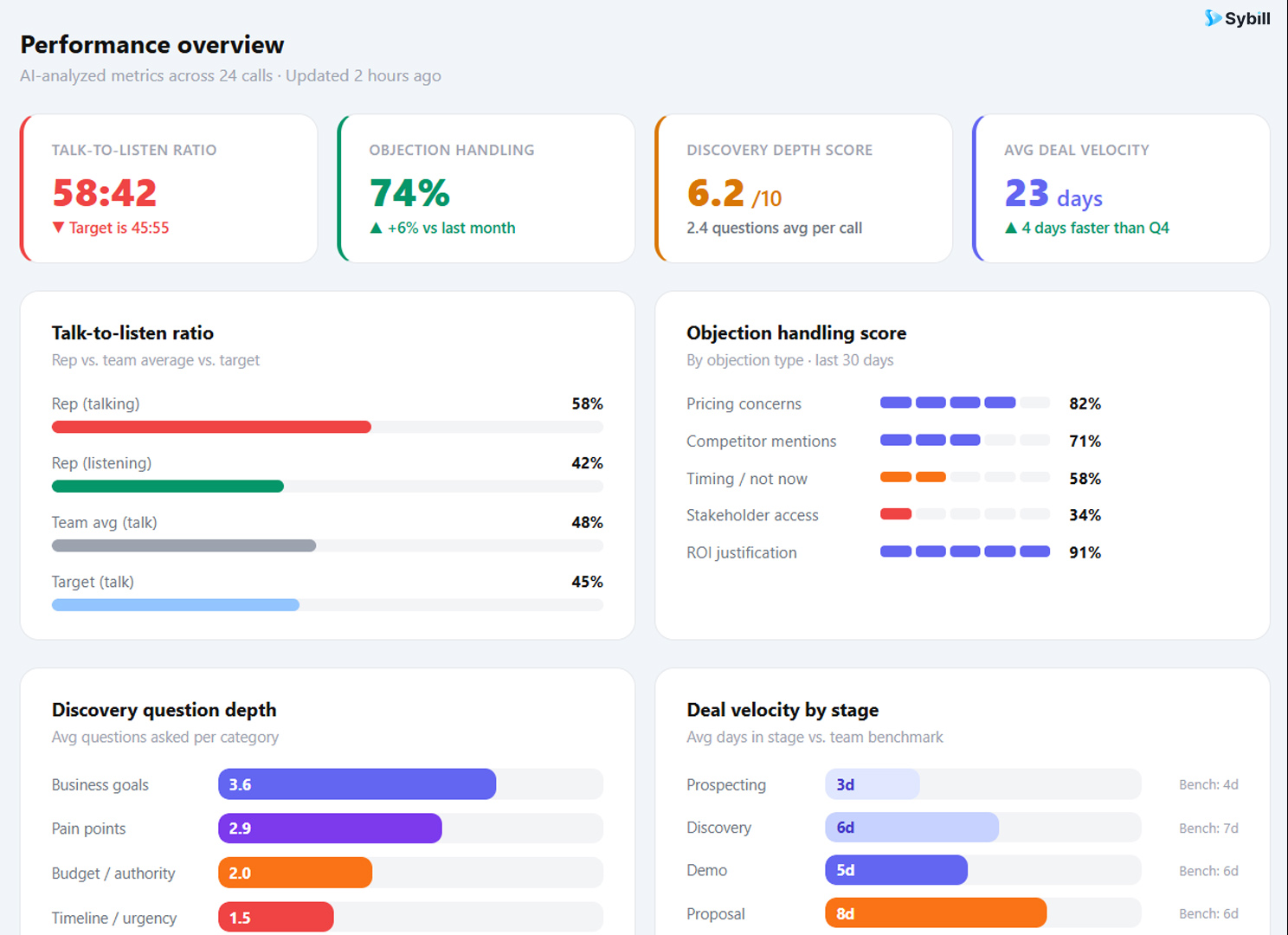
Reps are already juggling admin tasks, meetings, follow-ups, and pipeline management. Dumping ten coaching priorities on someone in a single 1:1 is a recipe for overwhelm and zero improvement.
Instead, identify the single highest-leverage area for each rep. Look at both leading indicators (effort, activity) and lagging indicators (conversion rates, deal size). If a rep's pipeline is thin, do not just tell them to make more calls. Dig into why. Maybe they are qualifying every lead after one meeting instead of throughout the sales cycle. Focus on that one behavior, and the downstream metrics will follow.
For a structured approach to isolating improvement areas, see our sales coaching templates guide.
When a deal closes or collapses, the rep usually knows exactly what happened. Before you offer your analysis, give them space to reflect. Ask open-ended questions: "What do you think went well?" "Where did you feel the deal start to slip?"
This does two powerful things. First, it builds the rep's own coaching muscle. Reps who can self-diagnose become self-correcting over time, which is the ultimate goal of any coaching program. Second, it demonstrates that you trust their judgment.
Self-evaluation works especially well when paired with tools that provide objective evidence. Sybill's Magic Summaries capture what happened on every call, including buyer tone, objections raised, and next steps agreed. When a rep reviews their summary before a 1:1, the conversation starts from a shared reality rather than fuzzy memories.
You do not have enough hours to sit in on every call. But you need visibility into what is happening across your team's conversations. This is where conversation intelligence software earns its keep.
The best coaching moments come from real calls, not hypothetical role-plays. Create a library of call clips organized by scenario: strong discovery calls, great objection handling, poor closing attempts, missed buying signals. When you can point a rep to a specific moment on a specific call and say "here is where the buyer disengaged, and here is why," the learning sticks.
Sybill makes this easy by surfacing key moments, including objections, competitor mentions, and tone shifts, so managers can review fewer minutes and coach more precisely.
People are motivated by what they can see. When reps can track their own improvement over time, whether that is discovery question depth, talk-to-listen ratio, or deal velocity, they stay engaged and push harder.
Share coaching metrics openly. Celebrate progress, not just outcomes. A rep who improved their close rate by 5% deserves as much recognition as the one who landed the biggest deal of the quarter. Visibility also creates healthy peer accountability. When the team can see each other's growth, collaboration replaces competition.
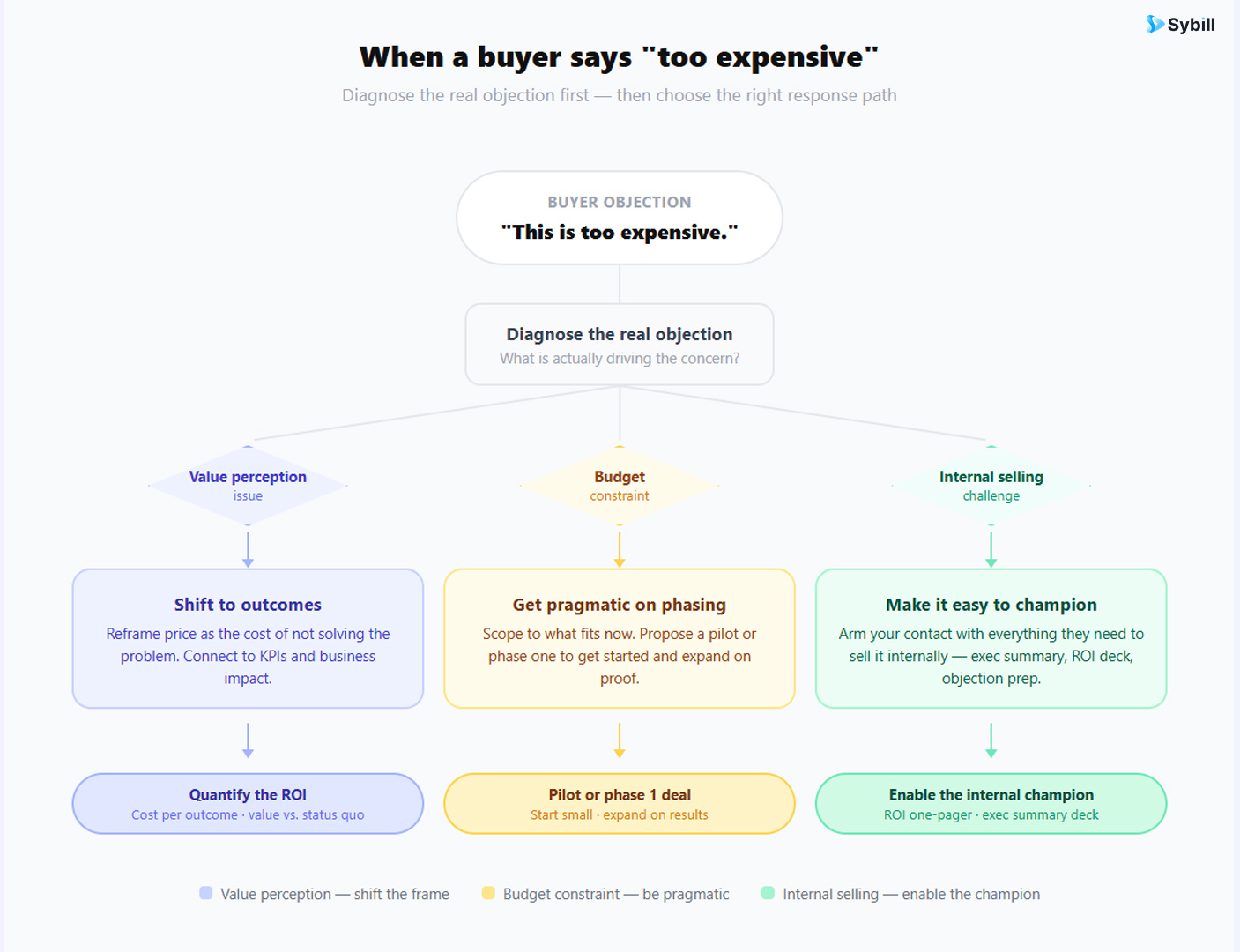
Objection handling is where deals are won or lost. Yet most reps treat objections as roadblocks rather than opportunities to understand the buyer's real concerns.
Effective coaching reframes objections as information. When a prospect says "this seems expensive," they might mean they do not see the value, they do not have budget authority, or they are already sold and just need help making the internal case. Each scenario requires a different response.
Build an internal objection-handling playbook and update it continuously based on real call data. Our complete objection handling guide walks through every major objection category with specific response frameworks. Sybill can also surface where pricing hesitation showed up across calls, pull language from closed-won deals where reps handled price well, and help reps prepare follow-ups that include the exact ROI points discussed.
Discovery is the foundation of every successful deal, and it is the stage where coaching has the highest ROI. A rep who runs a weak discovery call builds their entire deal on a shaky foundation.
Coach reps to ask questions that surface measurable pain, uncover the decision process, and reveal competing priorities. The best discovery questions do not come from a script. They come from preparation, curiosity, and the ability to follow the buyer's thread. For frameworks and examples, our guide on best discovery questions covers this in depth, including how to use Sybill's pre-call research briefs to walk into every meeting with context.
Recognition is a strategic lever, not just a feel-good gesture. When you publicly call out the specific actions a rep took to close a deal ("Sarah asked three follow-up questions on the prospect's implementation concerns, and that is what unlocked the technical buy-in"), you are teaching the entire team while celebrating one person.
Private coaching conversations, on the other hand, should be safe spaces for honest feedback. No one learns from being called out in front of peers for a mistake on a call.
Some of the most valuable coaching happens between reps, not between managers and reps. Your top performer has techniques that work specifically within your product, your market, and your buyer persona. Those insights are gold.
Create structured opportunities for peer learning. This could be a weekly "call of the week" review where a rep presents a challenging call and the team workshops it together, or a Slack channel where reps share what worked in their latest closes. Our post on underrated sales coaching tips covers reverse mentoring and other peer-driven approaches that flip the traditional coaching script.
It is tempting to spend all your coaching time on struggling reps (who need rescuing) and top performers (who are fun to work with). But the biggest ROI is in your middle 60%.
These are the reps who are competent, consistent, but not yet excellent. A small improvement in their performance often translates to a larger revenue impact than marginal gains from your top closers. Identify one or two specific skills where each middle performer could level up, and create a focused coaching plan around those areas.
Coaching that happens only during quarterly reviews or annual SKOs is not coaching. It is feedback with a three-month delay. By the time you discuss a problem, the rep has already repeated the mistake dozens of times.
Build coaching into the daily and weekly rhythm. Quick 10-minute call reviews in Slack. Weekly 1:1s that start with data, not status updates. Post-call feedback delivered through automated summaries that arrive in the rep's inbox before they have moved on to their next meeting.
Sybill generates coaching briefs for every rep on your team, so 1:1 prep takes minutes instead of hours. Ask Sybill to surface a rep's top objection struggles, discovery patterns, or missed follow-up opportunities, and walk into every coaching session armed with evidence.
If your team uses MEDDPICC, BANT, or Challenger, your coaching should reinforce that framework consistently. When coaching happens in isolation from your methodology, reps get mixed signals about what "good" looks like.
Use your methodology as the coaching rubric. Review calls through the lens of qualification criteria. Ask reps which MEDDPICC fields they feel weakest on for a given deal, and coach specifically to those gaps. Sybill's CRM Autofill automatically extracts qualification data after every call and maps it to your framework, which means both rep and manager are working from the same structured data.
Role-playing is one of the oldest coaching techniques in sales, and it still works. The key is making it realistic. Generic "sell me this pen" exercises teach nothing. Scenario-based role-plays built around actual deals in the pipeline, real objections from recent calls, and specific buyer personas teach everything.
Pair role-playing with AI tools for even better results. As we explore in our best sales techniques guide, reps can use ChatGPT as a virtual sparring partner to practice tough objections before calls, and then use Sybill's call analysis afterward to see how they performed in the real conversation.
This is the tip that makes all the other tips possible. Without AI, a manager with five reps and 20 opportunities each is responsible for 100 active deals. Monitoring every conversation, catching every missed signal, and providing timely feedback on each one is physically impossible.
AI closes that gap. Sybill captures every call, email, and CRM update, then surfaces the insights that matter for coaching. Managers can generate personalized coaching packs for each rep that include discovery scorecards, objection-handling patterns, deal execution gaps, and specific examples pulled from real meetings. 1:1s become structured around measurable patterns rather than isolated calls.
The compounding effect is significant. More connected data feeds richer pattern detection, which enables more targeted coaching, which improves outcomes, which feeds back into the model. Teams using AI-assisted coaching are not just coaching more. They are coaching smarter.
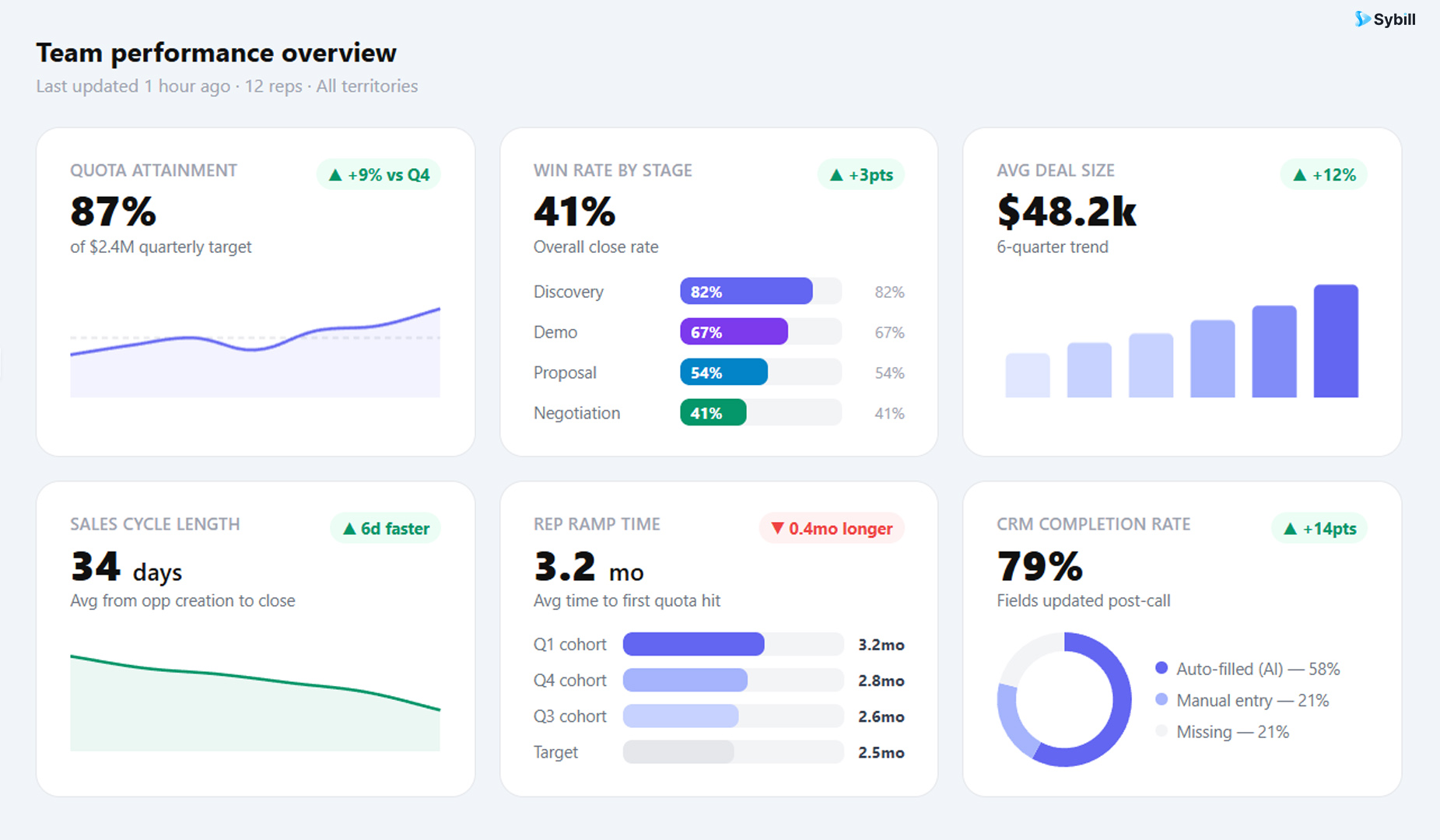
Coaching without measurement is just conversation. Here are the metrics that tell you whether your coaching program is actually working:
Quota attainment rate. The most direct measure. Are coached reps hitting quota more consistently over time?
Win rate by stage. Is coaching improving conversion at specific stages? If you are coaching heavily on discovery, you should see demo-to-proposal conversion improve.
Average deal size. Effective coaching often leads to reps selling bigger deals because they are better at uncovering pain, building value, and navigating multi-stakeholder decisions. Our guide on upsell and expansion plays connects coaching to revenue expansion.
Sales cycle length. Better coaching shortens cycles by reducing deal stalls, improving follow-up quality, and accelerating stakeholder alignment.
Rep ramp time. New hires who receive consistent coaching reach full productivity faster. Track time-to-first-deal and time-to-quota for coached versus uncoached cohorts.
CRM data quality. This is an indirect but telling metric. When coaching is working, reps update CRM more consistently because they see the connection between clean data and better coaching conversations.
Challenge: Not enough time to coach. This is the most common objection from managers. The solution is not finding more hours. It is making each coaching minute more productive. AI tools like Sybill automate the research and prep work so you can walk into every 1:1 with clear talking points in hand. Ask Sybill to prepare you for 1:1s, forecast calls, and pipeline reviews, and get structured briefs in seconds.
Challenge: Coaching feels generic. If you are delivering the same advice to every rep, you are training, not coaching. Personalization requires data. Use call analytics to understand each rep's unique strengths and gaps, and tailor your approach accordingly. Sybill's rep-level coaching packs solve this by aggregating insights across calls, emails, and deal outcomes to create individualized coaching recommendations.
Challenge: Reps resist feedback. Resistance usually comes from one of two places: the rep does not trust the feedback source, or the feedback feels punitive. Build trust first (see tip #1). Frame feedback as evidence-based (see tip #2). And always balance constructive criticism with genuine recognition of what is going well.
Challenge: Coaching impact is hard to prove. Track the metrics above. Tie coaching activities to outcomes. When you can show that a rep's win rate improved by 12% after six weeks of focused discovery coaching, you have a story that justifies continued investment.
Traditional coaching depended on the manager's ability to be everywhere at once. That model does not scale. Sybill was built to solve exactly this problem.
Automated coaching briefs. Before every 1:1, Sybill generates a coaching pack for each rep. It includes their top objection struggles, discovery patterns, deal risk areas, and competitor mentions, all pulled from actual conversations. No more spending Sunday night prepping for Monday's coaching sessions.
Cross-deal intelligence. Ask Sybill questions like "Which of my reps is struggling with pricing conversations?" or "Show me calls where discovery depth was below average." You get instant, evidence-backed answers that would have taken hours of manual call review. This is how AI agents for sales managers turn coaching into a data-driven practice.
Automated CRM updates. Clean CRM data is the foundation of good coaching. Sybill auto-fills 30+ CRM fields after every call, including qualification criteria, next steps, and deal health indicators. When your CRM reflects reality, your coaching conversations start from a place of truth.
Call clip libraries. Surface the best (and worst) examples from real calls and organize them by scenario. New reps learn from actual winning conversations. Struggling reps see exactly where their approach differs from top performers.
Sales forecasting that supports coaching. When forecasts are accurate, managers spend less time on deal interrogation and more time on genuine coaching. Sybill's deal health scores, updated continuously from buyer engagement signals, tell you which deals need coaching intervention before they slip.
What is the difference between sales coaching and sales training?
Sales training delivers foundational knowledge, product information, and process education, typically in a group setting. Sales coaching is ongoing, individualized guidance that helps reps apply what they have learned to specific deals and situations. Training tells you what to do. Coaching helps you do it better. For more on how AI is transforming both, see our guide on AI sales coaching.
How often should sales coaching happen?
Research suggests reps who receive at least three hours of coaching per month significantly outperform those who receive less. The most effective programs include weekly 1:1s, real-time call feedback, and periodic skill-focused sessions. Consistency matters more than duration.
What are the most effective sales coaching techniques?
The highest-impact techniques include data-driven 1:1 coaching, call recording review, objection handling practice, discovery call improvement, peer learning sessions, and role-playing with realistic scenarios. AI-assisted coaching is rapidly becoming essential for teams that need to scale personalized feedback.
Can AI replace human sales coaches?
No, and it probably never will in any meaningful sense. AI excels at pattern recognition, data analysis, and delivering consistent feedback at scale. But the best coaching moments are deeply human: helping a rep work through a confidence issue, navigating a politically complex deal, or helping someone find their authentic selling style. AI is a force multiplier for human coaches, not a replacement. The teams winning right now are using both.
How do you coach a struggling sales rep?
Start with data, not assumptions. Review their activity metrics and compare them to top performers. Look at their pipeline health, call patterns, and deal outcomes. Often the issue is not effort but approach. Identify the single biggest gap and coach specifically to that area before expanding to other improvement opportunities.
What tools do I need for effective sales coaching?
At minimum, you need a CRM, call recording, and a way to analyze conversations at scale. A conversation intelligence platform like Sybill combines all three and adds AI-powered coaching insights, automated CRM updates, and cross-deal intelligence that makes coaching actionable.
The best sales coaches are not the ones who work the longest hours. They are the ones who coach the right things, at the right time, to the right people, with the right evidence. AI does not replace that judgment. It amplifies it.
Sybill gives you the coaching intelligence you need to turn every 1:1 into a growth conversation, every call into a learning opportunity, and every rep into someone who consistently wins.
Get started for free with Sybill and see what AI-powered coaching looks like when it actually works.
Sales training delivers foundational knowledge, product information, and process education, typically in a group setting. Sales coaching is ongoing, individualized guidance that helps reps apply what they have learned to specific deals and situations. Training tells you what to do. Coaching helps you do it better. For more on how AI is transforming both, see our guide on AI sales coaching.
Research suggests reps who receive at least three hours of coaching per month significantly outperform those who receive less. The most effective programs include weekly 1:1s, real-time call feedback, and periodic skill-focused sessions. Consistency matters more than duration.
The highest-impact techniques include data-driven 1:1 coaching, call recording review, objection handling practice, discovery call improvement, peer learning sessions, and role-playing with realistic scenarios. AI-assisted coaching is rapidly becoming essential for teams that need to scale personalized feedback.