Find us at booth #83, join us for a harbor side happy hour, or catch Gorish’s talk.

Sept, 16-18 > Learn more

%20(1).avif)
Mamta Tainwala

March 16, 2026
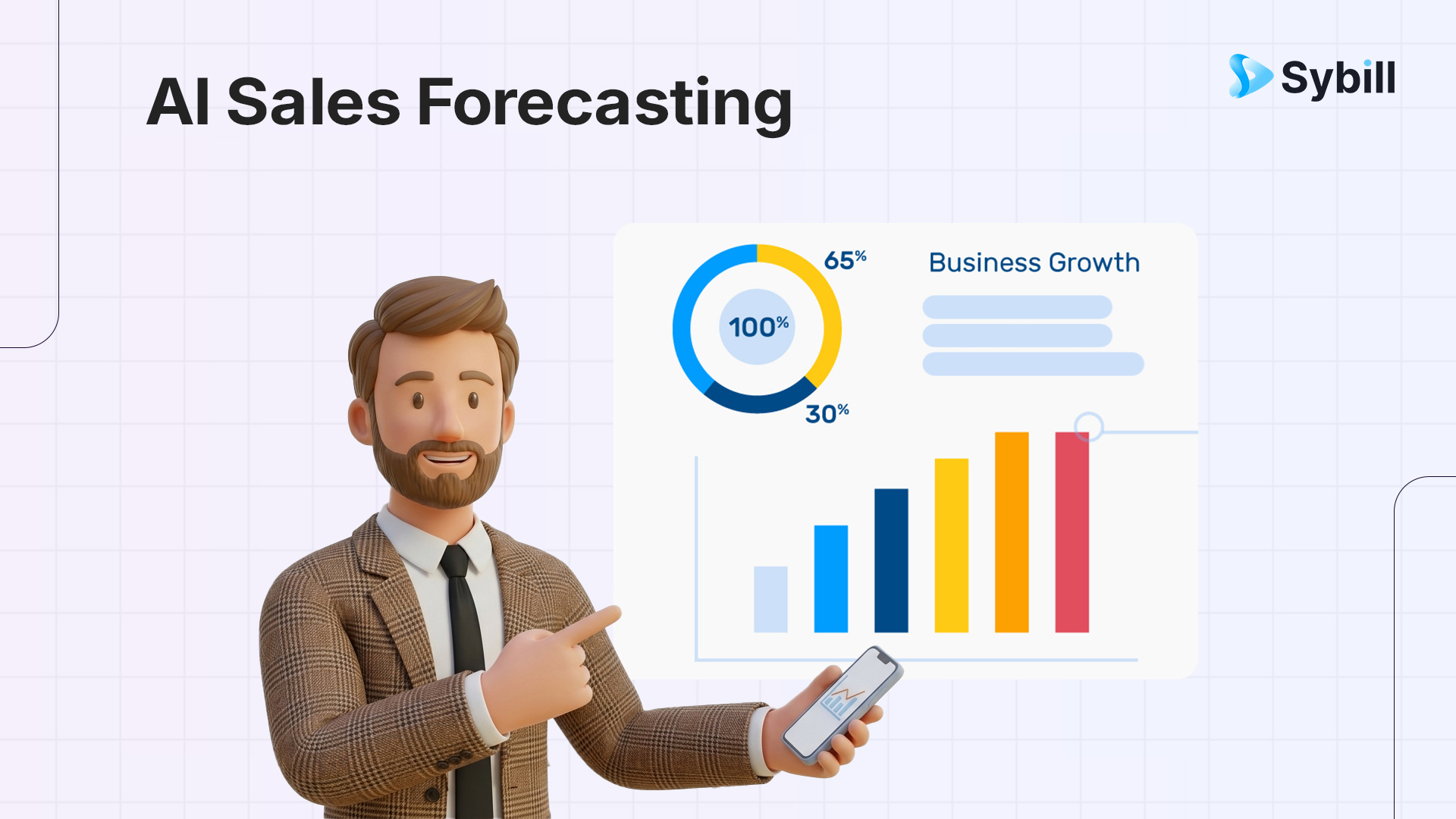
The gap between a forecast you trust and one you silently adjust downward before sending to the board is not a data problem, it is a methodology problem. And it’s obvious that companies using AI-driven forecasting see higher revenue growth and predictability than those relying on gut-based predictions.
Most sales teams are still forecasting the same way they did a decade ago: rep enters a close date, manager applies a judgment discount, someone rolls it up and calls it a number. The inputs are optimistic. The outputs are wrong. And the quarter ends in a scramble that everyone saw coming but nobody said out loud.
AI sales forecasting breaks that cycle. This guide explains exactly how it works, why it is more accurate than what you are doing now, and what your revenue team needs to do differently to actually benefit from it.
AI sales forecasting is the use of artificial intelligence and machine learning to predict how much revenue a sales team will generate over a defined period, typically a quarter or fiscal year.
Unlike traditional forecasting methods, which rely on deal stage, close date, and rep-entered probability, AI sales forecasting draws from behavioral signals across calls, emails, CRM activity, and buyer engagement patterns to generate predictions that reflect what is actually happening in a deal, not what a rep thinks should be happening.
The result is a forecast that updates continuously based on real activity, flags risk before it becomes a miss, and gives revenue leaders something worth committing to.
Understanding AI forecasting starts with understanding what it replaces, and why that replacement was overdue.
The CRM data problem. Most forecasting models are built on CRM fields. CRM fields are filled in by reps, who are human, optimistic, and often rushed. Deal stages drift ahead of actual progress. Close dates get pushed without penalty. Probability scores reflect what a rep wants to believe, not what the buyer is signaling. The foundation of most forecasts is therefore a dataset that is systematically biased toward good news.
The recency problem. Traditional forecasts are snapshots. They tell you what the pipeline looks like at the moment a report runs, but they do not tell you how it got there, whether momentum is accelerating or stalling, or which deals have gone quiet at exactly the wrong time. A pipeline that looked healthy on Monday can look completely different by Friday. Most teams find out on Friday.
The subjectivity problem. When a manager reviews a $200K deal and asks "how confident are you?", the rep says 80%. That confidence score reflects personality, not data. Top performers trend optimistic. Newer reps trend cautious. Neither estimate is calibrated to reality. Rolling these subjective scores up into a forecast introduces noise at every layer.
The lag problem. By the time a problem shows up in a formal forecast review, it is usually too late to fix it in the current quarter. Revenue operations teams spend enormous energy trying to identify slippage early using manual pipeline reviews. AI does this automatically, continuously, and without requiring anyone to build a custom report over the weekend.
The mechanics matter here, because "AI-powered" has become meaningless as a marketing term. A tool that applies a fixed scoring model to your deal stage is not the same thing as a platform that analyzes conversation sentiment across hundreds of calls and weights each deal's health against historical close patterns. Here is what genuine AI forecasting does.
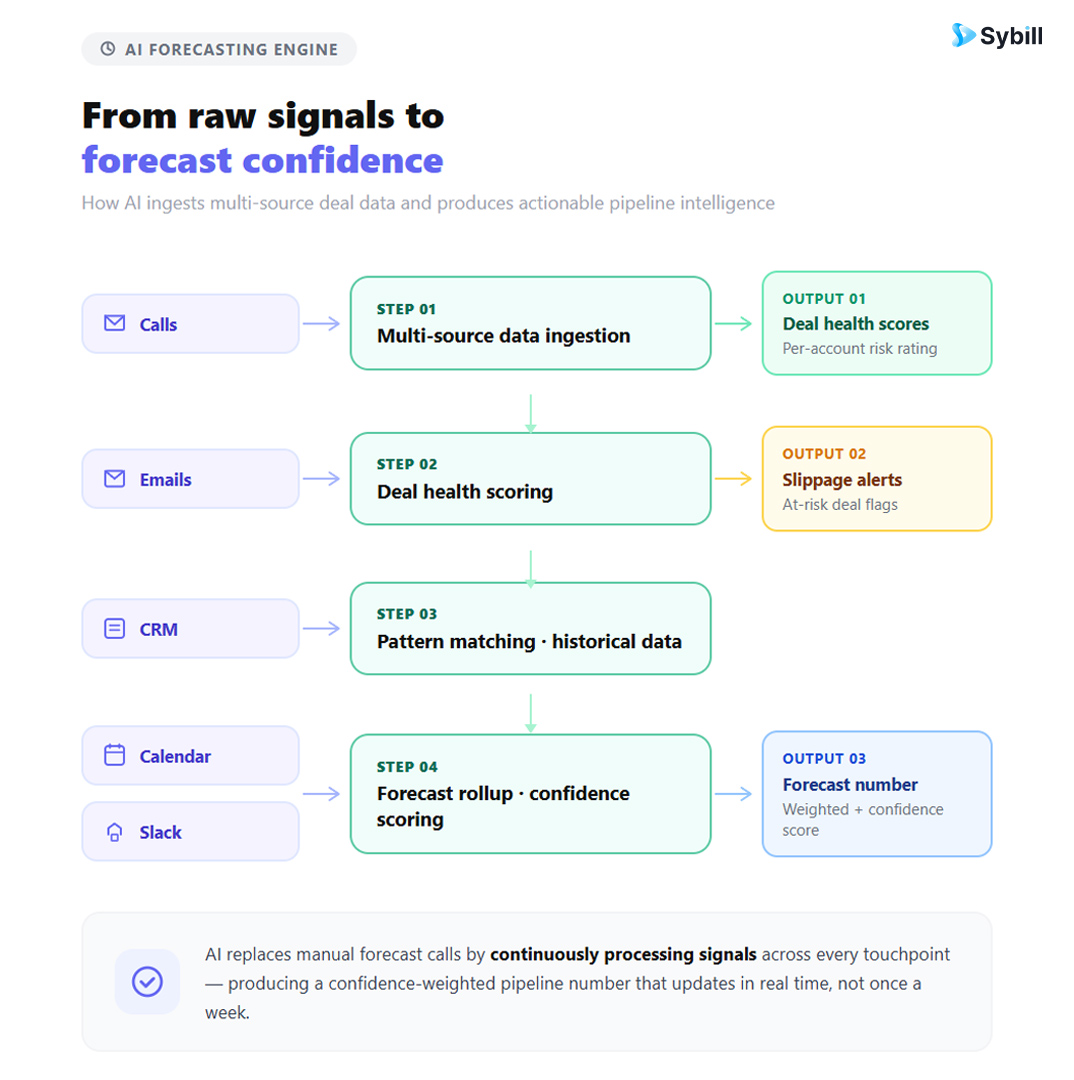
AI forecasting starts by pulling data from every channel where sales activity actually happens. That means CRM records, yes, but also call transcripts, email threads, calendar invites, Slack messages, and meeting notes. Each of these sources carries signals that a stage field cannot capture: how often the buyer is responding, whether sentiment on calls is warming or cooling, whether a champion has gone quiet, whether a key decision-maker has started showing up to meetings.
Machine learning for sales models trained on historical win and loss data learn to recognize which combinations of these signals precede a closed deal and which combinations precede a stalled one.
Each open opportunity gets a continuously updated health score based on the behavioral signals the AI is tracking. A deal where email response times are accelerating, where a new economic buyer joined the last call, and where next steps were confirmed on two consecutive meetings looks very different from a deal where responses have slowed, where no new stakeholders have been introduced, and where the rep has been doing all the talking.
These scores update as new activity comes in. If a deal's score drops significantly between Monday and Thursday, a manager should know about it before Thursday's pipeline review, not because of it. Deal inspection at this level of granularity was previously only possible by manually reviewing recordings and notes on individual deals. AI does it across every deal in the pipeline at once.
This is where AI forecasting genuinely outperforms human intuition. A sales manager with five years of experience has seen a few hundred deals. An AI model trained on your team's historical pipeline has seen thousands, including the specific combinations of signals that predict slippage in your market, with your buyer personas, at your deal size.
It knows that deals in this stage that go three weeks without a buyer response close at 12%, not 60%. It knows that when competitive mentions increase between the second and third call, win rate drops by a specific percentage. These patterns are invisible at a human cognitive level. At a machine learning level, they are the forecast.
Rather than adding up rep-entered probabilities, AI forecasting produces a confidence-adjusted revenue number for each deal, then rolls those up across reps, teams, territories, and time periods. Managers can see not just what is committed, but how much of that commitment is grounded in strong behavioral signals versus optimistic assumptions.
Ask Sybill takes this a step further: revenue leaders can query their pipeline conversationally. "Which deals in commit this quarter have declining buyer engagement?" "Which rep's pipeline has the most deals where next steps were not confirmed?" The answer is immediate, grounded in real activity, and does not require anyone to pull a report.
The quality of an AI forecast is determined by the quality of the signals it draws from. Here is a breakdown of the categories that matter most.
Conversation signals. What is the buyer actually saying on calls? Are they using language that signals urgency or delay? Are they raising the same objection multiple times? Is their energy level different from two meetings ago? Conversation intelligence tools analyze tone, sentiment, topic distribution, and engagement patterns from recorded calls to surface these signals automatically.
Email and response signals. Is the buyer responding faster or slower than they were two weeks ago? Did they forward the proposal to someone new? Did they open the pricing deck twelve times without replying? Email behavior is one of the most reliable early warning systems for deal health, and it is almost entirely absent from traditional forecasting models.
Stakeholder engagement signals. How many people from the buying organization have been involved in meetings? Has a VP shown up, or has the rep been stuck with the same individual contributor for eight weeks? Deals with broad stakeholder engagement close at dramatically higher rates than deals where a single contact is the only touchpoint. AI tracks this automatically.
CRM activity signals. Cadence matters. How recently did the rep log an activity? How long has this deal been in its current stage? Is the sales cycle running longer than historical averages for this deal size? CRM autofill tools that automatically populate fields from call and email data ensure that these signals are actually captured rather than lost to manual entry delays.
Competitive and risk signals. When a buyer starts mentioning competitors on calls, when budget language shifts, when a previously enthusiastic champion goes quiet, these are all material forecast inputs. AI surfaces them. Human reviewers in a weekly pipeline call miss them.
The honest answer: significantly more accurate, but the gap depends on data quality and implementation.
Salesforce research found that sales teams using AI are 1.3 times more likely to see revenue growth. Teams using AI sales intelligence tools built on behavioral data consistently report earlier identification of at-risk deals and materially lower forecast variance.
The important nuance is that AI forecasting improves over time. In the first month, it is drawing on whatever historical data exists in your CRM and call recordings. By month six, it has learned your specific pipeline patterns, which objections tend to kill deals at your company, which engagement signals best predict close likelihood in your market. The model compounds.
What AI forecasting does not fix is bad pipeline health. If the deals entering your funnel are poorly qualified, AI will tell you that faster and with more precision, but it cannot change the underlying reality. Forecasting accuracy and pipeline generation quality are connected. Teams that fix both see the largest improvements.
Get started for free with Sybill and see how AI deal intelligence from your calls, emails, and CRM can make your next forecast review a conversation about strategy, not surprises.
The manager's relationship with the forecast is where AI creates the most visible day-to-day change.
Without AI, forecast reviews are primarily data collection exercises. A manager asks each rep to walk through their pipeline. The rep defends their deals. The manager probes for risks the rep downplayed. It takes most of the available time and surfaces only what the rep is willing to share.
With AI, the data collection happens automatically and continuously. By the time a forecast call starts, the manager already knows which deals in commit have declining engagement, which have stalled longer than average, and which have risk signals that the rep has not flagged. The conversation shifts from "tell me about your pipeline" to "let's talk about these three deals."
AI agents for sales managers take this further by running continuous pipeline surveillance between formal reviews. They flag deals with missing MEDDPICC fields, identify segments with systematically slower velocity, and generate coaching-ready summaries for every rep before a one-on-one. The manager stops being the bottleneck for insight and becomes the decision-maker who acts on it.
This changes sales coaching too. When a rep consistently loses deals at the proposal stage, AI surfaces that pattern automatically. The coaching conversation becomes specific, evidence-based, and timed to when it can actually help rather than weeks after the deal was already lost.
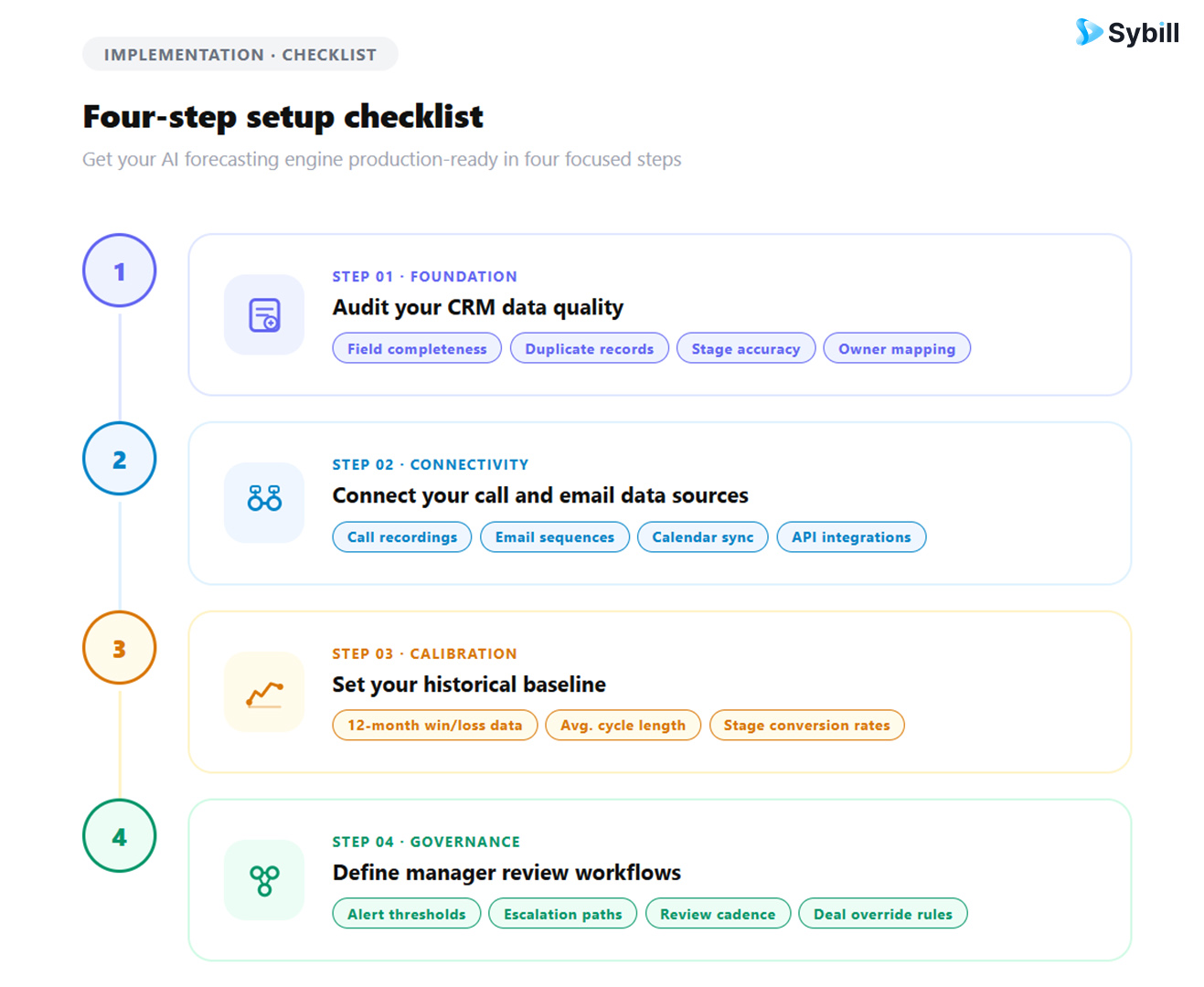
Most teams fail at AI forecasting implementation not because the technology does not work, but because they skip the foundation.
Start with CRM hygiene. AI forecasting is only as accurate as the data feeding it. If your CRM is full of stale deals, missing fields, and inconsistent stage definitions, fix that first. CRM automation tools that auto-fill fields from call data are the fastest way to improve input quality without adding to a rep's admin burden.
Connect your call and email data. Stage fields are the floor, not the ceiling. Your forecasting model needs to see what is actually happening in conversations. Integrate your call recording, email, and calendar data so the AI has behavioral signals to work with, not just the sanitized version of reality that reps enter manually.
Establish a historical baseline. Most AI forecasting tools improve as they learn your pipeline patterns. Give them access to at least two to three quarters of closed-won and closed-lost data. The model needs to understand what a winning deal looks like in your specific context before it can reliably identify the ones heading in the wrong direction.
Define what "at risk" means for your team. This sounds obvious, but teams often implement AI forecasting and then do not act on what it surfaces. Before you roll it out, agree on what constitutes a risk flag, who is responsible for responding to it, and within what timeframe. The technology surfaces the signal. Humans have to do something with it.
Build AI into your existing review cadence. The goal is not to add a new meeting. It is to make existing pipeline reviews faster, more grounded, and more action-oriented. Use AI summaries to replace the data collection portion of the review so the actual conversation can be about decisions.
For teams building toward a fully AI-automated sales funnel, forecasting is one layer of a larger system. The same data that powers deal health scoring also powers follow-up automation, personalized outreach, and rep-level coaching. The tools compound when they share the same data model.
These terms often get conflated, but they are not the same thing.
Sales forecasting is specifically about predicting future revenue. Revenue intelligence is the broader category of tools that analyze sales activity, buyer behavior, and deal dynamics to surface insights for reps, managers, and leaders. A revenue intelligence platform powers AI forecasting as one of its outputs, but it also powers coaching, pipeline management, competitive analysis, and rep performance tracking.
Think of it this way: AI forecasting tells you what the number will be. Revenue intelligence tells you why, which deals will get you there, which ones will not, and what to do about it.
Teams that invest in revenue intelligence tend to see the biggest improvements in forecast accuracy because they are fixing the upstream inputs: deal quality, CRM hygiene, engagement patterns, and coaching, that determine whether a forecast model has good data to work with in the first place.
Your quarterly forecast should be the most credible document your revenue team produces. Right now, for most teams, it is not. It is a number that started with rep confidence scores and ended with a manager's gut. AI forecasting changes the inputs, and the inputs are everything.
Get started for free with Sybill and build a forecast your whole revenue team can actually stand behind.
AI sales forecasting is the practice of using machine learning and artificial intelligence to predict future sales revenue based on behavioral signals from calls, emails, CRM data, and buyer engagement patterns. Unlike traditional forecasting, which relies on rep-entered stage fields and close dates, AI forecasting analyzes real activity data to generate probability-adjusted revenue predictions that update continuously.
AI improves forecast accuracy by drawing from data sources that traditional models ignore: conversation sentiment, email response cadence, stakeholder engagement, and deal velocity. It also matches current deal patterns against historical win and loss data to identify risk signals early. The result is a forecast that reflects buyer behavior rather than seller optimism.
AI sales forecasting works best with data from CRM records, call recordings and transcripts, email activity, calendar and meeting data, and historical win/loss outcomes. The more behavioral data it can access, the more accurate its predictions. Tools that auto-populate CRM fields from call and email data dramatically improve input quality and, in turn, forecast reliability.
The most accurate approaches combine pipeline stage data with behavioral signals and historical pattern matching. Multivariable AI models that factor in engagement velocity, stakeholder coverage, sentiment trends, and competitive mentions outperform simple weighted pipeline models. For a full breakdown, see Sybill's guide on sales forecasting methods.
Most teams see meaningful improvements within one to two quarters of consistent use, as the AI model builds a richer baseline of your specific pipeline patterns. Accuracy compounds over time as the model learns what winning deals look like in your market, at your deal size, with your buyer personas. Starting with clean CRM data and connected call and email sources accelerates this timeline significantly.
Not entirely, and it should not try to. AI is excellent at processing large datasets, identifying non-obvious patterns, and surfacing risk signals that humans miss. Human judgment remains essential for interpreting political dynamics within a buying organization, calibrating trust in a champion, and making strategic decisions about deal prioritization. The best forecasting workflows use AI to handle data analysis and pattern recognition while managers retain decision-making authority.
Traditional forecasting is built on stage-based probability weighting applied to rep-entered data. AI forecasting is built on behavioral signals pulled from actual sales activity. Traditional models are static snapshots. AI models update continuously. Traditional forecasting tells you what your pipeline is worth on paper. AI forecasting tells you how much of it will actually close and which deals are quietly heading in the wrong direction. For teams evaluating tools, the best sales forecasting tools guide breaks down the full landscape.
AI sales forecasting is the practice of using machine learning and artificial intelligence to predict future sales revenue based on behavioral signals from calls, emails, CRM data, and buyer engagement patterns. Unlike traditional forecasting, which relies on rep-entered stage fields and close dates, AI forecasting analyzes real activity data to generate probability-adjusted revenue predictions that update continuously.
AI improves forecast accuracy by drawing from data sources that traditional models ignore: conversation sentiment, email response cadence, stakeholder engagement, and deal velocity. It also matches current deal patterns against historical win and loss data to identify risk signals early. The result is a forecast that reflects buyer behavior rather than seller optimism.
AI sales forecasting works best with data from CRM records, call recordings and transcripts, email activity, calendar and meeting data, and historical win/loss outcomes. The more behavioral data it can access, the more accurate its predictions. Tools that auto-populate CRM fields from call and email data dramatically improve input quality and, in turn, forecast reliability.