Find us at booth #83, join us for a harbor side happy hour, or catch Gorish’s talk.

Sept, 16-18 > Learn more


Tamanna Mishra

July 23, 2026
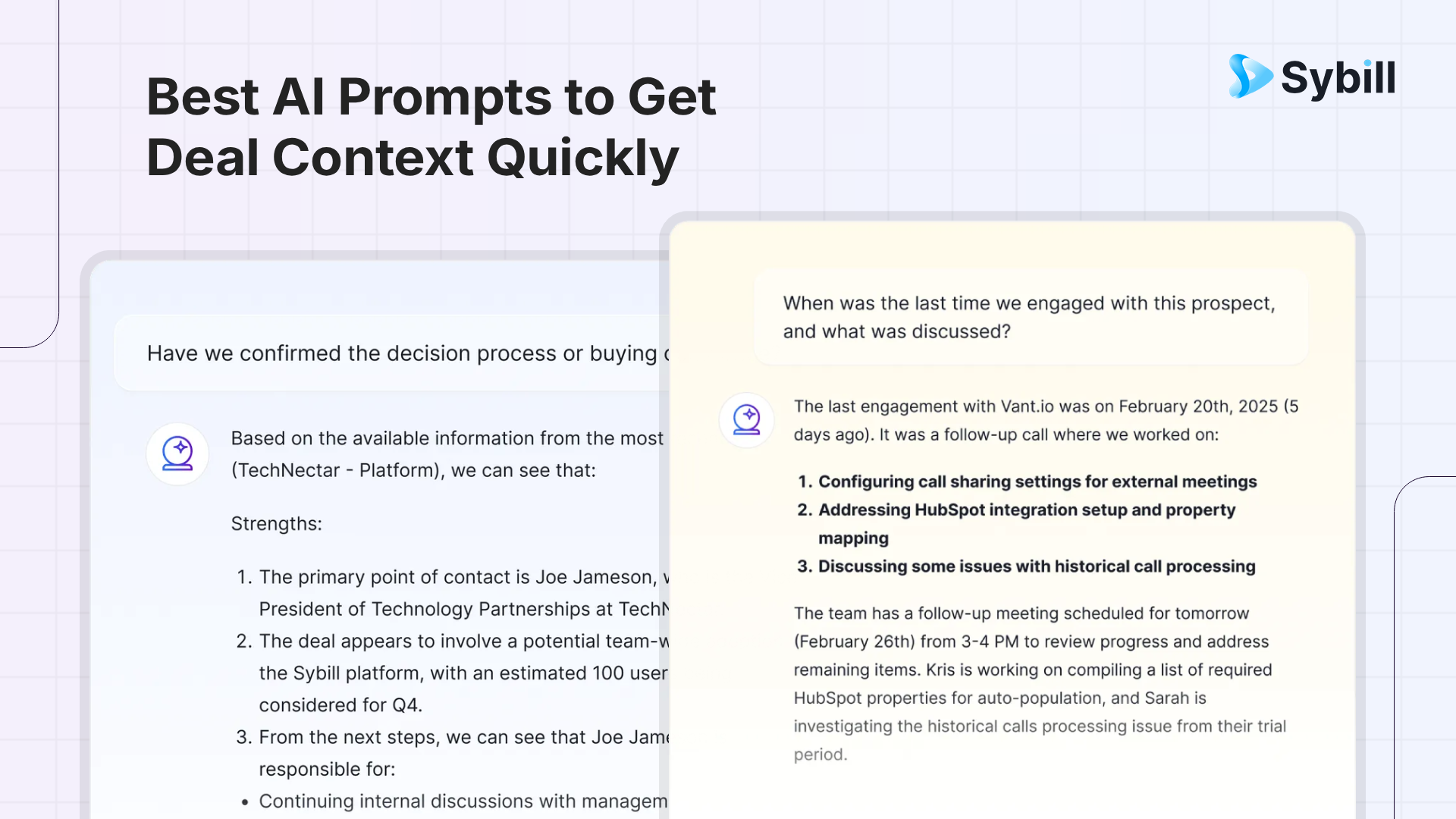
TL;DR: Ask AI to summarize what happened, map stakeholder priorities, surface unresolved objections, expose missing qualification information, and recommend the next move. ChatGPT and Claude can do this well, but only after you provide the transcripts, emails, CRM notes, and background. Ask Sybill already has the connected deal history, so reps can ask the question instead of rebuilding the case file first.
You remember the account. The VP liked it. You do not remember who promised the ROI model, whether security was resolved, or why the CFO appeared in the email thread.
This is the real use case for AI prompts for sales reps. Not another cold email with the charisma of a hotel confirmation. Enough reliable context to enter the next conversation prepared.
The internet has enough “50 ChatGPT prompts for sales” posts to wallpaper a sales floor. Most assume AI already knows the deal.
It does not.
Before a follow-up call, demo, or forecast review, an AE needs five answers:

A live opportunity may include several calls, incomplete CRM fields, a quiet champion, and a new stakeholder.
AI sales call preparation should turn that mess into a decision-ready view: what changed and what the rep must do next.
ChatGPT, Claude, and other general-purpose LLMs can organize a timeline, compare stakeholder priorities, and create a call plan. But a smart model is not psychic.
It does not automatically know what happened on earlier calls, what the buyer wrote in email, which CRM fields changed, or what your SE promised. You must collect that context, decide what is safe to share, paste it into the tool, explain the opportunity, and verify the answer.
That context assembly is the hidden tax behind most AI sales prompts. It is also exactly the kind of low-value work sellers want AI to remove. Salesforce reports that 85% of reps using agents say AI frees them for higher-value work.
Ask Sybill changes that workflow. Reps can ask about deals, accounts, and pipeline without first hunting through CRM records, transcripts, and email threads. Sybill’s wider workflow can draw on calls, emails, CRM activity, calendar information, and other connected context.

When using a generic LLM, begin with a context wrapper:
You are helping me prepare for the next meeting in an active B2B sales opportunity.
Company and product: [Add context]
Account and opportunity: [Add details]
Deal stage: [Add stage]
Meeting objective and participants: [Add details]
Source material: [Paste transcripts, emails, CRM notes, plans, and documents]
Use only the material provided. Separate confirmed facts, inferences, contradictions, and unknowns. Do not treat an objection as resolved without evidence. Cite the source interaction or date for important conclusions.
Return a two-minute recap, stakeholder priorities, open objections and commitments, missing qualification information, the three most important outcomes for the next call, and five questions I should ask.
Sales advice without evidence is fan fiction with a forecast category.
Use these as follow-ups after providing the master context. With Ask Sybill, the equivalent question is shorter because the opportunity history is already available.
1. Get the two-minute deal recap
Summarize this opportunity for an AE with two minutes before the call. Cover the business problem, reason for change, deal stage, stakeholders, open commitments, risks, and likely next step. Separate facts from inferences.

2. Build the deal timeline
Create a chronological timeline with meetings, stakeholders, discoveries, decisions, objections, commitments, and changes in scope, urgency, budget, timing, or sentiment.
This helps when returning after a gap or inheriting another rep’s opportunity. You can also find deal answers without digging through call transcripts.
Ask Sybill: “Show me the important milestones in this deal.”
3. Identify what changed
Compare the latest interaction with previous deal history. What changed in priorities, stakeholders, urgency, scope, timing, commercial position, or next steps? Flag momentum and risk signals.
Ask Sybill: “What changed since my last call with Acme?”
4. Map stakeholder priorities
Create a stakeholder map with role, influence, stated priorities, concerns, objections, engagement, and evidence. Do not infer support from seniority or attendance alone.
Ask Sybill: “What does each stakeholder care about?”
See the complete workflow for how to research multiple stakeholders before a sales demo.
5. Test champion strength
Assess whether [name] is acting as a champion. Look for evidence that they share internal information, bring in stakeholders, navigate the process, sell internally, and complete actions. Rate the relationship as strong, uncertain, or weak.
Ask Sybill: “How strong is our champion?”
6. Find the missing stakeholder
Which role or decision-maker is probably missing based on the business problem, purchase process, objections, and current contacts? Explain why they matter and how to involve them.
Ask Sybill: “Who else needs to be involved?”
7. Find unresolved objections
List every concern raised. Include who raised it, when, the seller response, whether it was resolved, what evidence is still required, and the next question or action.
Ask Sybill: “Which objections are still open?”
8. Find the concern behind the objection
Analyze possible underlying concerns. Label each conclusion explicit or inferred. Could a pricing objection reflect unclear value, budget ownership, implementation risk, internal consensus, or preference for the status quo?
Ask Sybill: “What may be behind the pricing concern?”
Do not let AI invent buyer psychology. A trustworthy answer shows evidence, not a personality diagnosis for the CFO.
9. Run a qualification gap analysis
Review this deal using [MEDDPICC, SPICED, BANT, or our framework]. For every field, show confirmed information, evidence, gaps, contradictions, and the best question to ask next.
Ask Sybill: “What MEDDPICC information is missing?”
10. Scan for deal risk
Identify and rank the five biggest risks. Consider stakeholder coverage, champion strength, decision process, compelling event, competition, procurement, security, budget, next steps, engagement, and date slippage.
Ask Sybill: “What could cause this deal to slip?”
This is useful before you prepare for a forecast call using AI.
11. Find contradictions
Identify conflicts between calls, emails, CRM notes, close dates, forecast category, and buyer commitments. Explain which source is newer or more reliable and what must be verified.
Ask Sybill: “Where does CRM disagree with the buyer?”
12. Define the next-call objective
Define the single most important outcome for the next meeting, two secondary outcomes, evidence of success, and what should not consume time.
Ask Sybill: “What must we accomplish on the next call?”
13. Build a stage-appropriate agenda
Create a concise agenda focused on unresolved issues. Include timing, owner, questions, proof to bring, and the decision or commitment to secure.
Ask Sybill: “Build an agenda around the open issues.”
Sybill can also automate recurring preparation through Pre-Meeting Briefs, which scan connected sources and surface agenda ideas, tasks, and deal context.
14. Rank the next best actions
Recommend five actions in priority order. Include intended outcome, owner, timing, dependency, and risk of delay. Avoid generic advice that does not solve a specific gap.
Ask Sybill: “What should I do next to move this deal?”
15. Brief the internal team
Write a one-page briefing for the manager, SE, executive sponsor, or implementation lead joining the call. Cover the business problem, stakeholders, stage, promises, objections, landmines, meeting objective, and their role.
Ask Sybill: “Brief my SE before the Acme demo.”

Generic AI can challenge a plan, reorganize evidence, and draft questions. This comparison of ChatGPT vs Claude vs Sybill for sales explains where each fits.
Active-deal questions are different. They depend on what the buyer said, who said it, what happened afterward, and whether the deal record reflects reality.
Ask Sybill lets reps question deals, accounts, and pipeline, then turn answers into assets such as mutual action plans and sales slides. Sybill’s wider workflow includes deal inspection, buyer needs and intent, competitor intelligence, Pre-Meeting Briefs, Magic Summaries, email follow-ups, CRM Autofill, AI Tasks, and Deal Workspace.
A generic LLM user says, “First, let me explain the deal.”
An Ask Sybill user says, “What am I missing?”
The AE should be moving the opportunity, not teaching an AI what the opportunity is.
One meeting is evidence, not the entire buying process. Review later calls, emails, CRM changes, documents, and stakeholder activity.
Require facts, inferences, contradictions, unknowns, and source dates. “The buyer likes us” is not evidence. “The buyer invited procurement and booked a commercial review” is.
Follow your organization’s AI and customer-data policies. Use approved business workspaces and understand data retention and access. OpenAI states that its business products and API do not use organizational inputs and outputs for model training by default, but your internal governance still matters.
The best sales prompt is the right question asked against current deal history.
ChatGPT and Claude can help once the evidence is assembled.
Ask Sybill removes the scavenger hunt, so reps can move from “What happened?” to “What should I do next?” before the meeting starts. Click here to try for free.
Because nobody wins a deal by being a transcript copy-paster.
The best prompts answer five questions: What happened, what each stakeholder cares about, which objections remain unresolved, what qualification information is missing, and what should happen next. Strong prompts also require evidence and identify unknowns instead of filling gaps with confident guesses.
AI can summarize previous conversations, map stakeholder needs, find objections and qualification gaps, build an agenda, suggest questions, and brief internal teammates. Generic tools need current source material. Context-connected sales AI can move faster because the relevant deal history is already available.
ChatGPT can use information available in the current chat, uploaded files, enabled memory, projects, or approved connected tools. It does not automatically know every call, email, CRM update, or stakeholder interaction in an active deal.
Review the business problem, changes since the last meeting, stakeholder priorities, objections, commitments, missing decision-makers, qualification gaps, competition, next steps, and the outcome required from the upcoming call. You do not need to remember everything. You need to know what matters now.
The best prompts answer five questions: What happened, what each stakeholder cares about, which objections remain unresolved, what qualification information is missing, and what should happen next. Strong prompts also require evidence and identify unknowns instead of filling gaps with confident guesses.
AI can summarize previous conversations, map stakeholder needs, find objections and qualification gaps, build an agenda, suggest questions, and brief internal teammates. Generic tools need current source material. Context-connected sales AI can move faster because the relevant deal history is already available.
ChatGPT can use information available in the current chat, uploaded files, enabled memory, projects, or approved connected tools. It does not automatically know every call, email, CRM update, or stakeholder interaction in an active deal.