Find us at booth #83, join us for a harbor side happy hour, or catch Gorish’s talk.

Sept, 16-18 > Learn more


Tamanna Mishra

July 3, 2026
%20(21).png)
Sales teams do not have an AI shortage, do they?
They have ChatGPT open in one tab. Claude in another. A call recorder somewhere in the background. CRM in a state of permanent emotional neglect. Slack threads multiplying like Gremlins after midnight. Then someone still asks, “Can you send a quick recap of where this deal stands?”
This is the problem with AI for sales. Most tools help with tasks. Very few help with workflows.
ChatGPT can help you draft a better email. Claude can help you analyze a long account brief. Both are powerful, useful, and worth having in the sales toolkit. But a sales workflow is not just drafting, summarizing, or researching. It is the messy chain of work that starts before a call and continues through discovery, follow-up, CRM updates, stakeholder mapping, deal inspection, pipeline movement, and manager review.
That is where the comparison gets interesting.
ChatGPT and Claude are great when you know what to ask. Sybill is built for the sales moments where the system already needs to know what matters: who said what, what changed, what the buyer cares about, which objection is still open, what needs to go into CRM, and what should happen next.
Sybill is built as an AI sales assistant for real revenue workflows: calls, emails, CRM, follow-ups, deal inspection, pipeline visibility, and coaching. Sybill connects meetings, CRM, email, dialers, collaboration tools, API, webhooks, and MCP so deal context can move wherever sales teams need it.
The lazy version of this comparison is: Which tool is best? The useful version is: Best for what?
Sales teams use AI across very different jobs. Some are individual productivity tasks, like writing a sharper follow-up or summarizing a company website. Some are strategic thinking tasks, like building a stakeholder map or analyzing account risk. Others are operational call summaries, tracking next steps, and surfacing deal risks.
ChatGPT is strongest as a flexible thinking and drafting partner. OpenAI’s sales resources describe use cases across outreach, strategy, competitive intelligence, data analysis, proposals, deal management, among others.
Claude is strongest when sales work requires deeper reading, longer context, and synthesis. Anthropic describes Claude as useful for summarization, search, collaborative writing, Q&A, coding, and more, which maps well to account research, deal analysis, and complex narrative-building.
Sybill is different. It is not a general-purpose AI tool that waits for reps to feed it context. It captures meetings, learns from emails, pulls from CRM, underboration, drafts follow-ups, autofills CRM, supports deal inspection, and creates unified deal memory across buyer interactions.
That is the big distinction.
ChatGPT and Claude can help reps do sales work. Sybill is designed to sit inside the sales workflow itself.
ChatGPT is useful for sales because sales teams constantly need to turn rough thinking into clear communication.
A rep can use ChatGPT to write a cold email, tighten a follow-up, turn messy notes into a call plan, build discovery questions, create objection-handling talk tracks, or brainstorm competitive positioning. It is fast, flexible, and good at helping reps get from “blank page panic” to “usable first draft.”
That matters. Reps are not paid to stare at a cursor while trying to make “just circling back” sound less spiritually dead.
ChatGPT works especially well when the rep provides clear inputs. For example, a rep could paste in a prospect’s homepage, a LinkedIn profile summary, and a few account notes, then ask for a discovery plan. Or they could ask ChatGPT to rewrite a follow-up email in a more consultative tone. OpenAI’s business resources also emphasize identifying repeatable AI use cases acro ones that create clear value, which is exactly how sales teams should think about ChatGPT adoption.
But here is the catch: ChatGPT is only as useful as the context it receives.
Unless it is connected to the right systems and governed properly, it does not automatically know what happened on the last call, what the buyer said three weeks ago, which stakeholder raised a security concern, what the CRM says, what the rep promised, or what the manager flagged during forecast review.
So the rep becomes the integration layer.
Copy the transcript. Paste the notes. Remove sensitive details. Add context. Rewrite the prompt. Correct the answer. Copy it back into Gmail. Update CRM manually. Summarize it again for Slack.
That is a side quest by itself.
Claude is excellent when sales work gets heavier than a quick draft.
For example, Claude can help a rep analyze a long annual report, turn account research into an executive briefing, synthesize multiple stakeholder priorities, build a point of view for a strategic account, or convert a messy internal note into a structured account plan.
This is where Claude feels especially useful for enterprise sales. Big deals are rarely simple. There are multiple stakeholders, half-stated objections, buried priorities, procurement concerns, competitive noise, and internal politics. Claude can help bring order to that chaos when the rep gives it enough source material.
Think of Claude as the colleague who can read the entire packet before the meeting and return with a clean, thoughtful summary. Very useful. Very grown-up. Very “I did the pre-read and brought tabs.”
But Claude has the same core limitation as any general-purpose AI tool: it needs the right sales context.
If the rep pastes in incomplete notes, Claude can still produce a polished answer. The issue is that polished does not always mean accurate. A beautiful account strategy built on missing deal history is still a beautiful hallucination wearing a blazer.
That is why Claude is strong for sales research and synthesis, but it does not replace a sales-native workflow system. It can help you think through the deal. It does not automatically know the deal.
Sybill’s advantage is not that it writes nicer sentences than ChatGPT or thinks more deeply than Claude.
Its advantage is that sales context is baked in.
Sybill is built around sales workflows: meetings, buyer conversations, CRM, email, dialers, Slack, Teams, manager inspection, and pipeline movement. The product is designed to learn from every deal touchpoint, from demo calls to internal Slack conversations, and turn that into unified deal memory.
That matters because reps do not just need “AI output.” They need forward motion.
After a discovery call, they need a clean summary, a follow-up email, next steps, CRM updates, stakeholder context, buyer needs, risks, and a point of view on what to do next. Before a demo, they need a pre-meeting brief that tells them what each stakeholder cares about. During pipeline review, managers need to know which deals are real, which are stuck, and which are floating on vibes.
This is where Sybill fits. It supports Magic Summaries, AI follow-ups, CRM autofill, Ask Sybill, pre-meeting briefs, buyer intelligence, competitor intelligence, deal inspection, AI coaching, sales plays, deal workspace, and pipeline workspace. Sybill forms the operating layer around sales execution.
If your team is using ChatGPT or Claude for sales, keep using them. But if reps are still copying call notes into prompts, pasting outputs back into CRM, rewriting follow-ups from scratch, and explaining deal context to every tool like it just joined the company yesterday, Sybill is the missing sales context layer.
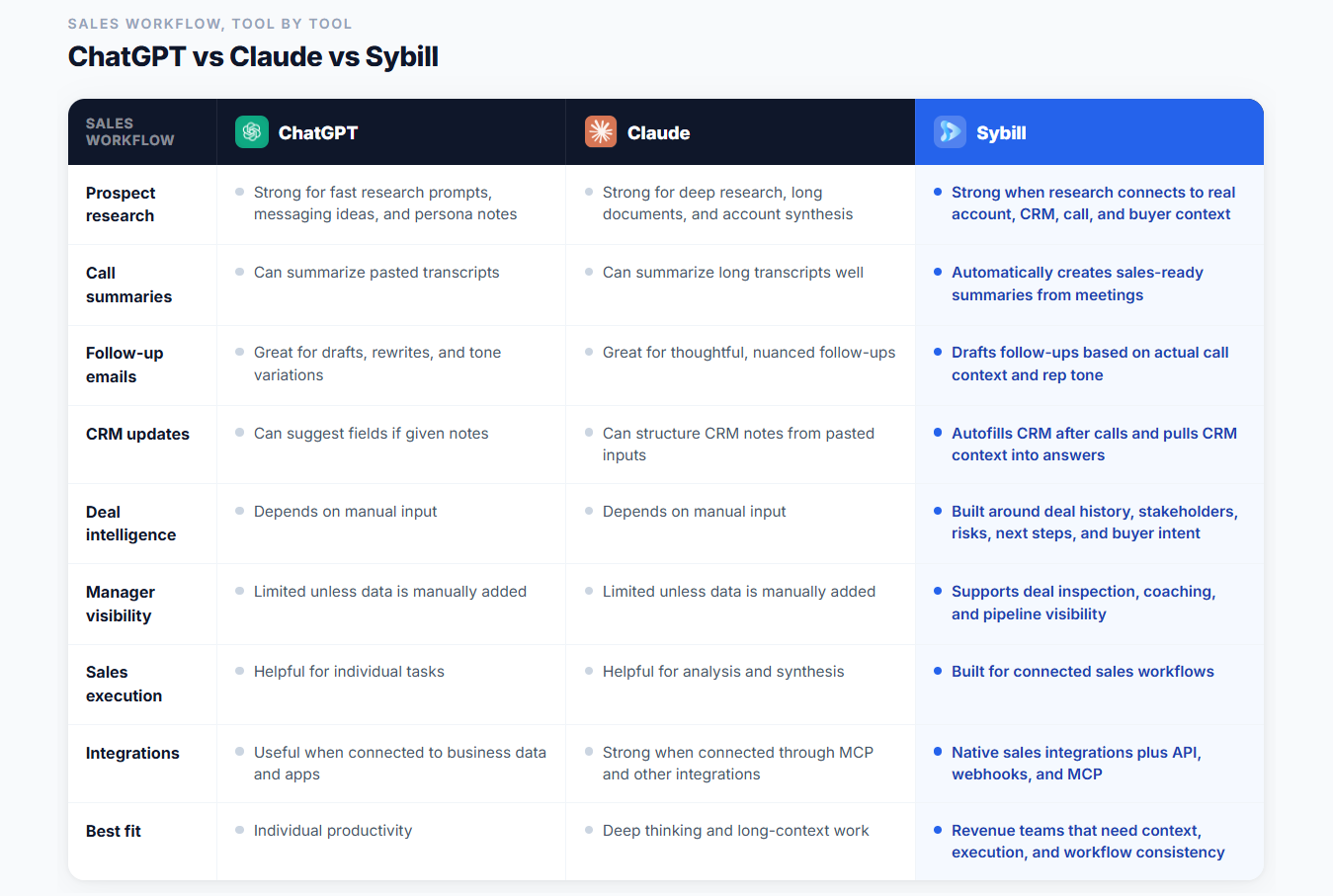
ChatGPT helps reps move faster on individual tasks. Claude helps reps think more deeply through complex information. Sybill helps teams run the sales workflow with context intact.
The issue is not whether ChatGPT or Claude can write a good email. They can. The issue is whether the AI knows which email should be written, to whom, based on which objection, after which call, tied to which next step, and reflected correctly in CRM.
That is the difference between task assistance and workflow intelligence.
A rep can ask a generic AI tool:
“Write a follow-up email after a discovery call.”
Useful, maybe.
A rep can ask a sales-contextual system:
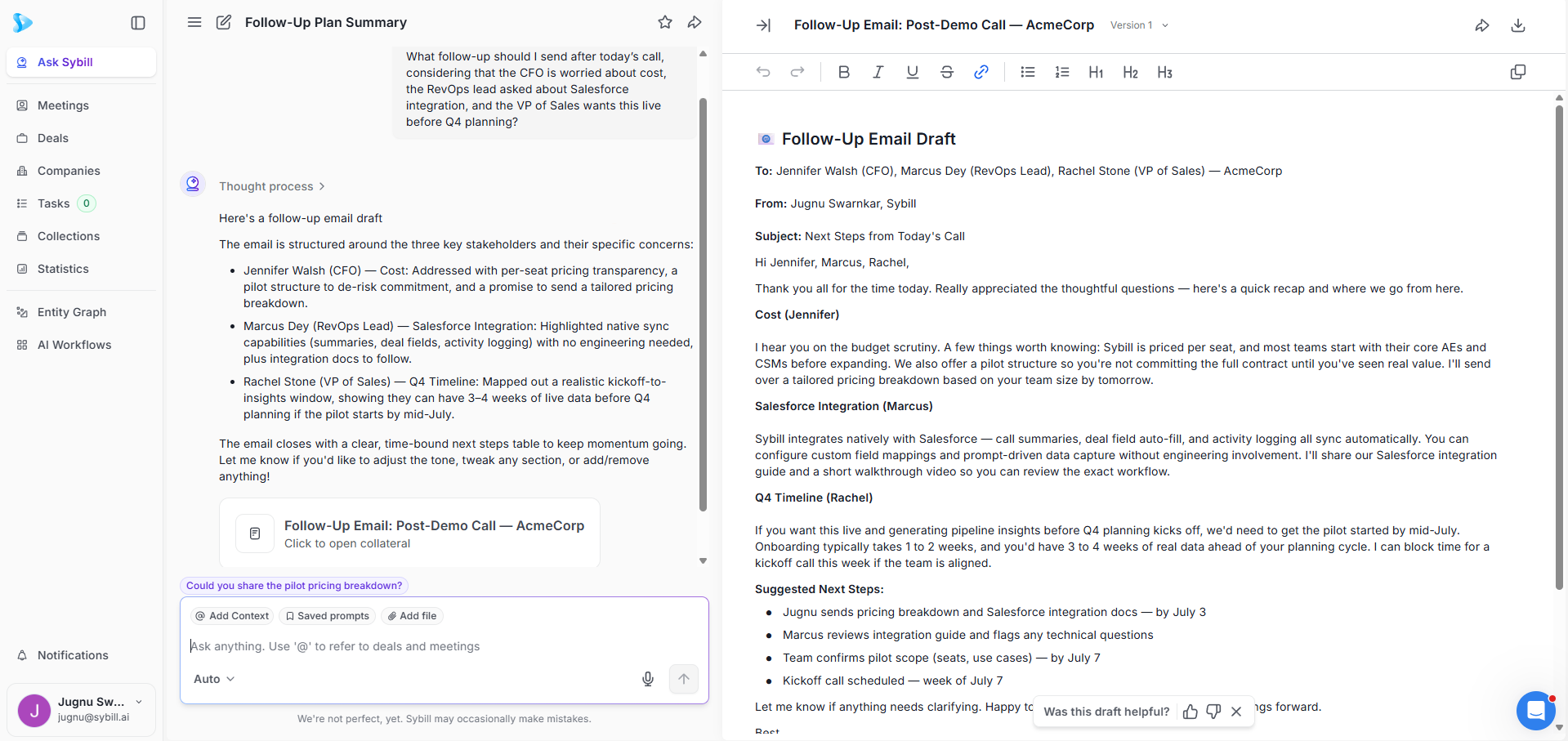
Much better.
The first prompt produces content. The second produces movement.
Sales is a context sport. Generic AI without context is like sending a Formula 1 car into Bangalore traffic without a driver, map, or survival instinct. Technically powerful. Practically questionable.
This is also why stakeholder research cannot stop at LinkedIn skimming. Sales teams need the full buying-room picture. Read how to research multiple stakeholders before a demo for a practical framework.
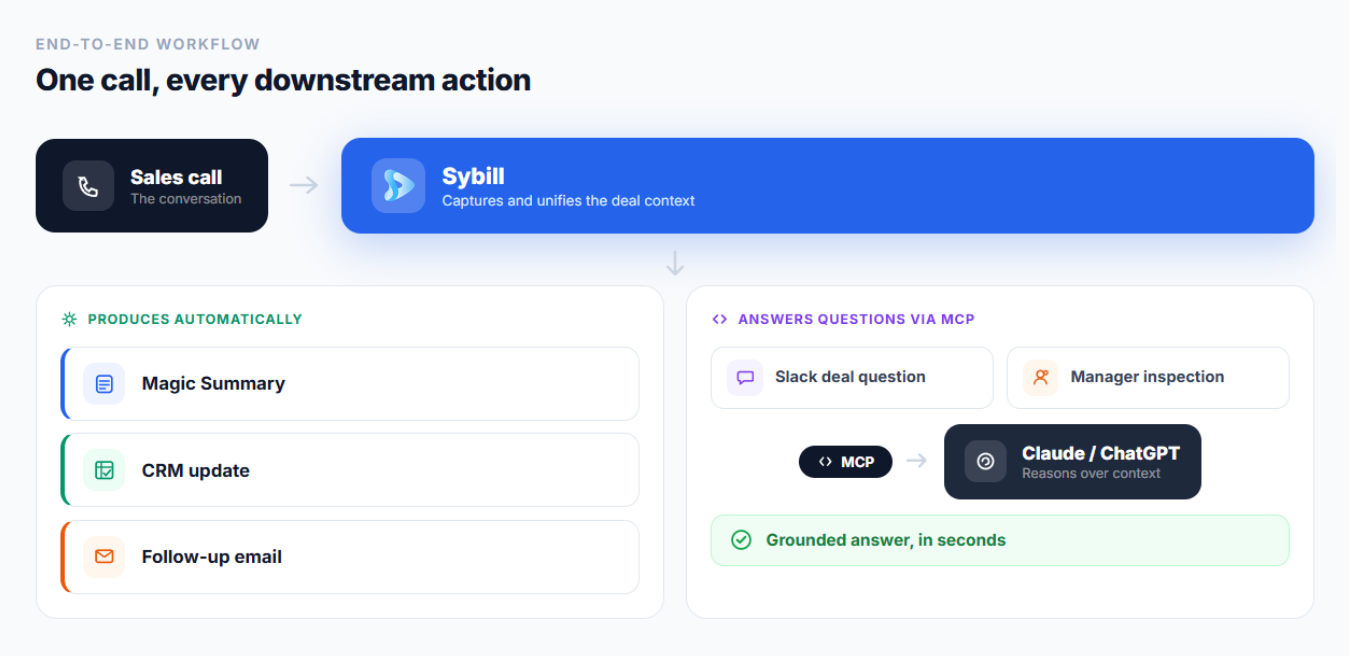
ChatGPT can still be the place where reps brainstorm creative messaging, generate email variations, reframe a value proposition, or practice objection handling. Claude can still be the place for deep research, and strategic account thinking.
Sybill becomes the sales context layer that makes all of that more useful.
This is where MCP matters. Anthropic’s Model Context Protocol documentation explains how AI systems can connect to external context and tools.
Sybill makes this practical for sales teams: it can connect to Claude, ChatGPT, Gemini, or another agent using MCP, so teams can bring Sybill’s deal data, context, and reasoning into the tools where they want to work.
So the better workflow is not:
Call happened.
Transcript generated.
Rep copies transcript.
Rep pastes into Claude.
Rep asks for summary.
Rep rewrites summary.
Rep opens CRM.
Rep updates fields.
Rep opens Gmail.
Rep writes follow-up.
Manager asks what changed.
Everyone sighs.
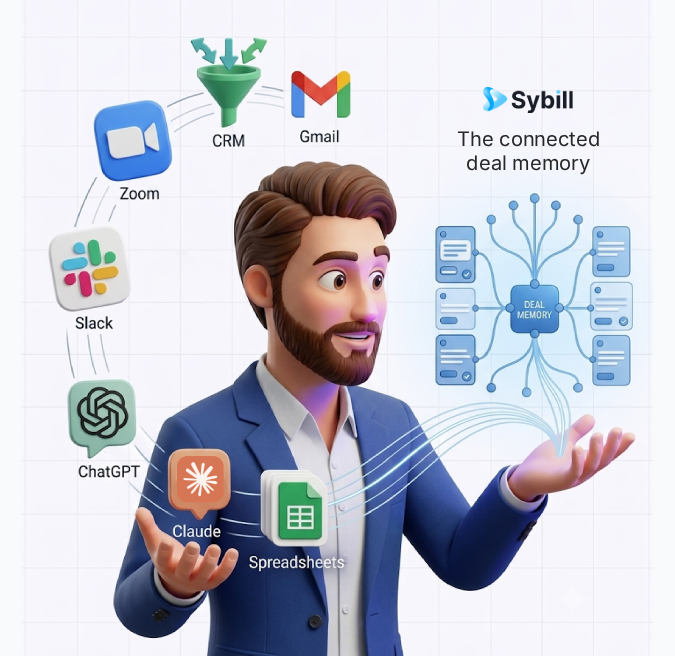
The better workflow is: Sybill captures the call, understands the deal, drafts the follow-up, updates CRM, tracks the context, and makes that context available across the stack.
Sales teams spent years trying to reduce admin work. Then AI arrived and, somehow, created a new kind of admin work.
Now reps are not just updating CRM. They are also managing prompts, copying transcripts, checking AI outputs, moving summaries across tools, and trying to remember which platform has which version of the truth.
This is why sales AI adoption can feel weirdly exhausting.
The rep is not thinking, “Wow, what a magical productivity layer.” The rep is thinking, “Why am I doing data entry in six places but with better branding?”
It also creates risk. Details get dropped. Follow-ups become generic. CRM updates become inconsistent. Managers inspect deals using stale information. RevOps tries to clean the mess later. Everybody pretends the forecast is more scientific than it is.
Sybill’s integration strategy is built against this exact problem. It connects to video meetings, generic AI tools like Claude and ChatGPT, CRM, email, dialers, collaboration tools, native integrations, API, webhooks, and MCP. It also supports tools such as Zoom, Google Meet, Teams, Webex, Gmail, Outlook, Slack, HubSpot, Salesforce, Dynamics, Salesloft, Outreach, Zoho, and more.
In other words, Sybill is not asking the rep to leave their existing AI stack. It is trying to make the AI stack remember.
Use ChatGPT when the job is flexible, creative, or prompt-led.
It is excellent for:
ChatGPT is also useful for sales leaders and enablement teams creating templates, role-play scenarios, training material, and messaging frameworks. OpenAI’s sales team resources include examples across proposals, business cases, deal management, objection handling, and enablement.
The caution: do not treat ChatGPT as if it automatically knows your pipeline. When the output depends on deal history, buyer context, CRM data, or internal sales strategy, the quality of the answer depends on the quality of the input.
Use Claude when the job requires deeper reading, longer context, and structured analysis.
It is especially useful for:
Claude is a strong thinking partner for complex sales work. But again, it needs the right data. If reps must manually gather the call history, CRM details, email threads, internal notes, and stakeholder context before Claude can help, the workflow still has friction.
That is why pairing Claude with a sales context layer can make it much more valuable.
Use Sybill when the work depends on real buyer conversations and connected sales execution.
That includes:
Sybill is especially useful for AEs, sales managers, RevOps teams, customer success teams, and sales leaders who need the deal story to be clear without forcing reps to become full-time note-takers.
Sybill, most importantly, does not replace ChatGPT or Claude. It makes sales context usable across the places where your sales team already works.
For teams trying to clean up forecast hygiene before it gets ugly, read how to spot deal risk before forecast review.
Here is the cleanest way to decide.
Choose ChatGPT if your main need is flexible personal productivity across writing, brainstorming, research, and analysis.
Choose Claude if your main need is deeper synthesis, long-context analysis, strategic account planning, and complex written work.
Choose Sybill if your main need is sales workflow execution across calls, CRM, follow-ups, deal inspection, and pipeline visibility.
For individual reps, ChatGPT and Claude can feel like superpowers. For revenue teams, Sybill solves the harder operational problem: keeping deal context connected, current, and usable.
Because the real pain is that the deal story is scattered across recordings, inboxes, CRM fields, Slack threads, manager notes, and someone’s memory from last Thursday.
That is where revenue teams lose speed. That is where forecast calls get fuzzy. That is where follow-ups become bland. That is where deals stall because nobody spotted the real blocker in time.
AI for sales should not just make reps sound more polished. It should help them sell with more context, consistency, and confidence.
ChatGPT and Claude are not the villains in this story. They are genuinely useful tools.
ChatGPT is great when reps need a fast writing partner, brainstorming assistant, or flexible productivity tool. Claude is excellent when the work needs deeper analysis, long context, and strategic synthesis.
But sales does not run on isolated prompts. It runs on connected workflows.
A real sales workflow needs to know what happened in the meeting, what changed since the last touchpoint, which stakeholder cares about what, what should go into CRM, what follow-up should go out, what risk needs attention, and what managers need to inspect before the forecast call.
That is Sybill’s lane.
Because the future of sales AI is not another tab. It is context that moves the deal.

Yes. ChatGPT is useful for sales research, cold email drafting, follow-up emails, discovery questions, objection handling, messaging variations, and sales enablement content. It works best when reps provide clear context and review outputs before using them with buyers.
Yes. Claude is useful for deeper sales research, account planning, stakeholder analysis, long-form synthesis, competitive research, and executive-ready summaries. It is especially helpful rce material such as account notes, call transcripts, CRM exports, reports, and buyer emails.
ChatGPT is often useful for fast drafting, brainstorming, rewriting, and flexible task support. Claude is strong for longer context, deep synthesis, and structured analysis. Both are general-purpose AI tools, so sales teams still need accurate deal context to get the best output.
Sybill is built specifically for sales workflows. It captures meetings, understands deal context, drafts follow-ups, updates CRM, supports deal inspection, and helps teams ask sales-specific questions based on real buyer interactions.
Yes. Sybill can connect to Claude, ChatGPT, Gemini, or another agent through MCP, so sales teams can bring Sybill’s deal data, context, and reasoning into the tools they already use.
Yes. CRM remains the system of record for pipeline, accounts, contacts, opportunities, and forecasting. AI sales tools like Sybill make CRM more useful by reducing manual updates, improving data quality, and helping teams turn buyer conversations into accurate deal records.
Yes. ChatGPT is useful for sales research, cold email drafting, follow-up emails, discovery questions, objection handling, messaging variations, and sales enablement content. It works best when reps provide clear context and review outputs before using them with buyers.
Yes. Claude is useful for deeper sales research, account planning, stakeholder analysis, long-form synthesis, competitive research, and executive-ready summaries. It is especially helpful rce material such as account notes, call transcripts, CRM exports, reports, and buyer emails.
ChatGPT is often useful for fast drafting, brainstorming, rewriting, and flexible task support. Claude is strong for longer context, deep synthesis, and structured analysis. Both are general-purpose AI tools, so sales teams still need accurate deal context to get the best output.