Find us at booth #83, join us for a harbor side happy hour, or catch Gorish’s talk.

Sept, 16-18 > Learn more

%20(1).avif)
Mamta Tainwala

April 7, 2026
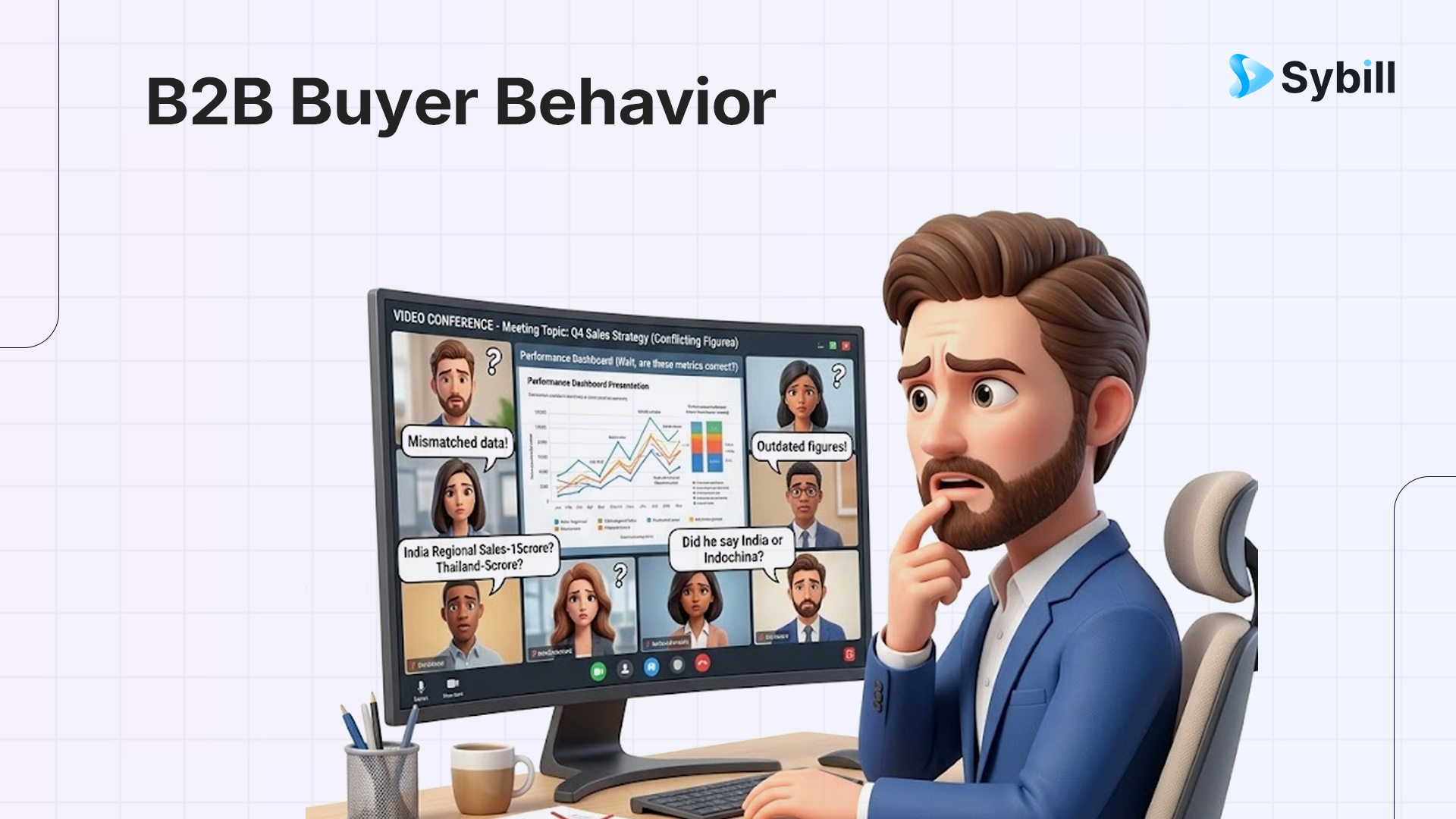
The B2B buyer of 2026 is not the buyer you built your sales playbook for.
They arrive to your first call having already done 70% of their evaluation. They have consulted 4 to 10 sources, used AI tools to build a pre-ranked vendor shortlist, and formed a preliminary consensus within a buying committee of 10 to 13 stakeholders before you even know the deal exists. By the time a seller enters the picture, 80% of the decision-making has already happened.
If you are still running a sales motion designed to educate buyers from scratch, guide them linearly through a funnel, and close a single champion, you are selling into a process that no longer exists.
This guide covers the market forces reshaping B2B buyer behavior, the specific data that proves how dramatically the buying process has shifted, and the concrete changes sales teams need to make to win in this new reality. We will also show how AI-powered tools like Sybill help sellers adapt by surfacing buyer intelligence, automating execution, and keeping pace with a buying process that moves faster and involves more people than ever before.
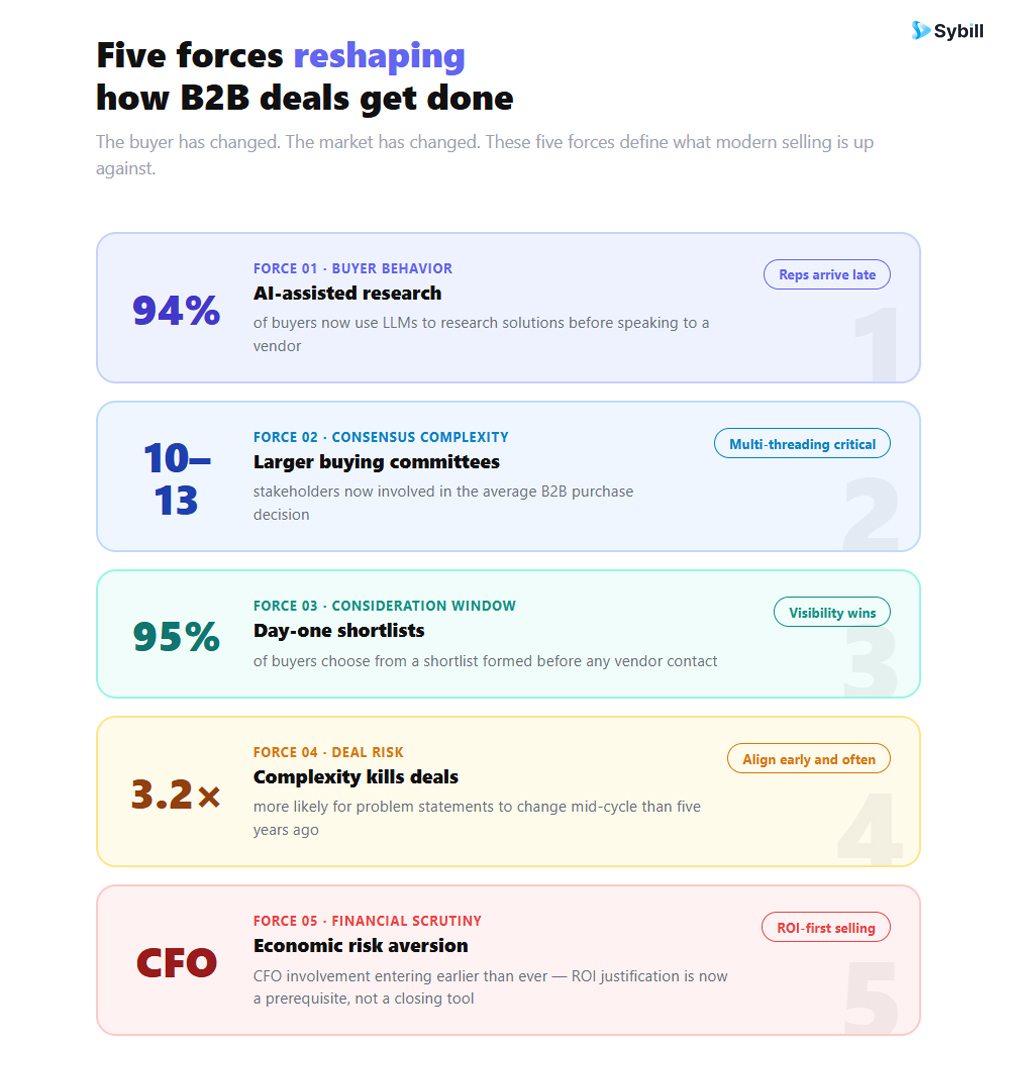
The most disruptive change in buyer behavior is that 94% of B2B buyers are using large language models (LLMs) during their purchasing process, according to the 6sense 2025 B2B Buyer Experience Report. Nearly 29% of buyers start their research with an AI tool more often than with a search engine, and over half ask AI for vendor shortlists before ever searching on Google.
This changes the competitive landscape in two ways. First, buyers arrive to sales conversations with more information, more pre-formed opinions, and more specific questions than any previous generation. The "educate and guide" sales motion that worked five years ago is now redundant for the research phase. Second, your visibility in AI-generated recommendations (AEO) matters as much as your Google ranking for early-stage discovery.
For sales teams, this means the first call is no longer about introductions and feature overviews. Buyers have already done that work. The first call is about validating fit, exploring nuance the buyer's research could not surface, and demonstrating a depth of understanding that AI-generated summaries cannot replicate. Reps who show up with a generic pitch lose immediately. Reps who arrive prepared with buyer-specific context and sharp discovery questions earn the conversation.
Forget the single decision-maker. The average B2B purchase now involves 10 to 13 internal stakeholders plus up to 9 external participants (consultants, analysts, peer references). For AI-related purchases, the buying group roughly doubles to 20+ participants.
These are not formal committees that sit in a room and vote. They are fluid networks of influence where different stakeholders carry weight at different stages. IT evaluates technical fit. Finance scrutinizes ROI and pricing. End users assess usability. Legal reviews compliance. Procurement negotiates terms. Each person in this network can derail a deal, and most of them will never join a sales call.
Selling into this reality requires multi-threading: building relationships with multiple stakeholders rather than relying on a single champion. Sybill's deal workspace tracks stakeholder involvement across every deal, flagging single-threaded risk and surfacing which buying committee members have been engaged and which have not.
Here is the data that should make every sales leader rethink their pipeline assumptions. According to 6sense, buyers now evaluate an average of 5.1 vendors. They have prior experience with 3.8 of those vendors. They fill 3.6 spots on their shortlist on Day One of the buying journey. And 95% of the time, the vendor they ultimately purchase from comes from that initial shortlist.
Read that again: the shortlist is nearly complete before a single vendor conversation happens. If you are not on the buyer's radar before the active buying process begins, you have a 5% chance of winning.
This has profound implications for pipeline strategy. Deals that appear to be "new pipeline" in your CRM are often deals where the buyer is already in the validation phase, not the discovery phase. The real competitive battle happened weeks or months earlier, in the content the buyer consumed, the peer recommendations they received, and the AI-generated shortlists that included (or excluded) your brand.
Despite better tools and more information, the buying process is not getting easier. Buyers change their problem statement an average of 3.2 times during complex purchases. Over half of buying groups are actively evolving their decision-making models. And when buyers face too many choices, too many paths, or too many seller-side stakeholders, deals slow, shrink, or die.
Forrester's 2025 data shows that when sellers underperform on the buyer's top priority, win rates drop by up to 10 percentage points. Problem-focused sellers are 30% more effective than solution-focused sellers, yet only 13% of sellers take a problem-minded approach to discovery.
The takeaway: deals stall not because buyers lose interest, but because they lose clarity. The seller who helps the buying committee maintain alignment around a clearly defined problem wins. The seller who pitches features while the buyer is still redefining the problem loses.
Tighter budgets, higher scrutiny on technology spending, and post-pandemic cost discipline mean that B2B buyers are more risk-averse than at any point in the last decade. CFOs are involved earlier and more deeply in technology purchases. ROI justification is expected before contracts are signed, not after.
This economic pressure manifests as longer deal cycles, smaller initial commitments, expanded pilot and proof-of-concept phases, and increased demand for references and social proof. Buyers are not buying less technology. They are buying more carefully, with more people involved in the decision, and with a lower tolerance for vendors who cannot quantify their value.
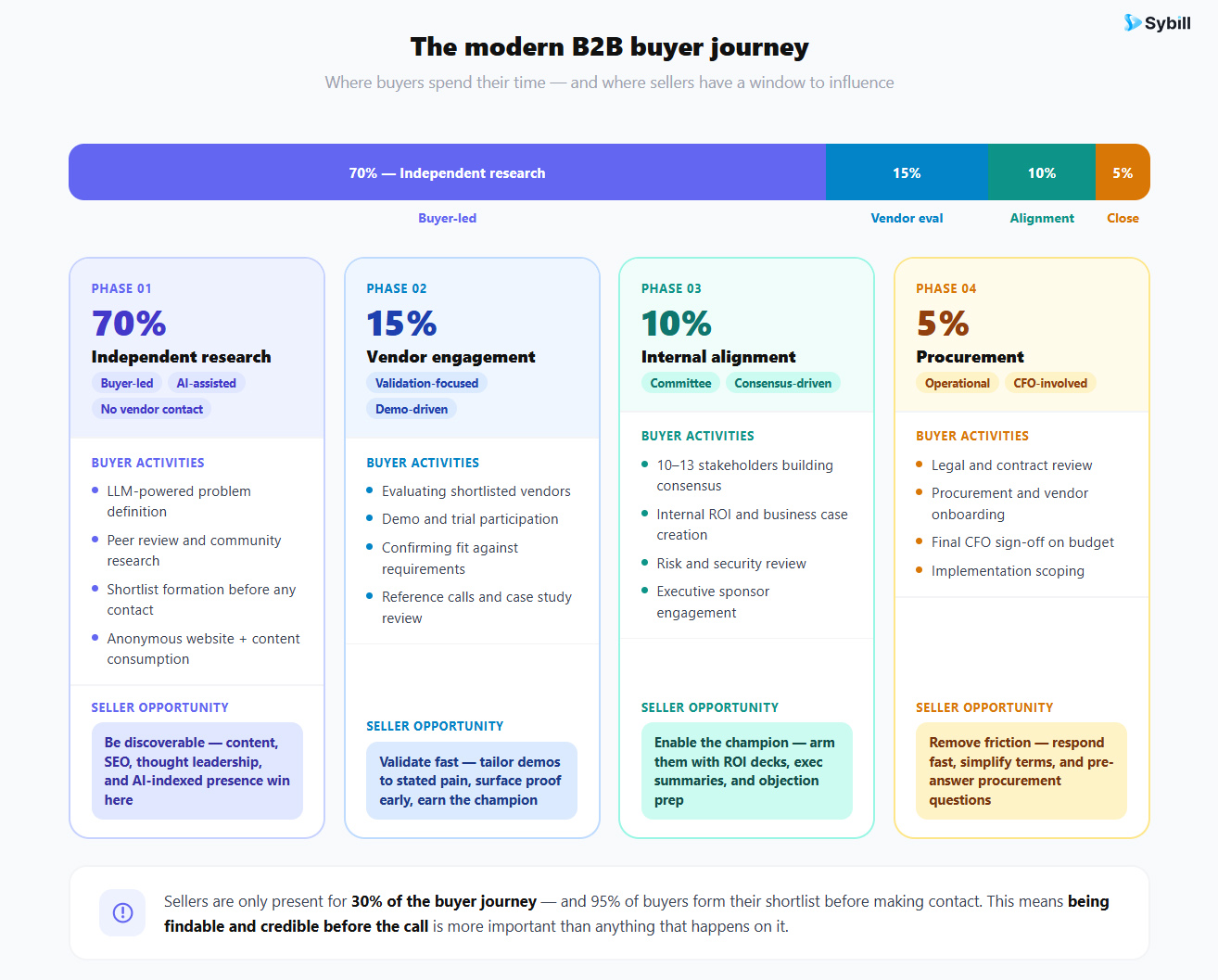
The traditional linear funnel (awareness > interest > consideration > decision) no longer describes how B2B purchases actually happen. The 2026 buying journey looks more like this:
Phase 1: Independent research (70% of the journey). Buyers identify a problem, research solutions, consult peers, use AI tools, and form a preliminary shortlist. This happens entirely without seller involvement. By the end of this phase, the buyer has a preferred vendor 80% of the time.
Phase 2: Vendor engagement (the remaining 30%). Buyers reach out to shortlisted vendors for demos, technical validation, pricing, and reference checks. This is the validation phase, not the discovery phase. The buyer is confirming their hypothesis, not starting from scratch.
Phase 3: Internal alignment. The buying committee debates, negotiates priorities, navigates internal politics, and builds consensus. This phase is invisible to sellers and is where most deals stall or die.
Phase 4: Procurement and close. Legal, compliance, and procurement processes add weeks or months to the timeline. This phase is operational, not strategic, but delays here can kill deal momentum.
The critical insight for sales teams: if your motion is optimized for Phase 2 (demos, proposals, closing) but you have no strategy for Phase 1 (being on the shortlist) or Phase 3 (helping buyers align internally), you are competing on a fraction of the battlefield.
If shortlists form on Day One and 95% of purchases come from that initial list, the most important selling happens before any rep picks up the phone.
Content that answers real buying questions. Buyers research independently. They are reading comparison articles, analyzing reviews, and asking AI tools for vendor recommendations. Your content needs to be there, answering the specific questions your ICP is asking, in the formats and channels where they look.
AI visibility (AEO). If 29% of buyers start with AI rather than Google, your brand needs to appear in AI-generated recommendations. This means creating content that LLMs can extract and cite when buyers ask questions like "What is the best conversation intelligence tool for mid-market sales teams?"
Social proof at scale. References, case studies, G2 reviews, and peer recommendations influence shortlist formation. Buyers trust other buyers more than they trust vendors. Make it easy for happy customers to share their experience.
When a buyer contacts you, they are not looking for a product overview. They have already done that research. They want to validate three things: does this solve my specific problem, can I trust this vendor to deliver, and can I build the internal case for this purchase.
The sellers who win in 2026 approach discovery differently. Instead of asking "What problem are you trying to solve?" (the buyer already researched this), they ask "When you evaluated this internally, what was the biggest point of disagreement on the committee?" or "What would need to be true for this to move forward this quarter?"
This level of specificity requires preparation. Pre-meeting briefs that pull context from prior interactions, public information, and deal history help reps walk into every conversation ready to validate rather than educate.
Single-threaded deals fail at dramatically higher rates than multi-threaded ones. With 10 to 13 stakeholders involved, relying on one champion to sell internally on your behalf is betting the deal on a single point of failure.
Effective multi-threading means identifying and engaging the champion (who advocates), the economic buyer (who approves budget), the technical evaluator (who validates feasibility), and end users (who confirm usability). Each person needs a different message, different proof points, and different value framing.
Conversation intelligence helps here by capturing who was mentioned on calls, what concerns were raised, and which stakeholders have been engaged versus absent. Ask Sybill can surface cross-deal patterns like "Which deals have no confirmed champion?" or "Where are we single-threaded in this quarter's commit?"
The biggest killer of B2B deals is not a competitor. It is the status quo. Deals die in committee because stakeholders cannot agree on the problem definition, the evaluation criteria, or the priority relative to other initiatives.
Sellers who help buyers build internal consensus win at disproportionate rates. This means providing shareable business cases, ROI calculators, and executive summaries that the champion can distribute to the committee. It means coaching the champion on how to present your solution internally. And it means creating follow-up materials that address each stakeholder's specific concerns.
Sybill's personalized follow-up emails are grounded in what was actually discussed on the call, which means the champion receives content they can forward directly to their CFO, CTO, or procurement lead with context already built in.
Buying complexity is the enemy. Every additional step, every unclear pricing structure, every delayed response, and every generic document adds friction that slows deals and reduces win rates.
The fastest-responding vendor wins disproportionately. Automated follow-ups sent within minutes of a call, CRM data updated in real time so nothing falls through cracks, and deal workspaces that keep every stakeholder interaction organized: these are not nice-to-haves. They are table stakes for sellers competing in a buying process that penalizes slowness and rewards clarity.
The gap between how fast buyers move and how fast sellers respond is the single biggest source of lost deals in 2026. Buyers research at AI speed. Sellers respond at manual-admin speed. AI closes that gap.
Pre-call intelligence. Sybill generates pre-meeting briefs that compile prior call context, buyer signals, CRM history, and deal status so reps walk into validation calls prepared, not scrambling.
Real-time conversation capture. Every call is automatically transcribed and analyzed. Magic Summaries capture what was discussed, what was decided, and what was committed. No more relying on memory or handwritten notes.
Instant, context-rich follow-ups. Sybill drafts personalized follow-up emails in the rep's voice within minutes of each call. The content references specific buyer concerns, objections, and next steps from the conversation, not generic templates.
CRM that reflects reality. CRM Autofill updates 30+ fields after every call, including deal stage, qualification criteria, stakeholder roles, and next steps. When pipeline reviews happen, the data is current, not three weeks stale.
Cross-deal intelligence. Ask Sybill answers questions like "Which deals have buyers who mentioned budget concerns in the last two weeks?" or "Where are we losing on competitor mentions?" Managers get deal intelligence that would have taken hours of manual review, delivered in seconds.
Coaching grounded in buyer behavior. Instead of coaching based on gut feel, managers can see exactly how reps handle discovery, objections, and pricing conversations across deals. AI-powered coaching surfaces the specific skill gaps where improvement would create the biggest win-rate impact.
Here are the specific data points that should drive your 2026 sales strategy decisions:
70% of the buying journey happens before seller contact (6sense). Build your strategy around being discoverable and credible during the independent research phase.
Buying committees average 10 to 13 internal stakeholders (6sense, Forrester). Every deal needs a multi-threading strategy, not a single-champion plan.
95% of purchases come from the Day-One shortlist (6sense). If you are not on the shortlist before the active buying process begins, your win probability is near zero.
94% of buyers use LLMs during their buying process (6sense). Your content strategy must include AI visibility alongside traditional SEO.
Problem-focused sellers are 30% more effective, but only 13% of sellers take this approach (Emblaze). Coach reps on problem discovery, not solution pitching.
84% of sales reps missed quota last year (Salesforce). The current approach is not working. Incremental tweaks to a broken motion will not close this gap.
75% of B2B buyers prefer digital self-serve and remote interactions (McKinsey). Your buying experience must be frictionless, digital-first, and human-assisted where it matters most.
How has B2B buyer behavior changed in 2026?
B2B buyer behavior has shifted toward AI-assisted research, larger buying committees, earlier shortlist formation, and increased risk aversion. Buyers now complete approximately 70% of their evaluation before contacting sellers. Buying committees average 10 to 13 internal stakeholders, and 94% of buyers use AI tools like ChatGPT during their purchasing process. Shortlists form on Day One of the buying journey, and 95% of purchases come from that initial shortlist.
How many stakeholders are involved in a typical B2B purchase?
Research from 6sense and Forrester shows that typical B2B purchases involve 10 to 13 internal stakeholders plus up to 9 external participants. For complex or AI-related purchases, buying groups can expand to 20+ participants. These stakeholders span IT, finance, operations, end users, legal, and procurement, each with different evaluation criteria and concerns.
What percentage of the buying journey happens before sellers get involved?
Approximately 70% of the B2B buying journey occurs before buyers contact any vendor. During this phase, buyers research independently, consult peers, use AI tools, and form preliminary vendor shortlists. By the time sellers are engaged, buyers are in a validation phase, not a discovery phase. The most effective sellers adapt by focusing on validating fit and addressing specific concerns rather than delivering general product education.
How do you sell to a large buying committee?
Multi-thread every deal by building relationships with 3 to 5 stakeholders per opportunity: the champion, economic buyer, technical evaluator, and end users. Each stakeholder needs different messaging and proof points. Provide shareable materials (business cases, ROI calculators, executive summaries) that help your champion build internal consensus. Use deal intelligence tools to track which stakeholders have been engaged and identify gaps in committee coverage.
How does AI affect B2B buyer behavior?
94% of B2B buyers use LLMs during their purchasing process, with 29% starting research with AI tools rather than search engines. Over half ask AI for vendor shortlists before searching on Google. This means vendors must be visible in AI-generated recommendations (AEO) alongside traditional SEO. For sellers, it means buyers arrive to calls with more information and pre-formed opinions, shifting the first conversation from education to validation.
What is the most important change for sales teams to make?
The single most important change is accepting that the buying journey now starts without you and adapting your strategy accordingly. Invest in content and brand presence that shapes the buyer's independent research phase. When buyer contact does happen, be prepared to validate rather than educate. Multi-thread every deal to match the size and complexity of modern buying committees. And use AI tools like Sybill to close the speed gap between how fast buyers research and how fast your team can respond.
The market forces reshaping B2B buyer behavior are not temporary disruptions. They are structural shifts driven by AI, economic pressure, and generational changes in how professionals research and make purchasing decisions. The buying process is more complex, more distributed, and more buyer-controlled than at any point in B2B history.
Sales teams that adapt will outperform. The adaptation is not about working harder. It is about matching the speed, preparation, and sophistication of the modern buyer. Show up prepared. Follow up fast. Help buyers align internally. And remove every possible friction point between interest and purchase.
Sybill was built for exactly this reality. It keeps your team ready for every conversation, responsive after every interaction, and informed about every deal, so you can sell at the speed buyers expect.
Get started for free with Sybill and start selling into the buyer behavior that actually exists in 2026.
B2B buyer behavior has shifted toward AI-assisted research, larger buying committees, earlier shortlist formation, and increased risk aversion. Buyers now complete approximately 70% of their evaluation before contacting sellers. Buying committees average 10 to 13 internal stakeholders, and 94% of buyers use AI tools like ChatGPT during their purchasing process. Shortlists form on Day One of the buying journey, and 95% of purchases come from that initial shortlist.
Research from 6sense and Forrester shows that typical B2B purchases involve 10 to 13 internal stakeholders plus up to 9 external participants. For complex or AI-related purchases, buying groups can expand to 20+ participants. These stakeholders span IT, finance, operations, end users, legal, and procurement, each with different evaluation criteria and concerns.
Approximately 70% of the B2B buying journey occurs before buyers contact any vendor. During this phase, buyers research independently, consult peers, use AI tools, and form preliminary vendor shortlists. By the time sellers are engaged, buyers are in a validation phase, not a discovery phase. The most effective sellers adapt by focusing on validating fit and addressing specific concerns rather than delivering general product education.