Find us at booth #83, join us for a harbor side happy hour, or catch Gorish’s talk.

Sept, 16-18 > Learn more

%20(1).avif)
Mamta Tainwala

February 26, 2026
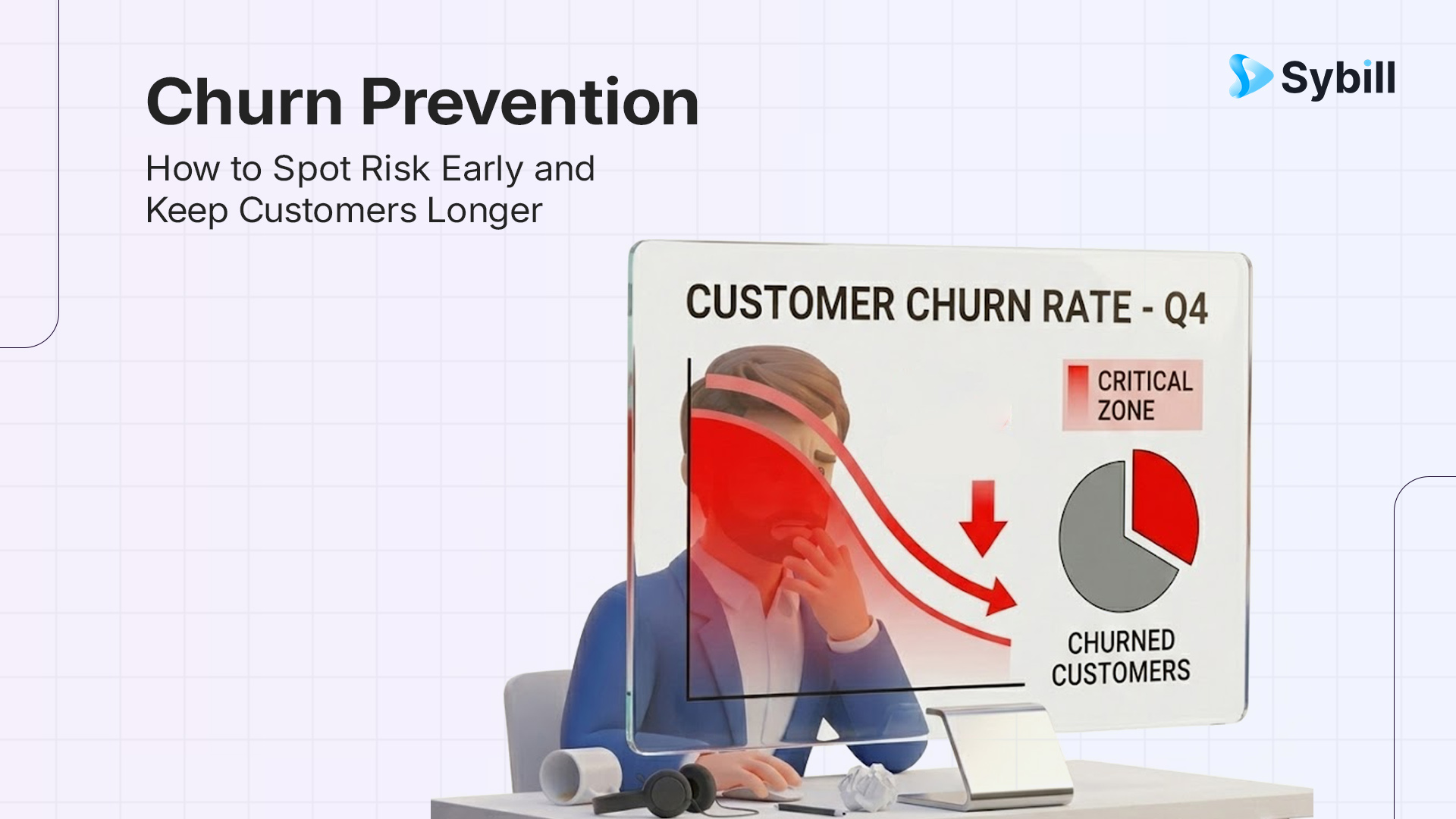
Churn is almost never a surprise. It's a data problem. Here's what your team needs to see before the cancellation email lands:
Acquiring a new customer costs five to seven times more than keeping an existing one. You probably already know that number. The question is what you're actually doing about it.
Most SaaS teams treat churn as a customer success problem that surfaces at renewal. By then, the decision has usually already been made. The customer disengaged months ago. The value conversation stopped happening. The champion left and nobody noticed in time. What looks like a renewal failure is almost always a retention failure that started much earlier.
Churn is predictable. The signals are visible in call data, engagement patterns, and the gap between what was promised during the sale and what was delivered after it. This guide covers how to see them sooner and what to do when you do.
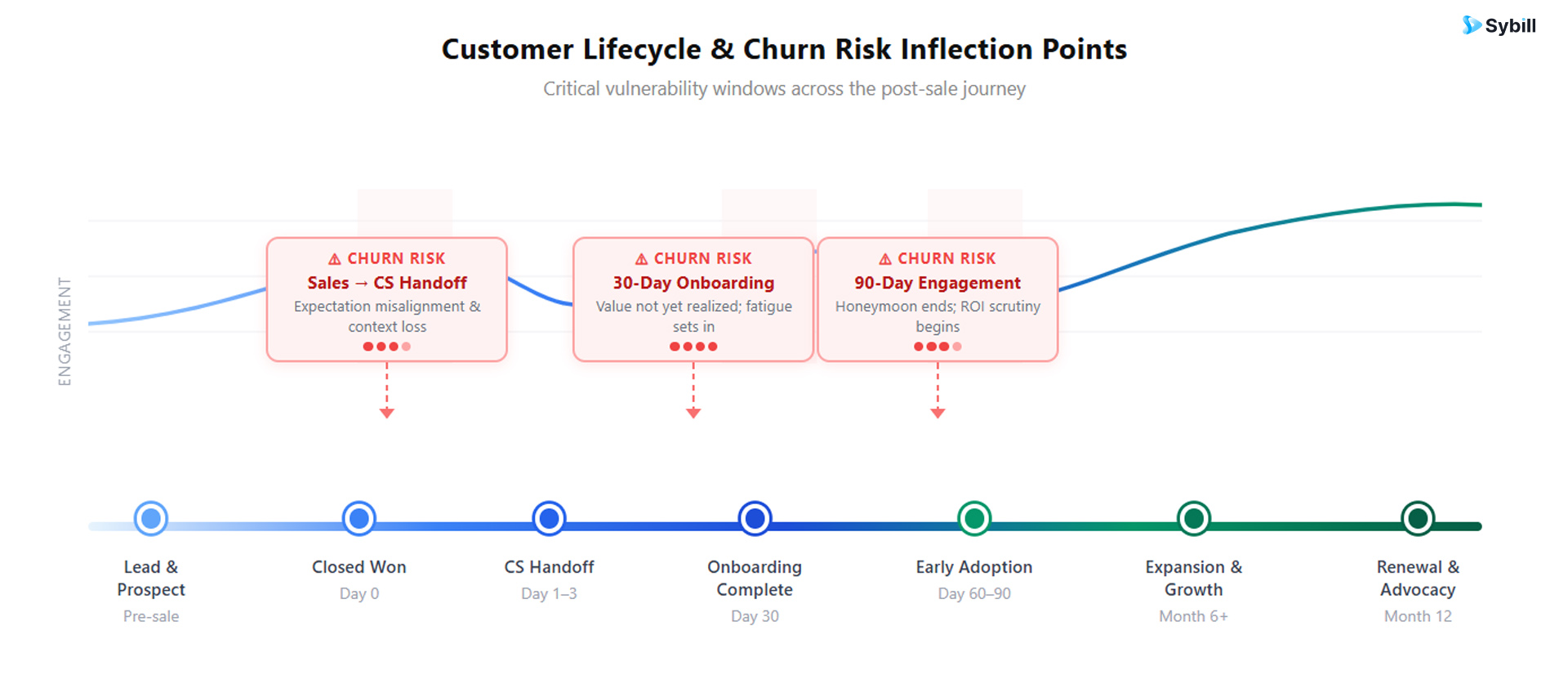
There's a tendency in SaaS organizations to treat churn as the customer success team's responsibility. Once the deal closes, it's CS's problem. Sales moves on to the next logo.
This framing has a significant cost. Research from the Harvard Business Review points to retention rate increases of just 5% producing profit gains of 25% to 95%. But the conditions that drive churn often originate during the sales cycle, not after it.
When a rep oversells to close the quarter, overpromises on capabilities to handle an objection, or fails to surface a customer's real success criteria during discovery, the customer success team inherits a mismatch that's very hard to correct. The customer signed up for an outcome that isn't coming. They will churn.
This is why churn prevention belongs to the entire revenue team, and why the sales-to-customer-success handoff is one of the highest-leverage moments in the customer lifecycle. A clean handoff with complete deal context, documented success criteria, and accurate expectations reduces first-year churn significantly. A sloppy one creates a timer.
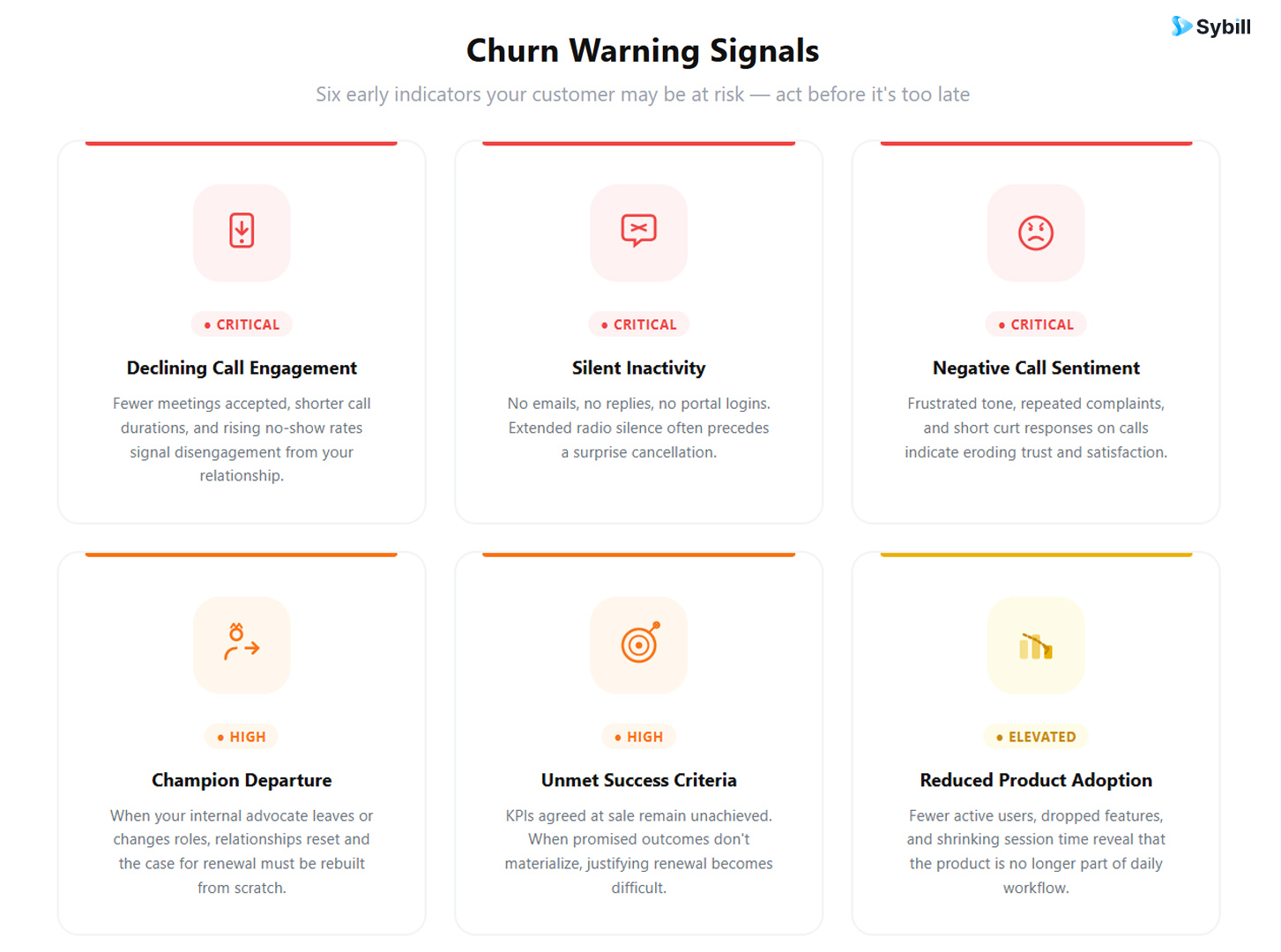
Every customer who churns sends signals before they leave. The challenge is that those signals arrive across different channels, often quietly, and rarely trigger an alert unless someone is specifically looking.
Here are the leading indicators that matter most in B2B churn prevention:
Declining engagement on calls. A customer who used to show up to QBRs with five stakeholders now sends one junior rep. Their champion is less engaged on calls. The energy has shifted. Without behavioral analysis of call data, this drift is hard to quantify. But it's one of the most reliable signals that the relationship is cooling.
Silent churn. The customer hasn't officially canceled, but they've stopped engaging. No replies to check-in emails. No activity in the product. No response to the CS manager's last three outreach attempts. This is what churn mitigation research calls "silent churn," and it's the most dangerous kind because it looks like inactivity, not risk.
Negative sentiment on calls. A customer who was enthusiastic in early onboarding calls is now clipped, skeptical, or passive. They're asking questions about contract terms. They're mentioning "evaluating options." These are verbal signals that, if captured and analyzed, are clear precursors to churn.
Champion departure. When the person who championed your solution internally leaves the account, the relationship resets. The new stakeholder has no history with your product, may have preferred a competitor, and has no emotional investment in making things work. Without proactive re-engagement, this scenario ends in churn surprisingly often.
Misalignment between promised and delivered outcomes. This one is insidious because it's invisible unless you're tracking it. What success criteria did the customer articulate during the sales cycle? Are those being met? If the rep documented discovery thoroughly, this question has an answer. If they didn't, the CS team is guessing.
A deal closed is not a customer retained. The transition from sales to customer success is where value continuity either holds or breaks.
When the handoff is incomplete, the CS team doesn't know what was promised. They don't know who the key stakeholders are or what internal politics shaped the purchase decision. They don't know what the customer's success criteria looked like in their own words. They're starting from scratch with a paying customer who already has expectations, and that gap is where early churn risk lives.
The most common handoff failures in B2B SaaS:
Sybill addresses this structurally. Every call in the sales cycle is automatically summarized and logged to the CRM with structured notes covering pain points, success criteria, stakeholder dynamics, and commitments made. When the account transfers to CS, the full deal context travels with it, so the CSM never has to ask the customer to repeat themselves.
As the sales-to-CS handoff guide notes, never making the customer repeat themselves is one of the highest-impact behaviors for early retention. It signals that their context was valued and preserved.
Most health scoring models rely on product usage, support ticket volume, and NPS. These are useful lagging indicators. They tell you a customer is at risk after the risk has already materialized.
A stronger health score incorporates conversation signals: engagement on calls, sentiment trends, how often the champion appears in recent interactions, whether success criteria are being discussed or avoided. Sybill's behavioral AI captures these signals automatically, giving customer success teams a richer picture of account health than product data alone can provide.
The best time to address churn risk is as early as possible, ideally before the customer has fully crystallized their dissatisfaction. An intervention at the 60-day mark, when engagement starts to drop, is infinitely more effective than one at month 11, two weeks before renewal.
This requires a proactive monitoring posture. CS teams need to be alerted when engagement drops, not when the customer goes dark. AI tools that flag changes in call tone, declining response rates, or shifts in stakeholder participation give teams the window they need to intervene with leverage still intact.
For high-value accounts, the enterprise account nurturing framework recommends tiered monitoring: the accounts most critical to your net dollar retention deserve active engagement tracking, not reactive check-ins.
One of the quietest churn drivers in B2B SaaS is value amnesia. The customer understood the ROI during the buying process. Six months into using the product, they've forgotten it, especially if the value isn't being actively surfaced and communicated.
Quarterly business reviews are the standard vehicle for this, but they only work if the success criteria from the sales cycle were documented and the outcomes are being measured. Otherwise, the QBR becomes a feature update session, not a value reinforcement session.
CS teams that use call data to continuously reference back to a customer's original stated goals, "In your first call with us, you told our team that reducing admin time was your primary goal. Here's how that's tracked over the past 90 days," are much harder to churn.
Churn patterns are not random. If you're losing a specific customer profile at a disproportionate rate, there's usually a reason: a segment where the product doesn't deliver the promised outcome, a sales motion that creates unrealistic expectations, a competitive vulnerability in a particular use case.
Churn analysis done systematically, meaning querying across your closed-lost and churned accounts for common patterns, turns individual losses into systemic insights. Which success criteria were most often unmet? Which rep promises generated the most CS escalations? Which customer profiles correlated with the shortest retention windows?
Ask Sybill makes this kind of cross-deal querying accessible in plain language. A revenue leader can ask "What were the most common unmet expectations in accounts that churned in Q3?" and surface patterns across dozens of calls and CRM records in seconds.
Customers who don't fit your ideal customer profile churn at significantly higher rates than those who do. This seems obvious, but many SaaS teams don't track churn segmented by ICP fit, which means they're investing in retention programs for customers who were never going to stay long-term.
A rigorous ICP calibration process, one that feeds churn data back into how you define and qualify ideal customers, is one of the highest-leverage churn prevention investments a growing SaaS company can make. The insight is simple: acquiring the wrong customers creates a churn problem that no retention strategy can fully solve.
Sybill's role in churn prevention sits primarily at three points in the customer lifecycle.
During the sale: Every call is captured, summarized, and logged automatically. Success criteria, stakeholder dynamics, and commitments made are documented before the handoff, so CS receives complete deal context, not a rep's summary from memory. This directly reduces early churn risk from misaligned expectations.
Get started for free with Sybill and eliminate the handoff gaps that create churn before the customer even onboards.
At the handoff: Sybill's deal summaries act as a structured handoff document, giving CS everything they need to continue the conversation the sales rep started, referencing the customer's own language and goals from discovery.
Across the account lifecycle: For ongoing customer calls, whether onboarding check-ins, QBRs, or renewal conversations, Sybill continues to capture engagement signals, sentiment shifts, and conversation content. CS teams get the same call intelligence that helped sales win the deal, now applied to keeping it.
For teams tracking net revenue retention as a key growth metric, this creates a continuous intelligence layer across the customer journey, not just at the point of sale.
What is churn prevention in B2B SaaS?
Churn prevention is the set of strategies, processes, and tools a B2B company uses to identify customers at risk of leaving and intervene before they cancel or fail to renew. Effective churn prevention combines early warning signal detection, proactive engagement, and alignment between what was sold and what is delivered.
What are the most common causes of B2B customer churn?
The most common causes include unmet expectations set during the sales cycle, poor onboarding that fails to get the customer to first value, champion departure, declining product adoption, inadequate customer success engagement, and competitive displacement. Many of these causes are identifiable weeks or months before renewal.
How do you detect churn risk early?
Reliable early signals include declining engagement on calls, reduced product usage, negative sentiment shifts in customer conversations, missed QBRs, champion turnover, and increasing support ticket frequency. AI tools can monitor these signals continuously across your account base and surface at-risk accounts before human observation would catch them.
What's the difference between churn prediction and churn prevention?
Churn prediction is the identification of at-risk accounts using data models and behavioral signals. Churn prevention is the execution: the actual actions taken to address the risk and retain the customer. Both are necessary, but prediction without prevention is just an early warning system with no follow-through.
How does a poor sales-to-CS handoff cause churn?
When the CS team doesn't receive complete deal context, they often onboard customers to generic plans rather than their specific goals. The customer feels like they're starting over, doesn't see the value they were promised, and disengages early. This is one of the most preventable causes of first-year churn.
Can AI tools help with churn prevention?
Yes. AI tools like Sybill help by capturing behavioral signals from calls and customer interactions, documenting success criteria and deal context for clean handoffs, flagging sentiment shifts and engagement drops in ongoing customer conversations, and enabling cross-account pattern analysis to identify systemic churn drivers.
What metrics should I track for churn prevention?
Key metrics include net revenue retention (NRR), customer health scores, time to first value, 30/60/90-day CSAT after onboarding, churn rate segmented by ICP fit, and first-year retention segmented by handoff quality. Together, these tell a complete story about where your retention is strong and where it's breaking.
Churn prevention is the set of strategies, processes, and tools a B2B company uses to identify customers at risk of leaving and intervene before they cancel or fail to renew. Effective churn prevention combines early warning signal detection, proactive engagement, and alignment between what was sold and what is delivered.
The most common causes include unmet expectations set during the sales cycle, poor onboarding that fails to get the customer to first value, champion departure, declining product adoption, inadequate customer success engagement, and competitive displacement. Many of these causes are identifiable weeks or months before renewal.
Reliable early signals include declining engagement on calls, reduced product usage, negative sentiment shifts in customer conversations, missed QBRs, champion turnover, and increasing support ticket frequency. AI tools can monitor these signals continuously across your account base and surface at-risk accounts before human observation would catch them.