Find us at booth #83, join us for a harbor side happy hour, or catch Gorish’s talk.

Sept, 16-18 > Learn more


Tamanna Mishra

April 3, 2026
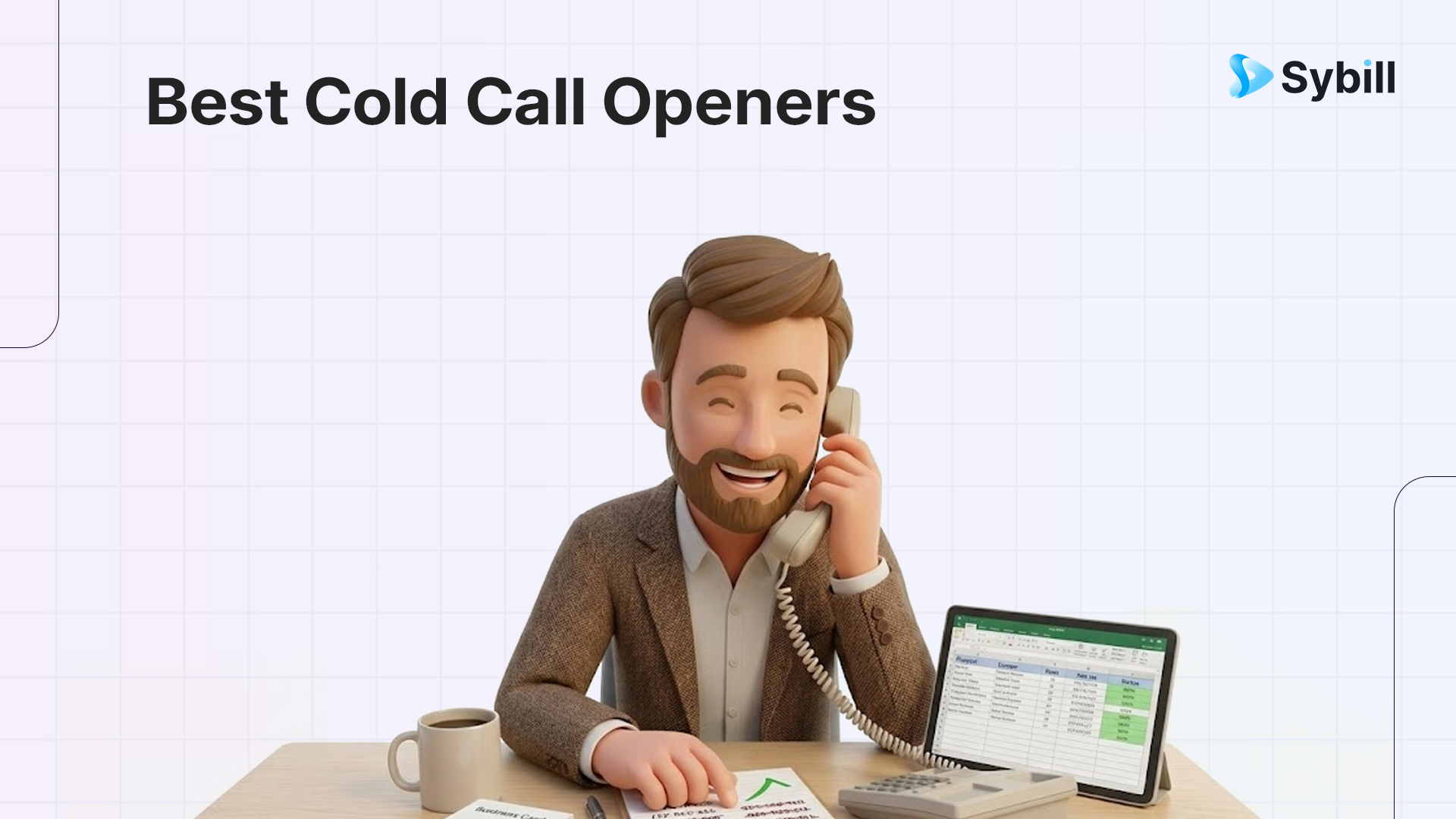
Cold calling today feels like walking into a party where nobody invited you, nobody wants to talk to you, and someone is already halfway to calling security.
And yet… It still works. Click here for a guide on whether cold calling is dead in 2026 and what actually works.
Here’s the uncomfortable truth most sales teams don’t want to admit:
Cold calling isn’t broken. Your opening line is.
Because in 2026, buyers aren’t rejecting calls. They’re rejecting bad interruptions.
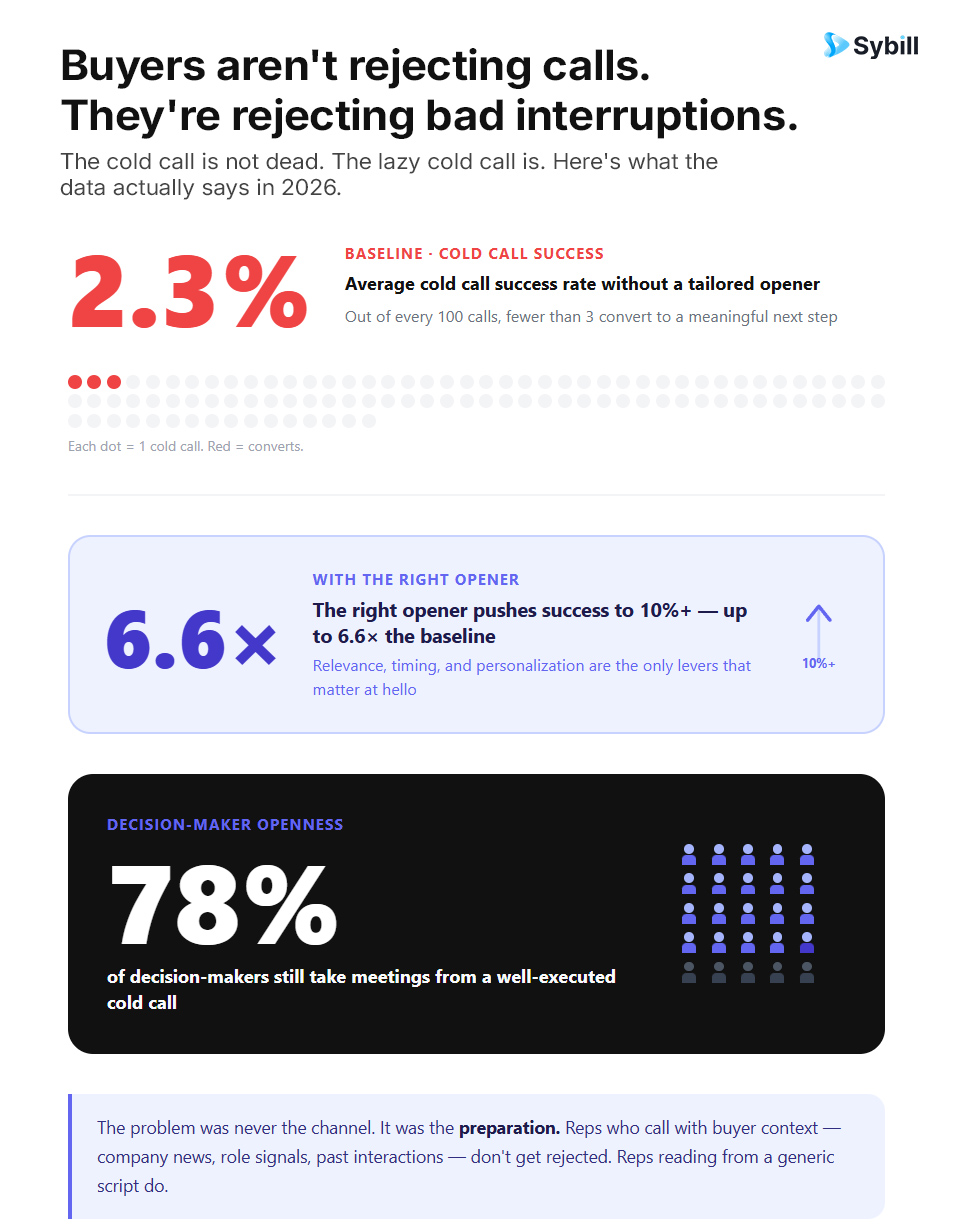
So the math is simple. You don’t need more dials. You need better first sentences.
This guide breaks down:
A cold call opener is the first one or two sentences you say when someone picks up the phone. That’s it.
But those two sentences decide everything.
Think of it like a handshake through the phone. Too weak, and you’re ignored. Too aggressive, and you’re rejected. Too generic, and you’re forgotten.
Here’s what’s really happening psychologically:
Your job is to earn the next 30 seconds.
“Cold” simply means no prior relationship. But the concept actually comes from entertainment. In TV shows, a “cold open” jumps straight into action before the intro.
Immediate engagement.
Cold calling works the same way.
You interrupt someone’s day. So you need to:
Let’s talk about the lines everyone still uses.
“Did I catch you at a bad time?”
“How’s your day going?”
They feel polite. Safe. Professional.
They also fail.
Even worse, your prospect already knows it’s a cold call.
So when you pretend otherwise, you lose credibility.
Most openers:
Worse, you lose the permission to continue.
Let’s drop the idea of “best lines.”
Winning teams don’t memorize lines. They execute strategies.
Because buyers don’t respond to words. They respond to signals.
Here are the four signals your opener must send if you want the call to survive.
What it sounds like:
“Most RevOps leaders I speak with are struggling with pipeline visibility right now. Curious if that’s showing up for you too?”
What it signals:
Why it works:
You’re not asking for time.
You’re earning attention through relevance.
Most reps try to be polite.
Top reps try to be interesting.
What it sounds like:
“I’ll keep this brief. The reason I’m calling is we’re helping teams like yours reduce no-show rates by 30%. Worth a quick chat?”
What it signals:
Why it works:
Buyers don’t fear sales calls.
They fear time sinks.
This opener removes that fear instantly.
What it sounds like:
“Saw you’re expanding into the US market. Most teams at that stage run into [specific challenge]. How are you thinking about that?”
What it signals:
Why it works:
Relevance beats creativity every single time.
Even a simple line becomes powerful when it’s specific.
What it sounds like:
“This might be slightly off, but most sales leaders I speak with say forecasting still feels like guesswork. Is that fair?”
What it signals:
Why it works:
It lowers resistance.
Instead of forcing a conversation, you open one.
Most cold call advice focuses on:
But the real shift is this: From scripting → to signaling
Your opener should answer three questions instantly:
If it doesn’t, it doesn’t matter how “smooth” it sounds.
Here’s where most teams get stuck.
They try 20 different opening lines…
but all 20 are built on the same weak strategy.
That’s why nothing improves.
High-performing teams:
No fluff. Just categories that actually convert.
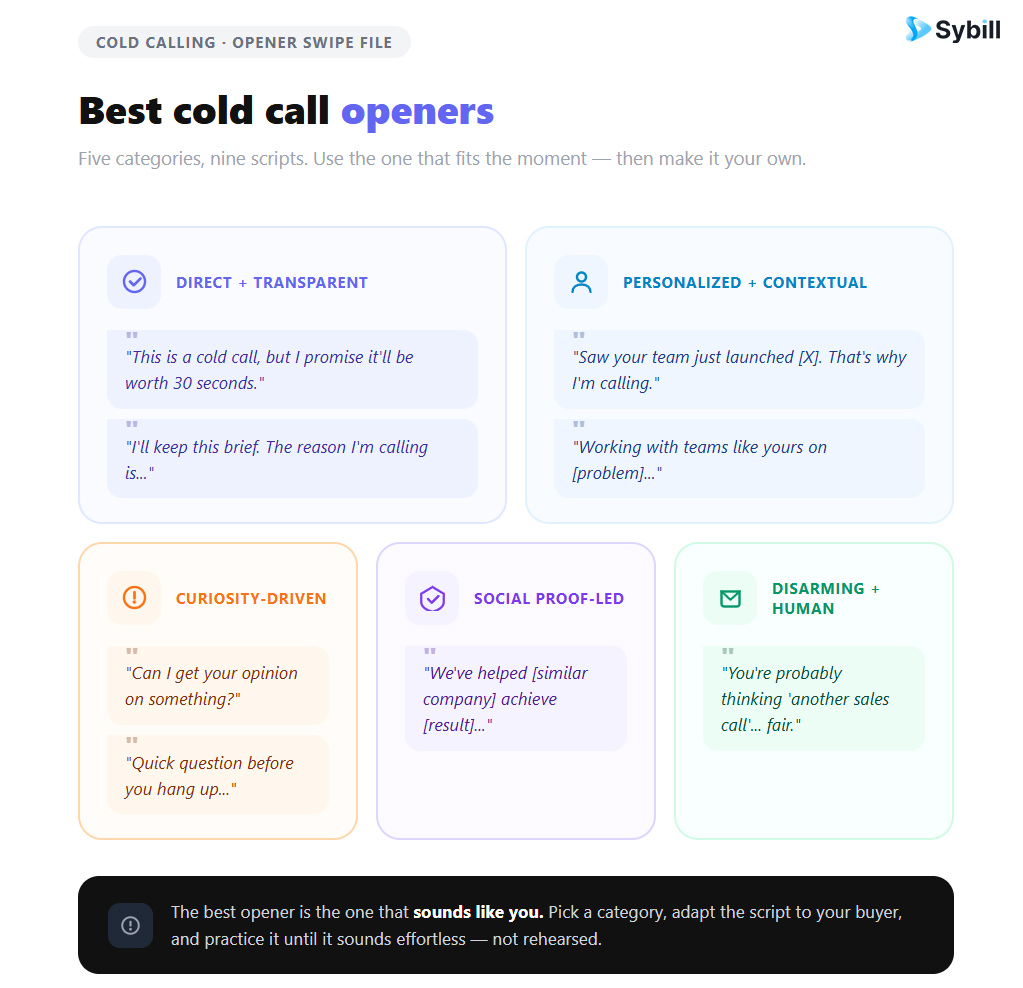
There is no single best cold call opening line. It depends on context, persona, and timing
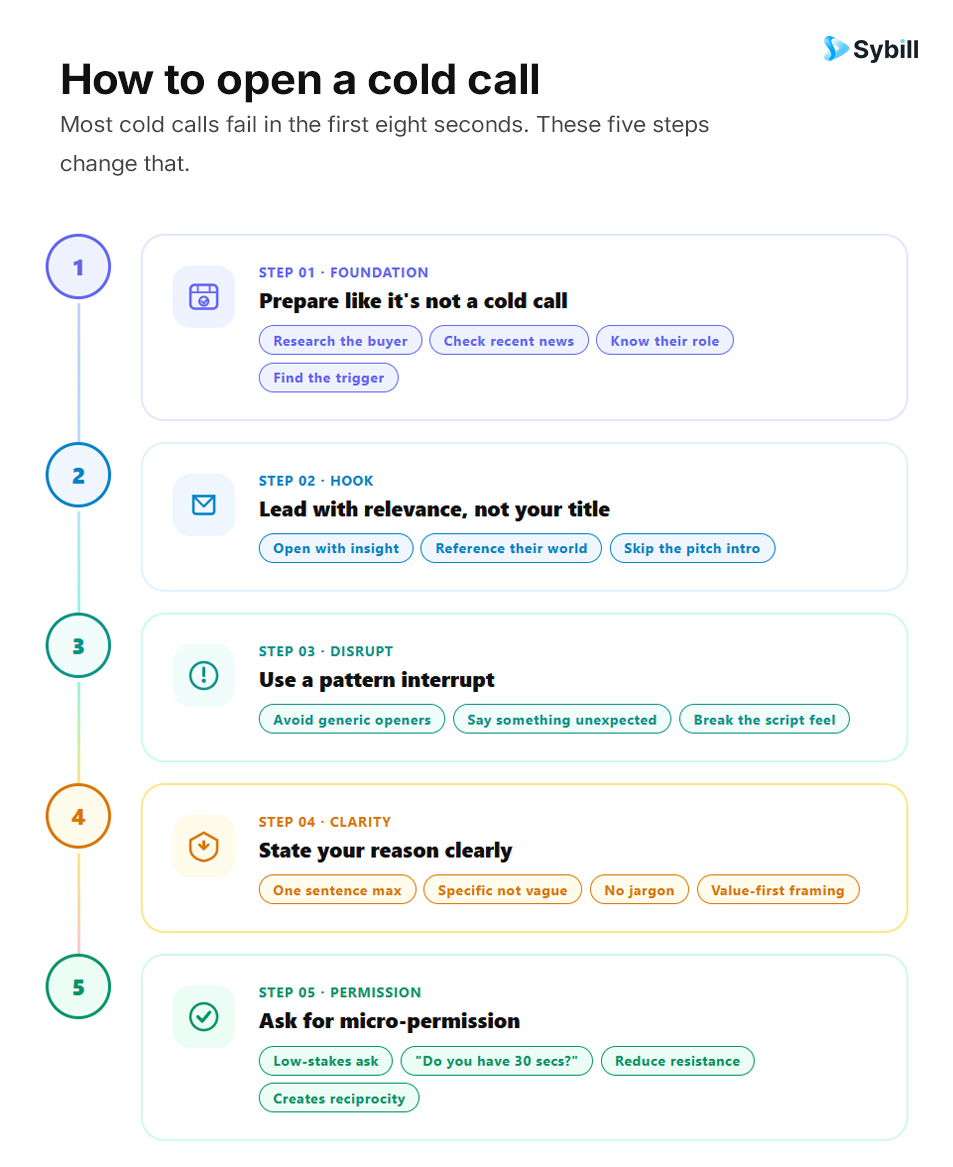
If you haven’t researched the prospect, it’s not a cold call.
It’s a blind call.
Know:
Bad:
“Hi, I’m John from XYZ company…”
Better:
“Most RevOps leaders I speak to are struggling with pipeline visibility…”
Break expectations early.
That’s how you avoid sounding like every other caller.
Clarity is underrated.
“The reason I’m calling is…” works because it removes friction instantly.
Not weak permission.
Controlled permission.
“Got 30 seconds?”
That’s it.
One of the biggest offenders? “Did I catch you at a bad time?”
You probably are. But worse, you are causing revenue leakage for yourself.
Here’s where things get interesting. The best sales teams are no longer guessing what works.
They’re analyzing it. Modern AI tools:
Which brings us to the real advantage.
Most tools tell you what to say. Sybill tells you what actually works for your buyers.
Instead of guessing, you get:
So your opener is always informed instead of generic
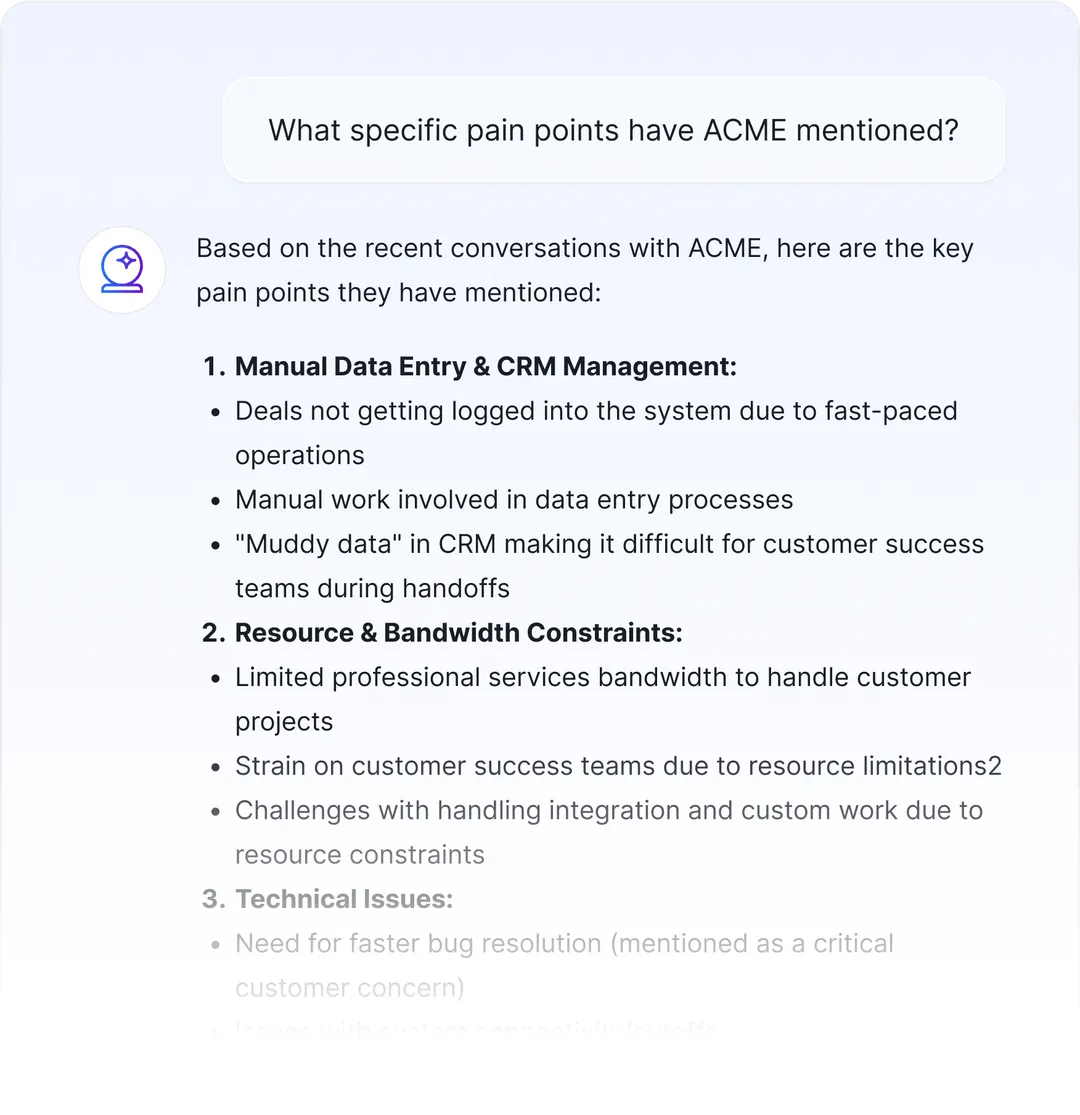
This is how cold calls stop being cold.

Top teams don’t rely on instinct. They run experiments.
Track:
Run A/B tests on openers. Review only the first 30–60 seconds of calls. Because that’s where deals are won or lost.
Cold calling didn’t stop working. Sales teams just stopped evolving. The difference between supersellers and everyone else? The former doesn’t rely on scripts.
Supersellers rely on:
And increasingly, AI.
If your openers still sound like everyone else, you’re competing for attention with hundreds of identical calls. If your openers sound informed, relevant, and human,
you’re already ahead.
There is no single best line. The most effective cold call openers combine relevance, clarity, and context. Data shows context-led and reason-for-call openers consistently outperform generic greetings because they immediately answer “why should I care?”
The 3 C’s of cold calling are Clarity, Context, and Control. Together, they determine whether your call moves forward or gets shut down in seconds.
If you miss any one of these, the call usually stalls. Strong cold call openers work because they combine all three within the first 15–20 seconds.
A strong starter references a trigger, pain point, or shared context. For example: “Most [role] I speak with are struggling with [problem]. Is that something you’re seeing too?” This invites conversation instead of forcing a pitch.
Catchy does not mean clever. It means relevant. The best opening statements spark curiosity while staying grounded in value, such as: “I’ll be brief. The reason I’m calling is we’re helping teams like yours solve [specific problem].”
Your opener should be under 15–20 seconds. The full cold call should ideally stay within 5–6 minutes while maintaining engagement . The goal is not to close, but to move to the next step.
There is no single best line. The most effective cold call openers combine relevance, clarity, and context. Data shows context-led and reason-for-call openers consistently outperform generic greetings because they immediately answer “why should I care?”
The 3 C’s of cold calling are Clarity, Context, and Control. Together, they determine whether your call moves forward or gets shut down in seconds. Clarity means being clear about who you are and why you’re calling. Avoid long introductions. Get to the point quickly so the prospect isn’t confused about your intent. Context explains why the call is relevant to them specifically. This could be based on their role, industry trends, or a recent trigger like hiring, expansion, or a new initiative. Without context, your call feels random. Control is your ability to guide the conversation forward without sounding pushy. This includes asking the right questions, setting expectations, and keeping the conversation focused. If you miss any one of these, the call usually stalls. Strong cold call openers work because they combine all three within the first 15–20 seconds.
A strong starter references a trigger, pain point, or shared context. For example: “Most [role] I speak with are struggling with [problem]. Is that something you’re seeing too?” This invites conversation instead of forcing a pitch.