Find us at booth #83, join us for a harbor side happy hour, or catch Gorish’s talk.

Sept, 16-18 > Learn more


Mamta Tainwala

April 23, 2026
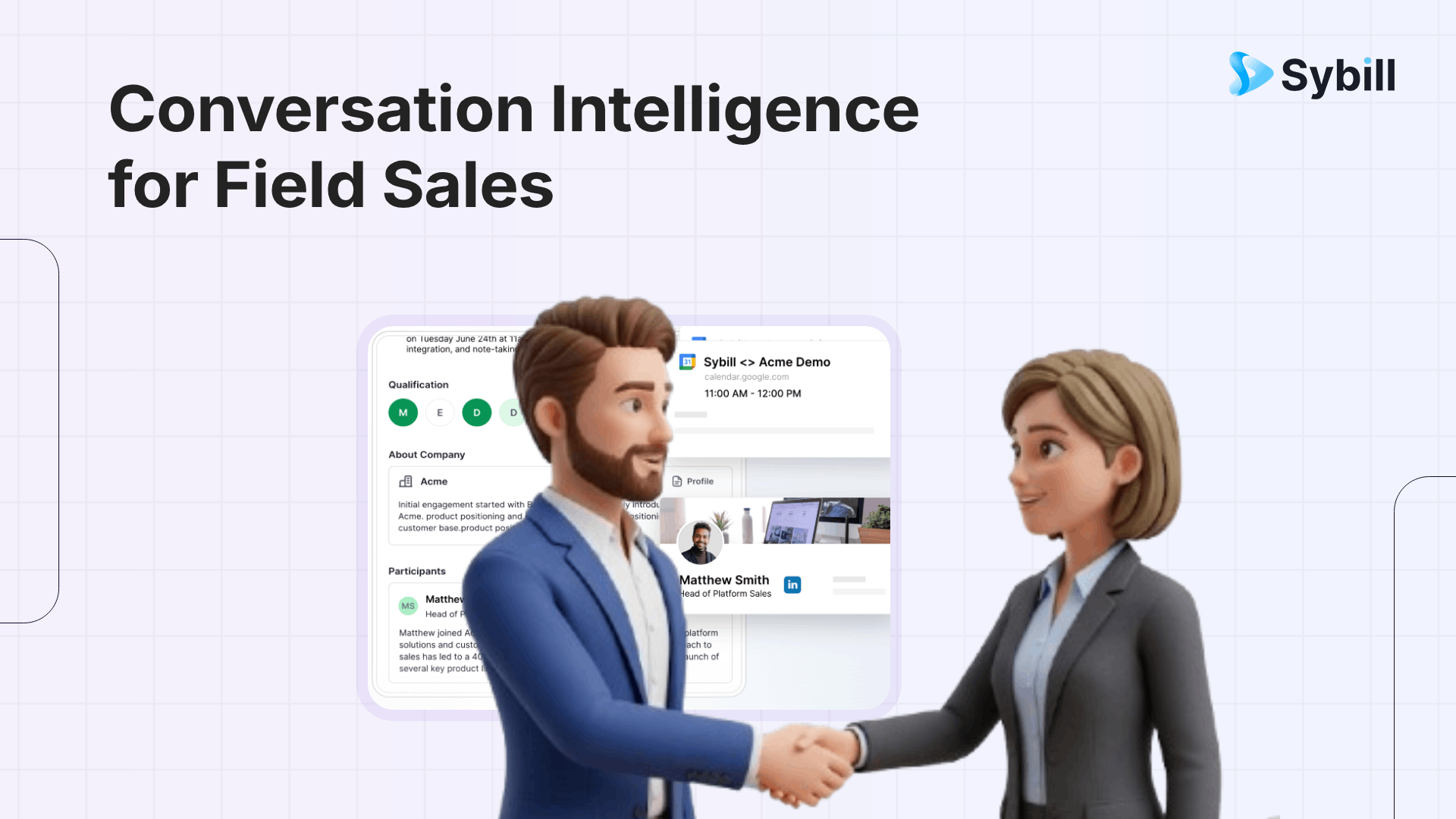
Conversation intelligence changed inside sales. That is not an exaggeration. Over the past five years, the ability to record, transcribe, and analyze every virtual sales call created an entirely new performance layer for inside teams. Managers could review calls without sitting in on them. Reps got personalized coaching based on real data, not hunches. CRM fields updated themselves. Follow-up emails wrote themselves. Pipeline forecasts got more accurate because the underlying data was richer and cleaner.
Field sales missed all of it.
While inside sales teams were building compounding intelligence from every recorded Zoom call, field sales reps were walking into client offices, running high-stakes meetings, and walking out with nothing but memory and notebook scribbles. The meeting, the actual conversation that determines whether a six-figure deal moves forward or dies, was a black box. No recording. No transcript. No structured data. No coaching signal. No automated CRM update.
That is changing fast. Conversation intelligence platforms are now extending to in-person meetings, and the impact on field sales operations is going to be as significant as it was for inside sales five years ago.

Conversation intelligence is AI-powered technology that records, transcribes, and analyzes sales conversations to extract actionable insights. It turns unstructured audio (what was said in a meeting) into structured data (pain points identified, objections raised, next steps agreed on, competitor mentions, deal stage progression, coaching signals) that sales teams can act on.
The technology combines several AI capabilities: automatic speech recognition for transcription, natural language processing for understanding context and intent, sentiment analysis for reading buyer engagement, and machine learning for identifying patterns across thousands of conversations.
For inside sales, conversation intelligence has become table stakes. According to recent industry data, 76% of companies have now embedded conversation intelligence into more than half of their customer interactions. The technology is no longer experimental. It is core infrastructure for revenue teams.
But there is a critical distinction that matters for this discussion. Almost all of that adoption has happened for virtual meetings: Zoom calls, Microsoft Teams sessions, Google Meet conferences, and phone calls run through dialers. The platforms that built the conversation intelligence category, tools like Gong, Chorus, and others, were designed for digital audio streams. They join a virtual meeting as a bot participant, capture the audio feed, and process it.
In-person meetings do not have a virtual meeting to join. There is no bot to add. There is no clean audio feed piped through a conferencing platform. And for most of conversation intelligence's history, that meant field sales was simply excluded from the equation.
The numbers tell the story. According to SPOTIO's 2026 State of Field Sales Survey, 33% of field sales teams are still not using AI at all. Among those that are, only 28% use conversation intelligence. Compare that to inside sales, where conversation intelligence adoption is approaching 80% at growth-stage and enterprise companies.
This gap matters because field sales handles some of the most consequential conversations in any sales organization. Enterprise deals. Multi-stakeholder negotiations. On-site product demonstrations. Strategic account reviews. These are the meetings where six and seven-figure decisions get made, and they are happening in a data vacuum.
Here is what organizations lose when field conversations are not captured:
When a field rep leaves, every relationship, every conversation detail, every nuance about what a client cares about leaves with them. There is no recording library. There is no searchable archive of past discussions. The new rep starts from scratch. In inside sales, the entire conversation history is preserved in the platform. In field sales, it lives only in the departing rep's memory.
Sales coaching for inside sales reps is data-driven. Managers can review call recordings, analyze talk-to-listen ratios, identify missed discovery questions, and provide specific, evidence-based feedback. For field sales reps, coaching is based on whatever the rep self-reports about how the meeting went. That is like coaching a basketball team based on the players' descriptions of the game instead of watching the film.
Field reps update the CRM from memory, often hours or days after the meeting. Details get lost. Fields stay empty. Next steps are vague. Competitor mentions are forgotten. The CRM becomes an increasingly unreliable reflection of what is actually happening in the pipeline. CRM autofill powered by conversation intelligence solves this by extracting deal data directly from the conversation and populating fields automatically.
Accurate forecasts depend on accurate deal data. When field meetings are a black box, deal stage assessments are based on the rep's subjective interpretation rather than observable buyer signals. A rep might report a meeting as "went great" when the buyer actually raised three significant objections and asked to loop in procurement. Without conversation data, there is no way to validate.
Research consistently shows that faster, more specific follow-ups convert at higher rates. But field reps who have been in meetings all day rarely sit down to craft detailed follow-up emails that reference specific discussion points. They send something generic the next morning, or they forget entirely. The momentum from a strong meeting dissipates because the execution after the meeting cannot keep up.

The mechanics of capturing in-person conversations differ from virtual meetings, but the intelligence layer that processes the audio is fundamentally the same. Here is how the workflow operates for field sales.
The rep records the in-person meeting using one of several methods. The most common is a smartphone voice memo: the rep starts recording on their phone at the beginning of the meeting and stops at the end. Some tools offer dedicated mobile apps with optimized audio capture for in-person environments. Others accept uploads of audio files recorded through any third-party app.
Sybill, for example, lets field reps capture in-person conversations by uploading voice memos, manual notes, or third-party audio recordings directly into the platform. The audio is then processed through the same AI pipeline that handles virtual meeting recordings.
Some tools also support offline recording, which is critical for field environments where connectivity is unreliable. The audio is stored locally on the device and synced for processing once the rep is back online.
The audio is transcribed using automatic speech recognition. For in-person meetings, this is more challenging than virtual calls because the audio quality is less predictable. Background noise, room acoustics, speaker distance from the microphone, and overlapping voices all affect accuracy. The best platforms have been trained on noisy, real-world audio and can achieve 85% to 95% accuracy in typical field conditions.
Speaker diarization, the ability to identify and separate different speakers, is particularly important for in-person recordings where all voices are captured from a single microphone rather than separate audio channels.
Once transcribed, the conversation is analyzed by AI models that extract structured insights. For sales-specific platforms, this means identifying pain points the buyer mentioned, objections raised, competitors discussed, next steps agreed on, questions asked, buying signals, and decision criteria. The output is a structured meeting summary built for sales workflows, not generic bullet points.
This is where conversation intelligence separates itself from simple transcription. The structured insights feed into downstream actions: CRM fields are populated automatically, follow-up email drafts are generated, deal stage is updated, coaching signals are surfaced for managers, and the conversation joins the broader deal context alongside emails, past meetings, and other interactions.
The entire pipeline, from audio capture to CRM update, can happen within minutes of the meeting ending.

When field conversations become part of the data layer, several capabilities that were previously exclusive to inside sales become available.
The traditional way to coach field reps is the ride-along: a manager physically accompanies a rep on client visits, observes their performance, and provides feedback. Ride-alongs are effective but brutally unscalable. A manager can shadow one, maybe two reps per day. That means most reps go weeks or months between coaching interactions.
Conversation intelligence enables virtual ride-alongs. Managers can review structured summaries of field meetings, identify coaching moments, and provide feedback without ever getting in the car. Rilla, a platform built specifically for outside sales coaching, reports that their customers conduct thousands of virtual ride-alongs per month, a volume that would be physically impossible with traditional shadowing.
The coaching insights go beyond subjective observation. AI can track talk-to-listen ratios (top performers in field sales talk 45% to 65% of the time), count open-ended questions asked per meeting, flag missed objection handling, and score presentations against the company's sales playbook. That level of granularity turns coaching from an occasional event into a continuous system.
Modern B2B deals involve multiple touchpoints across channels: emails, virtual calls, in-person meetings, Slack messages, and CRM activities. When in-person meetings are excluded from the data layer, you have a partial picture of every deal that involves field engagement.
With conversation intelligence covering both virtual and in-person interactions, tools like Sybill can build a complete deal context that spans all channels. Managers and reps can query across all deals and get answers that account for what happened in the field, not just what happened on Zoom. "Which enterprise deals had pricing objections in the last 30 days?" now includes the three on-site meetings where pricing was discussed face-to-face, not just the five Zoom calls.
One of the most powerful applications of conversation intelligence at scale is pattern recognition. When you have thousands of recorded and analyzed conversations, you can identify what differentiates winning reps from struggling ones, which objections correlate with lost deals, which discovery questions lead to larger deal sizes, and which topics buyers raise when they are ready to buy.
Inside sales has had access to these patterns for years. Field sales is just getting started. Organizations that capture field conversations at scale will build a dataset that reveals the behavioral patterns behind in-person selling success, insights that have never been systematically captured before.
Ask any field sales manager what their biggest operational headache is, and CRM data quality will be near the top. Reps who spend their days driving between meetings and running back-to-back client sessions are not going to open their laptop at 9 PM to meticulously update Salesforce fields.
Conversation intelligence solves this by extracting deal data directly from the conversation and populating CRM fields automatically. Sybill's CRM autofill works after both virtual and in-person meetings, filling MEDDPICC, BANT, or custom fields with a reported 99% fill rate. That means the CRM reflects what actually happened in the meeting, not what the rep remembered to type three days later.
When a field rep finishes a meeting, conversation intelligence can generate a follow-up email draft that references the specific discussion points, uses the rep's tone of voice, and includes the right next steps. The rep reviews it on their phone between meetings and sends it within hours instead of the next morning.
The speed and specificity matter. A follow-up that arrives the same afternoon and references the buyer's exact words ("You mentioned that your current vendor's implementation timeline is a deal-breaker. Here's how our onboarding works...") converts at dramatically higher rates than a generic "Great meeting today, looking forward to next steps" email sent 18 hours later.
Not all conversation intelligence platforms are built for field sales. Most were designed for virtual meetings and treat in-person capture as an add-on. Here is how to evaluate your options based on what your field team actually needs.
General transcription tools like Otter.ai and VoiceToNotes.ai capture audio well and produce accurate transcripts. But transcripts are not conversation intelligence. The value for sales teams comes from the structured analysis layer: extracting pain points, objections, next steps, competitor mentions, and buyer signals in a format that feeds into CRM and coaching workflows.
AI sales assistants like Sybill process field meeting audio through a sales-specific intelligence layer. The output is not a generic transcript with bullet points. It is a structured summary that maps directly to how sales teams review deals and manage pipelines.
Some tools focus exclusively on in-person conversation capture. Rilla, for example, is purpose-built for outside sales coaching in industries like home services, solar, and insurance. It excels at virtual ride-alongs and playbook scoring for face-to-face selling.
Other platforms, like Sybill, unify virtual and in-person meeting intelligence in a single deal context. Every Zoom call, every in-person meeting, every email thread feeds into the same deal workspace. For B2B sales teams where deals involve a mix of virtual and face-to-face interactions, this unified approach provides a more complete picture than tools that only cover one channel.
The right choice depends on your sales motion. If your reps sell exclusively in person (home services, D2D, retail), a purpose-built in-person tool may fit best. If your reps split time between virtual and field meetings (enterprise SaaS, manufacturing, medical devices), a unified platform avoids creating two separate data silos.
Some conversation intelligence platforms lean heavily into coaching: scorecards, playbook compliance, talk pattern analytics, and manager dashboards. Others focus more on execution automation: CRM autofill, follow-up email generation, pre-meeting briefs, and task management.
The coaching-heavy approach works well when the primary goal is improving rep behavior. The execution-heavy approach works well when the primary goal is eliminating admin work and accelerating deal progression. The best platforms do both, but most have a clear center of gravity.
For field sales teams where CRM data quality and post-meeting execution are the biggest pain points, execution-focused platforms deliver faster ROI. For teams where inconsistent selling behavior and a wide gap between top and bottom performers are the core challenges, coaching-focused platforms may be the better starting point.
Deploying conversation intelligence for field sales is different from rolling it out for inside sales. Inside sales reps already work on platforms where recording is built in. Field reps need to adopt a new behavior: recording in-person meetings. Here is a practical implementation framework.
Do not roll out to the entire field team at once. Start with 5 to 10 reps who are open to the technology and represent a cross-section of experience levels and territories. The pilot group validates the workflow, surfaces edge cases (noisy environments, long meetings, poor connectivity), and generates early wins that make the broader rollout easier.
Recording in-person meetings raises consent and legal considerations that virtual recording does not. Laws vary by jurisdiction: some US states require all-party consent, others require single-party consent, and international regulations like GDPR impose additional requirements. Before rolling out, work with legal to establish clear protocols for notifying meeting participants and obtaining consent.
Most field teams develop a simple verbal script: "I'd like to record our conversation so I can make sure I capture everything accurately and follow up properly. Is that okay with you?" The vast majority of prospects and clients agree, especially when the benefit (better follow-up, nothing falling through the cracks) is positioned clearly.
In-person audio quality will never match virtual meeting quality. But there are practical steps that significantly improve results: place the phone on the table between speakers rather than in a pocket, choose quieter settings when possible, and use an external microphone for critical meetings. Brief training on audio capture best practices goes a long way.
The fastest path to adoption is making the tool work within the rep's existing routine, not around it. If reps already use voice memos to capture notes after meetings, redirect that behavior to uploading memos into the conversation intelligence platform. If reps already open their CRM app between meetings, ensure the platform pushes summaries into the CRM view they already check.
Track the metrics that demonstrate ROI: CRM field completion rates (before and after), time-to-follow-up after meetings, forecast accuracy for field-sourced deals, and coaching session frequency. These are the numbers that justify expanding from pilot to full deployment.
Here is the thing about conversation intelligence that makes timing critical: the value compounds. Every recorded conversation makes the data richer. Every meeting analyzed improves the coaching models. Every CRM field populated automatically makes forecasts more accurate. Every deal that benefits from cross-deal querying represents institutional knowledge that did not exist before.
Inside sales teams that adopted conversation intelligence early have years of compounding advantage. Their coaching is sharper because it is built on thousands of analyzed calls. Their forecasts are more reliable because their CRM data is cleaner. Their onboarding is faster because new reps can review a library of real conversations instead of starting from scratch.
Field sales teams are at the beginning of that same curve. The organizations that start capturing field conversations now will build a dataset and an intelligence layer that becomes a durable competitive advantage. The ones that wait will be trying to catch up against competitors who have years of conversation data informing their strategy.
The tools are here. The technology works. The question is not whether conversation intelligence will come to field sales. It is whether your team adopts it before or after the competition.
Get started for free with Sybill and bring conversation intelligence to every meeting your field team takes, whether it happens on Zoom or across a conference table.
Conversation intelligence for field sales is AI-powered technology that records, transcribes, and analyzes in-person sales conversations to extract structured insights like buyer pain points, objections, next steps, and competitor mentions. It extends the same capabilities that inside sales teams use for virtual calls (coaching insights, CRM automation, deal intelligence) to face-to-face meetings conducted by field reps.
In-person meetings are captured through smartphone voice recordings, dedicated mobile apps, or third-party audio file uploads. The rep records the conversation on their phone, and the AI platform transcribes and analyzes the audio the same way it would process a virtual meeting recording. Some platforms support offline recording for environments with poor connectivity.
Call recording captures and stores audio. Conversation intelligence goes further by transcribing the audio, analyzing it using AI to extract structured sales insights (pain points, objections, buying signals, next steps), and feeding those insights into CRM systems, coaching workflows, and follow-up automation. Recording is the input. Intelligence is the output.
Conversation intelligence enables virtual ride-alongs, where managers review structured meeting summaries and AI-generated coaching insights instead of physically accompanying reps on client visits. While virtual ride-alongs cannot fully replicate observing body language and environmental context, they scale dramatically better. A manager who can shadow one rep per day physically can review 10 to 20 meeting summaries in the same timeframe.
Several platforms now support in-person conversation capture. Sybill provides full-cycle sales intelligence (summaries, CRM autofill, AI follow-ups, coaching) for both virtual and in-person meetings. Rilla is purpose-built for outside sales coaching in industries like home services and solar. Otter.ai and Fireflies.ai offer strong transcription with mobile recording apps. The best choice depends on whether your team needs sales-specific intelligence or general transcription.
Recording laws vary by jurisdiction. In the United States, some states require all-party consent (everyone in the conversation must agree), while others require only single-party consent. GDPR in Europe and other international regulations impose additional requirements. Always inform meeting participants and obtain consent before recording. Most prospects agree when the benefit of better follow-through is explained.
Transcription accuracy for in-person meetings typically ranges from 85% to 95%, compared to 95% to 98% for clean virtual calls. Factors that affect accuracy include background noise, speaker distance from the microphone, overlapping speakers, and room acoustics. Placing the recording device on the table between speakers and choosing quieter environments significantly improve results.
Conversation intelligence extracts deal-relevant information directly from the conversation (next steps, objections, competitor mentions, decision criteria, deal stage progression) and populates CRM fields automatically. This eliminates the reliance on reps manually updating the CRM from memory after meetings, which is the primary cause of poor data quality in field sales organizations.
Conversation intelligence for field sales is AI-powered technology that records, transcribes, and analyzes in-person sales conversations to extract structured insights like buyer pain points, objections, next steps, and competitor mentions. It extends the same capabilities that inside sales teams use for virtual calls (coaching insights, CRM automation, deal intelligence) to face-to-face meetings conducted by field reps.
In-person meetings are captured through smartphone voice recordings, dedicated mobile apps, or third-party audio file uploads. The rep records the conversation on their phone, and the AI platform transcribes and analyzes the audio the same way it would process a virtual meeting recording. Some platforms support offline recording for environments with poor connectivity.
Call recording captures and stores audio. Conversation intelligence goes further by transcribing the audio, analyzing it using AI to extract structured sales insights (pain points, objections, buying signals, next steps), and feeding those insights into CRM systems, coaching workflows, and follow-up automation. Recording is the input. Intelligence is the output.