Find us at booth #83, join us for a harbor side happy hour, or catch Gorish’s talk.

Sept, 16-18 > Learn more

%20(1).avif)
Mamta Tainwala

July 22, 2026
%20(48).png)
Sales pipeline management is the practice of tracking and advancing every deal through defined stages, from prospecting to close, using consistent qualification criteria, regular reviews, clean CRM data, and health metrics like velocity, win rate, and coverage. Done well, it converts a list of opportunities into a predictable revenue system; done poorly, it produces stalled deals and forecasts nobody trusts.
This is the complete operating manual: the stages, the metrics, the review cadence, the failure modes, and the honest accounting of what AI now does versus what still needs a human.
A sales pipeline is the structured representation of every open deal, organized by stage: typically prospecting, qualification, engagement, proposal, closing, and post-sale follow-up. Each stage has entry and exit criteria, so a deal's position communicates exactly what has happened and what must happen next. The pipeline is the shared source of truth for reps, managers, and forecasts.
The distinction worth making early: a pipeline is not a funnel. The funnel describes aggregate conversion (many leads narrow to few customers); the pipeline tracks individual deals through your process. You analyze funnels. You manage pipelines.
And management is the operative word, because a pipeline left alone does not stay accurate. Deals stall silently, stages drift from reality, close dates slip quarter after quarter, and within months the CRM describes a fictional company. Pipeline management is the set of habits (reviews, hygiene, criteria enforcement) that keeps the map matching the territory. Which matters for a reason Harvard Business Review documented years ago and every RevOps leader has confirmed since: companies with a formal, managed sales process generate meaningfully more revenue growth than those running on improvisation.
Most B2B pipelines run six stages: prospecting (identifying potential buyers), qualification (confirming fit and intent), engagement (discovery, demos, and trust-building), proposal (presenting solution and terms), closing (final negotiation and signature), and post-sale follow-up (onboarding handoff and expansion). Each stage needs explicit exit criteria, or stage labels become opinions.
The stages, with the management question each one answers:
1. Prospecting. Deals enter here from outbound, inbound, referrals, and expansion signals. The management question: is enough qualified volume entering to sustain coverage? That is a pipeline generation problem, and it is upstream of everything else in this guide.
2. Qualification. Fit and intent get confirmed against a consistent framework, whether BANT, MEDDPICC, or your own. The management question: does this deal deserve rep attention? Disqualification here is a win, not a loss; it is attention returned to real deals.
3. Engagement. Discovery, demos, multithreading, objection handling. Deals spend most of their life here, and this is where they stall. The management question: is the deal actually moving, evidenced by buyer actions, or just aging with activity?
4. Proposal. Solution, pricing, terms. The management question: did we earn this stage, or did we skip ahead? Proposals sent before pain and process were established are the leading cause of the mid-funnel graveyard.
5. Closing. Negotiation, procurement, signature. The management question: what is the last mile blocker, named specifically, with an owner?
6. Post-sale follow-up. Handoff to customer success, onboarding, and the expansion runway. Not technically "pipeline," except that expansion revenue starts here and the handoff quality decides it.
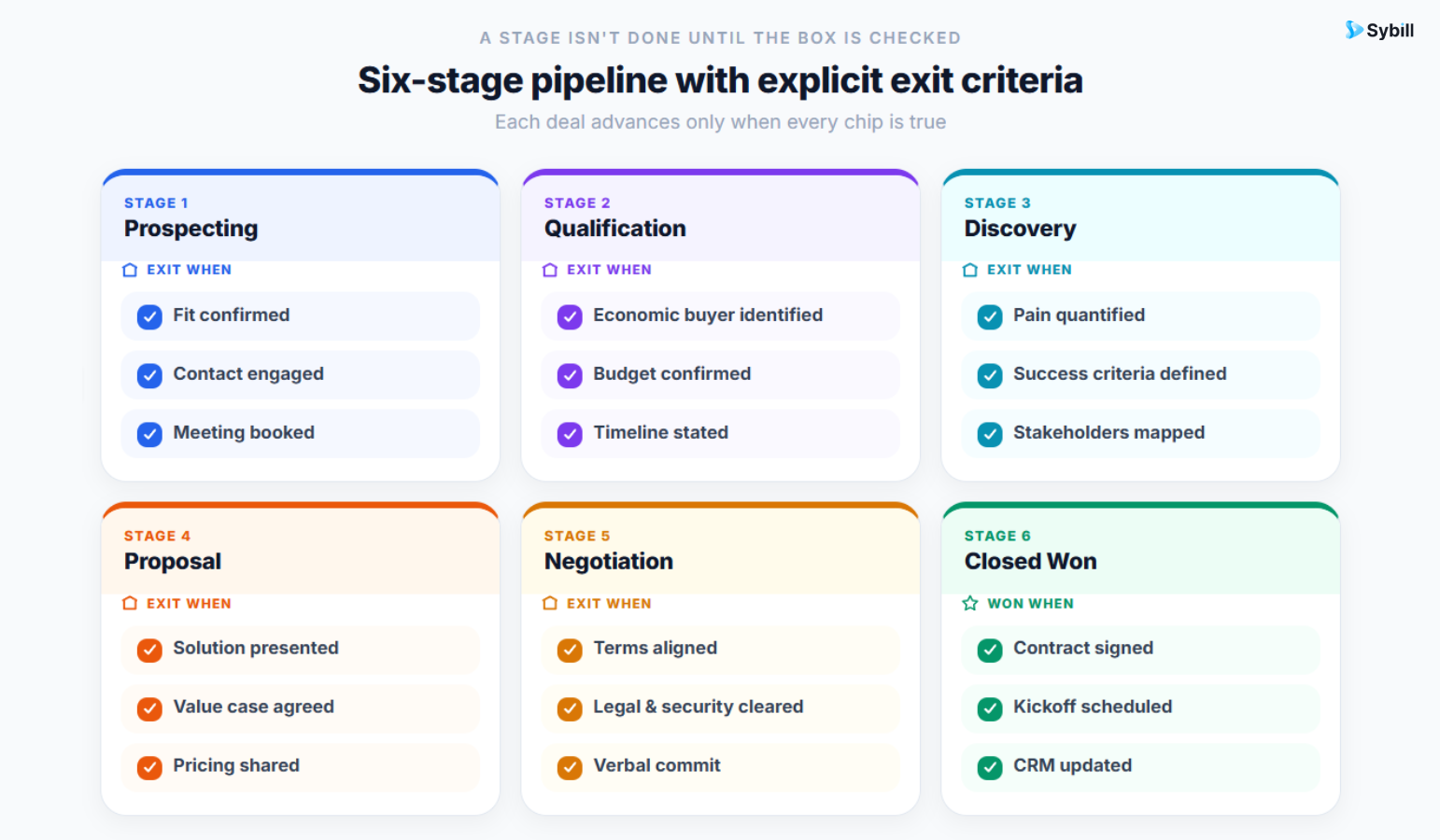
The design rule underneath all six: a stage is a set of completed facts, not a mood. "Engagement" should mean specific things happened (discovery completed, champion identified, demo delivered), and a deal only advances when the facts exist. Where teams enforce this with evidence rather than honor system, the pipeline stays honest; everywhere else, stage fields describe rep optimism with a dropdown.
Unmanaged pipelines fail in three expensive ways: deals stall invisibly because no one tracks momentum, forecasts miss because stage data reflects optimism rather than evidence, and rep attention scatters across opportunities that will never close. Managed pipelines reverse all three: risks surface early, forecasts hold, and effort concentrates on winnable deals.
The costs, made concrete:
Stalls compound silently. A deal that has not moved in three weeks is not resting; it is dying. Without systematic momentum tracking, nobody notices until the quarter-end scramble, when it is too late to re-engage the buyer who went quiet in week two.
Forecasts inherit the fiction. Every inflated stage, every optimistic close date, every "qualified" deal that never met the criteria flows straight into the number leadership commits upward. When the pipeline data is dirty, the forecast call becomes negotiation theater, and after two or three misses, the board stops trusting the number entirely. Rebuilding that trust takes years.
Attention is misallocated. A rep juggling 60 open deals where 25 are dead weight gives every real opportunity less than it needs. The bloat problem and its math get their own treatment in our breakdown of pipeline growth versus close rate; the short version is that a smaller honest pipeline outperforms a large fictional one every quarter of the year.
The flip side is what a managed pipeline buys: deal risks flagged while there is still time to act, coaching aimed at the stages where deals actually die, and revenue that arrives roughly when the pipeline said it would. Predictability is not a personality trait. It is a data hygiene outcome.
Your pipeline is only as honest as its last update. Sybill fills the CRM from what buyers actually said, flags stalling deals, and keeps every stage grounded in evidence. Start for free.
Four metrics give a complete health picture: pipeline velocity (revenue per day, computed as opportunities × win rate × deal size ÷ cycle length), win rate (closed-won ÷ all closed), pipeline coverage (open pipeline ÷ quota, benchmarked at 3 to 4x depending on win rate), and forecast accuracy (projected vs actual). Review them weekly at the team level, monthly by rep and segment.
What each one tells you, and the trap in each:
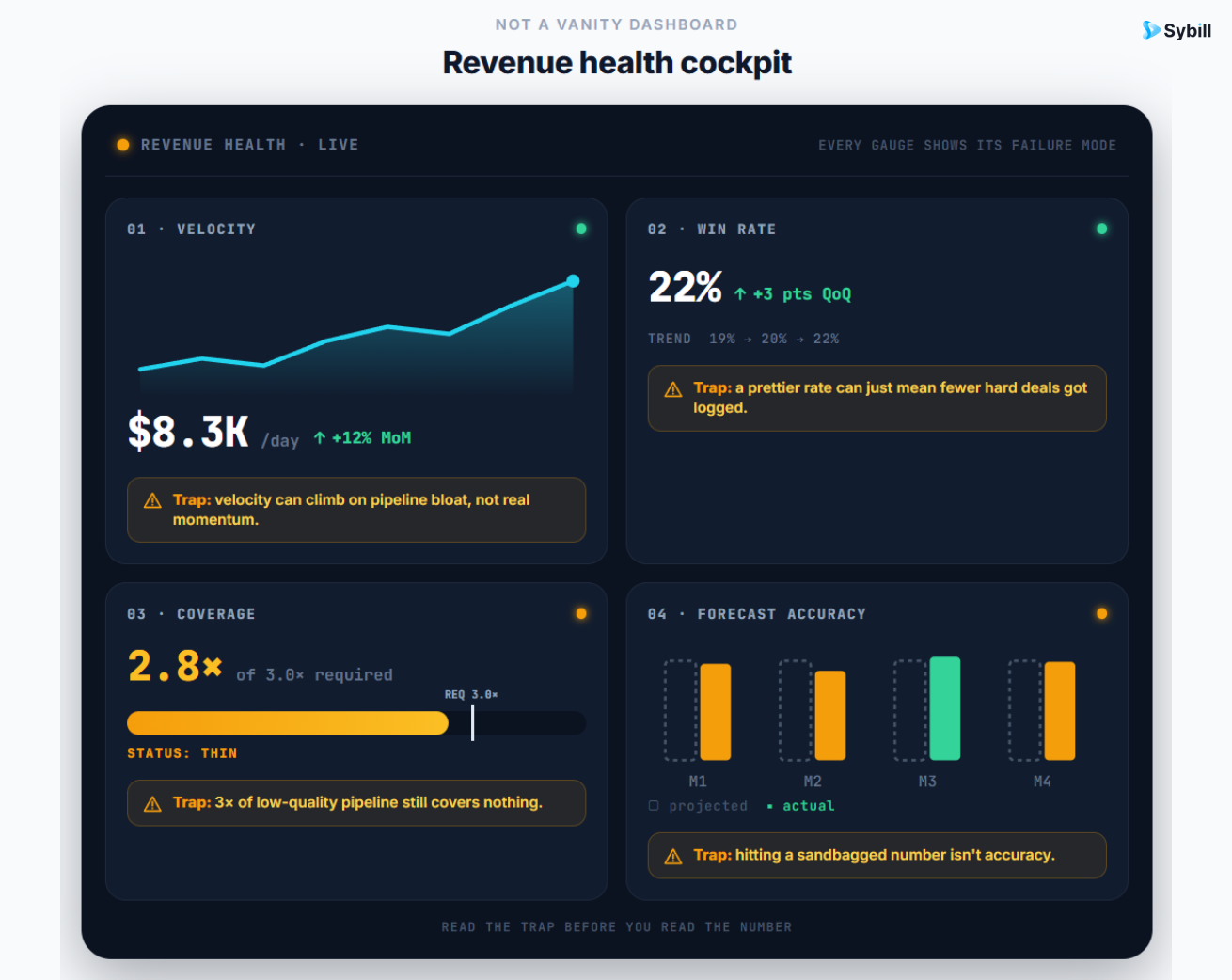
Pipeline velocity. The master metric, because it contains the others. Rising velocity means the machine is improving; the four components tell you which part. Trap: averaging across segments hides everything, so compute it by deal band.
Win rate. The conversion truth-teller. Trap: it is gameable through sandbagging, so pair it with coverage and watch the trend, not the snapshot.
Coverage. Open qualified pipeline against quota, adjusted for your actual win rate: a 25 percent win rate needs roughly 4x, a 33 percent rate needs 3x. Trap: coverage computed on a bloated pipeline is a comfort blanket. Coverage only means anything after qualification is enforced.
Forecast accuracy. The metric leadership actually feels. Trap: teams improve it by forecasting conservatively rather than by cleaning the pipeline, which hits the target while missing the point.
All four run on the same substrate: CRM data that reflects reality. Which is why the least glamorous practice in this guide, hygiene, is also the highest leverage one. RevOps teams that automate CRM updates from actual conversations get all four metrics trustworthy at once, without a single nag in Slack, and keeping every deal's history in one place means the metrics and the deal narratives never contradict each other.
Effective pipeline reviews follow a tight structure: metrics overview first (velocity, coverage, conversion trends), then at-risk deals with named blockers and owners, then decisions on what to advance, escalate, or disqualify. Every deal discussed leaves with a next step and a date. Reviews inspect evidence, not narration, and run weekly in 30 to 45 minutes.
The difference between a review that manages the pipeline and one that recites it:
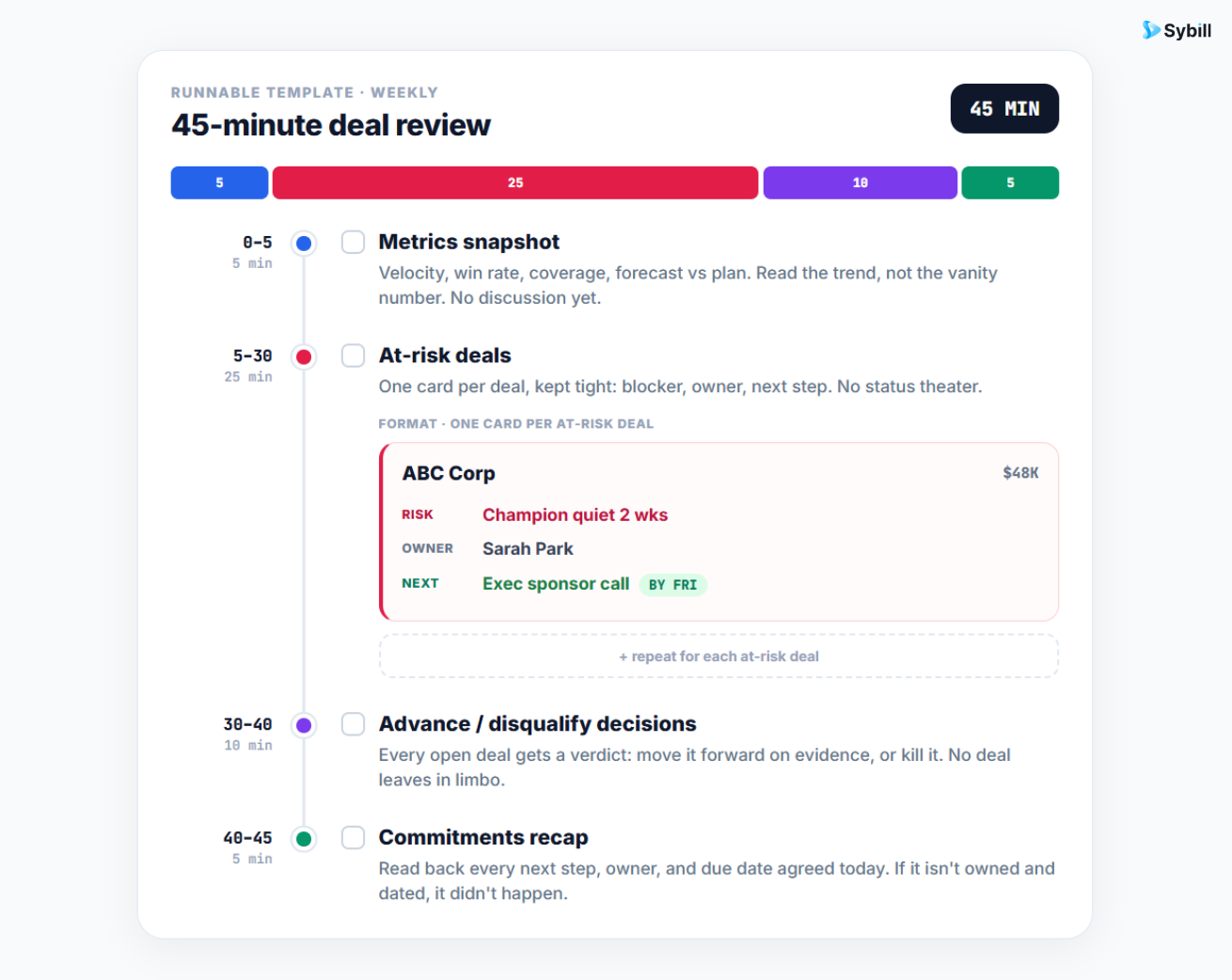
Evidence beats narration. "The deal feels good" is not information. "The economic buyer attended both calls and asked about implementation timelines" is. Pull the deal inspection view so the conversation record answers the qualification questions, and half the meeting's debate evaporates because the facts are on screen.
At-risk deals get the airtime. Healthy deals need thirty seconds. The stalled ones, the single-threaded ones, the ones where the champion went quiet: those get the room's collective brain. Sales managers who walk in with the risk list pre-built, instead of discovering it live, run reviews in half the time with twice the output.
Every deal leaves with a verb. Advance, escalate, disqualify, or re-engage, with an owner and a date. A review that produces no decisions was a status meeting wearing a nicer calendar title.
Disqualification is a legitimate outcome. The review is exactly where zombie deals should die, publicly and without shame. Every one closed out makes the coverage number honest and the forecast tighter.
For the tactical layer beyond the review itself, we keep two field guides: 10 tips for effective pipeline management and strategic B2B pipeline tips.
AI removes the two failure points that break most pipeline management: data entry (CRM records now update themselves from conversations) and detection (stalling deals, missing stakeholders, and unresolved risks get flagged automatically instead of discovered at quarter-end). Humans keep the judgment calls: deal strategy, prioritization, and the decision to disqualify.
The honest division of labor in 2026:
AI owns the record. Every call becomes summaries, synced CRM fields, follow-up emails, and captured tasks without a rep typing a word. This is not a convenience feature. It is the fix for the root cause of almost every pipeline pathology in this guide, because stale data was never a discipline problem. It was a time problem, and the time problem is now solvable.
AI owns the watching. No human monitors 200 deals for momentum loss. AI does it continuously: engagement dropping, next steps missing, a competitor suddenly appearing in calls. Account executives get hours back weekly and get told which of their deals need attention today, and Ask Sybill answers pipeline questions on demand: "Which of my proposals have had no buyer contact in two weeks?" Sybill has analyzed over 33 Million sales conversations, and the consistent pattern is that deals signal their stalls in conversation weeks before the stage field admits anything.
Humans own the judgment. Which deal gets the executive sponsor, when to walk away, how to restructure the proposal after procurement pushes back: no model makes those calls. AI's job is making sure the human making them is looking at the truth.
The upgrade path is short: instrument the conversations, let the CRM fill itself, put the risk flags into the weekly review, and spend the recovered hours on the deals the flags point at.
Here is what pipeline management actually is, underneath the stages and metrics: it is the discipline of keeping your promises legible. Every deal in the pipeline is a promise about future revenue, and management is the practice of knowing, honestly and currently, which promises are real, which are wobbling, and which were never promises at all.
Teams that keep that ledger honest forecast within a few points, coach where deals actually die, and finish quarters without the heroic scramble. Teams that let it drift get the fiction, the surprise, and the Thursday-night pipeline cleanup before the board meeting.
The honest ledger used to cost hours of rep discipline per week. Now it costs a login. Sybill keeps the record, watches the deals, and hands your team back the hours, so the pipeline finally says what is true.
Try Sybill free or book a demo and manage the pipeline you actually have.
A pipeline tracks individual deals through your sales process stages and is managed deal by deal. A funnel describes aggregate conversion: how many leads narrow into customers across the whole population. Teams manage pipelines and analyze funnels; the pipeline is the operational tool, the funnel is the analytical view.
Five to seven for most B2B teams. Fewer than five loses diagnostic resolution about where deals stall; more than seven creates stage-update overhead reps will not maintain. What matters more than the count is explicit exit criteria for each stage, so advancement reflects completed facts rather than optimism.
Weekly at the team level for deal movement, risks, and coverage; monthly for by-rep and by-segment conversion trends; quarterly for structural questions like stage definitions and win rate by competitor. Reps should scan their own pipelines daily, which takes minutes when the data updates itself.
Most B2B teams convert 15 to 30 percent of qualified pipeline, which is why coverage benchmarks sit at 3 to 4x quota. The honest number depends on qualification strictness: a team with a tight front door converts more of a smaller pipeline. Track your own stage-to-stage rates rather than borrowing benchmarks.
Letting stage data drift from reality. Nearly every downstream failure (missed forecasts, stalled deals discovered late, misallocated rep time) traces back to CRM records that describe optimism instead of evidence. Automating record-keeping from actual conversations fixes the root cause rather than nagging the symptom.
A pipeline tracks individual deals through your sales process stages and is managed deal by deal. A funnel describes aggregate conversion: how many leads narrow into customers across the whole population. Teams manage pipelines and analyze funnels; the pipeline is the operational tool, the funnel is the analytical view.
Five to seven for most B2B teams. Fewer than five loses diagnostic resolution about where deals stall; more than seven creates stage-update overhead reps will not maintain. What matters more than the count is explicit exit criteria for each stage, so advancement reflects completed facts rather than optimism.
Weekly at the team level for deal movement, risks, and coverage; monthly for by-rep and by-segment conversion trends; quarterly for structural questions like stage definitions and win rate by competitor. Reps should scan their own pipelines daily, which takes minutes when the data updates itself.