Find us at booth #83, join us for a harbor side happy hour, or catch Gorish’s talk.

Sept, 16-18 > Learn more

%20(1).avif)
Mamta Tainwala

August 1, 2026
%20(60).png)
Getting full value from a sales engagement platform comes down to seven plays: persona-tuned sequences with real A/B discipline, signal-branched multichannel cadences, deep CRM and stack integration, conversion metrics instead of activity metrics, message copy fed by conversation evidence, using the platform for coaching and ramp, and quarterly sequence hygiene. Most teams run two of the seven and wonder why the seat cost stings at renewal.
And one structural truth the category does not advertise: every SEP goes dark at the exact moment the deal gets decided. We will get to that, because fixing it is where the last third of the value lives.
A sales engagement platform (SEP) is software that orchestrates and tracks outbound interactions across channels: email sequences, call dialing, LinkedIn touches, and SMS, with templates, cadence automation, and engagement analytics built in. Outreach, Salesloft, and Apollo are the category's flagship names. The SEP's job is executing and measuring the touches that create sales conversations.
Worth thirty seconds of disambiguation, because the previous version of this post fumbled it and the terms genuinely confuse buyers:
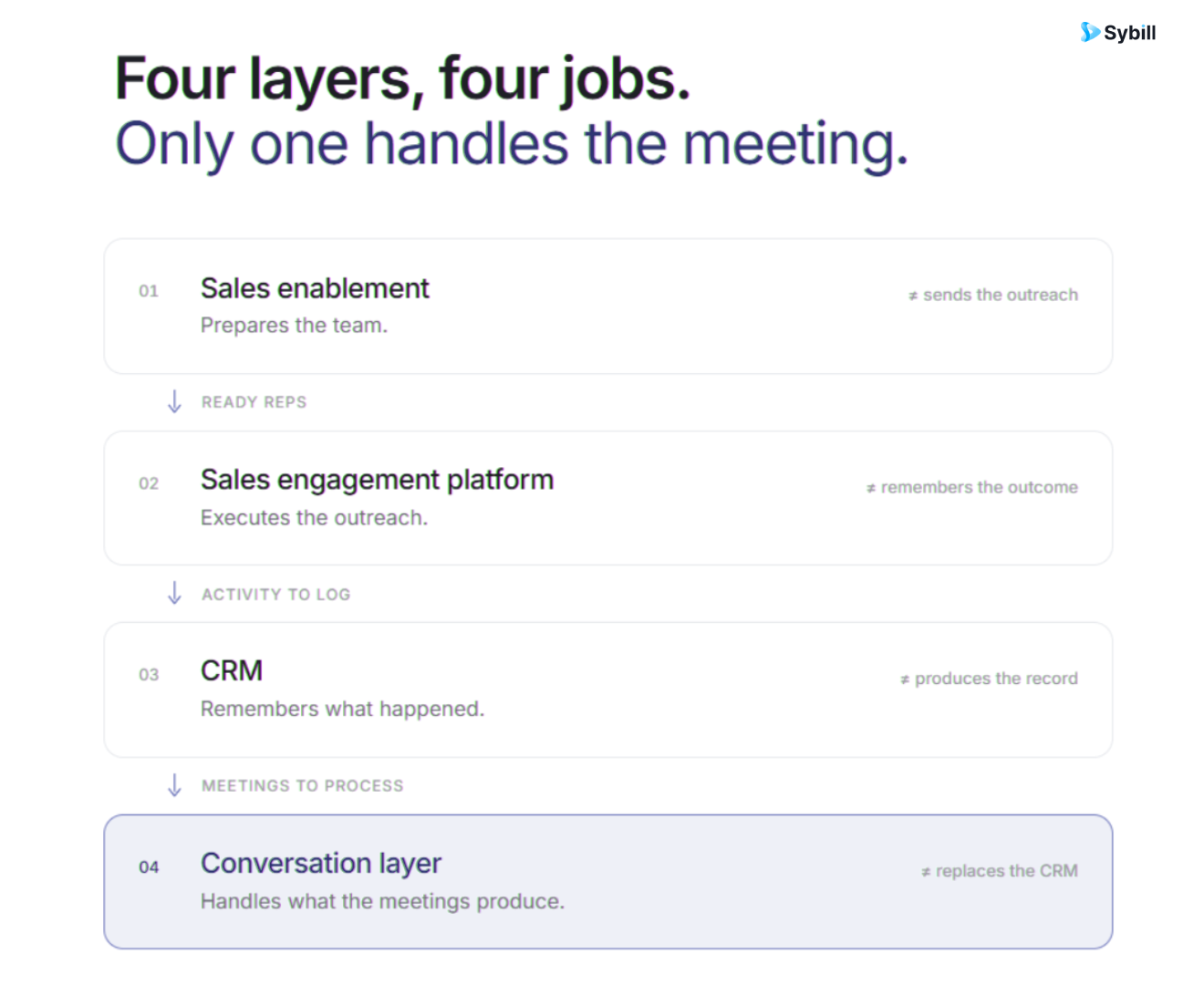
Sales engagement is the activity: the touches between sellers and buyers. The platform is the software that orchestrates those touches at scale. Sales enablement is a different function entirely: equipping the team with skills, content, and training. And the CRM is the system of record underneath all of it. In stack terms: enablement prepares the team, the SEP executes the outreach, the CRM remembers what happened, and (foreshadowing) something has to handle the conversations the SEP creates.
The category earns its price when it is genuinely used: consistent multichannel execution, no lead falling through sequence cracks, and outreach performance measured instead of guessed. The category becomes expensive shelfware when teams buy it, load three generic sequences, and let it ride. Which, candidly, is the median outcome, and the reason this post exists.
Three reasons: the platform got configured once at rollout and never revisited (sequences from 2024 still running in 2026), activity metrics create an illusion of utilization (thousands of touches sent proves the tool is busy, not effective), and nobody owns optimization (reps execute, managers inspect pipeline, and sequence performance belongs to no one's OKRs).
Run the honest audit on your own instance. When were your top five sequences last edited? What is the reply rate trend over four quarters? Who reviewed it? If those answers are "at onboarding," "unknown," and "nobody," you are paying enterprise seat prices for a scheduling tool. Your team has targets, not vibes, and the SEP should be interrogated against those targets like any other line item.
The fix is the seven plays below, and none of them requires buying anything new. That is rather the point.
The seven plays:
Generic sequences get generic results. Split your cadences by persona, industry, and funnel stage, then run one controlled test at a time: subject line this month, opening line next. The discipline most teams skip is sample size and patience; declaring a winner off forty sends is astrology. Your cold email fundamentals set the floor; testing sets the ceiling.
A cadence that fires touch four on day eight regardless of behavior is a calendar, not a strategy. Use the engagement data the SEP already collects: an opened-but-unanswered proposal email routes to a call task, a triple-open routes to priority follow-up, zero opens routes to a channel switch. Signal-based branching is the difference between persistence that converts and persistence that gets you ghosted, and it pairs naturally with lead scoring deciding who enters which cadence at all.
The SEP is one layer of a stack, and its value multiplies or dies on its plumbing. CRM sync should be bidirectional and automatic, so engagement history and outcomes live in one source of truth instead of two half-truths; marketing automation should exchange signals both ways for real sales-marketing alignment; and the broader CRM automation layer should handle the record-keeping the SEP's activity logging only gestures at. The audit question: does any human re-type anything between systems? Every yes is a leak.
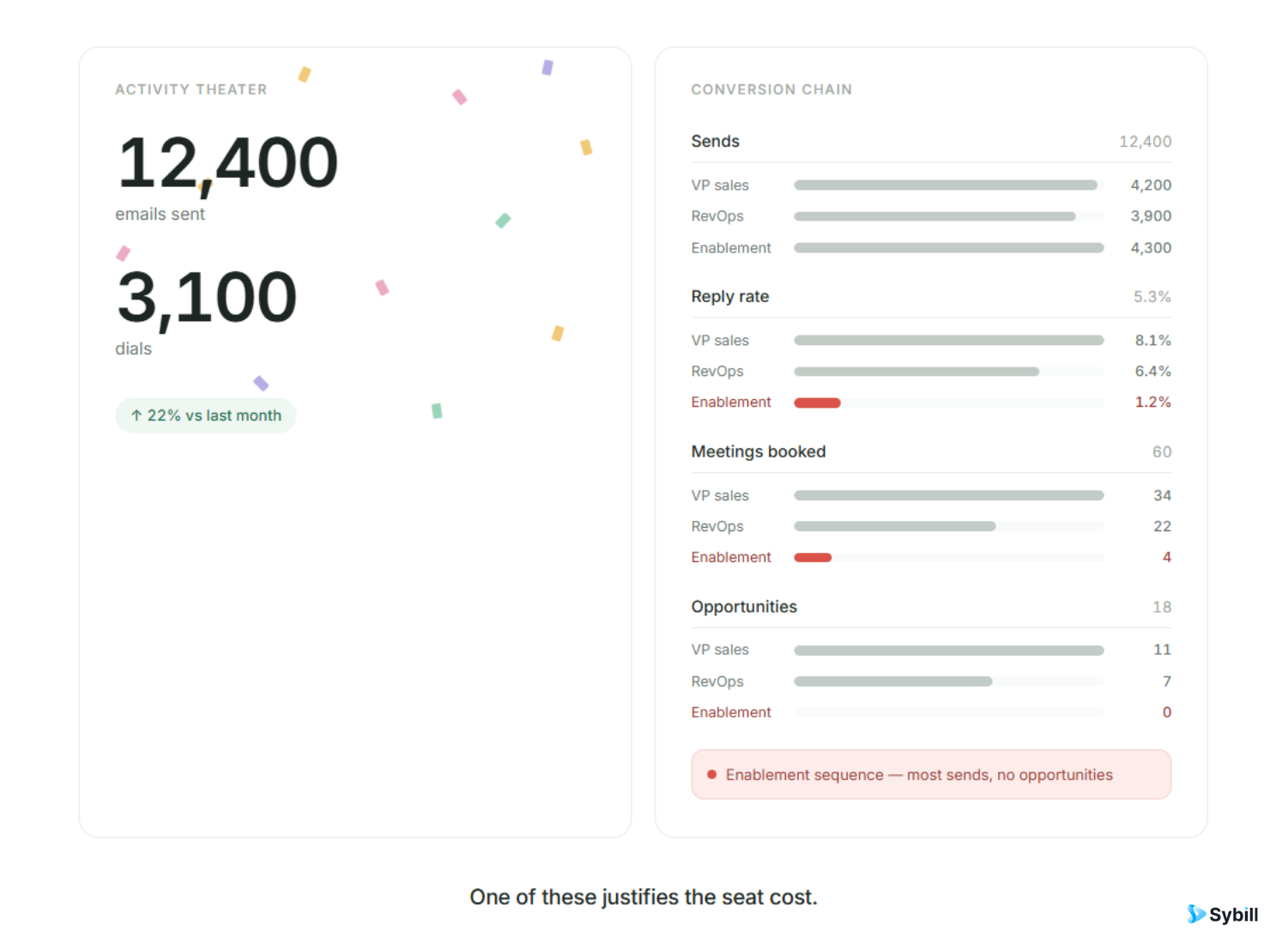
Touches sent, dials made, and emails opened measure effort. Reply rate, meeting-booked rate, and sequence-to-opportunity conversion measure results, and only results justify the seat cost. Build the weekly report on the conversion chain (sends → replies → meetings → opportunities) segmented by persona and sequence, and let underperformers face the data. Low opens indict subject lines; low replies indict the message; low meeting rates indict targeting. Each diagnosis has a different fix, which is exactly why the blended activity number tells you nothing.
Here is the play almost nobody runs, and the one with the highest copy-quality ceiling: your sequences should be written in your buyers' language, and your buyers dictate that language on every recorded call. The objections they raise, the phrases they use for their pain, the triggers that made them take the first meeting: all of it is sitting in your conversation history, waiting to become subject lines and opening paragraphs. Sybill has analyzed around 33 million sales conversations, and the pattern is consistent: the words buyers use to describe their problems are rarely the words vendors use in sequences, and closing that gap is a reply-rate lever hiding in plain sight. Ask Sybill makes the mining a query ("what do prospects in first calls say about their current tools?"), and the output feeds straight back into play 1's tests. More on the craft in our guides to AI in emails and sales email examples.
The SEP doubles as a training environment. For onboarding: dedicated new-hire cadences, a curated repository of proven templates and scripts, and side-by-side performance data that shows a new rep exactly how their numbers compare to the pattern. For ongoing coaching: sequence and call metrics identify who needs help with what, and call recordings turn the feedback specific. Our sales coaching templates plug into exactly this loop.
Sequences rot: buyer expectations shift, messages fatigue, channels saturate. Put a quarterly review on the calendar with three agenda items: kill or refresh the bottom-quartile sequences, promote what the data says is working, and collect frontline feedback, because reps hear the market's response to your outreach every day and are almost never asked about it. A feedback loop plus a deprecation habit keeps the instance alive; without both, every SEP trends toward a museum of 2024's best thinking.
Your SEP books the meeting. Sybill takes it from there. Every conversation captured, summarized, and turned into follow-ups, CRM updates, and deal intelligence, automatically. Get started for free with Sybill.
The meeting itself. Sales engagement platforms orchestrate and measure everything up to the conversation (sequences, dials, opens, booked meetings) and then go dark at precisely the moment deals get decided. What was said, promised, objected to, and agreed in the meeting, and everything that must happen after it, sits outside the SEP's architecture, which is why the modern stack pairs an engagement layer with a conversation layer.
This deserves to be said plainly, because vendors on both sides blur it. The SEP's world ends at "meeting booked." Everything that decides revenue happens after that boundary: the discovery conversation, the demo, the objection that surfaced in minute forty, the follow-up that did or did not go out that afternoon, the CRM record that did or did not capture the real next step. Measured by the SEP, a booked meeting that went brilliantly and one that cratered look identical.
The complement architecture, then:
The engagement layer (Outreach, Salesloft, Apollo) owns the pre-conversation motion: who gets touched, when, on which channel, with which message. Sybill does not do this, and the seven plays above are about making that layer earn its cost.
The conversation layer (Sybill) owns everything the meeting produces: magic summaries of what actually happened, follow-up emails drafted from the conversation in the rep's tone while the SEP's generic bump sequence stays holstered, CRM autofill writing the record the engagement layer cannot see, tasks captured from verbal commitments, and the deal intelligence that tells you which booked meetings became real opportunities, which is the number that finally closes play 4's conversion chain end to end.
And the loop closes both ways: the conversation layer's output (buyer language, objections, competitor mentions) is play 5's raw material for the engagement layer's next sequences. This is the same complement logic behind Sybill + Gong coexisting in mature stacks: layers, not rivals. The teams that get this architecture right stop asking "which tool" and start asking "which layer is weakest right now," which is a much cheaper question to answer.
Every SEP renewal conversation eventually arrives at the same uncomfortable math: the tool did exactly what it promised, executed the touches, tracked the opens, and the results still depended entirely on what the team fed it and what happened after it handed off. Sequences written from personas instead of evidence. Metrics that counted motion instead of meetings. And a total blackout on the conversations the whole apparatus existed to create.
Run the seven plays and the engagement layer earns its price. Pair it with a conversation layer and the whole chain finally gets measured, from first touch to signed deal, with the buyer's own words feeding the next round of outreach.
The fisherman metaphor from the old version of this post can retire now. This is just plumbing, done properly, end to end.
Get started for free with Sybill or book a demo and light up the half of the funnel your SEP cannot see.
The CRM is the system of record: accounts, contacts, deals, and history. A sales engagement platform is the system of action for outreach: executing and tracking sequences, calls, and touches across channels. They work as a pair, with the SEP writing engagement data back into the CRM, ideally automatically and bidirectionally.
Outreach, Salesloft, and Apollo lead the category, with HubSpot's Sales Hub sequences serving teams already in that ecosystem. The honest selection criteria are fit-based: your team size, channel mix, CRM compatibility, and admin capacity matter more than feature-list comparisons, since most teams underuse whichever platform they choose.
Sales engagement is the execution of buyer interactions: the sequences, calls, and touches, orchestrated by an engagement platform. Sales enablement is the preparation behind them: training, content, coaching, and tools that equip the team to execute well. Enablement builds capability; engagement deploys it.
Yes, and mature stacks pair them deliberately: the SEP orchestrates outreach up to the booked meeting, and conversation intelligence takes over from the meeting onward, capturing what was said, automating follow-ups and CRM updates, and feeding buyer language back into sequence copy. They cover opposite halves of the same funnel.
Conversion-chain metrics over activity counts: reply rate, meeting-booked rate, and sequence-to-opportunity conversion, segmented by persona and sequence. Activity metrics like sends and dials measure effort, not results, and optimizing them produces busier teams rather than fuller pipelines.
The CRM is the system of record: accounts, contacts, deals, and history. A sales engagement platform is the system of action for outreach: executing and tracking sequences, calls, and touches across channels. They work as a pair, with the SEP writing engagement data back into the CRM, ideally automatically and bidirectionally.
Outreach, Salesloft, and Apollo lead the category, with HubSpot's Sales Hub sequences serving teams already in that ecosystem. The honest selection criteria are fit-based: your team size, channel mix, CRM compatibility, and admin capacity matter more than feature-list comparisons, since most teams underuse whichever platform they choose.
Sales engagement is the execution of buyer interactions: the sequences, calls, and touches, orchestrated by an engagement platform. Sales enablement is the preparation behind them: training, content, coaching, and tools that equip the team to execute well. Enablement builds capability; engagement deploys it.