
Find us at booth #83, join us for a harbor side happy hour, or catch Gorish’s talk.

Sept, 16-18 > Learn more


Tamanna Mishra

July 18, 2026
%20(42).png)
A sales battlecard is a short, tactical sales enablement asset that helps reps handle competitor comparisons, pricing pushback, objections, persona-specific messaging, and product differentiation during live deals. The best sales battlecards are concise, proof-backed, updated from real sales conversations, and easy to use in the moment. Use the free sales battlecard templates below for structure, but use real deal intelligence to keep them accurate.
A sales battlecard is a one-page or one-screen reference guide that helps reps respond to competitive questions, buyer objections, pricing pressure, and product comparisons.
It is not a full sales playbook. A sales playbook explains the sales motion. A battlecard helps with a specific moment in the deal, like:
“We are also evaluating Competitor X.”
“You are more expensive.”
“Our current tool already does this.”
“Can you explain how you are different?”
This is the moment where weak reps ramble, average reps promise to “circle back,” and prepared reps calmly reframe the conversation. No jazz hands. No panic. Just a sharp answer, a proof point, and a better question.
That matters because modern B2B buyers are doing more homework before they speak to sales. Gartner found that 67% of B2B buyers prefer a rep-free experience, which means reps often enter conversations after buyers have already formed opinions from websites, peer networks, reviews, and AI-generated summaries.
The job of a battlecard is not to help reps memorize insults about competitors. It is to help them create buyer confidence.
Battlecards used to be static PDFs buried in a Google Drive folder with names like “Competitive Intel Final FINAL v7.” Very glamorous. Very dead.
Today, a good sales battlecard needs to support a buying process that is messier, more digital, and more crowded. Forrester’s 2026 State of Business Buying research found that the typical buying decision includes 13 internal stakeholders and nine external influencers. For complex or strategic purchases, the group gets even bigger.
That means the competitor objection may not come from the person on the call. It may come from procurement. Or finance. Or security. Or a colleague who asked ChatGPT for the “best alternatives” and came back with a half-right answer delivered with full confidence.
That matters because modern B2B buyers are doing more homework before they speak to sales. Gartner found that 67% of B2B buyers prefer a rep-free experience, which means reps often enter conversations after buyers have already formed opinions from websites, peer networks, reviews, and AI-generated summaries.
That is where sales battlecards earn their rent.
A useful battlecard helps reps:
And the best battlecards are not created from vibes. They are built from real sales calls, CRM notes, emails, win/loss patterns, and buyer language.
That is also where Sybill’s Competitor Intelligence becomes useful. Sybill helps teams track when competitors come up, how buyers talk about them, which objections appear, and why deals are won or lost. Instead of guessing what should go into a battlecard, teams can build from actual deal context.
A sales battlecard should be short enough for reps to use mid-call and specific enough to change the conversation. If it reads like a market research report, congratulations, you have created homework. Reps will not use it.

A great sales battlecard should help a rep answer three questions fast:
What is happening in this competitive deal?
What should I say next?
What proof should I use?
That last part is critical. Buyers do not need more claims. They need evidence. Use customer stories, call snippets, case studies, ROI examples, review themes, and implementation proof wherever possible.
For sales teams already using AI, this is where tools can separate the useful from the theatrical. Generic AI can help draft a first version. But sales-specific AI needs deal context. Ask Sybill lets reps and managers ask questions across CRM, calls, emails, Slack, and deal history, so battlecard content can reflect what is actually happening in pipeline.
Copy these sales battlecard templates into your CRM, enablement tool, Notion workspace, Google Doc, or sales wiki. Keep them in the blog if you want. Just do not let them become museum pieces.
Use this when one competitor keeps showing up in active deals.

Do not make this a “they suck, we rule” card. Buyers can smell that nonsense through a screen. Be precise. For example, “They may be a fit for smaller teams that only need basic call recording. We win when the buyer needs CRM updates, follow-ups, deal intelligence, and cross-deal answers in one workflow.”
Use this when reps hear the same objections across multiple competitors or deal stages.

Sybill can help here because Magic Summaries capture pain points, objections, outcomes, and next steps from real sales conversations. That gives enablement teams better raw material than a brainstorm in a conference room.
Use this when competitors undercut your price or buyers reduce the conversation to license cost.

This card should help reps avoid the classic trap: defending price like they are apologizing for it. If the buyer says a competitor is cheaper, the rep needs to move the conversation from price to value, risk, adoption, manual work, data quality, and revenue impact.
This is especially important because Forrester says procurement professionals are decision-makers in 53% of business buying cycles and often engage from the start of the process.
For Sybill, the pricing conversation can connect directly to workflow value. CRM Autofill updates CRM after calls and emails, captures deal signals like competitors and next steps, and reduces the admin tax that eats selling time.
Use this when the same product needs to land differently with different stakeholders.
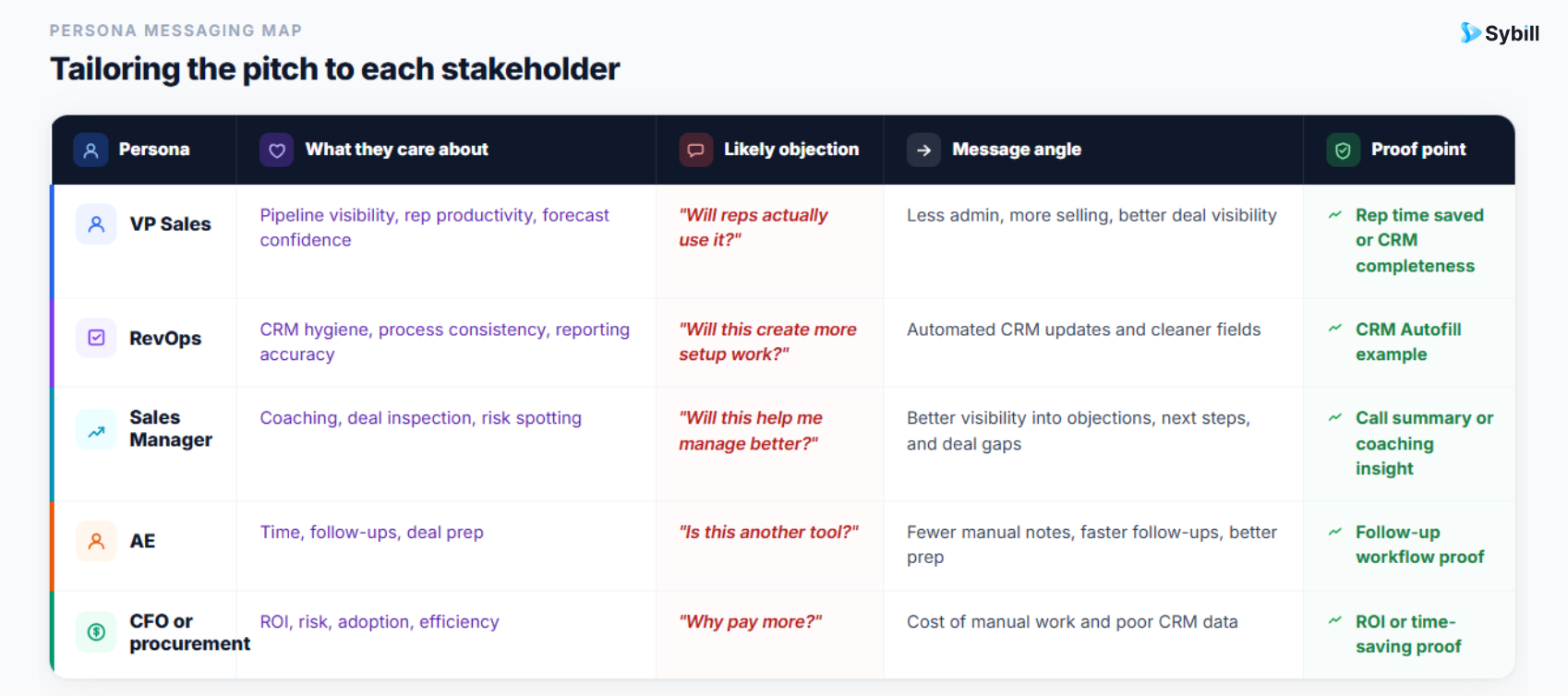
A CFO does not care that your dashboard looks gorgeous. An AE does not care about “strategic visibility” if it adds three more clicks after every call. Persona-based messaging keeps reps from pitching one generic value prop to five very different humans.
Use Ask Sybill to surface what different stakeholders have asked, what they care about, and where each deal may be stuck.
Use this when reps need to explain why your product is meaningfully different.

This is where most sales battlecards get boring. They list features like a product page in disguise.
Do this instead:
Feature: CRM updates
Differentiator: Sybill captures deal signals from calls and emails and updates CRM fields automatically.
Buyer outcome: Reps spend less time reconstructing meetings, managers get cleaner deal data, and forecast conversations become less theatrical.
See the difference? One is a feature. The other is a reason to care.
For follow-up workflows, read Sybill’s sales follow-up email guide, which explains how real meeting context, pain points, objections, and next steps should shape follow-up emails.
Use this when reps need to expose competitor gaps without sounding petty.
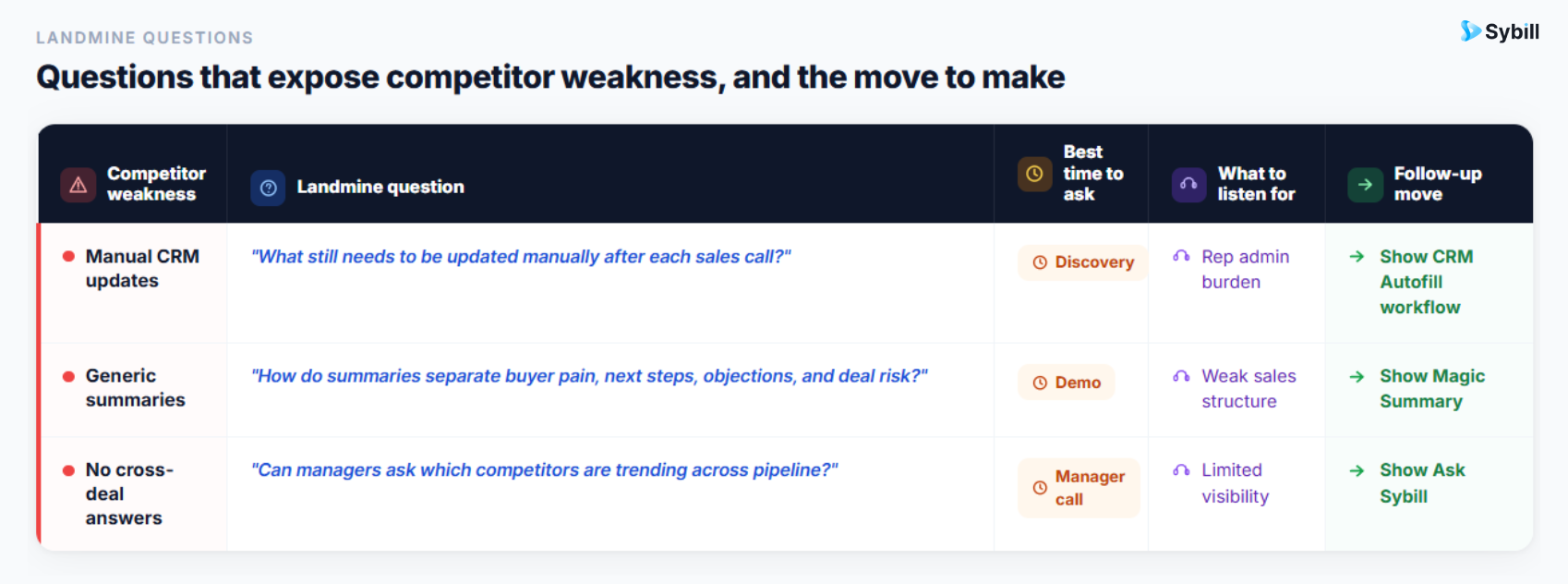
A landmine question should not sound like an attack. It should sound like smart discovery. The buyer should realize the gap before you say it.
Bad: “Their tool cannot do that.”
Better: “How are you checking whether competitor mentions and objections are being captured consistently across every deal?”
See? No blood on the floor. Still effective.
Use this after a competitive moment happens on a call.
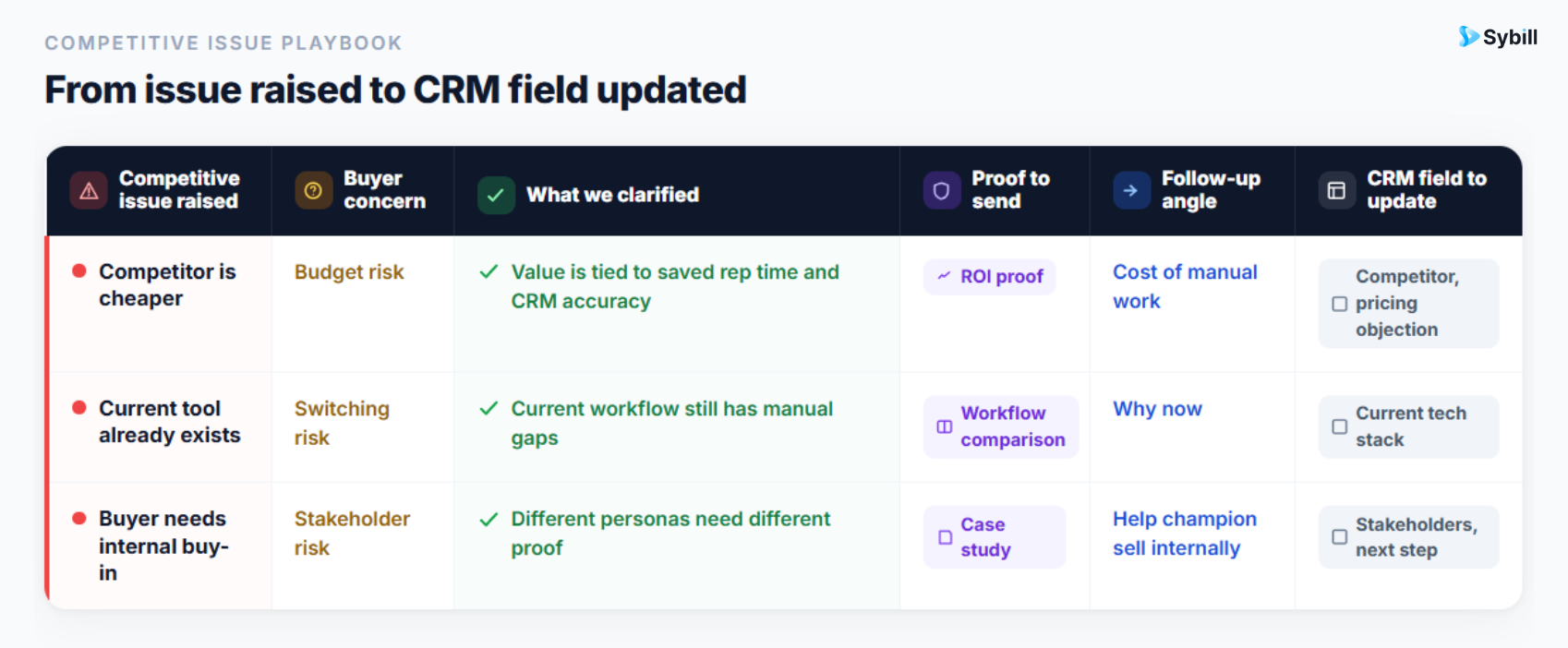
The battlecard should not die when the call ends. If a buyer raises a competitor, the follow-up should acknowledge the concern, summarize what was discussed, send the right proof, and move the deal forward.
This is where Sybill is especially useful. Sybill’s Personalized Emails turn sales conversations into ready-to-send follow-ups using meeting context, buyer pain points, objections, and next steps.
Here is the cleanest way to build sales battlecards that reps will not ignore.

Do not build ten battlecards because someone saw ten logos on G2. Start with the competitors appearing in your active pipeline and closed-lost notes.
Ask:
Sybill’s Competitor Intelligence helps teams answer these questions from real conversations, not rep memory.
The best objection handling battlecard uses the buyer’s words. Not the marketing team’s idealized version of the buyer’s words.
Use call summaries, transcripts, CRM notes, and follow-up emails to find:
If your team is still digging through transcripts manually, read Sybill’s guide on AI call transcript analysis. The point is not to read more transcripts. The point is to get deal answers faster.
Battlecards need field reality. Ask your best reps:
This step matters for adoption too. McKinsey’s influence model for behavior change highlights role modeling, skill building, formal reinforcement, and conviction as key to making change stick. If top reps help shape the battlecards, other reps are more likely to trust and use them.
Every sales battlecard needs:
Static battlecards go stale quietly. The buyer finds out first. Then your rep finds out in real time. Brutal.
Templates give you structure. Sybill gives you the context that makes the structure worth using.
Sybill helps revenue teams capture the raw material that battlecards need: competitor mentions, objections, pricing concerns, stakeholder priorities, next steps, deal risks, and follow-up context. CRM Autofill pushes important deal signals into the CRM after calls and emails, including competitors and next steps. Ask Sybill helps reps and managers ask deal questions across sales context instead of hunting through notes, Slack threads, and call recordings.
That means enablement teams can stop asking, “What should this battlecard say?” and start asking better questions:
Which competitors are showing up most often?
What objections are trending this month?
Where do we lose on pricing?
Which proof points help deals move forward?
What are top reps saying that others should copy?
That is the difference between a static sales battlecard template and a living sales enablement system.

Do not measure battlecards by downloads alone. A rep can download a card, ignore it, and still lose the deal with confidence.
Measure whether battlecards are used in competitive opportunities, whether win rates improve, whether objections are handled consistently, and whether CRM data gets cleaner. If your CRM does not capture competitor mentions and objections consistently, use Sybill CRM Autofill to close that gap.
Free sales battlecard templates are useful. But the template is not the strategy.
The real strategy is turning every sales conversation into usable competitive intelligence: what buyers said, which competitors appeared, what objections came up, what proof worked, and what follow-up moved the deal forward.
That is how reps stop winging competitive conversations.
That is how enablement stops shipping PDFs nobody opens.
And that is how a sales battlecard becomes what it was always supposed to be: not a document, but a deal weapon.
Want to build battlecards from real buyer context? Use Sybill to capture competitor mentions, objections, CRM updates, follow-up context, and deal intelligence from every sales conversation.
A sales battlecard template is a structured format for creating a short sales enablement asset that helps reps handle competitor comparisons, objections, pricing pushback, product differentiation, and buyer questions. The template gives the structure. Real deal intelligence gives it value.
A strong sales battlecard should include a competitor snapshot, why you win, why you lose, objection handling, pricing pushback, persona messaging, landmine questions, proof points, follow-up guidance, and a last verified date.
Start with the competitors that appear most often in active deals. Review call summaries, CRM notes, emails, closed-won deals, and closed-lost deals. Interview top reps, write short talk tracks, add proof points, validate the card, assign an owner, and update it regularly.
Update sales battlecards whenever pricing, packaging, product capabilities, competitor messaging, or buyer objections change. For fast-moving competitors, review monthly. At minimum, every battlecard should have a last verified date and a clear owner.
A sales playbook explains the broader sales process, including qualification, discovery, demos, follow-ups, and closing. A sales battlecard is narrower. It helps reps handle a specific competitive situation, objection, persona, product, or pricing conversation.
Yes, AI can help create sales battlecards faster. But generic AI should not be the final source of truth. The best AI sales battlecards are grounded in actual calls, emails, CRM data, win/loss patterns, buyer objections, and proof points. That is why sales-specific AI tools like Sybill are better suited for battlecard workflows than generic AI prompts alone.
A sales battlecard template is a structured format for creating a short sales enablement asset that helps reps handle competitor comparisons, objections, pricing pushback, product differentiation, and buyer questions. The template gives the structure. Real deal intelligence gives it value.
A strong sales battlecard should include a competitor snapshot, why you win, why you lose, objection handling, pricing pushback, persona messaging, landmine questions, proof points, follow-up guidance, and a last verified date.
Start with the competitors that appear most often in active deals. Review call summaries, CRM notes, emails, closed-won deals, and closed-lost deals. Interview top reps, write short talk tracks, add proof points, validate the card, assign an owner, and update it regularly.








