Find us at booth #83, join us for a harbor side happy hour, or catch Gorish’s talk.

Sept, 16-18 > Learn more

%20(1).avif)
Mamta Tainwala

April 4, 2026

Freemium or free trial? It is one of the most consequential product-led growth decisions a SaaS company can make, and most teams get it wrong because they choose based on vibes rather than data.
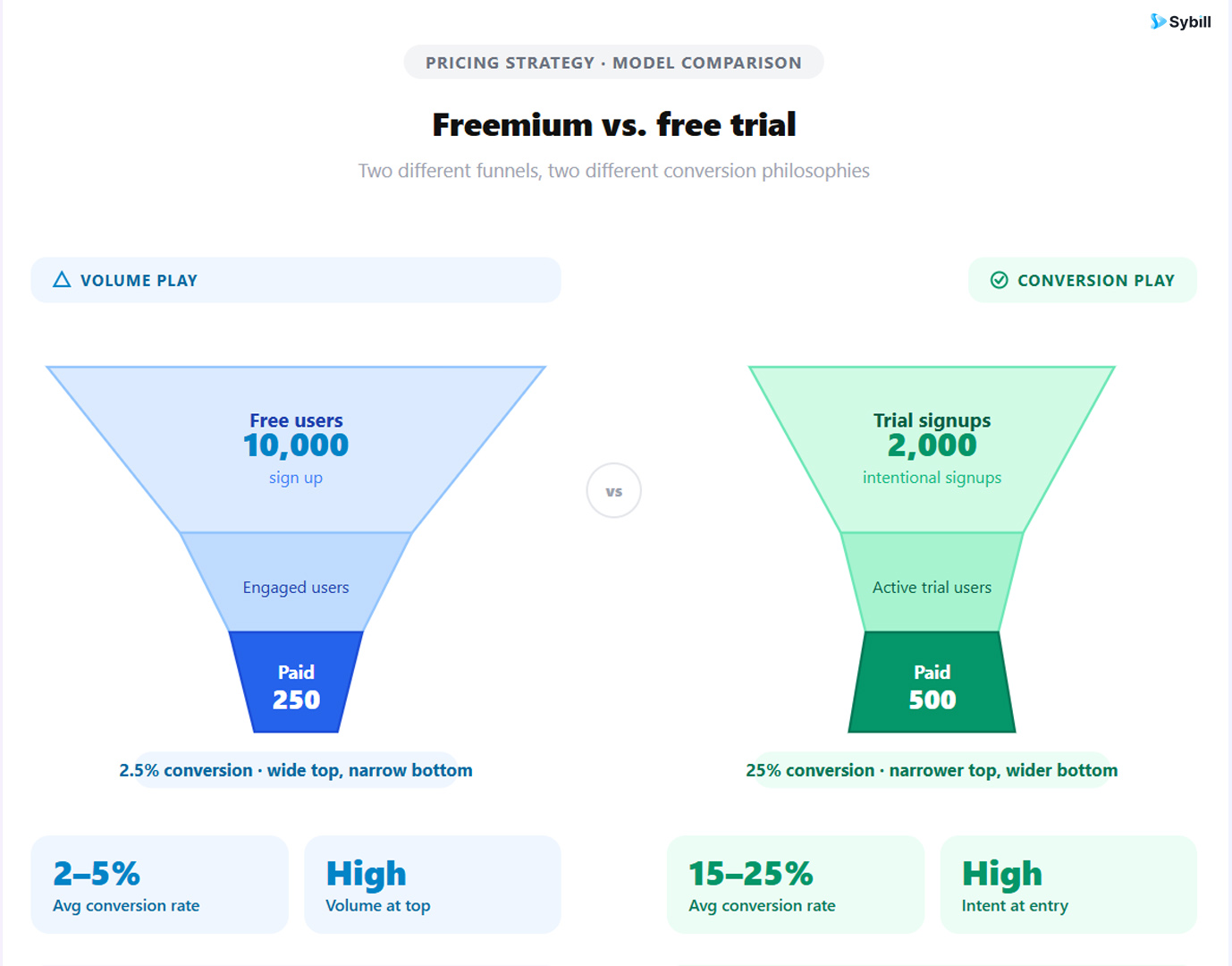
Here is the core tension. Freemium models attract massive user bases but convert only 2 to 5% of them to paid plans. Free trials bring in fewer signups but convert 15 to 25% of those users. Both numbers are correct, and both are misleading without context.
The right choice depends on your product complexity, average contract value, time-to-value, and go-to-market motion. Pick the wrong model, and you either burn cash supporting free users who never pay or create friction that kills acquisition before users experience your product's value.
This guide gives you the data, the frameworks, and the strategic lens to make this decision well. We will break down exactly how each model works, the real-world economics behind them, when each one wins, and why a growing number of SaaS companies are adopting hybrid approaches that combine elements of both.
A freemium model gives users permanent, unlimited access to a limited version of the product at no cost. Users can use the free tier indefinitely, with no time pressure to upgrade. Revenue comes from the percentage of users who eventually pay for premium features, higher usage limits, or advanced functionality.
The word "freemium" combines "free" and "premium." The strategy relies on giving away enough value that users become embedded in the product, then creating enough differentiation in the paid tiers that a meaningful percentage sees the upgrade as worth the cost.
Classic freemium examples include Slack (free for small teams, paid for larger organizations and advanced features), Canva (free design tools with premium templates and capabilities), Dropbox (free storage with paid capacity upgrades), and Zoom (free 40-minute meetings, paid for longer and more participants).
The economics of freemium are built on volume. If 100,000 users sign up and 3% convert, that is 3,000 paying customers acquired without a single sales call. The trade-off is that the other 97,000 users consume server resources, support bandwidth, and product attention without generating direct revenue.
A free trial gives users full (or nearly full) access to the product for a limited time, typically 7 to 30 days. Once the trial expires, the user must pay to continue using the product. There is no permanent free tier to fall back on.
Free trials come in two flavors. Opt-in trials do not require a credit card at signup. The user enters their email, gets access, and is prompted to pay when the trial ends. Opt-out trials require a credit card upfront and automatically bill the user when the trial expires unless they cancel. The difference between these two approaches is dramatic: opt-out trials convert at roughly 48.8%, while opt-in trials convert at approximately 18.2%, according to First Page Sage's analysis of 86 SaaS companies.
Free trial examples include Salesforce (30-day trial of the full platform), Shopify (free trial before committing to a plan), HubSpot Sales Hub (14-day trial of premium features), and Sybill (14-day free trial with full access to AI-powered call summaries, CRM autofill, and follow-up automation).
The economics of free trials are built on conversion efficiency. Fewer users sign up compared to freemium, but a much larger share of those who do become paying customers. The bet is that giving users the full product experience for a compressed window creates urgency and demonstrates enough value to justify the purchase.
Before diving into strategy, let's ground this discussion in actual data. These benchmarks come from First Page Sage's multi-year study of 86 SaaS companies and Kyle Poyar's analysis of over 1,000 products.
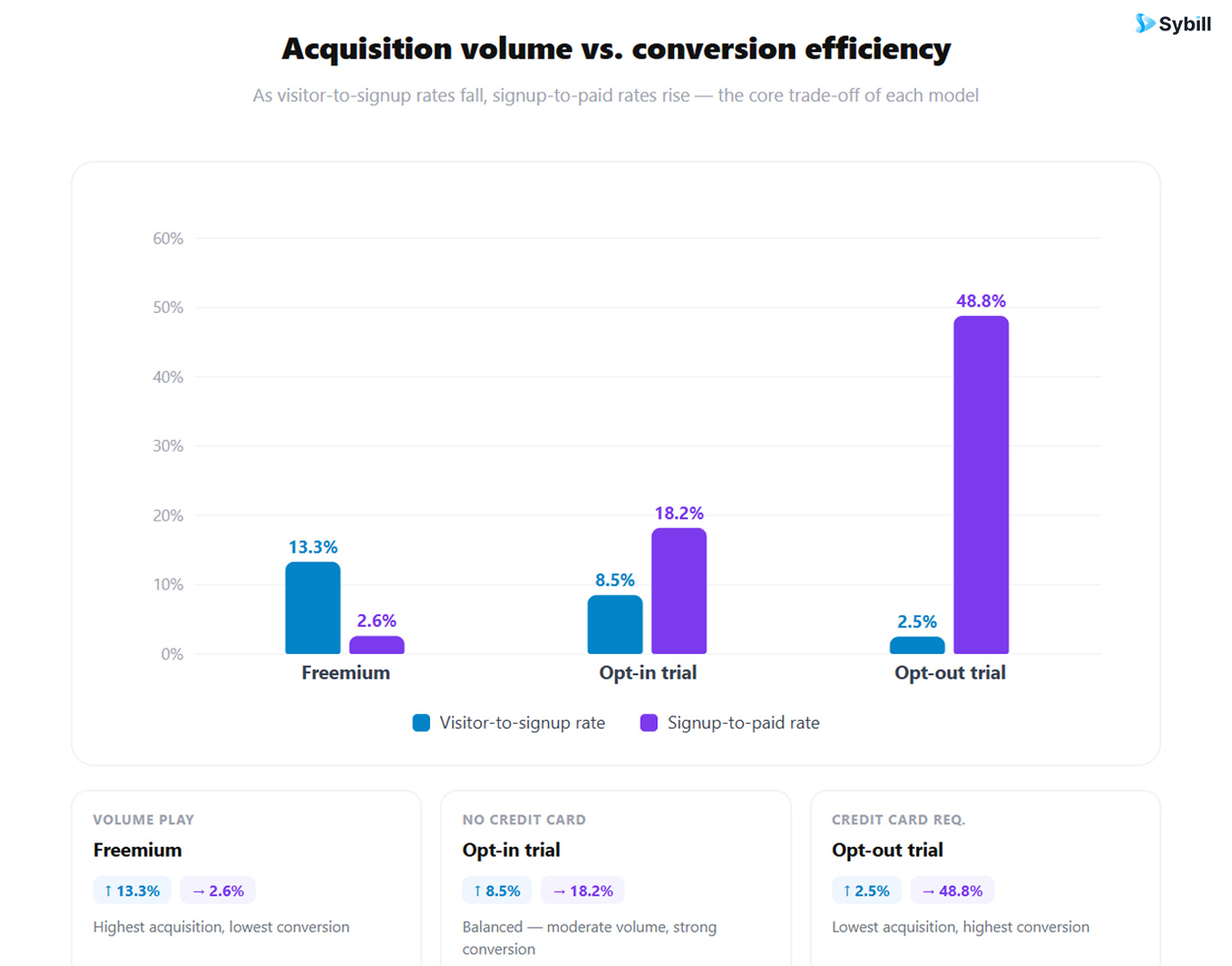
Freemium conversion rates: Visitor-to-freemium signup: ~13.3% (organic), ~15.9% (paid). Freemium-to-paid conversion: ~2.6% (organic), ~2.8% (paid). Self-serve freemium products typically see 3 to 5% conversion, with exceptional performers reaching 6 to 8%. Sales-assisted freemium models perform better at 5 to 7%, with top performers hitting 10 to 15%.
Free trial conversion rates (opt-in, no credit card): Visitor-to-trial signup: ~8.5% (organic), ~7.1% (paid). Trial-to-paid conversion: ~18.2% (organic), ~17.4% (paid).
Free trial conversion rates (opt-out, credit card required): Visitor-to-trial signup: ~2.5% (organic), ~2.2% (paid). Trial-to-paid conversion: ~48.8% (organic), ~51% (paid).
The pattern is clear. Freemium attracts the most users but converts the fewest. Opt-in trials attract moderate users with moderate conversion. Opt-out trials attract the fewest signups but convert nearly half of them.
The model you choose creates a performance gap before a single onboarding email is sent. That makes this a structural decision, not a tactical one.
Massive top-of-funnel. Freemium removes the biggest barrier to adoption: cost. Anyone can try your product without committing a dollar or a credit card. This creates a large user base that generates word-of-mouth, organic virality, and network effects.
Zero urgency pressure. Users can explore at their own pace without a countdown clock creating anxiety. For complex products where time-to-value is longer, this patience can be an advantage.
Network effects and virality. Products where free users create value for other users (Slack, Dropbox, LinkedIn) benefit enormously from freemium. Each free user makes the platform more valuable for everyone, including future paid users.
Product-qualified leads. Usage data from the free tier tells your sales team exactly who is engaged, what features they are using, and when they are hitting the limits that signal upgrade readiness. This intelligence is gold for sales teams focused on expansion.
Extremely low conversion rates. At 2 to 5%, you need a very large free user base to generate meaningful revenue. If your market is not large enough to support that volume, freemium economics do not work.
High support and infrastructure costs. Free users still consume resources: servers, storage, support tickets, and product development attention. If the cost to serve each free user is not near zero, freemium bleeds cash.
Freeloader risk. Many users will happily use the free tier forever and never convert. If your free tier is too generous, you may satisfy users' needs entirely, removing any motivation to upgrade.
Deferred revenue. Freemium is a long game. Revenue comes slowly as users gradually discover paid features and hit usage limits. If your business needs revenue now, freemium's timeline may not align with your cash flow needs.
Freemium is the right model when your product has strong network effects (collaboration tools, communication platforms), when time-to-value is long and users need extended exposure, when your market is massive and you can afford low conversion rates at high volume, when free users create value for paid users, and when the marginal cost to serve each additional free user approaches zero.
Higher conversion rates. At 15 to 25% for opt-in and nearly 50% for opt-out, free trials convert significantly more signups into revenue. This makes unit economics work with a smaller user base.
Built-in urgency. The expiration date creates a decision point. Users must evaluate the product and make a purchase decision within the trial window, which compresses the sales cycle and reduces deal stall.
Full product exposure. Trials give users access to premium features they would never experience in a limited freemium tier. This means users make their purchase decision based on the real product, not a stripped-down version.
Cleaner unit economics. Because trial users either convert or leave, you do not accumulate a growing base of non-paying users consuming resources. This makes cost forecasting more predictable.
Sales-assist friendly. Free trials create a natural window for your sales team to engage: during the trial, when users are actively evaluating. Tools like Sybill's pre-meeting briefs can prepare AEs with context on what the trial user has explored, making those conversations more targeted and effective.
Higher signup friction. Fewer people sign up for a trial than for a free tier, especially when a credit card is required. You are trading volume for quality.
Time pressure can backfire. If your product is complex and users cannot reach the "aha moment" within the trial window, they will churn not because the product lacks value, but because they ran out of time to discover it.
No ongoing free tier for re-engagement. Once a trial expires, the user is gone (unless you have a strong re-engagement sequence). With freemium, dormant users can return months later when their needs change.
Operational pressure on onboarding. Every day of the trial matters. If your onboarding is slow, confusing, or generic, you are wasting the most critical window in the customer journey. The data shows that top-performing SaaS companies achieve activation rates of 60% or higher and time-to-first-value of under 10 minutes.
Free trials are the right model when your product delivers clear value quickly (time-to-value under a few days), when your ACV supports the cost of sales-assisted conversion, when your product is too complex to demonstrate value in a limited free tier, when you need revenue sooner rather than later, and when your target buyer is actively evaluating solutions (not casually browsing).
A growing number of SaaS companies are adopting the reverse trial model, which combines elements of both approaches.
Here is how it works: new users get full access to the premium product for a limited trial period (typically 14 days). When the trial expires, instead of losing access entirely, they are downgraded to a permanent free tier with limited features. They can continue using the basic product indefinitely, or upgrade to reclaim the premium features they already experienced.
The reverse trial solves the core weaknesses of both models. It gives users the full product experience (like a trial), creating urgency and demonstrating maximum value. But it also provides a safety net (like freemium), so users who are not ready to buy today do not disappear entirely. They stay in your ecosystem, using the free tier, and can be nurtured toward conversion over time.
Companies like Airtable, Loom, and Sybill use variations of this approach. Sybill's free trial gives users access to the full AI sales assistant, including Magic Summaries, CRM Autofill, personalized follow-up emails, and Ask Sybill. Users experience the complete product, see the time savings firsthand, and then decide whether to continue at a paid tier.
The reverse trial is particularly effective for products where the "aha moment" requires premium features to reach, where the free tier still provides enough value to keep users engaged, and where the sales motion benefits from both urgency and long-term nurture.
Choosing between freemium and free trial is not about which model is "better." It is about which model fits your specific product, market, and business stage.
Your product has network effects where free users create value for others. Your time-to-value is measured in weeks or months, not minutes or days. Your market is large enough to support 2 to 5% conversion at volume. The cost to serve each free user is near zero. You are building a category and need market penetration over immediate revenue. Your product can be meaningfully useful in a limited version.
Your product demonstrates clear value within days. Your ACV is high enough to justify sales-assisted conversion. You need revenue predictability and cannot afford a large non-paying user base. Your buyer is actively evaluating solutions (not casually exploring). Your sales team can engage trial users with targeted outreach during the evaluation window.
Your product needs premium features to deliver the "aha moment." You want the conversion efficiency of a trial with the long-tail engagement of freemium. Your sales motion benefits from both urgency (trial deadline) and ongoing nurture (free tier users). You can build a clear upgrade path from the free tier to paid.
Your product is highly complex and requires guided onboarding. Your ACV is above $25,000 and justifies a consultative sales process. Your buyer persona requires internal stakeholder alignment before purchasing. Time-to-value cannot be reached in self-serve mode.
Whichever model you choose, the single biggest lever for conversion is time-to-value. How quickly can a new user experience the core benefit of your product?
Top-performing SaaS companies achieve activation rates above 60% and get users to their first meaningful moment of value in under 10 minutes. Companies that fail at this see conversion rates collapse regardless of whether they offer freemium or free trials.
Here are the optimization levers that apply across all models:
Onboarding experience. Your first five minutes determine whether a user sticks around. Guided walkthroughs, smart defaults, and progress indicators help users reach value faster. Generic "welcome to our product" emails do not cut it.
Activation triggers. Identify the 2 to 3 actions most correlated with conversion and design your onboarding to drive users toward those actions. For a conversation intelligence tool, this might be recording the first call. For a CRM, it might be importing contacts and logging the first deal.
Upgrade prompts at friction points. The best upgrade prompts appear when a user hits a limit that matters. Loom shows an upgrade prompt when users exceed the free recording time. Slack surfaces premium features when teams outgrow the free tier. These prompts feel helpful rather than pushy because they appear at moments of genuine need.
Personalized nurture sequences. Segment your nurture based on activation status and usage patterns. A user who recorded 10 calls in week one needs a different message than one who signed up and never logged in. AI-powered tools make this personalization scalable by capturing buyer intent signals automatically.
Sales-assist at the right moment. For B2B products, having a rep reach out during the trial window can significantly boost conversion, especially for accounts that match your ideal customer profile. The key is timing and context. A rep who references the user's actual product behavior ("I noticed you recorded 15 calls this week, here is how teams like yours get the most out of the coaching features") converts far better than one who sends a generic "how is your trial going?" email.
Slack's freemium model is the textbook example of network-effect-driven free user acquisition. The free tier is generous enough that small teams can use it indefinitely. But as teams grow, they hit limits (message history, integrations, admin controls) that make upgrading feel natural rather than forced. Slack's viral loop, where free users invite colleagues who invite other teams, created the growth engine that made the company a household name in business communication.
Shopify offers a free trial that gives merchants full access to build their store. The genius is in the time-to-value: within the trial window, merchants invest significant effort in building their storefront, uploading products, and configuring settings. By the time the trial ends, they have invested enough work that paying to keep it live feels like the obvious choice. The switching cost they created for themselves during the trial is the conversion engine.
Sybill offers a freemium model that gives users full access to the AI sales assistant, including call recording and Magic Summaries, CRM Autofill, personalized follow-up emails, and Ask Sybill for deal intelligence on credit basis. The approach works because the value is immediate and visceral: reps finish their first call and find a perfectly written summary, a drafted follow-up email, and their CRM updated, all within minutes. That moment of experiencing 5+ hours of saved time in the first week makes the conversion decision straightforward.
AI is reshaping both models in ways that are worth understanding for any SaaS team making this decision in 2026.
For freemium models, AI enables smarter free-to-paid conversion by identifying which free users are most likely to upgrade based on usage patterns, feature engagement, and behavioral signals. Instead of blasting every free user with the same upgrade prompt, AI-powered systems can target the right user with the right message at the right moment.
For free trial models, AI compresses time-to-value dramatically. Products that once required hours of setup and manual configuration can now deliver instant value through AI automation. Sybill is a prime example: the AI handles the heavy lifting (call analysis, CRM updates, follow-up drafting) from the first meeting, so users experience the core value proposition on day one of the trial rather than day seven.
For sales teams working trial conversions, AI provides the context that makes outreach relevant. Instead of generic check-in emails, reps can use conversation intelligence data to understand exactly what a trial user has experienced, which features they engaged with, and where they might need help. This turns trial follow-up from a volume game into a precision game.
The net effect is that AI raises conversion rates across all models by reducing the gap between "signed up" and "experienced value." The faster a user reaches their aha moment, regardless of the model, the more likely they are to pay.
What is the difference between freemium and free trial?
A freemium model gives users permanent free access to a limited version of the product, with no time constraint. A free trial gives users full access to the product for a limited time (typically 7 to 30 days), after which they must pay to continue. Freemium is a volume play that attracts large user bases with lower conversion rates (2 to 5%). Free trials attract fewer signups but convert at significantly higher rates (15 to 25% for opt-in, ~49% for opt-out).
What is a good freemium-to-paid conversion rate?
The average freemium-to-paid conversion rate is approximately 2.6% for organic users and 2.8% for paid traffic. Self-serve freemium products typically see 3 to 5%, with exceptional performers reaching 6 to 8%. Sales-assisted freemium models average 5 to 7%, with top performers reaching 10 to 15%. A rate above 5% is generally considered strong for a self-serve product.
What is a good free trial conversion rate?
For opt-in trials (no credit card required), the benchmark is approximately 18.2%. For opt-out trials (credit card required), the benchmark is approximately 48.8%. Good trial performance falls in the 8 to 12% range, great performance in the 15 to 25% range. Enterprise SaaS trials typically convert at 10 to 15% due to longer evaluation cycles and larger buying committees.
What is a reverse trial?
A reverse trial gives new users full access to the premium product for a limited period, then downgrades them to a permanent free tier when the trial expires. Users can upgrade at any point to reclaim premium features. This model combines the conversion efficiency of a free trial with the long-tail engagement of freemium. It is particularly effective when premium features are needed to reach the "aha moment."
Should I require a credit card for my free trial?
Requiring a credit card (opt-out trial) dramatically increases conversion rates, from ~18% to ~49%, but significantly reduces initial signups, from ~8.5% to ~2.5% of visitors. The right choice depends on your priorities. If you need high conversion efficiency and can afford lower volume, opt-out is superior. If you need a large top-of-funnel for brand awareness and you have strong onboarding to compensate for lower conversion rates, opt-in reduces friction.
Can I use both freemium and free trial?
Yes. The reverse trial model combines both. You can also segment your approach by offering a free trial to one user type (like enterprise evaluators) and a freemium tier to another (like individual users or small teams). The key is ensuring clear positioning so users understand which path is right for them.
How does Sybill's free trial work?
Sybill offers a 14-day free trial with full access to its AI sales assistant capabilities, including call recording, Magic Summaries, CRM Autofill, personalized follow-up emails, pre-meeting briefs, and Ask Sybill for deal intelligence. Users experience the full product from day one, so the value is visible immediately. Paid plans start at $19/user/month for Essentials.
The freemium vs free trial decision is structural. It shapes your acquisition economics, your sales motion, your product development priorities, and your cash flow timeline. It is not something to copy from a competitor or decide in a single meeting.
Start with your product's time-to-value. If users can reach a meaningful moment of value quickly, a free trial (or reverse trial) captures that momentum and converts it into revenue. If value builds over weeks or months through usage, network effects, or habit formation, freemium gives users the runway they need.
Then look at your economics. Can you afford to serve thousands of free users who may never convert? If yes, freemium's volume play can build a massive growth engine. If not, free trials' conversion efficiency lets you build a sustainable business with a smaller user base.
Whatever you choose, remember that the model is the container. What goes inside it, the onboarding experience, the activation triggers, the nurture sequences, and the sales-assist timing, determines whether users actually convert. The companies winning in 2026 are not winning because they picked freemium or free trial. They are winning because they obsess over time-to-value and remove every barrier between signup and that first moment where the user thinks: "I need this."
Get started for free with Sybill and experience why sales teams convert from trial to paid in the first week.
A freemium model gives users permanent free access to a limited version of the product, with no time constraint. A free trial gives users full access to the product for a limited time (typically 7 to 30 days), after which they must pay to continue. Freemium is a volume play that attracts large user bases with lower conversion rates (2 to 5%). Free trials attract fewer signups but convert at significantly higher rates (15 to 25% for opt-in, ~49% for opt-out).
The average freemium-to-paid conversion rate is approximately 2.6% for organic users and 2.8% for paid traffic. Self-serve freemium products typically see 3 to 5%, with exceptional performers reaching 6 to 8%. Sales-assisted freemium models average 5 to 7%, with top performers reaching 10 to 15%. A rate above 5% is generally considered strong for a self-serve product.
For opt-in trials (no credit card required), the benchmark is approximately 18.2%. For opt-out trials (credit card required), the benchmark is approximately 48.8%. Good trial performance falls in the 8 to 12% range, great performance in the 15 to 25% range. Enterprise SaaS trials typically convert at 10 to 15% due to longer evaluation cycles and larger buying committees.