Find us at booth #83, join us for a harbor side happy hour, or catch Gorish’s talk.

Sept, 16-18 > Learn more


Mamta Tainwala

April 30, 2026
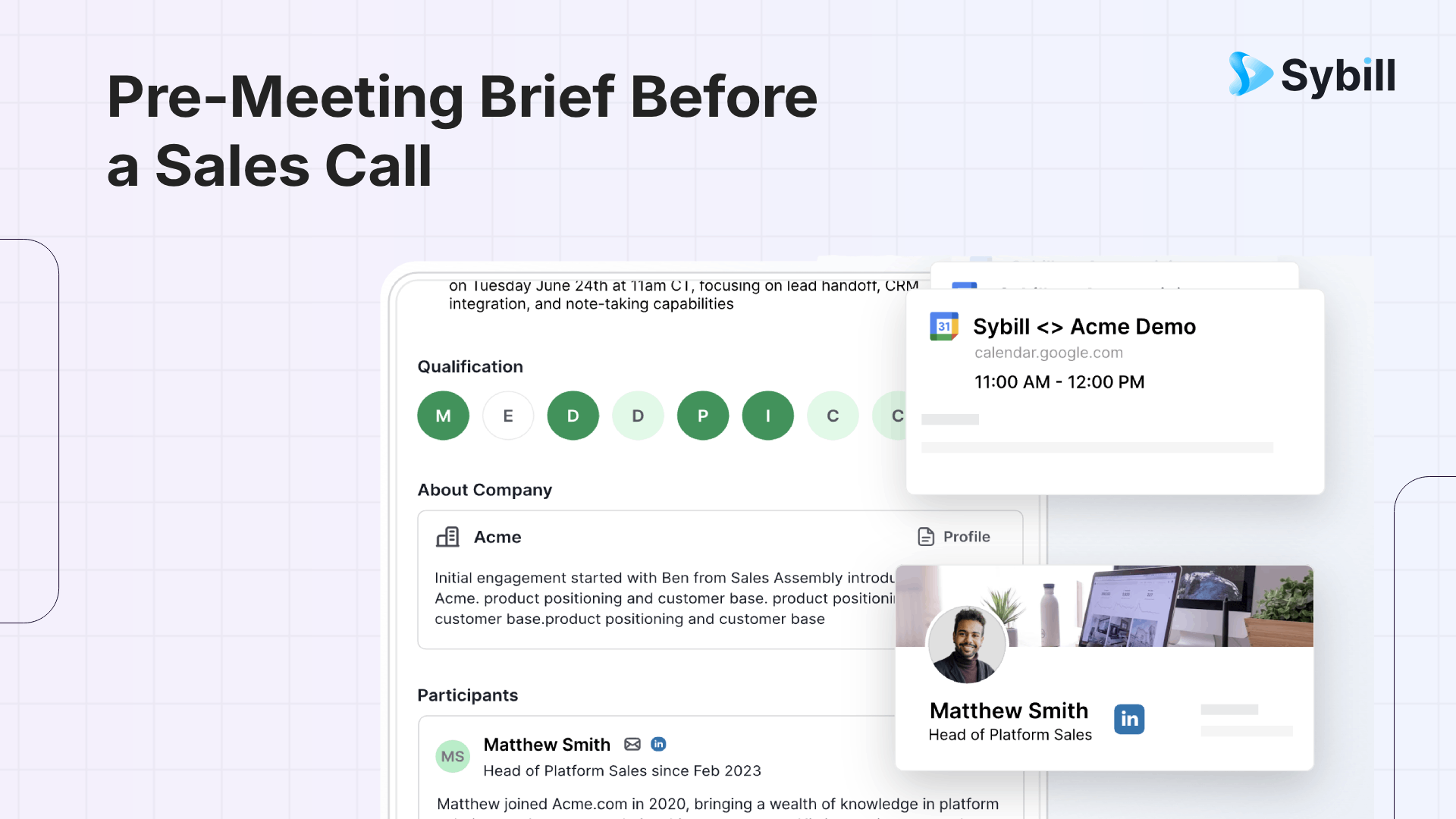
Sybill delivers automated pre-meeting briefs before every sales call, combining attendee profiles, company context, prior call history, email thread summaries, CRM deal data, outstanding action items, and a suggested agenda mapped to your selling framework. The brief lands in your inbox before the meeting without any manual research. No other conversation intelligence tool matches this level of automated, deal-aware meeting prep. Other approaches exist (LinkedIn Sales Navigator for manual research, Cirrus Insight for Salesforce-first teams, or DIY workflows with Claude Code), but none combine prospect research with your own deal history the way Sybill does.
Here is a stat that should haunt every sales leader: top performers spend 6x more time on pre-call research than average reps. Buyers consistently say the number one thing that differentiates a great salesperson is "understanding my business."
And yet, most reps walk into calls having done a 90-second LinkedIn scan and a quick glance at the CRM record. Not because they do not care. Because they have six meetings today and the math simply does not work. Proper meeting prep takes 20 to 30 minutes per call. If you have five calls, that is 2.5 hours of research before you have said a single word to a prospect.
So reps make a rational trade-off: they prep deeply for the big meetings and wing the rest. The problem is that winging it has compounding costs. You ask a question the prospect already answered last call. You miss that the deal champion changed roles. You walk into a multi-stakeholder meeting without knowing who the new VP is or what they care about. Each of these moments erodes buyer confidence and slows deal velocity. It is the kind of pattern that effective sales coaching identifies, but by then the damage is done.
The fix is not telling reps to prep harder. It is giving them a tool that does the prep for them, automatically, before every single call.

Before we get into tools, let us define what "everything you need to know about the prospect" actually means in practice. A great pre-meeting brief is not a data dump. It is curated, prioritized intelligence that makes you a better seller in the next 45 minutes.
Attendee profiles. Who is on the call? What are their titles, tenures, and backgrounds? Are they new to this deal or have you spoken before? What do they likely care about based on their role?
Company context. Industry, size, funding stage, recent news, strategic priorities. Not everything publicly available about the company, just what is relevant to your conversation.
Deal history. This is where most tools fall apart. A pre-meeting brief without deal context is just prospect research. You need a summary of every prior call, including what was discussed, what objections came up, what was promised, and what the current deal stage is. You need the email thread summaries showing what has been communicated between meetings.
CRM data. Current deal stage, qualification progress against your selling framework (MEDDIC, BANT, SPICED), close date, deal amount, and any custom fields your team tracks.
Outstanding action items. What did you promise to send after the last call? What did the buyer commit to? Which items are still open? Tracking these is essential for maintaining deal momentum.
Suggested agenda. Based on the deal stage, prior conversations, and open items, what should this meeting cover? A good brief does not just tell you what happened. It suggests what to do next.
This is the standard. Anything less, and you are doing manual research with extra steps.
Sybill's pre-meeting briefs are not a research report about the company. They are a deal-aware preparation document that combines external prospect data with your own conversation history, emails, and CRM records. That distinction is what makes them uniquely valuable for sales.
Here is how it works: before every scheduled meeting, Sybill automatically assembles a brief and delivers it to your inbox. No manual input. No prompts. No remembering to run a search. It just shows up.
What the brief includes:
Attendee details with LinkedIn profiles and role context. Company snapshot with relevant news and strategic priorities. A summary of every prior call with this account, pulling from Sybill's Magic Summaries, including outcomes, pain points, objections, and competitive mentions from each conversation. Email thread context showing what has been communicated between meetings. Current CRM deal data, including stage, qualification field completion, and any recent changes. Outstanding action items from prior meetings. A suggested agenda mapped to your selling methodology and deal stage.
The brief draws from Sybill's complete understanding of the deal because Sybill is already recording your calls, reading your emails, and updating your CRM fields. It is the same conversational intelligence engine that powers everything else. It does not need to go find information. It already has it. The pre-meeting brief is the natural output of a system that has been paying attention to your entire deal from day one.

Why this matters more than it sounds:
Think about the second meeting with a prospect. You had a great discovery call two weeks ago. Between then and now, you have had 15 other calls with other prospects. Your internal champion sent a couple of emails with questions. Your SE followed up with a technical document. The deal stage moved. And now you are five minutes away from the follow-up call.
Without a pre-meeting brief, you scramble to read the CRM notes (if they exist), skim the email thread, and try to reconstruct what happened. With Sybill, you open one document that has all of it, synthesized and organized.
One Sybill user described it well: "Sybill is the first tool I open in the morning. And I am still discovering new use cases weekly." That morning ritual is often a pre-meeting brief review.
For field sales teams: Sybill's mobile app delivers pre-meeting briefs on the go. Reviewing a brief on the drive to a client site takes two minutes and makes you walk in with the context of a rep who spent an hour preparing.
Get started for free with Sybill and get automated pre-meeting briefs that combine prospect research, deal history, email context, and CRM data before every conversation.
Sybill is the only conversation intelligence tool that delivers fully automated, deal-aware pre-meeting briefs that combine your own interaction history with prospect research. But other approaches exist for different parts of the meeting prep problem. Here is an honest look at the alternatives:
Sales Navigator is the most common manual research tool for pre-call prep. It shows you role changes, shared connections, recent posts, and company updates. The problem is that it only covers the external prospect data. It knows nothing about your deal: what was discussed on prior calls, what objections came up, what the buyer's timeline is, or what you promised to send. It is research without context. And it requires you to manually open it, search, and synthesize, for every single meeting.
Best for: Supplementing AI-generated briefs with social selling context.
Cirrus Insight offers a "Meeting AI" feature that researches attendees and accounts from Salesforce data before calls, delivering a digest to your inbox each morning. It pulls from public web data, third-party sources, and your Salesforce activity history. For Salesforce-first teams, it is a decent option that covers company research and some CRM context.
Where it falls short: It does not include conversation summaries from prior calls, email thread context, or methodology-mapped agendas. The prep is more like enriched contact research than a true deal brief. It also works best within the Salesforce ecosystem, so HubSpot, Zoho, or Dynamics users miss out.
A growing number of sales ops teams are building custom pre-call research agents using AI coding tools. These agents check your calendar, research attendees via web search and LinkedIn, and push a brief to Slack or email. The results can be solid for company and attendee research.
Where they fall short: Custom agents do not have access to your call recordings, your email threads, or your CRM deal data the way Sybill does natively. You end up with good external research but none of the internal deal context that makes a pre-meeting brief truly useful. Building and maintaining these workflows also requires engineering resources.
The core limitation of every alternative is the same: they do not know your deal. They can tell you about the company. They can tell you about the person. But they cannot tell you what the buyer said on the last call, what they emailed about afterward, what CRM fields have changed, or what you need to follow up on.
That is the gap Sybill fills. Because it is already recording your calls, processing your emails, and updating your CRM, the pre-meeting brief is a natural extension of the intelligence it has already built. It is not a separate research product. It is your deal memory, delivered before every conversation.

Even with automated briefs, a little intentionality goes a long way. Here are practical tips for turning pre-meeting briefs into a genuine competitive advantage:
Review the brief, do not just skim it. Two minutes of focused reading before a call is worth more than 20 minutes of scattered research. Pay special attention to open action items and the buyer's language from the last conversation.
Mirror the buyer's words. If the brief shows that the prospect described their problem as "we are drowning in manual CRM entry," use that exact language in your conversation. Mirroring builds trust and signals that you listened.
Check what has changed since the last call. Did the deal stage move? Did a new stakeholder get added to the CRM? Did qualification fields update? Changes between meetings often signal momentum or risk.
Use the suggested agenda as a starting point. Sybill maps agendas to your deal stage and methodology. Customize based on what you know, but start with the AI's recommendation.
Share briefs with your SE or team. Before a multi-stakeholder meeting, sharing the brief ensures everyone on your side walks in with the same context. No more pre-call alignment meetings about what happened on the last call. This is especially useful for complex enterprise deals where call summary sections capture details that individual memory cannot.
For managers: Use pre-meeting briefs as a coaching tool. Review a rep's brief before their big meeting and use it to ask strategic coaching questions: "I see the buyer mentioned a competitor last time. How are you planning to address that?"
An AI pre-meeting brief is an automatically generated document delivered before a sales call that combines prospect research, prior conversation summaries, email context, CRM deal data, and outstanding action items into a single preparation document. The goal is to eliminate manual pre-call research and ensure reps walk into every meeting fully prepared.
Sybill offers the most complete automated pre-meeting briefs for sales teams. Unlike research-only tools, Sybill combines attendee profiles and company context with deal-specific intelligence: prior call summaries, email threads, CRM qualification data, open action items, and methodology-mapped suggested agendas. The briefs are generated and delivered automatically before every scheduled meeting.
LinkedIn provides external prospect data: role history, connections, recent activity. AI pre-meeting briefs like Sybill's add internal deal context that LinkedIn cannot access: what was discussed on prior calls, what objections were raised, what the buyer's priorities are, what has been promised, and what needs to happen next. The combination of external research and internal deal intelligence is what makes the brief actionable.
Yes. Sybill's mobile app delivers pre-meeting briefs that field reps can review on the way to client meetings. Because Sybill also records in-person meetings natively through its mobile app, field conversations feed back into the system and inform future briefs. This means your second in-person meeting with a prospect benefits from the AI's understanding of the first.
Absolutely. Managers can review a rep's pre-meeting brief before a big call and use it to coach strategically: flagging risks the rep might miss, suggesting questions based on prior objections, or identifying gaps in deal qualification. Pre-meeting briefs also help managers coach without sitting in on every call, since they can see the full deal context at a glance and ask informed follow-up questions afterward.
The difference between a good rep and a great rep is not talent. It is preparation. And the difference between manual preparation and AI-powered preparation is the difference between prepping for two calls a day and prepping for every call, every day, automatically.
Get started for free with Sybill and get pre-meeting briefs that combine prospect research, call history, email context, CRM data, and suggested agendas before every conversation. Your buyers will notice. Your pipeline will too.
An AI pre-meeting brief is an automatically generated document delivered before a sales call that combines prospect research, prior conversation summaries, email context, CRM deal data, and outstanding action items into a single preparation document. The goal is to eliminate manual pre-call research and ensure reps walk into every meeting fully prepared.
Sybill offers the most complete automated pre-meeting briefs for sales teams. Unlike research-only tools, Sybill combines attendee profiles and company context with deal-specific intelligence: prior call summaries, email threads, CRM qualification data, open action items, and methodology-mapped suggested agendas. The briefs are generated and delivered automatically before every scheduled meeting.
LinkedIn provides external prospect data: role history, connections, recent activity. AI pre-meeting briefs like Sybill's add internal deal context that LinkedIn cannot access: what was discussed on prior calls, what objections were raised, what the buyer's priorities are, what has been promised, and what needs to happen next. The combination of external research and internal deal intelligence is what makes the brief actionable.